


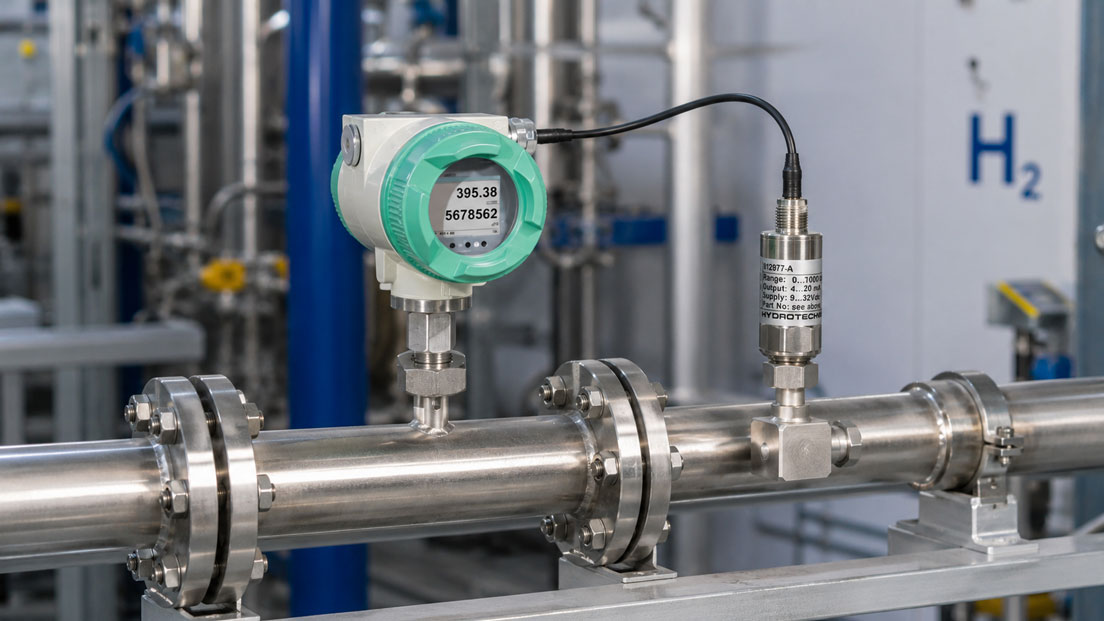
For hydrogen, specifying a flow value alone is often insufficient. A value of 100 m³/h may describe a completely different transported quantity of hydrogen depending on the pressure and temperature. If the same mass flow is compressed, the actual gas volume flowing through the pipe decreases. If the gas is heated or expanded, the volume increases again.
For electrolysers, fuel cells, compressors, test benches and storage systems, it is therefore essential to know which flow variable is being measured or calculated. Actual volumetric flow, standard volumetric flow and mass flow are not interchangeable. They answer different questions and require different information regarding pressure, temperature and reference conditions.
Mass flow is often the most meaningful variable when hydrogen is to be balanced, dosed or assessed in terms of process efficiency. It describes the actual mass transported per unit of time and generally remains unchanged when only the pressure or temperature changes. Actual volumetric flow, by contrast, is particularly important for pipe sizing, flow velocity, valve sizing and pressure loss.
This article explains the differences, presents suitable measuring principles and describes what must be considered regarding pressure loss, installation, gas tightness and calibration. Suitable solutions can be found in the H² flowmeters category. The flow measurement technology section provides an overview of additional measuring principles.
Contents
- Why is hydrogen flow measurement demanding?
- Distinguishing between actual volume, standard volume and mass
- Why is mass flow often more meaningful?
- When does volumetric flow remain important?
- Correctly designing pressure and temperature compensation
- Comparing measuring principles for hydrogen
- Thermal mass-flow measurement
- Coriolis mass-flow measurement
- Ultrasonic flow measurement
- Differential pressure, Venturi tube and FlowPak
- Assessing pressure loss and measuring range
- Gas tightness, materials and installation
- Calibration and gas conversion
- Typical applications
- Practical example: Electrolyser with downstream compressor
- Selection guide for H₂ flowmeters
- Which products are suitable?
- Conclusion
- Frequently asked questions
Why is hydrogen flow measurement demanding?
Hydrogen has a very low density and is highly compressible. Even changes in the process pressure or gas temperature significantly alter the actual volume flowing through the pipe. A volumetric-flow value is therefore only unambiguous when the corresponding pressure and temperature conditions are also known.
There are also particular requirements regarding gas tightness and material selection. Hydrogen can escape more easily through unsuitable seals and materials than many other industrial gases. Process connections, welds, valves and measuring tubes must therefore be designed for the specific hydrogen application.
The measuring principle must also match the process. An electrolyser may produce comparatively low and slowly fluctuating gas flows. A fuel-cell test bench may require a rapid response to load changes. Refuelling or compression systems, by contrast, involve high pressures, highly dynamic processes and significant temperature changes.
Instrument selection therefore requires more than the minimum and maximum flow rates. The following are equally important:
- minimum, normal and maximum process pressure,
- gas and ambient temperature,
- required measured variable,
- gas purity and composition,
- permissible pressure loss,
- required dynamic response,
- material and gas-tightness requirements,
- explosion protection and other approvals.
Distinguishing between actual volume, standard volume and mass
Actual volumetric flow
Actual volumetric flow describes the volume passing through the pipe under the pressure and temperature conditions actually present at the measuring point. Typical units are m³/h, l/min or l/s.
This value is important for the mechanical and hydraulic design. It determines, among other things, the flow velocity, required pipe size and pressure loss across the pipework, valves and measuring instrument.
Without information on the operating pressure and gas temperature, however, the actual volumetric flow cannot be converted unambiguously into a transported hydrogen mass.
Standard volumetric flow
Standard volumetric flow converts the gas volume back to defined reference conditions. This makes it possible to compare gas flows even when they were measured at different operating pressures or temperatures.
The unit is frequently stated as Nm³/h or m³n/h. This notation alone is not sufficient. The reference temperature, reference pressure and, where applicable, other conditions used must also be documented.
If two systems use different reference temperatures, their standard volumetric-flow values may differ even though the same mass flow is present. The measuring instrument, PLC, test-bench software and billing system must therefore use identical standard conditions.
Mass flow
Mass flow describes the actual hydrogen mass transported per unit of time. Typical units are kg/h, kg/min or g/s.
The following relationship applies between actual volumetric flow and mass flow:
ṁ = ρ × V̇
Where:
- ṁ = mass flow,
- ρ = hydrogen density under the respective conditions,
- V̇ = volumetric flow.
Because the density changes with pressure and temperature, a mass flow calculated from the volumetric flow must be compensated accordingly. A direct mass-flow measuring method does not require this subsequent volume-to-density conversion in the same form.
| Measured variable | Typical unit | Main application |
|---|---|---|
| Actual volumetric flow | m³/h, l/min | Pipe sizing, flow velocity and pressure loss |
| Standard volumetric flow | Nm³/h, m³n/h | Comparison of gas consumption and system operating conditions |
| Mass flow | kg/h, g/s | Balancing, dosing, efficiency and comparison of substance quantities |
Why is mass flow often more meaningful?
The actual quantity of hydrogen produced, stored or consumed is described more accurately by mass than by the instantaneous gas volume. When hydrogen is compressed, its actual volume decreases. The mass, however, remains unchanged as long as no gas is removed or lost through leakage.
This is particularly important when assessing efficiency. For an electrolyser, the produced hydrogen mass can be compared with the electrical energy used. For a fuel cell, the consumed mass can be compared with the electrical energy generated.
Mass also provides a clear basis for test benches and dosing processes. A device under test is often intended to receive a defined quantity of hydrogen. If the supply pressure or gas temperature fluctuates, the same actual volumetric flow may contain a different mass. Purely volumetric control could therefore supply a varying amount of substance.
Mass flow is particularly advantageous for:
- production balances for electrolysers,
- consumption measurement on fuel cells,
- dosing and mixing processes,
- efficiency calculations,
- inlet and outlet balances of storage systems,
- comparisons between systems operating at different pressure levels,
- test benches with changing operating conditions.
This does not mean that a mass-flow meter is always the best or most economical solution. The measuring range, accuracy, pressure loss, dynamic response and plant design must still be considered.
When does volumetric flow remain important?
Actual volumetric flow is indispensable for the mechanical design of the plant. Pipes and valves are influenced not only by the transported mass, but also by the actual gas volume flowing through them and the resulting velocity.
At low pressure, a low mass flow may produce a comparatively large actual volumetric flow. This can result in high flow velocities, noise and pressure losses. After compression, the same mass flow occupies a significantly smaller actual volume.
Actual volumetric flow is therefore required for:
- sizing the pipe diameter,
- calculating flow velocity,
- sizing valves and filters,
- assessing pressure losses,
- designing compressors and gas-treatment systems,
- checking installation and flow conditions.
In practice, a combination is therefore often useful: mass flow describes the transported quantity of hydrogen, while actual volumetric flow describes the flow conditions within the plant.
Correctly designing pressure and temperature compensation
If the mass flow or standard volumetric flow is calculated from a measured actual volumetric flow, the pressure and temperature must be measured at the correct location. The decisive conditions are those at the flow-measuring point, not a vessel or compressor pressure measured far away.
The following simplified relationship applies to gas conversion:
V̇N = V̇B × pB,abs / pN × TN / TB × ZN / ZB
Where:
- V̇N = standard volumetric flow,
- V̇B = actual volumetric flow,
- pB,abs = absolute operating pressure,
- pN = standard pressure,
- TB = operating temperature in kelvin,
- TN = standard temperature in kelvin,
- Z = real-gas or compressibility factor.
A common error is the use of gauge pressure instead of absolute pressure. Absolute pressure must be used for gas conversions. Temperatures must also not be entered directly in degrees Celsius, but as absolute temperatures in kelvin.
At higher pressures, the assumption of an ideal gas is not always sufficient. The real-gas factor must then be taken into account. The calculation used must match the hydrogen purity, pressure range and temperature range.
Comparing measuring principles for hydrogen
| Measuring principle | Primary measured variable | Strengths | Important limitations |
|---|---|---|---|
| Thermal | Mass flow or standard volumetric flow | Good sensitivity at low gas flows and low pressure loss | Gas composition and contamination influence the measurement |
| Coriolis | Direct mass flow | Direct mass measurement, high accuracy and no pressure/temperature conversion of the volume required | Demanding sizing due to the very low H₂ density and possible pressure loss |
| Ultrasonic | Flow velocity and volumetric flow | No moving parts, low pressure loss and suitable for larger pipes | Acoustic conditions, gas density, pressure and flow profile must be considered |
| Differential pressure | Differential pressure and calculated volumetric or mass flow | Robust and scalable for high flow rates and pressures | Density compensation and pressure loss must be considered |
Thermal mass-flow measurement
A thermal mass-flow meter uses the heat transfer between a heated sensing element and the gas flowing past it. As the mass flow increases, more heat is dissipated. The electronics determine the gas flow from this heat transfer.
Thermal sensors are particularly attractive for low to medium gas flows. They contain no rotating measuring elements and, with a suitable design, cause only a low pressure loss. They frequently output a standard volumetric flow or a derived mass flow directly.
Calibration is, however, gas-dependent. Hydrogen has different thermal properties from air, nitrogen or natural gas. A sensor calibrated for compressed air must therefore not be used without a hydrogen configuration or conversion confirmed by the manufacturer.
The gas composition must also be known. A pure hydrogen stream is easier to assess than an anode off-gas, forming gas or hydrogen-containing gas mixture. Changes in the proportions of hydrogen, nitrogen, water vapour or other components can alter the thermal measuring behaviour.
Thermal mass-flow meters are suitable, for example, for:
- electrolysers with low to medium production volumes,
- fuel-cell supply lines,
- laboratory and development test benches,
- consumption and leakage monitoring,
- gas-mixing and dosing applications.
Coriolis mass-flow measurement
A Coriolis flowmeter measures mass flow directly through the effect of the flowing mass on a vibrating measuring tube. Pressure and temperature therefore do not have to be used to convert a previously measured actual volumetric flow into mass.
This is a major advantage under strongly changing operating conditions. The measured value remains related to the actual transported mass, regardless of whether the hydrogen is measured before or after a compressor.
The low density of hydrogen nevertheless places high demands on the sizing. At very low mass flows, the usable measuring signal may be small. An excessively large sensor would not make adequate use of the normal flow range. A very small measuring tube, by contrast, may cause increased pressure loss.
The following must be checked in particular:
- minimum and maximum mass flow,
- process and test pressure,
- permissible pressure loss,
- maximum gas velocity,
- vibrations and pulsations,
- material and pressure-rating suitability,
- gas tightness of the process connections.
Coriolis is particularly suitable for precise balancing, research, dosing and high-quality test benches. For large pipes or very low available differential pressures, a different measuring principle may be more economical or hydraulically favourable.
Ultrasonic flow measurement
Ultrasonic flowmeters determine the flow velocity using the transit time or frequency shift of acoustic signals. Because no mechanical rotor is located in the gas stream, the pressure loss can be very low.
The method is particularly attractive for larger pipe diameters and high flow rates. Mass flow, however, is normally not determined from the measured velocity alone. The pipe cross-section and gas density are also required. Pressure, temperature and gas composition must be considered for a mass-flow or standard-volume output.
Hydrogen has particular acoustic properties. The measuring path, sensor frequency, pipe material, gas pressure and signal strength must therefore be matched to the medium. Not every ultrasonic flowmeter for natural gas or compressed air is automatically suitable for hydrogen.
The flow profile also remains relevant. Pipe bends, control valves and changes in cross-section can influence the velocity distribution. Multi-path systems can detect such effects more effectively, but are more complex and expensive.
Differential pressure, Venturi tube and FlowPak
In differential-pressure measurement, a defined restriction in the pipe generates a measurable pressure difference. The flow is calculated from the differential pressure, geometry and fluid properties.
The hydrogen density must be considered when calculating mass flow. If the pressure and temperature change, additional process values or suitable compensation are therefore required.
Compared with many other differential-pressure primary elements, Venturi tubes cause a relatively low permanent pressure loss and are suitable for large pipes and high flow rates. However, they require sufficient installation space and sizing tailored to the process.
The FLC-HHR-FP FlowPak flowmeter is designed for installation situations where no straight inlet and outlet runs are available. For a hydrogen application, the specific pressure rating, materials, connections, gas tightness, differential-pressure measurement and density compensation must be defined on a project-specific basis.
Assessing pressure loss and measuring range
A flowmeter may be metrologically suitable but still fail to match the hydraulic conditions of the plant. Particularly in low-pressure lines supplying fuel cells or electrolysers, even a small additional pressure loss can influence the control system.
Although more pressure is available in high-pressure systems, every pressure loss still increases compressor work and energy demand. In refuelling and rapid filling processes, it can also limit the achievable flow rate.
The pressure loss should be calculated for at least the following operating points:
- minimum flow,
- normal operating point,
- maximum flow,
- minimum and maximum operating pressure,
- minimum and maximum gas temperature.
The measuring-range dynamics are also decisive. A sensor that reliably measures the maximum flow may already be below its usable measuring limit at low leakage or standby flows. Conversely, a sensor optimised for the lowest flows may be overloaded during peaks or cause excessive pressure loss.
Gas tightness, materials and installation
For hydrogen, the complete measuring point must be considered. A suitable sensor alone is not sufficient if the adapters, seals, valves or fittings have not been approved for the process.
The following must be checked:
- wetted materials,
- seal materials and sealing principle,
- permissible operating and test pressure,
- temperature range,
- leakage rate of the complete connection,
- welded and process connections,
- cleanliness requirements,
- explosion protection of the electronics,
- mechanical load caused by the pipework.
The flowmeter should be installed without mechanical stress. Pipe forces must not be introduced into the sensor through the process connections. Suitable supports must be provided for heavy measuring instruments.
Before commissioning, the complete measuring point must be checked for leaks using a method suitable for the application. A stable flow reading does not replace a leak test.
Calibration and gas conversion
The calibration must match the measuring principle and subsequent application. For certain instruments, a calibration with air or nitrogen may be converted to hydrogen using validated gas factors. However, this conversion must be supported by the instrument manufacturer and suitable for the required measuring range.
For high accuracy requirements, wide pressure ranges or safety-critical applications, calibration with hydrogen or a demonstrably suitable alternative method under realistic conditions is preferable.
The following details should be stated clearly in the calibration documentation:
- calibration gas and gas composition,
- pressure and temperature during calibration,
- mass-flow or volumetric-flow reference,
- standard conditions used,
- measuring range and calibration points,
- measurement uncertainty,
- gas or real-gas corrections applied.
A calibration certificate for volumetric flow is not automatically comparable with a subsequent mass-flow measurement. The measured variable and reference conditions must match.
Typical applications
| Application | Preferred measured variable | Important selection criteria |
|---|---|---|
| Electrolyser | Mass flow or defined standard volumetric flow | Production balance, gas purity, moisture and low flow |
| Fuel cell | Mass flow | Rapid load changes, low pressure loss and possible gas mixtures |
| H₂ test bench | Mass flow and actual volume | Dynamic response, repeatability, data recording and changing pressures |
| Compression and storage | Mass flow | High pressure, temperature changes and inlet/outlet balance |
| Distribution network | Standard volumetric flow or mass flow | Large pipes, pressure loss and long-term stability |
| Refuelling | Mass flow | High dynamic response, pressure rating, temperature and regulatory requirements |
Practical example: Electrolyser with downstream compressor
An electrolyser produces hydrogen at a comparatively low pressure. The gas stream is then dried, compressed and fed into a storage vessel. The production quantity is to be balanced while the compressor stage is monitored at the same time.
Upstream of the compressor, the actual volume is comparatively large because of the lower pressure. Downstream of the compressor, the actual gas volume flowing through the pipe is significantly smaller. If only the two actual volumetric flows were compared, this could create the false impression that considerably less hydrogen is present downstream of the compressor.
In steady-state operation, however, the mass flow upstream and downstream of the compressor should be nearly identical. Remaining differences may result from time delays, storage filling, withdrawal, measurement uncertainty or leakage.
Mass flow is therefore used for the production balance. Pressure and temperature are also measured at both measuring points. Actual volumetric flow remains relevant for pipe sizing and assessing compressor operation.
If the inlet side shows a stable mass flow while a permanently lower mass is measured downstream of the compressor, the following points are checked first:
- time synchronisation of the measured values,
- different filter and damping times,
- gas composition and moisture,
- zero point and measuring range of the sensors,
- temporary storage in pipes and vessels,
- gas tightness of the compressor, valves and connections.
This example shows why mass and actual volume should not be treated as competing variables. Mass is decisive for the balance, while volume is decisive for flow-related plant design.
Selection guide for H₂ flowmeters
For reliable instrument sizing, at least the following information should be available:
- pure hydrogen or a hydrogen mixture,
- gas composition and possible fluctuations,
- minimum, normal and maximum flow,
- required output as actual volume, standard volume or mass,
- minimum and maximum absolute pressure,
- gas and ambient temperature,
- maximum permissible pressure loss,
- pipe size and process connection,
- mounting position and available inlet runs,
- required response time,
- accuracy and measurement uncertainty,
- material and gas-tightness requirements,
- ATEX, pressure-equipment or other approval requirements,
- calibration gas and required traceability,
- balancing, test-bench or billing requirements.
Only on the basis of these data can it be determined whether a thermal mass-flow sensor, Coriolis system, ultrasonic flowmeter or differential-pressure solution is technically and economically appropriate.
Which products are suitable?
H² flowmeters
The H² flowmeters category contains measuring solutions specifically assigned to hydrogen applications. The specific version must always be checked against the operating conditions and required approvals.
FLC-HHR-FP FlowPak flowmeter
The FLC-HHR-FP FlowPak flowmeter operates according to the differential-pressure principle and is designed for applications with limited installation space. It does not require conventional straight inlet and outlet runs.
A suitable differential-pressure transmitter and pressure and temperature values for density or mass-flow calculation are also required for a hydrogen measuring point. The materials, pressure rating and process connections must be defined on a project-specific basis.
Thermal H₂ flow sensors
The H² flow sensors section contains IVA 550 and IVA 570 thermal sensor solutions for gas-flow and consumption measurement. Depending on the model and approval, they can be used for hydrogen and provide a standard volumetric-flow value directly.
Before selection, the gas composition, pressure, temperature, measuring range, installation type and required approval must be clearly defined.
Coriolis and ultrasonic flowmeters
Further Coriolis, ultrasonic and process flowmeters can be found in the flow measurement technology section. Not every instrument listed there is automatically suitable for hydrogen. The H₂ compatibility of the materials, seals, pressure rating, measuring principle and approvals must be confirmed for each application.
Conclusion: Mass for balancing, volume for flow-related design
For hydrogen, a volumetric-flow value can only be interpreted correctly together with its pressure and temperature conditions. Actual volumetric flow changes during compression, expansion or heating, even though the same hydrogen mass is being transported.
Mass flow is therefore often the more meaningful variable for production quantities, consumption, dosing and efficiency. A defined standard volumetric flow can also provide good comparability, provided that all systems use the same reference conditions.
Actual volumetric flow nevertheless remains indispensable. It determines the flow velocity, pipe sizing and pressure loss. Good measuring-point planning therefore assesses mass, actual volume, pressure and temperature together.
Thermal mass-flow sensors are particularly suitable for low and medium gas flows. Coriolis measures mass directly and is attractive for precise balances. Ultrasonic measurement offers advantages in larger pipes and with low pressure loss. Differential-pressure systems are robust and scalable for high flow rates, but require suitable density compensation.
The correct solution results from the complete process: the gas composition, measuring range, pressure, temperature, pressure loss, dynamic response, materials, gas tightness, approvals and calibration must all be compatible.
Frequently asked questions about hydrogen flow measurement
Why is a volumetric-flow value alone insufficient for hydrogen?
The gas volume depends strongly on pressure and temperature. A volumetric-flow value is therefore only unambiguous together with the operating or reference conditions.
What is the difference between m³/h and Nm³/h?
m³/h normally describes the volume under the actual operating conditions. Nm³/h refers to defined standard conditions. The standard temperature and standard pressure used must be documented.
Is mass flow always better than standard volumetric flow?
Not necessarily. Both variables may be suitable for balancing. Mass flow does not require freely selected standard conditions. Standard volumetric flow is also comparable if the same reference conditions are used everywhere.
Which measuring principle is suitable for low hydrogen flow rates?
Thermal mass-flow sensors and small Coriolis systems may be suitable. The actual minimum flow, pressure, gas composition and required accuracy are decisive.
Does a thermal sensor measure mass flow directly?
It determines the gas flow through mass-dependent heat transfer. The calibration depends strongly on the thermal properties and composition of the gas.
Does a Coriolis flowmeter require pressure and temperature compensation?
No conversion of actual volume using pressure and temperature is required for direct mass-flow measurement. Pressure and temperature remain relevant, however, for process assessment, instrument sizing and additional volumetric outputs.
Can a flowmeter designed for compressed air also be used for hydrogen?
Only if the manufacturer explicitly confirms its suitability for hydrogen. The gas configuration, materials, seals, pressure rating and, where applicable, explosion protection must match the application.
Why is pressure loss particularly important for fuel cells?
The supply system often operates with limited differential pressure. Excessive pressure loss across the measuring instrument can influence the control system and the available hydrogen supply to the fuel-cell system.
Must a hydrogen flowmeter be calibrated using actual H₂?
This depends on the measuring principle and accuracy requirements. Validated gas factors or substitute calibrations may be possible for suitable instruments. For high accuracy and critical applications, calibration under conditions as close as possible to the actual H₂ process is advantageous.