


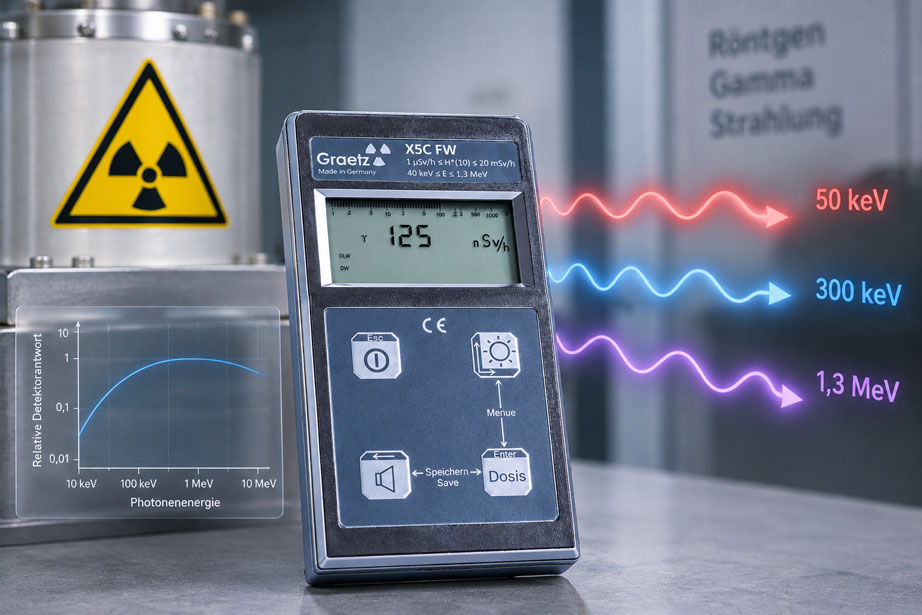
A dose rate meter is checked using a known gamma source and displays a plausible value. The same instrument is then used near an X-ray system, another radionuclide source or in an unknown radiation field. Although the indicated dose rate may appear similar, an important question arises: does the detector actually respond to the new radiation energy in the same way as it did during the original check?
In principle, the answer is: not exactly. Radiation detectors have an energy-dependent sensitivity. The probability with which photons interact with the detector material, attenuation by the housing and filters, and internal signal processing all depend on photon energy. A detector can therefore respond differently depending on the energy even when the underlying physical radiation quantity is the same.
For dose rate meters used in radiation protection, this behaviour is corrected as far as possible by design. One example is the energy-compensated Geiger-Müller tube, in which the material and geometry of a compensation layer alter the natural energy response of the tube so that the overall instrument response better matches the intended dose quantity across a defined photon energy range.
The most important rule is therefore: A displayed dose rate value is only reliable within the specified characteristics of the particular instrument or probe being used. Energy range, detector principle, measured quantity, measuring range and calibration conditions must all be compatible with the radiation source.
What does radiation energy mean?
In gamma and X-ray radiation, the radiation field consists of photons. Each photon carries a certain amount of energy, which in radiation measurement is typically expressed in electronvolts, kiloelectronvolts or megaelectronvolts.
Photon energy must not be confused with dose rate. Two radiation fields can have the same dose rate while consisting of photons with very different energies. Conversely, higher photon energy does not automatically mean a higher dose rate. The number, energy and interaction of the photons, among other factors, are relevant to the dose rate.
Radionuclides often emit characteristic gamma energies or several defined energy lines. X-ray systems, by contrast, typically generate a broader photon spectrum whose shape depends, among other things, on tube voltage, filtration, anode material and geometry.
For a measuring instrument, it is therefore important not only how much radiation is present, but also in which energy range the photons lie.
What does detector energy dependence mean?
Energy dependence describes how the displayed value or sensitivity of a detector changes when the photon energy changes. An ideal dose rate meter would provide exactly the same correct response for the intended quantity at all energies within its operating range.
Real detectors only approximate this ideal. The probability of radiation interacting with the detector material changes with energy. At the same time, the housing, electrodes, filters and other structural components affect which photons actually reach the sensitive region.
Particularly at low photon energies, even relatively thin material layers can have a considerable influence. Higher-energy photons pass through the same materials much more easily. This can cause the relative sensitivity to vary across the energy range.
The manufacturer therefore characterises the measuring system for a specific energy range and – where more detailed information is provided – additionally by means of an energy-response or energy-dependence curve. Such a curve is considerably more informative for assessment than simply specifying a lower and upper energy limit.
Why different detectors respond differently
The detector principle has a major influence on how the measuring instrument responds to different photon energies. A Geiger-Müller tube, a scintillation detector and an ionisation chamber have different physical characteristics and are therefore optimised for different tasks.
| Detector principle | Typical strength | Relation to energy dependence |
|---|---|---|
| Energy-compensated Geiger-Müller tube | Robust, wide dose rate range, well suited to portable radiation protection instruments | Natural energy dependence is reduced by design through compensation |
| NaI(Tl) scintillator | Very high sensitivity, particularly for detecting low radiation intensities | Strong energy-dependent interaction; pulse response depends on photon energy |
| Ionisation chamber | Direct measurement of charge generated by ionisation, often used for dosimetry and reference measurements | Can provide favourable energy behaviour over broad ranges, but the specific design remains decisive |
| Contamination detector | Detection of surface contamination or α/β/γ radiation | Not automatically suitable for quantitative ambient dose rate measurement |
These differences explain why an especially sensitive scintillation detector is not automatically the better dose rate meter. A device may be excellent at locating a radioactive source without its raw count rate being directly interpretable as an energy-independent dose rate.
Conversely, an energy-compensated Geiger-Müller tube is specifically designed to provide an appropriate response to a defined dose quantity over a specified energy range.
What does energy compensation mean?
An uncompensated Geiger-Müller tube typically does not provide an ideal dose response over all photon energies. At certain energies, its sensitivity to the desired dose quantity may be significantly increased or reduced.
For energy compensation, the tube is therefore surrounded by suitable materials or filters. These attenuate photons of different energies to different degrees and thereby modify the overall response of the detector.
The aim is not to attenuate all photons equally. Instead, the combination of detector and compensation is designed so that the measuring system responds as closely as possible to the intended dosimetric quantity over the specified energy range.
The GRAETZ X5C FW and X5C plus, for example, use an energy-compensated Geiger-Müller tube to measure the ambient dose equivalent rate Ḣ*(10).
However, energy compensation does not mean that the instrument response is exactly identical at every arbitrary photon energy. It applies within the specified instrument characteristics and tolerances.
Interpreting the energy range correctly
Data sheets for dose rate meters frequently contain a specification such as:
40 keV – 1.3 MeV
This specification describes the intended photon energy range of the measuring system. It must not be confused with the dose rate measuring range.
The dose rate measuring range answers the question:
How weak or strong may the radiation field be?
The energy range, by contrast, answers:
Which photon energies may be present in the radiation field being assessed?
Both conditions must be fulfilled simultaneously. A radiation field may easily lie within the instrument’s dose rate range while a relevant part of the photon spectrum lies outside the specified energy range of the detector.
| GRAETZ component | Published energy range | Typical application |
|---|---|---|
| X5C FW base instrument | 40 keV – 1.3 MeV | Gamma and X-ray radiation, ambient dose equivalent rate |
| Gamma probe 18545 C | 40 keV – 1.3 MeV | Low dose rates |
| Gamma probe 18509 C | 55 keV – 1.3 MeV | Extended dose rate range |
| Gamma probe 18529 C | 70 keV – 3 MeV | High dose rates and higher energy range |
| NaI scintillation probe GRAETZ 2002 | γ: 25 keV – 2 MeV | Highly sensitive β/γ detection and count-rate measurement |
The table also shows why not every probe is suitable for every task. A probe can offer a wider dose rate range but have a different lower energy threshold. Both dimensions must therefore be considered when selecting the equipment.
Distinguishing calibration energy from the real application
A radiation measuring instrument is calibrated or tested under defined reference conditions. Known radiation qualities are used for this purpose. The calibration factor determined under these conditions provides traceability of the measuring system to a known reference.
If the same instrument is subsequently used in a radiation field with a different energy distribution, the detector’s energy dependence becomes relevant. Within the specified range and intended tolerances, this behaviour forms part of the instrument characterisation. Outside that range, quantitative interpretation is not automatically valid.
It would therefore be incorrect to state: “The instrument has been calibrated, so it measures every gamma and X-ray energy with the same accuracy.” Calibration and the specified energy response belong together.
For particularly demanding measurement tasks, it may be useful to have the instrument response tested at a radiation quality that is as close as possible to the real application.
Special considerations for X-rays
With a radioactive gamma source, specific characteristic photon energies can often be stated. An X-ray tube, by contrast, produces a spectrum. The selected tube voltage must therefore not be equated with a single photon energy.
An X-ray system operated at, for example, 100 kV does not generate only 100 keV photons. The spectrum extends from lower energies up to a maximum value limited by the tube voltage. Filtration and absorption additionally modify the spectral distribution.
For selecting a dose rate meter, the number displayed on the X-ray system control panel is therefore not the only relevant parameter. Filtration, radiation quality and measurement geometry should also be considered.
With strongly pulsed X-ray radiation, the time structure becomes an additional factor. In that case, besides energy dependence, it must also be checked whether the detector and electronics are suitable for the pulse duration, pulse dose and instantaneous dose rate.
Gamma sources with different energies
Energy is also relevant for gamma radiation. Different radionuclides emit different gamma energies or combinations of several energy lines.
A dose rate meter may therefore show a certain response at one reference source and a slightly different response at another nuclide within its permitted energy-dependence tolerance.
This is exactly why energy compensation is important for typical radiation protection measurements: it reduces the differences sufficiently for the measuring system to be used for the defined dose quantity over its intended energy range.
With unknown sources, however, the measured value should not be used to infer a specific radionuclide directly. A dose rate meter measures a dose quantity; it does not automatically identify the nuclide composition. Other detectors and spectrometric methods are required for radionuclide identification.
Considering measurement geometry and angular dependence
Not only the energy but also the direction from which the radiation reaches the detector can influence the response. The housing, battery, electronics and shielding materials lie differently in the radiation path depending on the direction of incidence.
In addition to energy dependence, a radiation measuring instrument therefore also has an angular dependence. For reproducible comparison measurements, the instrument should therefore be used in the same orientation relative to the source wherever possible.
The distance must also be reproducible. With small or approximately point-like sources, the dose rate changes strongly with distance. A positional change of only a few centimetres can therefore produce a much larger difference in the measured value than the energy dependence of the detector.
For comparison measurements, at least the following parameters should therefore be documented:
- measuring instrument or probe used,
- distance from the source,
- orientation of the detector,
- position relative to shielding and scattering objects,
- radiation type and known energy or radiation quality,
- measurement time or integration time.
Background and statistics at low dose rates
At low dose rates, the statistical nature of radiation measurement becomes more apparent. Counting detectors register individual interaction events. The number of events within a short time interval fluctuates statistically.
Close to the natural background level, even a small change in measuring position or a short measurement period can therefore produce visibly fluctuating readings. This must not automatically be interpreted as energy dependence.
Longer integration times reduce the relative statistical fluctuation. At the same time, however, the display responds more slowly to actual changes in the radiation field.
| Observation | Possible cause | Sensible check |
|---|---|---|
| Measured value fluctuates strongly near background | Counting statistics | Increase measurement time and consider the average value |
| Different indication when the instrument is rotated | Angular dependence or shielding | Define a reproducible measurement orientation |
| Deviation occurs only at an X-ray system | Energy distribution or pulsed operation | Check energy range and pulse parameters |
| Deviation at a particular gamma source | Energy dependence or geometry | Compare the reference setup and instrument specification |
| Display reaches the measuring-range limit | Overrange or detector saturation | Observe the measuring-range limit and use a suitable probe |
Selecting external probes to suit the application
Modular dose rate measurement systems offer the advantage that the base instrument can be combined with different probes. This allows not only the dose rate range but also the appropriate energy range to be adapted to the measurement task.
With the GRAETZ probe range, the base instrument automatically applies the probe-specific calibration factor for compatible gamma probes. The probes differ, among other things, in energy range and dose rate measuring range.
A probe for very high dose rates is therefore not necessarily the best solution for measurements close to natural background. Conversely, a particularly sensitive probe can quickly exceed its intended measuring range when used near a strong source.
A NaI scintillation probe also serves a different purpose from an energy-compensated dose rate probe. The GRAETZ 2002, for example, is a highly sensitive pulse probe for β/γ detection. Its high sensitivity makes it very useful for search and detection tasks, but the count rate must not be equated with a general energy-independent dose rate without suitable calibration or instrument configuration.
Systematically checking implausible measured values
If a dose rate meter shows unexpectedly different values at two radiation sources, energy dependence should not immediately be assumed to be the sole cause. Several influencing variables may act simultaneously.
First, it should be checked whether the same dose quantity is being compared and whether both measurements lie within the specified dose rate and energy ranges. The distance, orientation and radiation geometry should then be checked.
For X-ray systems, tube voltage, filtration and, where applicable, pulsed operation must also be considered. For radioactive sources, source geometry, shielding and scattered radiation must be taken into account.
The function of the measuring instrument itself should also be checked. Battery condition, self-test and, where applicable, a reproducible response check using a designated test source help distinguish an instrument fault from a change in radiation quality.
Practical example: switching from gamma to X-ray radiation
A portable dose rate meter is regularly used for operational radiation protection. At a known gamma source, it produces reproducible results over a long period. The instrument is then to be used for checks in the vicinity of an X-ray system.
The expected dose rate range lies within the instrument specification. However, this information alone is not sufficient. It must first be checked whether the relevant radiation quality of the X-ray system also lies within the specified energy range.
It is also checked whether the system operates continuously or in pulsed mode. With pulsed radiation, time-dependent detector characteristics may become relevant in addition to energy dependence.
For the comparison measurement, the position of the measuring instrument is defined precisely. Distance and orientation remain constant. Only then are the results evaluated.
This procedure prevents a common misunderstanding: a difference between gamma and X-ray measurements is not automatically attributed to the instrument. Radiation energy, geometry and source operating mode are considered together first.
Systematic test procedure
When selecting or evaluating a dose rate meter for different radiation energies, the following procedure is recommended:
- Determine the measured quantity: For example, ambient dose equivalent rate Ḣ*(10).
- Identify the radiation type: Clearly distinguish gamma, X-ray or other radiation.
- Determine the energy or radiation quality: Record nuclide information or X-ray parameters.
- Check the energy range of the instrument: The source must lie within the specified instrument characteristics.
- Check the dose rate measuring range: Consider the expected minimum and maximum values.
- Check the detector principle: Classify the energy-compensated GM tube, scintillator or other principle.
- Consider any external probe: In modular systems, the characteristics of the probe actually being used apply.
- Check pulsed X-ray operation: For pulsed systems, consider additional time-related limits.
- Define the measurement geometry: Set the distance and detector orientation reproducibly.
- Determine the background: Particularly relevant at low dose rates.
- Select a sufficient measurement time: Take statistical fluctuations at low count rates into account.
- Perform a function check: Use the self-test and, where applicable, a reproducible response check.
- Document the results: Record the instrument, probe, source, energy, distance and operating mode.
Common interpretation errors
Confusing energy range with dose rate measuring range
The energy range describes the photon energy. The dose rate measuring range, by contrast, describes the intensity of the radiation field. The two specifications are independent of each other.
Equating “suitable for gamma” with “suitable for every gamma energy”
A gamma dose rate meter also has a specified energy range. Outside this range, the quantitative indication is not automatically reliable.
Interpreting calibration as energy independence
Calibration is performed under defined conditions. For other photon energies, the specified energy behaviour of the measuring system must also be taken into account.
Equating tube voltage with a single X-ray energy
An X-ray tube produces an energy spectrum. Tube voltage, filtration and other parameters determine the radiation quality.
Interpreting a high count rate directly as a high dose rate
The count rate of a detector depends on sensitivity, detector size and photon energy. Without suitable calibration, a count rate is not a universally valid dose rate.
Ignoring detector orientation
The housing and internal components can create angular dependence. Comparison measurements therefore require a reproducible orientation.
Interpreting statistical fluctuations as instrument drift
At low dose rates, counting detectors naturally fluctuate. A longer measurement or integration time improves the statistical significance.
Failing to consider pulsed operation
An instrument may be suitable in terms of energy range and normal dose rate range and still be unsuitable for strongly pulsed X-ray radiation. The time-dependent instrument characteristics must be checked separately.
Suitable GRAETZ measurement technology
ICS Schneider Messtechnik offers various GRAETZ solutions for dose rate measurement, radiation protection and specialised measurement tasks.
The GRAETZ X5C FW is a portable dose rate meter for gamma and X-ray radiation. The base instrument uses an energy-compensated Geiger-Müller tube and measures the ambient dose equivalent rate Ḣ*(10). An energy range of 40 keV to 1.3 MeV is specified for the instrument.
The GRAETZ X5C plus also features an energy-compensated Geiger-Müller tube and can be combined with external probes from the GRAETZ probe range.
The GRAETZ probe range allows adaptation to different dose rate and energy ranges. For example, the published energy ranges of different gamma probes extend from 40 keV to 1.3 MeV and, depending on the probe, up to 3 MeV.
For particularly sensitive detection tasks, the NaI scintillation probe GRAETZ 2002 is available. It is designed for β/γ detection and has a published gamma energy range of 25 keV to 2 MeV. Its use as a pulse probe must be distinguished from energy-compensated dose rate measurement.
Dose rate meters at ICS Schneider
Radiation measurement technology at ICS Schneider
Conclusion
A dose rate meter does not have completely energy-independent sensitivity. The detector response fundamentally changes with photon energy. In radiation protection instruments, this effect is reduced through appropriate detector design, energy compensation and calibration so that the measuring system can be used for the intended dose quantity within a defined energy range.
The energy range is therefore just as much part of the instrument specification as the dose rate measuring range. A measured value is only reliable if both the intensity of the radiation field and its relevant photon energies are compatible with the measuring system.
With X-ray radiation in particular, it must also be taken into account that there is no single energy value but rather a spectrum. Tube voltage, filtration and, where applicable, pulsed operation must therefore be considered when selecting the instrument.
Measurement geometry, angular dependence, background and statistical fluctuations can also cause visible differences. A discrepancy between two measurement situations must therefore not automatically be attributed to the detector’s energy dependence.
Anyone who considers radiation type, energy or radiation quality, dose rate range, detector principle and measurement geometry together can interpret dose rate values much more reliably and select the appropriate instrument or probe for the particular application.
FAQ on the energy dependence of dose rate meters
What does energy dependence mean for a dose rate meter?
It describes how the displayed value or sensitivity of the detector changes when the photon energy changes.
Why does a detector not respond equally to every gamma energy?
The probability of photons interacting with the detector material and surrounding components depends on their energy. This changes the detector response.
What does an energy range of 40 keV to 1.3 MeV mean?
It describes the intended photon energy range of the measuring system. It must not be confused with the dose rate measuring range.
What does energy compensation mean?
Suitable materials and detector design are used to modify the natural energy dependence of the detector so that its response better matches the intended dose quantity over a defined energy range.
Is an energy-compensated detector completely energy-independent?
No. Compensation reduces the energy dependence within the specified range. The remaining tolerances are defined by the instrument specification or test results.
Can I also use a gamma dose rate meter for X-rays?
If the instrument is explicitly intended for X-ray radiation and the relevant radiation quality lies within its specified energy and dose rate ranges, this may be possible. For pulsed X-rays, the time-dependent instrument characteristics must additionally be checked.
Is the tube voltage of an X-ray system the same as the photon energy?
No. An X-ray tube produces a spectrum of different photon energies. The tube voltage limits the maximum possible photon energy but does not describe one single energy for the complete radiation field.
Why is filtration in an X-ray system important?
Filters change the photon spectrum by preferentially attenuating lower-energy components. This changes the radiation quality.
Can an instrument calibrated using Cs-137 measure every other gamma source exactly?
Not solely on the basis of that calibration. The specified energy behaviour of the measuring system at the photon energies of the respective source must also be taken into account.
Is a scintillation probe more accurate than a Geiger-Müller tube?
Not necessarily. Scintillation detectors often provide very high sensitivity. Whether they are suitable for quantitative dose rate measurement depends on calibration, energy response and the specific measurement task.
Why does a scintillation probe show different count rates for different nuclides?
The detection probability and the proportion of energy deposited in the detector depend on the photon energy. A raw count rate is therefore not automatically energy-independent.
What is H*(10)?
H*(10) denotes the ambient dose equivalent. The associated dose rate quantity Ḣ*(10) is used for many radiation protection measurements to assess radiation fields.
Why is the orientation of the measuring instrument important?
The housing, filters and internal components can influence the radiation differently depending on the direction of incidence. This creates angular dependence.
Can the background affect the assessment?
Yes. Particularly at low dose rates, the measuring signal lies only slightly above the natural background. Statistical fluctuations then become relatively more visible.
Why does a longer measurement time help at low dose rates?
With counting detectors, more individual events are recorded over a longer period. This reduces the relative statistical fluctuation of the average value.
Can I determine the radionuclide from the dose rate?
No. A dose rate meter determines a dose quantity but does not automatically identify the radionuclide. Suitable spectrometric or nuclide-specific measurement technology is required for that purpose.
Which GRAETZ instrument is suitable for gamma and X-ray radiation?
The GRAETZ X5C FW and X5C plus are designed for corresponding dose rate measurements using an energy-compensated Geiger-Müller tube. The specific application must remain within the relevant instrument or probe specification.
When do I need an external probe?
An external probe can be useful when a different dose rate range, energy range, greater measuring distance or a specialised measurement task is required.