


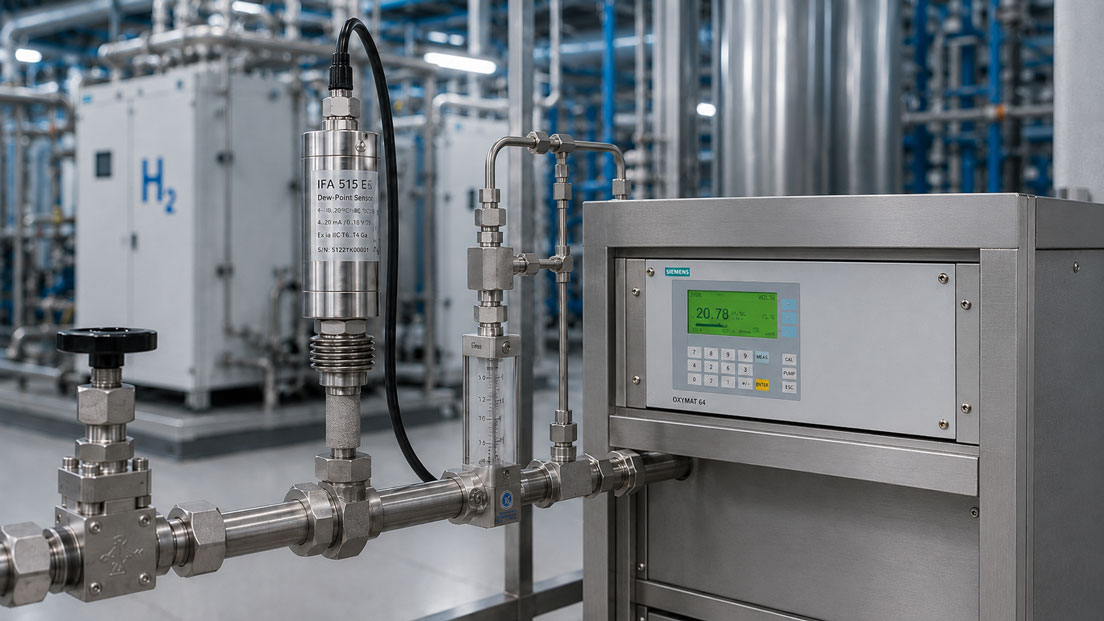
The electrolyzer is producing hydrogen, pressure and flow are within the intended range, and the dryer also appears to be operating correctly. Nevertheless, the downstream application suddenly reports quality problems. The dew point rises, more oxygen is measured in the hydrogen or the determined H₂ concentration changes.
Such changes can provide an early indication of problems in the electrolysis process, gas separation or gas treatment. An increasing moisture content may, for example, indicate an exhausted or inadequately regenerated dryer. An increasing oxygen concentration, on the other hand, may indicate changes in gas separation, leakage, air ingress or other process deviations.
For reliable quality monitoring, it is therefore not sufficient to consider only a single “hydrogen purity” value.
In many applications, at least three measured variables are of particular interest:
- hydrogen concentration or H₂ purity,
- residual oxygen in the hydrogen, and
- residual moisture or dew point.
Which additional impurities need to be monitored depends on the electrolysis process, gas treatment and subsequent use of the hydrogen.
Measuring instruments and components for hydrogen applications can be found under H² hydrogen applications. Solutions for continuous gas analysis are grouped under Siemens process analytics / gas analyzers.
Table of Contents
- Why must hydrogen quality be monitored downstream of the electrolyzer?
- Which measured variables are particularly important?
- What does H₂ purity actually mean?
- Why monitor oxygen in hydrogen?
- Why residual moisture is so important
- Correctly distinguishing between dew point and pressure dew point
- Detecting dryer breakthrough at an early stage
- Detecting changes in membrane performance and gas separation
- Correctly designing the sampling system
- Correctly accounting for pressure reduction
- Materials and lines for the gas sample
- Avoiding air ingress as a measurement error
- Sample flow and response time
- Calibration gases and functional testing
- Using alarm limits and trends effectively
- Relationship to fuel-cell hydrogen quality
- Typical fault patterns
- Recommended setup for quality monitoring
- Practical example downstream of an electrolyzer
- Which products and solutions are suitable?
- Conclusion
- Frequently asked questions
Why must hydrogen quality be monitored downstream of the electrolyzer?
An electrolyzer does not automatically produce hydrogen at the quality required by every downstream application.
Depending on the system, the generated hydrogen passes through several process stages, for example:
- gas/liquid separation,
- drying,
- additional gas purification where required,
- compression,
- intermediate storage, and
- transfer to the consumer.
The gas quality can change at any of these points.
In electrolysis, the hydrogen and oxygen sides are also not completely independent of one another. Depending on the electrolysis process, the product gases are separated from one another by membranes, diaphragms or other separating elements.
If the operating condition, differential pressure, load, temperature or condition of the separating elements changes, the composition of the product gas may also change.
Continuous or regular quality measurement can make such changes visible before they become apparent at the downstream consumer.
Which measured variables are particularly important?
Several measured variables are useful for typical monitoring directly downstream of the electrolyzer and gas treatment system.
| Measured variable | Typical information provided | Possible abnormality |
|---|---|---|
| H₂ concentration | Hydrogen fraction in the gas mixture being analyzed | Foreign-gas concentration increases |
| O₂ concentration | Residual oxygen in the hydrogen stream | Gas separation, air ingress or process condition has changed |
| Dew point / residual moisture | Water content after separation and drying | Dryer performance decreases |
| Pressure | Operating and sampling conditions | Pressure change affects the process and dew-point evaluation |
| Sample flow | Ensures defined flow through the analyzer | Blockage, leakage or incorrect setting |
Depending on the intended use, additional components may also be relevant.
Quality monitoring should therefore always be planned backwards from the hydrogen product ultimately required.
What does H₂ purity actually mean?
A hydrogen purity specification of, for example, 99.9 %, 99.99 % or 99.999 % initially appears unambiguous.
From a measurement perspective, however, it must be clarified how this value was determined.
An analyzer can, for example, determine the hydrogen concentration based on a characteristic physical property of the gas mixture.
This works particularly well when the mixture is binary or quasi-binary and the composition of the remaining gas components is known or sufficiently constant.
For a mixture containing several unknown trace components, the interpretation becomes more difficult.
The calculation:
H₂ purity = 100 % − O₂ − H₂O
is also not generally sufficient.
It would assume that no other relevant components apart from oxygen and water are present.
Depending on the process, however, other gases or trace substances may occur.
A distinction should therefore be made between overall determination of the H₂ concentration and selective monitoring of individual impurities.
Why monitor oxygen in hydrogen?
Oxygen is one of the most obvious quality parameters to monitor downstream of an electrolyzer.
A change in the O₂ concentration can have several causes.
These include, for example:
- changes in gas separation within the electrolyzer,
- operating conditions with unfavourable gas transport between the two sides,
- problems with the membrane or diaphragm,
- leaks in the sampling system,
- air ingress during maintenance work, and
- insufficient purging after a system has been opened.
It is important to remember that an elevated O₂ reading does not automatically indicate a fault in the electrolyzer.
Especially at low oxygen concentrations, even minor air ingress into the sample line can significantly affect the measurement result.
The process and the sampling system must therefore be considered together.
Why residual moisture is so important
The hydrogen leaving the electrolysis process may initially contain a considerable amount of moisture.
The gas is therefore dried before many downstream applications.
Residual moisture downstream of the dryer is an important indicator of whether the gas treatment system is still operating correctly.
An increasing water content can be caused, for example, by:
- increasing loading of an adsorption dryer,
- insufficient regeneration,
- malfunction when switching between dryer columns,
- bypass leakage,
- unusually high moisture loading at the dryer inlet, or
- process changes in the electrolyzer.
It is particularly useful to monitor not only an individual dew-point value, but also its trend over time.
A slowly increasing dew point can indicate declining dryer performance before a defined quality limit is actually exceeded.
Correctly distinguishing between dew point and pressure dew point
When measuring moisture in pressurized hydrogen, it must be clearly known at which pressure the specified dew point applies.
The pressure dew point describes the temperature at which water vapour begins to condense at the existing gas pressure.
If the same gas stream is subsequently depressurized, the water-vapour concentration does not necessarily change immediately, but the relationship between dew point and total pressure does.
Dew-point values measured before and after pressure reduction therefore cannot be directly compared without taking the measurement pressure into account.
For reproducible quality measurements, the following should therefore be documented:
- the pressure at which the measurement is performed,
- whether the value is specified as pressure dew point or atmospheric dew point, and
- whether conversion is performed by the measuring instrument or evaluation system.
Especially with very dry hydrogen, different pressure references can result in significantly different dew-point values.
Detecting dryer breakthrough at an early stage
A dew-point measurement directly downstream of the drying stage is particularly suitable for condition monitoring.
During normal operation, the moisture value remains within a relatively stable range.
As dryer performance begins to decline, the dew point typically rises.
The trend over time can provide more information than a simple limit value.
An example:
A system operates for an extended period with a consistently low pressure dew point. The value then begins to rise slowly with every hour of operation and drops significantly again after switching to a regenerated dryer column.
This pattern is more indicative of the drying or regeneration process than of a random measurement error.
If, on the other hand, a significantly higher value is measured immediately after maintenance work, the moisture may initially originate from opened lines, valves or the sampling system itself.
Detecting changes in membrane performance and gas separation
During electrolysis, hydrogen and oxygen are generated on different sides of the system.
Gas separation must operate in such a way that the product-gas quality remains within the specified limits.
If gas transport between the two sides changes, this may become visible through a change in the foreign-gas concentration.
An increasing oxygen value in the hydrogen stream is therefore an important diagnostic parameter.
During root-cause analysis, the following should be considered, among other factors:
- system load,
- process pressure,
- differential pressure between the H₂ and O₂ sides,
- temperature,
- start-up and shutdown conditions, and
- the trend of the measurement signal over time.
A single elevated measurement does not yet permit a clear diagnosis.
However, if the deviation occurs reproducibly under specific operating conditions, it provides a much more informative fault pattern.
Correctly designing the sampling system
In gas analysis, the analyzer alone does not determine measurement quality.
The sampling system between the process and the measuring instrument is equally important.
A typical setup may, for example, consist of:
- a sampling connection on the H₂ line,
- an isolation valve,
- a filter where required,
- pressure reduction,
- flow restriction or flow control,
- dew-point measurement,
- gas analyzer, and
- safe discharge of the sample gas.
The specific setup depends on process pressure, gas quality, analyzer and safety concept.
However, one important basic rule applies: the sample line should be as short and simple as technically practical.
Every additional fitting, unnecessary volume and unsuitable material can affect the response time or measured value.
Correctly accounting for pressure reduction
Electrolysis systems and downstream compressors can provide hydrogen at pressures significantly above the permissible inlet pressure of a gas analyzer.
The sample must then be depressurized in a controlled manner before analysis.
Several factors are relevant during pressure reduction:
- permissible inlet pressure of the pressure regulator,
- suitable materials for hydrogen,
- outlet pressure for the analyzer,
- required sample flow, and
- effect of the pressure change on moisture evaluation.
Especially for dew-point measurement, it must be decided whether the measurement is to be performed directly at process pressure or after a defined pressure reduction.
Only when the conditions are known can measurements from different systems or different points in time be meaningfully compared.
Materials and lines for the gas sample
In trace analysis, even components that would hardly be noticeable in a normal process line can become relevant.
For fast and reproducible moisture measurement, the sampling system should absorb and subsequently release as little water as possible.
Clean metallic tubing is therefore often preferable to long plastic or elastomer hoses for demanding dew-point measurements.
The sample line should also be as gas-tight as possible for oxygen measurement.
Factors to be considered include:
- tubing material,
- seal materials,
- fittings,
- valves,
- filter elements, and
- pressure regulators.
All wetted components must be suitable for hydrogen, the process pressure and the intended operating conditions.
Avoiding air ingress as a measurement error
One of the most important sources of error when measuring low oxygen concentrations is ambient air entering the sampling system.
Air contains a significant concentration of oxygen. Even a small leak can therefore noticeably change a trace-oxygen reading.
Typical weak points include:
- leaking fittings,
- unsuitable hose connections,
- valves that are not fully closed,
- sample pumps installed on the wrong side of the system, or
- insufficiently purged lines after maintenance work.
If the oxygen reading suddenly increases, a membrane fault in the electrolyzer should therefore not be assumed immediately.
The first step should be to check whether the analyzer is actually receiving a representative, leak-free process sample.
Sample flow and response time
The sample flow influences how quickly a process change becomes visible at the analyzer.
At a very low flow rate, the gas sample may require a long time to replace the entire contents of the line and the internal volume of the analysis system.
This creates a time delay.
A higher flow rate generally reduces this delay, but it must not exceed the permissible operating conditions of the analyzer.
The following should therefore be considered together during system design:
- line length,
- line diameter,
- internal sample volume,
- permissible analyzer flow, and
- required response time.
If O₂ and dew-point measurements are operated in different sample paths, different delay times may also occur.
During process analysis, it should therefore be known which measured value corresponds to which actual point in time in the process.
Calibration gases and functional testing
A gas analyzer should not be assessed solely on the basis of whether it displays plausible values during process operation.
Regular functional checks or calibrations are required for reliable quality assurance.
Depending on the analyzer, these may include:
- zero gas,
- defined test gas,
- certified calibration gas,
- flow control, and
- verification of the complete sample conditioning system.
Especially for trace measurements, the test gas should be suitable for the measurement task and the respective analysis method.
The gas routing during calibration is also important. A correct calibration gas does not provide a reliable result if ambient air or residual gas from a large dead volume enters the sample on its way to the analyzer.
For dew-point measurements, the calibration status of the moisture sensor should also be checked regularly.
Using alarm limits and trends effectively
Process monitoring becomes particularly effective when more than a single limit value is evaluated.
Useful functions can include:
- warning threshold,
- alarm limit,
- time delay,
- trend monitoring, and
- plausibility comparison with operating conditions.
A very short measurement spike may have a different cause than a continuous increase over several hours.
In a dryer, for example, a slowly increasing dew point may indicate an approaching breakthrough.
For oxygen, on the other hand, a reproducible change at specific load points can provide information about the process conditions in the electrolyzer.
Alarm limits should not simply be adopted as generic values, but should be derived from the product specification, downstream application, system concept and measurement uncertainty.
Relationship to fuel-cell hydrogen quality
If the generated hydrogen is subsequently used in a fuel cell, the gas-quality requirements may go far beyond a simple statement such as “H₂ > 99.9 %”.
For such applications, individual trace gases may be subject to separate limits.
Measuring hydrogen, oxygen and moisture is therefore an important part of quality monitoring, but it does not necessarily detect all impurities that may be relevant to the downstream application.
The measurement strategy should be derived from the required product specification.
In practice, this means:
- defining the required gas quality,
- identifying relevant impurities,
- selecting suitable measurement methods,
- considering detection limits and measurement uncertainty, and
- including sampling in the quality assessment.
A high nominal H₂ concentration is therefore not automatically equivalent to full compliance with a fuel-cell specification.
Typical fault patterns
| Observation | Possible cause | Recommended check |
|---|---|---|
| Dew point increases slowly over several hours | Dryer loading or beginning breakthrough | Check dryer condition, regeneration and switching |
| Dew point rises sharply after maintenance | Moisture in an opened sample line | Purge the system sufficiently and allow it to stabilise |
| O₂ value suddenly increases while the process remains unchanged | Possible air ingress into the sample line | Check sampling system for leaks |
| O₂ increases reproducibly under specific load conditions | Possible change in gas transport or process condition | Evaluate load, pressure, differential pressure and gas separation together |
| H₂ purity value changes while O₂ and moisture remain constant | Other gas components or measurement matrix has changed | Check the measurement principle and possible foreign gases |
| Dew-point values before and after pressure reduction differ significantly | Different measurement pressures or pressure-dew-point reference | Check the pressure reference of the measured values |
| Analyzer responds very slowly to process changes | Sample flow too low or dead volume too large | Check sample line and flow rate |
| Measured value takes a long time to stabilise after switching to calibration gas | Large residual volume or slow gas exchange | Check purge time and sampling setup |
Recommended setup for quality monitoring
- Define the target quality: Determine the downstream application for which the hydrogen is intended.
- Determine relevant components: Define H₂, O₂, H₂O and any additional impurities.
- Select the measuring point: Decide whether measurement should take place directly downstream of the electrolyzer, dryer, compressor or storage system.
- Determine process pressure: Check whether direct measurement or pressure reduction is required.
- Design the sample conditioning system: Select suitable valves, pressure regulators, filters and flow control components.
- Minimise dead volume: Keep the sample line as short and simple as possible.
- Check materials: Select wetted materials suitable for hydrogen and trace analysis.
- Define moisture measurement: Clearly specify the measurement pressure and reference of the dew-point value.
- Define O₂ analysis: Consider the measuring range, detection limit and specific H₂ matrix.
- Evaluate H₂ concentration measurement: Check whether the existing gas mixture is suitable for the measurement principle being used.
- Define the calibration concept: Specify suitable zero and test gases as well as test intervals.
- Define warning and alarm limits: Derive them from the actual product specification and process requirements.
- Record trend values: Make slow changes visible at an early stage.
- Evaluate process data together: Compare quality values with load, pressure, temperature and operating condition.
Practical example downstream of an electrolyzer
In an industrial electrolysis system, the hydrogen is routed through a multi-stage dryer after gas separation.
Residual moisture and oxygen are continuously monitored downstream of the gas treatment system.
The dew point remains stable for several weeks. It then begins to rise slowly during longer production periods.
After switching to the second dryer column, the value falls significantly again.
The oxygen value remains largely unchanged during this time.
This fault pattern initially points away from a gas-separation problem in the electrolyzer and more towards a change in the drying process.
During maintenance, it is found that regeneration of one dryer column is no longer being completed properly.
After the problem is corrected, the dew point remains stable again.
A few months later, a different fault pattern occurs.
This time, the residual moisture remains constant while the oxygen concentration rises reproducibly within a specific load range.
The investigation therefore focuses not on the dryer, but on the operating condition and gas separation of the electrolyzer as well as the leak-tightness of the O₂ sampling system.
The example demonstrates the advantage of selective quality measurement: the individual measured variables not only help with product release, but also with locating process problems.
Which products and solutions are suitable?
Siemens SIPROCESS GA700 OXYMAT 7 – measuring oxygen in process gas
The SIPROCESS GA700 OXYMAT 7 is an analyzer module for continuous oxygen measurement.
It allows O₂ to be monitored as an individual quality parameter.
For use in hydrogen, the specific configuration must always be matched to the measuring range, sample-gas matrix, sampling conditions and required detection limit.
Especially at low oxygen concentrations, a technically well-designed, low-leakage sampling system is also essential.
Siemens SIPROCESS GA700 CALOMAT 7 – H₂ in binary and quasi-binary gas mixtures
The SIPROCESS GA700 CALOMAT 7 is suitable for the quantitative determination of hydrogen or other components in binary or quasi-binary gas mixtures.
It can therefore be of interest for continuous H₂ concentration measurement, for example, provided that the gas composition is suitable for the measurement principle used.
Where several changing trace impurities are present, however, such concentration measurement does not automatically replace selective analysis of oxygen, moisture or other relevant substances.
IFA 515 Ex – dew-point measurement in hydrogen and hazardous areas
The IFA 515 Ex is designed for residual-moisture and dew-point measurement in various gases, including hydrogen.
The intrinsically safe version is particularly suitable for measuring points where dew-point measurement is to be performed within an appropriately designed hazardous area.
The sensor can, for example, be installed downstream of the drying or gas treatment stage to continuously monitor changes in residual moisture.
IFA 550 – dew-point monitoring with local display and alarm
The IFA 550 is also suitable for residual-moisture and dew-point measurement in hydrogen.
The local display and the ability to monitor limit values are particularly useful when dryer quality needs to be visible directly at the plant.
Depending on the version, dew-point data can also be transmitted to a higher-level control system or data acquisition system.
Complete gas analysis systems
In many plants, the individual analyzer is not the complete solution; instead, a coordinated analysis system is required.
Such a system can combine, for example:
- sampling,
- hydrogen-compatible isolation valves,
- pressure reduction,
- flow control,
- dew-point measurement,
- O₂ analysis,
- H₂ concentration measurement,
- calibration-gas switching, and
- safe sample-gas discharge.
Further components for electrolysis, compression, storage and hydrogen measurement technology can be found under H² hydrogen applications.
Further gas analyzers and analysis modules are grouped under Siemens process analytics / gas analyzers.
ICS Schneider Messtechnik supports you in selecting gas analyzers, dew-point sensors, pressure and flow measurement technology, as well as in designing complete measurement and sample-conditioning systems for hydrogen plants.
Conclusion
Hydrogen quality downstream of an electrolyzer cannot be reliably assessed using only a single “purity value”.
The combination of H₂ concentration, residual oxygen and residual moisture or dew point is particularly informative.
The individual measured variables provide different information.
An increasing dew point can indicate declining dryer performance. A change in oxygen concentration, on the other hand, can indicate changes in gas separation, operating conditions or the sampling system.
Sample conditioning is also crucial for reliable results. Pressure, flow, line material, dead volume and leak-tightness can have a considerable influence on the indicated value, particularly for trace measurements.
For dew-point measurements, it must also be clearly defined at which pressure the measured value applies.
For fuel-cell and other high-quality hydrogen applications, measuring O₂ and H₂O alone is also not necessarily sufficient. The components to be monitored must be derived from the required product specification.
A correctly designed quality-monitoring system therefore serves not only for product control. It also becomes a diagnostic tool for the dryer, gas separation, sample conditioning and the entire electrolysis process.
Frequently asked questions about hydrogen quality downstream of the electrolyzer
Which values should be measured downstream of an electrolyzer?
H₂ concentration, residual oxygen and residual moisture or dew point are often particularly relevant. Depending on the subsequent use, additional impurities may also need to be monitored.
Why is oxygen in hydrogen an important measured value?
A change in O₂ concentration can indicate changes in gas separation, specific operating conditions, air ingress or faults in the sampling system. The measured value should therefore always be evaluated together with the process conditions.
Why is the dew point measured downstream of the electrolyzer?
Dew-point measurement indicates the residual moisture content of the hydrogen. Downstream of a dryer, an increasing dew point can provide an early indication of declining dryer performance or beginning dryer breakthrough.
What is the difference between dew point and pressure dew point?
The pressure dew point refers to the existing gas pressure. When hydrogen is depressurized, the relationship between total pressure and dew point changes. Dew-point values must therefore always be considered together with their pressure reference.
Can I calculate hydrogen purity from oxygen and moisture?
Not in general. Such a calculation would assume that no other relevant gas components are present. For a complete quality assessment, all impurities relevant to the respective application must be taken into account.
Why does the O₂ analyzer suddenly indicate more oxygen?
In addition to an actual process change, ambient air may also enter through a leaking sample line. Especially at low O₂ concentrations, the complete sampling system should therefore first be checked for leak-tightness and sufficient purging.
Why does a dew-point sensor respond so slowly after maintenance work?
Opened lines and valves can absorb moisture from the surrounding environment. After reconnection, this moisture must first be removed from the sampling system. With very dry gases, stabilisation can therefore take a comparatively long time.
Can dew-point measurement be performed downstream of a pressure regulator?
In principle, yes, provided that the measurement setup is designed accordingly. However, the measurement pressure must be known because a value measured after pressure reduction cannot be directly compared with a pressure dew point measured at process pressure.
Is an H₂ purity analyzer sufficient for fuel-cell hydrogen?
Not necessarily. Measurement of the total H₂ concentration cannot automatically detect all individual trace gases. The required analysis parameters must be derived from the hydrogen specification applicable to the application.
How can dryer breakthrough be detected at an early stage?
Continuous dew-point measurement with trend recording is particularly useful. A dew point that increases over time can indicate declining dryer performance even before a limit value is exceeded.