


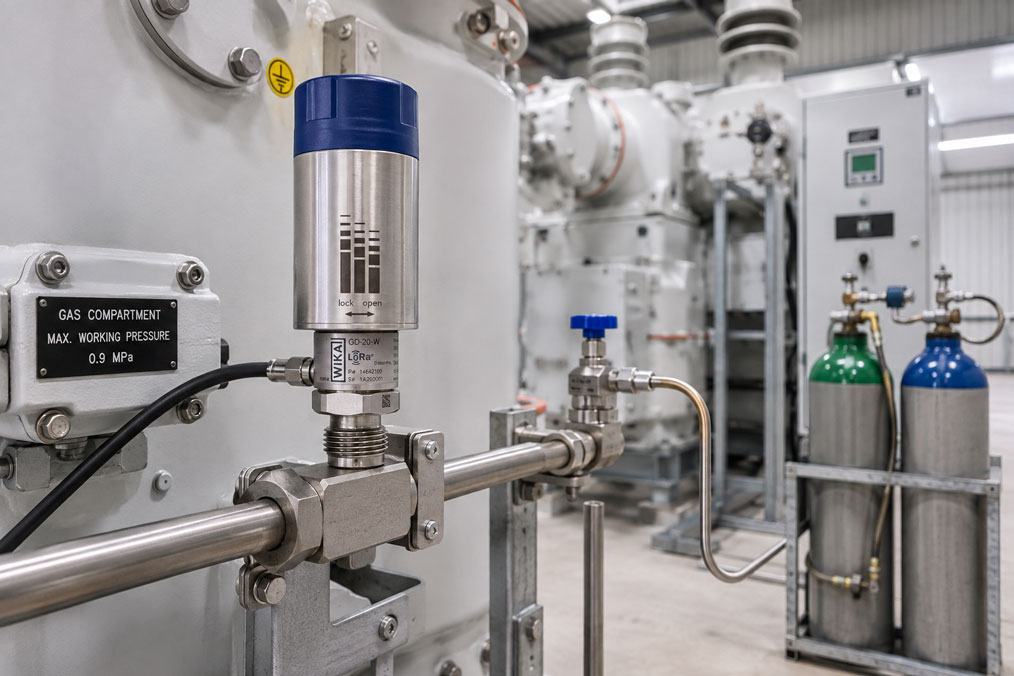
An existing SF₆ switchgear installation is being expanded with a new generation of gas-insulated switchgear. Instead of pure SF₆, the new system uses an alternative insulating gas or a defined gas mixture.
The existing gas density monitor may look suitable, the pressure range may also appear comparable and the process connection may even fit mechanically.
Nevertheless, this does not mean that the device is also metrologically suitable for the new gas.
The reason lies in the temperature compensation:
The relationship between pressure, temperature and gas density depends on the physical properties of the gas and, in the case of gas mixtures, additionally on its actual composition.
A measuring instrument whose compensation has been designed specifically for SF₆ can therefore indicate a plausible-looking but incorrect compensated gas condition when used with an alternative gas mixture.
For new generations of switchgear, it is therefore necessary to check not only the pressure range but also whether the gas density measuring device is approved or configured for the actual insulating gas being used.
Measuring instruments and service components for gas-insulated switchgear can be found under SF₆ gas solutions. Devices for continuous monitoring are grouped under gas density sensors.
Table of Contents
- Why monitor gas density and not only pressure?
- Which alternative insulating gases are available?
- Why gas composition is crucial
- Relationship between pressure, temperature and density
- Why an SF₆ device is not automatically suitable
- Temperature compensation for gas mixtures
- Reference gas principle as an alternative
- What applies to Clean Air or Natural Origin Gases?
- Correctly assessing C4-FN-based gas mixtures
- Is pressure measurement alone sufficient?
- Redefining alarm and switching points
- Why refilling can affect gas composition
- Additionally analysing gas composition
- Retrofitting existing SF₆ monitoring systems
- Typical fault patterns
- Recommended procedure for device selection
- Practical example during switchgear modernisation
- Which products and solutions are suitable?
- Conclusion
- Frequently asked questions
Why monitor gas density and not only pressure?
In gas-insulated switchgear, a sufficient quantity of the specified insulating gas must be present in the sealed gas compartment.
Directly measured gas pressure alone is only of limited use for assessing this gas quantity because pressure changes with temperature.
If a sealed system is heated, the pressure rises even though no additional gas has been added.
When the temperature falls, the pressure decreases accordingly.
A simple pressure switch could therefore report an apparent gas loss during major temperature fluctuations even though the actual gas quantity remains unchanged.
Gas density monitors and electronic gas density sensors compensate for this temperature influence.
This allows them to distinguish between:
- a normal temperature-related pressure change and
- an actual loss of gas mass
.
However, this compensation must be suitable for the gas being used.
Which alternative insulating gases are available?
New gas-insulated switchgear systems can operate with very different insulating media.
These include, for example:
- gas mixtures based on nitrogen, oxygen and, where applicable, carbon dioxide,
- dry or treated air mixtures,
- C4-FN-based gas mixtures,
- CO₂-based mixtures, and
- other insulating gas mixtures defined by the respective switchgear manufacturer.
The designations used sometimes differ between manufacturers and switchgear platforms.
For measurement technology, the trade name alone is therefore not decisive.
What matters is the actual specified gas composition of the particular system.
Why gas composition is crucial
A gas mixture consists of several components with different physical properties.
If their mixing ratio changes, the following properties may also change:
- average molar mass,
- density,
- pressure-temperature behaviour and
- real gas behaviour or compressibility.
This means:
The same pressure at the same temperature does not automatically correspond to the same gas density for two different gas mixtures.
A measuring instrument that calculates a compensated state from pressure and temperature must therefore know which gas or defined gas mixture the calculation is intended for.
This is particularly important for mixtures containing components with significantly different physical properties.
Relationship between pressure, temperature and density
For an idealised gas, the basic relationship can be expressed in simplified form as:
ρ = p × M / (R × T)
where:
- ρ = gas density,
- p = absolute pressure,
- M = molar mass,
- R = universal gas constant, and
- T = absolute temperature.
For real gases, it must additionally be taken into account that they do not behave ideally under all operating conditions.
In simplified form, an additional compressibility factor Z can be considered:
ρ = p × M / (Z × R × T)
This means that pressure and temperature alone are not sufficient for gas density calculation.
The physical properties of the gas or gas mixture being used also form part of the calculation.
For a mixture, these properties in turn depend on the proportions of the individual components.
Why an SF₆ device is not automatically suitable
Many conventional electronic SF₆ gas density transmitters initially measure pressure and temperature.
These measured variables are then used together with a stored characteristic curve or equation of state to calculate the SF₆ gas density or a pressure compensated to a reference temperature.
This calculation is matched to the properties of SF₆.
If the same device is used with another gas without appropriate adaptation, the stored gas properties no longer correspond to the actual medium.
This is particularly critical because the displayed value may still appear plausible.
The sensor may continue to measure pressure and temperature correctly.
However, the gas quantity calculated or compensated from these values may be incorrect.
A mechanically compatible process connection or a similar nominal pressure is therefore not sufficient proof of suitability.
Temperature compensation for gas mixtures
For a defined gas mixture, temperature compensation must be matched precisely to that mixture.
Electronic gas density sensors can use different methods for this purpose.
A modern sensor can, for example:
- measure pressure,
- measure gas temperature,
- take the defined components of the mixture into account, and
- calculate the gas density or a compensated gas condition from these values.
When ordering or configuring the device, the following information in particular must therefore be known:
- gas type or gas mixture,
- proportions of the individual components,
- nominal filling condition,
- temperature range, and
- required alarm or evaluation limits.
A general setting such as “alternative gas” is not necessarily sufficient for precise electronic density calculation.
Reference gas principle as an alternative
In addition to electronic calculation, gas density monitors with a hermetically sealed reference chamber can be used.
The measuring principle compares the condition in the monitored gas compartment with a defined reference gas volume.
If the process and reference sides are affected equally by a temperature change, the monitor can switch along a defined isochore with temperature compensation.
This principle can also be designed for alternative insulating gases.
However, the decisive point remains:
Even a device suitable for alternative gases must be selected in the correct version for the specific gas and the required switching points.
The statement “suitable for alternative gases” does not mean that an arbitrarily configured device can be exchanged between all gas mixtures without verification.
What applies to Clean Air or Natural Origin Gases?
Some new switchgear systems use insulating gases consisting mainly of naturally occurring gases such as nitrogen and oxygen.
Depending on the system, additional components such as carbon dioxide may form part of the specified mixture.
Such gas mixtures differ significantly from SF₆ in terms of their physical properties.
Density compensation designed for SF₆ should therefore not simply be adopted.
In certain switchgear concepts, instead of a conventional SF₆ density indication, a pressure compensated to a reference temperature or another state variable defined by the manufacturer may be monitored.
The switchgear manufacturer’s specification is therefore always decisive.
For selecting the measuring instrument, at least the following information should be available:
- gas composition,
- nominal filling pressure or nominal density,
- reference temperature,
- permissible operating range, and
- alarm and lockout limits.
Correctly assessing C4-FN-based gas mixtures
Another group of alternative insulating media uses C4-FN as a component of a gas mixture.
The C4-FN proportion is combined with other carrier gases.
From a measurement perspective, the information “contains C4-FN” alone is therefore not sufficient.
For correct density compensation, the specified composition of the complete mixture must be taken into account.
This applies in particular when an electronic gas density sensor calculates the current gas condition from pressure and temperature.
A sensor should therefore be configured for the intended mixture or approved for it by the manufacturer.
Is pressure measurement alone sufficient?
A conventional pressure measurement can fundamentally determine the actual pressure in the gas compartment.
However, it does not initially distinguish between:
- a pressure change caused by temperature and
- a pressure change caused by actual gas loss.
For systems with a limited temperature range or with higher-level temperature correction, pressure measurement may form part of a suitable monitoring concept.
In outdoor installations, however, temperatures can vary considerably.
A simple pressure limit could then interpret seasonal or daily fluctuations as changes in gas condition.
The correct measured variable must therefore be derived from the intended switchgear and monitoring concept.
Redefining alarm and switching points
When changing to another insulating gas, existing SF₆ switching points must not automatically be retained.
A typical monitoring concept may distinguish between several conditions:
- normal filling condition,
- first warning level,
- refill or maintenance limit, and
- critical lockout or shutdown limit.
These limits form part of the design of the respective switchgear.
They depend, among other things, on:
- gas mixture,
- nominal filling condition,
- insulation requirements,
- switching capacity,
- temperature range, and
- switchgear design
.
The switching points of the gas density monitor must therefore correspond to the specifications of the switchgear manufacturer.
Why refilling can affect gas composition
With a pure gas, refilling is comparatively straightforward in terms of gas composition.
With a gas mixture, however, an additional parameter must be considered:
the mixing ratio.
If gas is added after a leak, it must be ensured that the composition specified for the system is still maintained afterwards.
Potential problems include:
- refilling with the wrong gas,
- using a mixture with the wrong concentration,
- mixing different gas qualities,
- residual gas after maintenance or evacuation, and
- gas treatment or recovery that does not comply with the specification.
For alternative gas mixtures, the refilling procedure should therefore always follow the specified service procedure for the switchgear.
A correct pressure value after filling is not sufficient proof that the gas composition is also correct.
Additionally analysing gas composition
Gas density monitoring and gas analysis perform different tasks.
The gas density sensor primarily monitors whether the defined gas condition or the required quantity of gas in the sealed gas compartment is maintained.
A gas analysis, on the other hand, can determine which components are actually present in the gas.
Depending on the gas and the analyser, the following can be examined, for example:
- gas composition or purity,
- moisture, and
- other gas-dependent quality parameters.
This is particularly useful after:
- initial filling,
- refilling,
- major maintenance work,
- gas recovery, or
- suspected mixing
.
A correct density indication therefore does not automatically replace checking the actual gas composition.
Retrofitting existing SF₆ monitoring systems
When modernising an existing measuring point, the installed components should not be considered only from a mechanical perspective.
Before a retrofit, at least the following points should be clarified:
- Which new gas or gas mixture will be used?
- What is the exact specified composition?
- Which state variable is to be monitored?
- Which reference temperature is used?
- Which warning and lockout limits apply?
- Is the existing measuring instrument approved for this gas?
- Can the device be reconfigured or must it be replaced?
- Are the process connection and sealing system suitable for the new measuring instrument?
- Do PLC or SCADA limits need to be adjusted?
- How will the gas composition be checked after the retrofit?
An existing 4–20 mA signal may, for example, still be electrically compatible with the control system.
However, this does not automatically mean that the previous scaling or the underlying gas calculation is still correct.
Typical fault patterns
| Observation | Possible cause | Recommended check |
|---|---|---|
| Gas density fluctuates unusually strongly with ambient temperature | Temperature compensation may not match the gas | Check gas configuration and temperature compensation |
| Pressure appears plausible, but compensated value is abnormal | Incorrect gas equation or gas composition configured | Compare sensor parameters with the actual gas mixture |
| Old alarm limits are reached very early after retrofit | SF₆ limits were retained | Use the limits specified for the new switchgear concept |
| Pressure is correct after refilling, but gas quality is uncertain | Mixing ratio may have changed | Analyse gas composition |
| New sensor provides a different value from the old SF₆ monitor | Different gas model or reference variable | Check the measured variables and reference temperatures being compared |
| 4–20 mA signal works, but SCADA shows incorrect density | Old scaling or old gas definition is still being used | Check signal range and engineering units |
| Gas loss is suspected despite a plausible pressure indication | Temperature change is masking the pressure change | Evaluate the temperature-compensated gas condition |
| Gas mixture was topped up with a different mixture | Composition may no longer comply with the specification | Check gas analysis and manufacturer requirements |
Recommended procedure for device selection
- Identify the switchgear: Clearly determine manufacturer, series and gas compartment.
- Define the insulating gas: Record not only the trade name but, where possible, the complete gas composition.
- Determine the nominal condition: Clarify filling pressure or nominal density and reference temperature.
- Define the temperature range: Consider indoor or outdoor installation.
- Define the monitored variable: Gas density, compensated pressure or another variable specified by the manufacturer.
- Select the measuring principle: Electronic sensor or reference chamber principle.
- Check gas approval: The device must be explicitly suitable for the intended gas or mixture.
- Configure the gas mixture: For electronic systems, store the correct composition or have it factory-configured.
- Adopt alarm limits: Define warning and lockout points according to the switchgear manufacturer.
- Select the output signal: For example 4–20 mA or Modbus RTU according to the control system.
- Check the mechanical design: Verify process connection, leak tightness and installation situation.
- Adapt SCADA: Update scaling, unit, limits and gas designation.
- Define the refilling concept: Ensure that the specified mixture is maintained.
- Plan gas analysis: Check composition during service or if mixing is suspected.
Practical example during switchgear modernisation
An operator replaces an older switchgear section with a new gas-insulated system using an alternative insulating gas mixture.
The existing control system operates with 4–20 mA signals.
The old SF₆ gas density transmitter also provides a 4–20 mA output.
This initially leads to the idea of simply reusing a similar sensor on the new switchgear.
However, the technical review shows that the previous transmitter bases its temperature compensation specifically on the nonlinear behaviour of SF₆.
The new switchgear, by contrast, uses a defined gas mixture with different physical properties.
A gas density sensor configured for the specific gas composition is therefore used for the new measuring point.
Pressure and temperature continue to be measured directly, but the calculated gas density is now based on the properties of the gas mixture actually being used.
The 4–20 mA or digital signal is then integrated into the control system using the correct limits.
After filling, the gas quality is also checked.
This separates two different questions:
- Gas density monitoring: Is there still sufficient insulating gas in the gas compartment?
- Gas analysis: Does the actual composition still comply with the specified mixture?
The example demonstrates why changing the insulating gas requires more than simply applying a new label or changing the scaling.
The gas model being used is a functional part of the gas density measurement.
Which products and solutions are suitable?
WIKA GD-20 – gas density sensor for SF₆ and defined alternative gas mixtures
The WIKA GD-20 is particularly suitable for new or digitalised gas density monitoring applications.
The sensor measures pressure and temperature and calculates the compensated gas condition from these values.
For defined alternative insulating gas mixtures, the device can be factory-configured according to the gas composition.
Possible components of defined mixtures can include:
- SF₆,
- N₂,
- O₂,
- CO₂,
- C4-FN,
- CF₄,
- helium, and
- argon.
The digital version with Modbus RTU is particularly interesting when detailed condition data in addition to the compensated gas condition is to be transmitted to a PLC or SCADA system.
WIKA GDM-RC-100 – gas density monitor with reference chamber for alternative gases
The WIKA GDM-RC-100 operates according to the reference gas principle.
This enables temperature-compensated indication and switching along the defined isochore.
The device is explicitly designed for alternative insulating gases as well.
It is particularly suitable when:
- a local mechanical indication is required,
- defined switching contacts are needed, and
- gas-dependent density monitoring without purely electronic compensation is required.
Here too, the gas, filling condition and switching points must be clearly defined when selecting the device.
WIKA GA11 – checking the composition and moisture of alternative insulating gases
The WIKA GA11 supplements continuous gas density monitoring with analysis of the actual gas quality.
Depending on the device version, the GA11 can be used for SF₆ as well as alternative C4-FN gas mixtures and Natural Origin Gases.
This makes the device suitable, for example, for testing after:
- initial filling,
- maintenance,
- refilling,
- gas treatment, or
- suspected changes in gas composition.
Gas density measurement and gas analysis therefore complement each other effectively: the density sensor continuously monitors the gas condition, while the analysis checks whether the gas composition actually corresponds to the specified quality.
Further measuring instruments, filling equipment, analysers and service components can be found under SF₆ gas solutions.
ICS Schneider Messtechnik supports you in selecting and designing gas density monitors, gas density sensors and analysis systems for SF₆ as well as alternative insulating gases and gas mixtures.
Conclusion
When changing from SF₆ to an alternative insulating gas, the existing gas density monitoring system cannot automatically be retained.
The decisive reason lies in the physics of the gas.
The relationship between pressure, temperature and density is determined by physical properties such as molar mass and real gas behaviour.
For gas mixtures, the mixing ratio of the individual components must additionally be taken into account.
An electronic gas density sensor using compensation configured for SF₆ can therefore calculate an incorrect compensated value for an alternative gas even though its pressure and temperature sensors are functioning correctly.
For alternative insulating gases, either an appropriately configurable electronic sensor or a suitably designed reference gas system must therefore be used.
Correct alarm limits are equally important. Existing SF₆ warning and lockout points must not be transferred to a new switchgear platform without verification.
For gas mixtures, it must also be taken into account that refilling can affect not only the pressure but also the composition.
Gas analysis can therefore be useful in addition to continuous density monitoring.
The most important rule is:
Do not select by housing, connection or pressure range – select according to the actual insulating gas, gas composition, filling condition and the required temperature compensation.
Frequently asked questions about the gas density of alternative insulating gases
Can an SF₆ gas density monitor be used for an alternative insulating gas?
Not automatically. The decisive factors are how the device performs temperature compensation and whether it is designed and approved for the specific alternative gas or gas mixture.
Why does gas density depend on gas composition?
The different gas components have different molar masses and thermodynamic properties. As a result, the relationship between pressure, temperature and density changes with the composition of the mixture.
Can I simply monitor pressure in a gas mixture?
Pressure can be monitored, but it also changes with temperature. Whether pressure measurement alone is sufficient therefore depends on the monitoring concept and the specifications of the switchgear manufacturer.
What does temperature-compensated gas pressure mean?
The currently measured pressure is converted to a defined reference condition using the gas temperature and a suitable gas model. This allows temperature-related pressure changes to be distinguished from actual gas loss.
Does an electronic gas density sensor have to be configured for the gas mixture?
For a sensor that calculates gas density from pressure and temperature, the calculation used must match the actual gas mixture. Suitable devices can therefore be factory-configured for defined mixtures.
What is the advantage of a gas density monitor with a reference chamber?
The reference gas principle enables temperature-compensated switching or indication along a defined isochore. Devices designed accordingly can also be used for alternative insulating gases.
Can the SF₆ alarm limits be retained during a retrofit?
Not without verification. Warning, refill and lockout limits form part of the respective switchgear and insulating gas concept and must be defined according to the specifications for the new system.
Why is gas composition important after refilling?
With a gas mixture, not only the total gas quantity but also the specified mixing ratio must be maintained. A correct filling pressure alone does not confirm the composition.
Can a gas density sensor measure the composition of the gas mixture?
Normally not. A gas density sensor monitors pressure, temperature and gas state variables derived from them. A suitable gas analyser is required to determine the actual gas composition.
Which information is required when selecting a gas density sensor for an alternative gas?
In particular, the specific gas or complete gas composition, nominal filling condition, reference temperature, operating and ambient temperature, required alarm limits, process connection and required output signal are needed.