


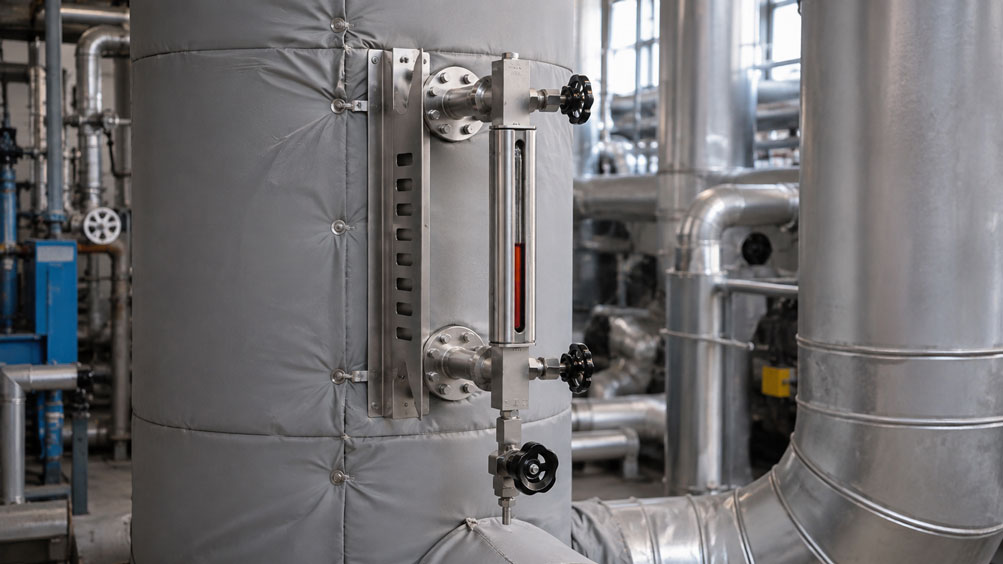
A sight glass level indicator provides a particularly simple way of checking the level: the operator can directly see how high the liquid level is inside the vessel. With hot water, steam, heat transfer oil or other hot process media, however, this simple measurement task quickly becomes a demanding question of valve design and safety.
The decisive factor is not only whether the sight glass can withstand the operating temperature. The following must also be taken into account:
- operating pressure,
- sight glass design,
- process medium,
- sealing materials,
- shut-off valves,
- temperature changes,
- reading position,
- maintenance and cleaning
.
Hot aqueous media and steam are particularly critical. Temperature, pressure and chemical conditions can place long-term stress on the glass surface. At the same time, a sudden temperature change can generate high thermal stresses in the sight glass.
A sight glass level indicator for hot media must therefore be designed as a complete pressure-bearing measuring point – from the vessel connection, shut-off valves and seals through to the glass and the safe viewing area.
For such applications, ICS Schneider offers, among other products, the WIKA Type LGG Sight Glass Level Indicator for direct level indication. Depending on the version, different reflex, transparent and glass tube designs, process connections, materials as well as options for illumination, heating and insulation are available. Further solutions can be found under Level Measurement Technology at ICS Schneider.
Table of Contents
- How a sight glass level indicator displays the level
- Why hot media place special demands on the system
- Always evaluate pressure and temperature together
- Distinguishing between reflex, transparent and glass tube indicators
- When a reflex sight glass is suitable
- When a transparent sight glass is suitable
- Glass material and temperature resistance
- Why mica protection can be important in hot applications
- Special considerations for hot water and steam
- Why shut-off valves are part of the measuring point
- Self-closing ball as an additional safety function
- Correctly commissioning a hot sight glass level indicator
- Avoiding thermal shock and thermal stress
- Selecting the correct sealing material
- Stress-free installation on the vessel
- Planning safe readability
- Contact protection and warning labels
- Planning insulation correctly
- Illumination for difficult reading conditions
- Contamination, deposits and condensate
- Cleaning the sight glass correctly
- Treating sight glasses as wear parts
- When the glass or mica protection should be replaced
- Distinguishing between level indication and safety function
- When another level indication method is more suitable
- Typical error patterns
- Systematically selecting a sight glass level indicator
- Practical example: hot water vessel
- WIKA LGG at ICS Schneider
- Conclusion
- FAQ
How a sight glass level indicator displays the level
A conventional sight glass level indicator operates according to the principle of communicating vessels.
The indicator is usually connected to the vessel via a lower and an upper process connection.
As a result, the liquid level in the sight glass channel generally settles at the same height as the liquid level inside the vessel.
The level becomes directly visible
No electronic conversion of:
pressure → level height
or:
time of flight → distance → level
is required.
This is a major advantage of direct visual indication.
The method requires no auxiliary power
Even if the:
24 V supply
or:
PLC / control system
fails, the liquid level remains visible on site, provided that the measuring point itself is functional and accessible.
Why hot media place special demands on the system
Even at ambient temperature, a sight glass level indicator is already a pressure-bearing component.
At high process medium temperatures, additional loads arise.
These include in particular
- thermal expansion of metallic components,
- temperature loading of the seals,
- thermal loading of the glass,
- temperature changes during startup and shutdown,
- risk of burns to operating personnel,
- increased influence of certain media on the glass surface.
In steam and hot-water applications
the combination of:
high temperature + water + chemical composition
can also be decisive.
Selection must therefore not be based solely on the maximum permissible temperature of the glass.
Always evaluate pressure and temperature together
The question:
Up to what temperature is the sight glass level indicator suitable?
is not sufficient for technical design.
At a minimum, the following are required:
maximum operating pressure
and:
maximum operating temperature
as well as the actual process medium.
For the WIKA Type LGG
WIKA specifies model-dependent operating limits of:
-196 … +374 °C
and:
vacuum up to 250 bar
.
However, these values describe the product range and must not be interpreted as general approval for every individual configuration.
The actual permissible combination
depends, among other things, on:
- sight glass design,
- glass size,
- material,
- process connection,
- seal,
- process medium.
The permissible pressure-temperature combination of the specific instrument configuration is therefore always decisive for selection.
Distinguishing between reflex, transparent and glass tube indicators
Not all sight glass level indicators have the same design.
For industrial plants, the following are commonly used:
- reflex sight glasses,
- transparent sight glasses,
- glass tube sight glasses.
The selection affects
- readability,
- pressure and temperature range,
- glass protection options,
- suitability for steam,
- observation of color and interface layers.
When a reflex sight glass is suitable
In a reflex sight glass, the glass plate has prismatic structures.
This creates a clear optical difference between the liquid and gas phases.
In the gas section
the light is strongly reflected.
In the liquid section
the refraction of light changes, causing the liquid to appear significantly darker.
This makes the liquid level easy to identify even without an additional scale.
Reflex indicators are particularly suitable
when:
- a clearly visible liquid boundary is required,
- the medium is sufficiently transparent,
- observation of the medium color is not required.
When a transparent sight glass is suitable
With a transparent sight glass level indicator, the liquid channel is viewed through transparent glass plates.
This allows more than just the actual level line to be observed.
Depending on the medium, the following may also be visible
- color,
- turbidity,
- phase interfaces,
- contamination.
Transparent versions are also particularly relevant for certain demanding steam and high-temperature applications
because additional protective layers such as mica sheets can be installed between the process medium and the glass.
This option is an important difference compared with a conventional reflex indicator.
Glass material and temperature resistance
The WIKA LGG uses borosilicate glass in accordance with DIN 7081 for the sight glasses.
Borosilicate glass is characterized, among other things, by comparatively good resistance to temperature changes.
However, this does not mean
that every borosilicate glass can be used regardless of:
- temperature,
- pressure,
- medium,
- mechanical clamping.
The permissible operating conditions always result from the complete sight glass assembly.
Even small surface damage is relevant
Glass can withstand pressure as long as:
- geometry,
- surface,
- clamping
remain within the intended conditions.
Scratches, erosion or cracks can impair mechanical safety.
Why mica protection can be important in hot applications
Mica sheets are installed between the process medium and the glass in certain sight glass applications.
They do not serve the same purpose as external contact protection for personnel.
The mica shield protects the sight glass on the process side
and can reduce direct exposure of the glass surface, particularly with hot aqueous media or steam.
For the WIKA LGG
the glasses may be used for steam without mica protection up to:
243 °C
.
With the appropriate mica version, steam applications up to:
300 °C
are possible.
WIKA explicitly points out
that high temperatures and high pH values can increase glass erosion in boiler applications with aqueous media.
From:
243 °C
transparent glasses with mica protection should be used in such applications.
Mica therefore protects the pressure-bearing viewing system – it is not a substitute for any necessary personnel protection against hot surfaces.
Special considerations for hot water and steam
Steam places special demands on a sight glass level indicator.
For saturated steam, pressure and temperature are directly related.
As steam pressure increases, the saturation temperature therefore also increases.
Condensate can also form
The sight glass level indicator may simultaneously contain:
- steam,
- condensate,
- liquid water.
This affects both thermal loading and readability.
For steam applications, particular attention must therefore be paid to whether
- a reflex or transparent design is suitable,
- mica protection is required,
- pressure and temperature are compatible with the selected version,
- valves and seals are suitable for steam.
Why shut-off valves are part of the measuring point
A sight glass level indicator is directly connected to the process.
In the event of a defect, it must therefore be possible to isolate it from the vessel.
Typically,
the upper and lower process connections are fitted with:
shut-off valves
or valve heads.
In addition:
- drain,
- vent,
- quick-closing functions
can be provided.
The shut-off valves are not only used for maintenance
They also allow the sight glass level indicator to be isolated from the vessel in the event of:
- glass breakage,
- leakage,
- seal failure,
- maintenance work.
This possibility is particularly important with hot and pressurized media.
Self-closing ball as an additional safety function
Various valve versions of the WIKA LGG are equipped with a self-closing ball as a safety element.
During normal operation
the medium can flow between the vessel and the sight glass level indicator.
At a significantly increased flow rate
for example as a result of glass breakage, the ball can move towards the valve seat and restrict the discharge.
This can reduce the amount of escaping process medium.
However, the self-closing ball does not replace
the designated shut-off valves or the correct response to a fault.
In the event of leakage or glass breakage, the measuring point must be isolated from the vessel in accordance with the operating instructions.
Correctly commissioning a hot sight glass level indicator
A cold sight glass level indicator should not be exposed uncontrollably to a very hot process medium.
Large temperature differences can generate high thermal stresses.
For the LGG, WIKA therefore specifies controlled adaptation to the process medium temperature
when process and ambient temperatures differ significantly.
The sight glass level indicator is gradually flushed or heated with the medium before being placed fully into operation.
Pressure equalization is also performed in a controlled manner
For valves with a self-closing ball, the valves should initially be opened only partially.
They are fully opened only after pressure equalization has taken place.
Rapid full opening can not only be thermally unfavorable but, with a self-closing ball, can also cause the ball to unintentionally shut off the flow.
Avoiding thermal shock and thermal stress
Glass is sensitive to large temperature differences within the component.
A critical scenario would be, for example
cold sight glass level indicator + suddenly hot medium
.
The inner glass surface heats up faster than the outer surface.
This generates mechanical stresses.
The reverse situation is also critical
hot sight glass + cold cleaning medium
.
Controlled temperature changes should therefore also be ensured during cleaning and recommissioning.
Selecting the correct sealing material
It is not only the glass that must be suitable for the process temperature.
The seal is located directly between:
glass
and:
metal glass holder
and therefore influences both leak tightness and mechanical clamping.
When selecting the material, the following must be considered simultaneously
- temperature,
- process medium,
- pressure,
- chemical resistance,
- continuous load.
A sealing material that is chemically resistant to the medium is not automatically suitable for the required temperature.
Conversely,
a temperature-resistant material must also be chemically compatible with the process medium.
Stress-free installation on the vessel
The upper and lower vessel connections must match the geometry of the sight glass level indicator.
A common installation error is to force misaligned process connections together mechanically.
This can cause
- mechanical stress in the housing,
- uneven loading of the seals,
- additional stress on the glass,
- leakage.
The sight glass level indicator should therefore not be used as a mechanical compensation element for incorrectly positioned vessel nozzles
The process connections must be geometrically aligned.
Connected piping must also not transmit unnecessary forces to the instrument.
Planning safe readability
With a hot sight glass level indicator, the viewing position must be considered before installation, not afterwards.
The operator should be able to identify the level without:
- having to touch hot surfaces,
- standing directly in front of potential leakage points,
- reaching over piping,
- having to climb on unsuitable aids.
The following are therefore useful during planning
- suitable installation height,
- good viewing angle,
- sufficient distance from hot piping,
- free access to the shut-off valves,
- sufficient illumination.
Even the best direct level indication is of little value if, during normal plant operation, it can only be read from an unfavorable or hazardous position.
Contact protection and warning labels
With hot media, it is not only the glass and liquid that can reach high temperatures.
The following can also become very hot:
- valve heads,
- flanges,
- glass holders,
- pipe connections.
For the LGG, WIKA requires warning labels at surface temperatures above 60 °C
on:
flanges, pipes, housing, etc.
as well as suitable protective measures against burns.
Depending on the risk assessment
these can include, for example:
- sufficient distance,
- contact protection,
- suitable shielding,
- personal protective equipment.
However, additional protection must not unacceptably restrict the necessary view of the level or access to the shut-off valves.
Planning insulation correctly
In very hot plants, vessels and piping are often thermally insulated.
Depending on the version, insulation options are also available for the WIKA LGG.
However, the insulation must be designed so that
- the viewing area remains unobstructed,
- valves remain operable,
- drain and vent remain accessible,
- maintenance points remain accessible.
A common planning error
is to install complete vessel insulation afterwards, leaving the sight glass level indicator only partially visible or accessible for maintenance.
Illumination for difficult reading conditions
For transparent or low-contrast media, illumination can significantly improve readability.
WIKA offers optional illumination solutions for the LGG.
This can be particularly useful in
- dark machine rooms,
- long sight glass assemblies,
- transparent indicators,
- poorly visible liquid boundaries.
Good illumination can also prevent operating personnel from having to lean unnecessarily close to a hot measuring point.
Contamination, deposits and condensate
A technically intact sight glass can still become unusable if the view of the liquid level is restricted.
Possible causes include
- limescale deposits,
- corrosion products,
- oil films,
- solid deposits,
- discoloration,
- glass erosion,
- condensate.
With hot media
deposits can additionally be promoted by:
- evaporation,
- temperature gradients,
- chemical reactions.
Reliable long-term readability therefore requires regular inspection of the viewing system.
Cleaning the sight glass correctly
A contaminated indicator should not be treated with arbitrary tools or cleaning chemicals.
The cleaning agent must be compatible with
- process medium,
- valve material,
- glass,
- mica,
- seals.
Particular care is required with mica protection
WIKA points out that mica sheets should not be mechanically cleaned, for example with brushes.
Hard or sharp objects are also unsuitable for cleaning the viewing system.
Before maintenance work
the measuring point must be:
isolated → depressurized → drained → sufficiently cooled
in accordance with the operating instructions.
For hot, aggressive or hazardous media, the corresponding operational protective measures must also be observed.
Treating sight glasses as wear parts
A sight glass should not be operated according to the principle:
as long as it is not broken, it is fine
.
WIKA classifies the glasses and mica protection of the LGG as wear parts.
Their condition depends, among other things, on
- pressure,
- temperature,
- process medium,
- chemical composition,
- operating time.
The following should be checked regularly
- leak tightness of the connections,
- leak tightness of the valves,
- glass surface,
- glass tubes,
- mica sheets,
- transparency,
- function of the valve heads.
When the glass or mica protection should be replaced
Replacement should not be delayed until complete failure occurs.
Critical indications include, for example
- cracks,
- chipping,
- severe clouding,
- visible material erosion,
- significantly reduced transparency,
- damage to the mica protection.
Damaged or worn components must be replaced in good time.
When replacing components
the seals are also relevant.
When replacing the glass of a segment, WIKA recommends renewing the glass and seals and, where applicable, the mica protection of the relevant indicator in accordance with the manufacturer’s specifications.
A leak test is required after work on the pressure-bearing viewing system.
Distinguishing between level indication and safety function
A sight glass level indicator provides direct and robust local monitoring.
It is therefore highly valuable for the operator.
However, a visual indicator is not automatically a safety-related shutdown function
For the LGG, WIKA explicitly states that the device must not be used as a safety or emergency shutdown device.
If, for example, a vessel must be protected against overfilling
depending on the plant, an additional:
- level switch,
- level transmitter,
- independent overfill protection system
may be required.
Direct visual indication and automatic safety functions should therefore be regarded as separate tasks.
When another level indication method is more suitable
A sight glass level indicator is not automatically the best solution for every hot application.
An alternative level measurement technology may be appropriate
when:
- the measuring point is difficult to access,
- remote transmission to the PLC is required,
- very high personnel protection requirements apply,
- the medium heavily contaminates the viewing system,
- continuous automatic recording is required.
One possible alternative
is a bypass level indicator with magnetic indication.
In this case, the direct indicator is located outside the actual process medium.
Depending on the version, it can additionally be combined with:
- level switches,
- transmitters,
- remote indicators.
Which solution is more suitable depends on the medium, temperature, pressure, required indication and safety concept.
Typical error patterns
| Observation | Possible cause | Recommended check |
|---|---|---|
| Sight glass starts leaking after commissioning | thermal settling or uneven installation | check bolted connections according to manufacturer specifications |
| Glass cracks after startup | temperature change may have been too rapid | check commissioning procedure and temperature equalization |
| Glass surface becomes increasingly cloudy | chemical or thermal attack | check medium, temperature and required mica protection |
| Level is difficult to identify | contamination or unsuitable sight glass design | check cleaning, reflex/transparent selection and illumination |
| Liquid column responds only slowly | valve not fully open or channel contaminated | check valve position and liquid channel |
| Indicator remains unchanged although vessel level changes | process connection blocked | check upper and lower connection |
| No medium enters when valve is fully opened | self-closing ball has activated | open valves gradually in accordance with manufacturer instructions |
| Condensate affects the indication | steam application or temperature difference | check drain and operating condition |
| Seal protrudes laterally | installation or sealing problem | take measuring point out of service and check installation |
| Valve assembly is very hot and difficult to access | inadequate viewing and protection concept | check contact protection, distance and operating position |
| Sight glass cannot be installed without mechanical stress | vessel connections are misaligned | correct nozzle geometry |
| Leakage occurs after cleaning | seals reused or installed incorrectly | check seals and installation according to manufacturer specifications |
Systematically selecting a sight glass level indicator
- Determine the process medium: Specify water, steam, heat transfer oil, chemical or another medium completely.
- Determine operating temperature: Consider normal, minimum and maximum temperature.
- Determine operating pressure: Identify normal pressure, maximum pressure and possible vacuum conditions.
- Consider fault conditions: Also evaluate possible maximum process conditions.
- Select the sight glass design: Choose reflex, transparent or glass tube according to the application.
- Check steam application: Evaluate the required mica protection and suitable transparent version.
- Define materials: Select housing, connections and wetted parts to suit the medium.
- Select seals: Evaluate temperature and chemical resistance together.
- Determine process connections: Select flange, threaded or welded connection to suit the plant.
- Define center-to-center distance: Determine the exact distance between the upper and lower vessel connections.
- Provide shut-off valves: Plan upper and lower process isolation for operation and maintenance.
- Check self-closing ball: Select a suitable valve version according to the safety concept.
- Plan drain and vent: Consider maintenance, condensate and controlled commissioning.
- Define the viewing position: Ensure a safe viewing angle and ergonomic operating height.
- Evaluate surface protection: Provide warning labels and, if required, contact protection.
- Coordinate insulation: The viewing area and valves must not be covered.
- Check illumination: Provide suitable illumination if visibility is poor.
- Plan commissioning: Equalize pressure and temperature in a controlled manner.
- Define a maintenance plan: Regularly check leak tightness, glass condition, mica and valve function.
- Evaluate the safety function separately: If overfill protection is required, provide suitable additional safety equipment.
Practical example: hot water vessel
A process vessel contains hot water and is to be equipped with direct local level indication.
Assumed operating conditions:
Temperature: 180 °C
Pressure: 12 bar
Step 1: Check pressure and temperature
The required sight glass version must be suitable for:
180 °C / 12 bar
and the water used.
Step 2: Define the design
Depending on the other process conditions, either a reflex or transparent version may be suitable for clear direct level indication.
Step 3: Plan the valves
The upper and lower vessel connections are equipped with suitable shut-off valves.
A drain and/or vent is additionally considered for maintenance and commissioning.
Step 4: Determine the installation position
The indicator is installed so that the operator can identify the level from a safe distance.
Hot piping must not obstruct access to the valves.
Step 5: Control commissioning
The cold sight glass level indicator is not suddenly exposed to the fully heated process.
Temperature and pressure are equalized in a controlled manner in accordance with the manufacturer’s instructions.
Step 6: Define maintenance
The following are checked regularly:
- glass condition,
- leak tightness,
- valve function,
- readability.
Result
Temperature alone does not determine whether a sight glass level indicator is suitable. Only the combination of process data, sight glass design, valves, materials, commissioning procedure and safe operation results in a reliable measuring point.
WIKA LGG at ICS Schneider
WIKA Type LGG Sight Glass Level Indicator
The WIKA Type LGG is designed for continuous direct indication of liquid levels.
ICS and WIKA specify, among other things:
- process- and application-specific manufacture,
- model-dependent operating temperatures from
-196 … +374 °C, - model-dependent operating pressures from vacuum up to
250 bar, - different process connections and materials,
- borosilicate glass in accordance with DIN 7081,
- optional illumination,
- optional heating and/or insulation.
For steam applications
WIKA specifies for the glasses:
up to 243 °C without mica protection
and:
up to 300 °C with the appropriate mica version
.
For other media
depending on the version, temperatures up to:
300 °C
and in special cases up to:
374 °C
are possible.
The specific version must always be selected according to the medium, pressure and temperature.
Further solutions can be found under Sight Glass Level Indicators from WIKA / KSR Kuebler as well as under Level Measurement Technology at ICS Schneider.
Conclusion
Sight glass level indicators provide particularly direct and intuitive level monitoring. With hot media, however, the requirements for design, installation and operation increase significantly.
Pressure and temperature must be considered together
A maximum temperature specification alone is not sufficient. The permissible combination of pressure, temperature, medium and specific instrument configuration is decisive.
Reflex and transparent designs serve different purposes
Reflex indicators provide a very clear liquid contrast. Transparent indicators allow direct observation of the medium and the use of additional mica protection layers.
For hot water and steam, mica protection can be decisive
For corresponding high-temperature steam applications, WIKA specifies transparent glasses with mica protection in order to protect the glass surface against increased exposure.
Shut-off valves are part of the safety concept
The sight glass level indicator must be capable of being reliably isolated from the vessel during maintenance, in the event of leakage or in case of glass breakage.
Temperature changes must be controlled
Large temperature differences between a cold indicator and a hot medium can cause thermal stresses. Commissioning should therefore be carried out in accordance with the manufacturer’s specifications.
Safe readability begins during plant design
Installation height, viewing angle, contact protection, warning labels, illumination and accessibility of the valves are all part of measuring point planning.
Glasses and mica protection are wear parts
Cracks, clouding, material erosion and damage must be identified in good time. Regular visual inspections and leak tests are therefore necessary.
For practical applications
Determine the medium → define maximum pressure and maximum temperature → select reflex, transparent or glass tube version → determine glass and, where required, mica protection → check materials and seals → provide upper and lower shut-off valves → plan drain and vent → align vessel connections without mechanical stress → determine a safe viewing position → evaluate contact protection and warning labels → equalize temperature and pressure in a controlled manner during commissioning → regularly check readability, leak tightness, valves, glass and mica → design any required automatic safety functions independently of the visual indicator.
FAQ: Sight Glass Level Indicators for Hot Media
Can a sight glass level indicator be used for hot water?
Yes. However, the specific version must be suitable for the operating pressure, temperature, water chemistry, sealing materials and required sight glass design.
Can a sight glass level indicator be used for steam?
Yes. For steam applications, the permissible glass and valve configuration as well as pressure and temperature must be taken into account.
Up to what temperature is the WIKA LGG suitable?
Depending on the model, WIKA specifies operating temperatures from -196 to +374 °C. The actual permissible temperature depends on the specific version and the medium.
Up to what pressure is the WIKA LGG suitable?
Depending on the model, WIKA specifies operating pressures from vacuum up to 250 bar. This maximum value does not apply generally to every configuration.
Which glasses are used in the WIKA LGG?
WIKA uses borosilicate sight glasses in accordance with DIN 7081.
What is a reflex sight glass level indicator?
With the reflex principle, prismatic structures in the glass create a strong optical difference between the liquid and gas phases.
What is a transparent sight glass level indicator?
With a transparent indicator, the medium is viewed directly through transparent glass plates. This can also make color, turbidity or phase interfaces visible.
When is mica installed in front of the sight glass?
Mica can be used with certain hot or chemically demanding media to protect the actual sight glass on the process side.
Why is mica important with hot steam?
Hot aqueous media can attack the glass surface. A mica shield reduces direct contact between the process medium and the glass.
From what steam temperature does WIKA require mica protection for the LGG?
For aqueous media in corresponding boiler applications, WIKA requires transparent glasses with mica protection from 243 °C.
What steam temperature is possible with mica protection?
WIKA specifies steam temperatures up to 300 °C for the LGG with the appropriate mica version.
Is mica a contact guard for the operator?
No. The mica layer protects the sight glass on the process side. Any required personnel protection against hot surfaces must be considered separately.
Why does a sight glass level indicator require shut-off valves?
So that it can be reliably isolated from the process for maintenance or in the event of leakage or glass breakage.
What is a self-closing ball?
In certain valve versions, a ball can move towards the valve seat at a significantly increased flow rate and thereby restrict the discharge of process medium.
Does a self-closing ball replace the shut-off valve?
No. The regular shut-off valves are still required.
Why should a hot sight glass level indicator be commissioned slowly?
So that pressure and temperature can be equalized in a controlled manner and unnecessary thermal stresses in the viewing system can be avoided.
What is thermal shock?
Thermal shock is caused by a rapid and significant temperature change that generates high mechanical stresses within the glass.
Can cold cleaning water be applied to a hot sight glass?
Uncontrolled large temperature changes should be avoided. Cleaning and recommissioning must be performed in accordance with the manufacturer’s and plant specifications.
Why is the selection of the seal important?
The seal must simultaneously be suitable for the temperature, pressure and chemical composition of the medium.
Can a sight glass level indicator be installed under mechanical stress?
No. Misaligned vessel connections can generate mechanical stress in the housing, seal and glass.
How should a hot sight glass level indicator be installed?
It should be connected without mechanical stress, be safely readable and keep the shut-off valves easily accessible.
Does a hot sight glass level indicator need to be marked?
For the LGG, WIKA requires warning labels on hot components and suitable protective measures against burns at temperatures above 60 °C.
Can a protective shield be useful?
Depending on the risk assessment, suitable shielding or contact protection can be useful. However, visibility of the indicator and operability of the valves must not be unacceptably restricted.
Can the sight glass level indicator be insulated?
Depending on the version, insulation options are available. However, the viewing area, valves, drain and maintenance points must remain accessible.
Is illumination available for the WIKA LGG?
Yes. WIKA offers optional illumination.
Why does a sight glass become cloudy over time?
Possible causes include deposits, chemical attack, glass erosion, contamination or ageing.
Are sight glasses wear parts?
Yes. WIKA classifies the glasses and mica protection of the LGG as wear parts whose condition depends, among other things, on pressure, temperature, medium and operating time.
What needs to be checked regularly?
In particular, leak tightness, glass condition, transparency, mica protection and function of the valve heads.
When should a sight glass be replaced?
It should be replaced in accordance with the manufacturer’s instructions in the event of cracks, chipping, severe material erosion, significant clouding or other safety-relevant damage.
Can seals be reused when replacing the glass?
The manufacturer’s specifications must be observed for such maintenance work. WIKA specifies new or suitable seals when replacing components of the viewing system.
Is a leak test required after replacing the glass?
Yes. After work on the pressure-bearing viewing system, leak tightness must be verified.
Is a sight glass level indicator an overfill protection system?
No. Direct visual indication does not automatically replace a required safety-related level switch or overfill protection function.
When is a bypass level indicator more suitable?
For example, when an easily readable mechanical indicator with optional electrical remote transmission is required or when a direct sight glass is unfavorable for the application.
Where can I find the WIKA LGG at ICS Schneider?
Further information is available under WIKA Type LGG Sight Glass Level Indicator at ICS Schneider.
Where can I find further sight glass level indicators?
An overview is available under Sight Glass Level Indicators at ICS Schneider.
Where can I find further level measurement technology?
Further solutions can be found under Level Measurement Technology at ICS Schneider.