


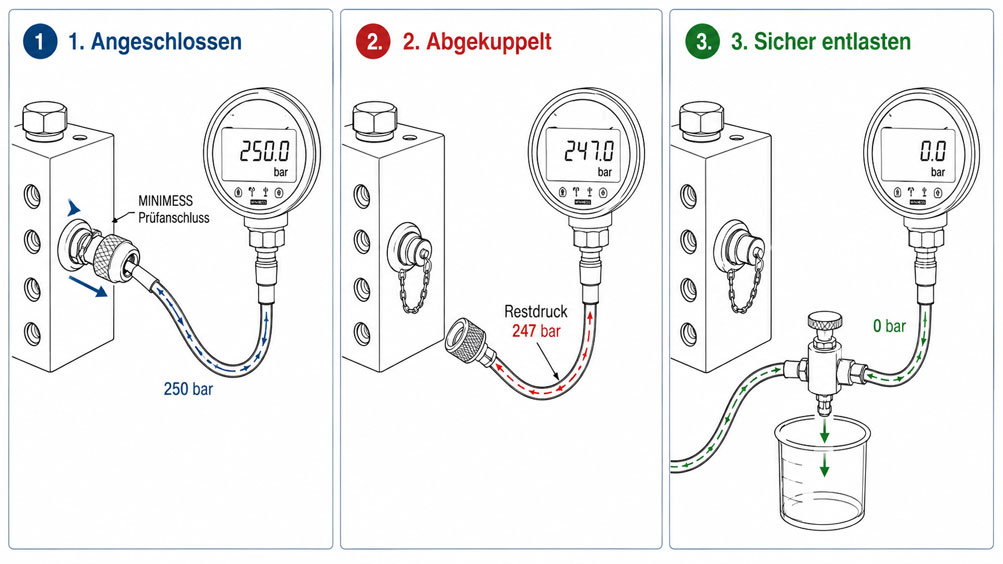
A service technician measures a system pressure of 250 bar on a hydraulic system via a MINIMESS test point. After the measurement is completed, the measuring line is disconnected from the process connection. The system is therefore no longer connected to the measuring instrument. Nevertheless, the pressure gauge at the other end of the hose still indicates almost 250 bar. Is the measuring instrument defective?
Not necessarily. When a self-sealing measuring coupling is disconnected, the connection to the system is closed. If the other end of the hose is also connected to a closed measuring instrument or a connection with a non-return function, the pressure medium can remain trapped between these two points.
The trapped volume in a MINIMESS microbore hose is small, but it can still remain under very high pressure. With a hose designed for several hundred bar, it must therefore not be assumed that the hose is automatically depressurized after disconnection.
“Disconnected from the process” and “depressurized” are two different conditions. Before the hose, measuring instrument, adapter or coupling is dismantled any further, it must be clearly established whether residual pressure is still present and through which designated route it can be safely relieved.
Why does pressure remain trapped in the MINIMESS hose?
In a typical mobile pressure measurement, the MINIMESS hose connects a permanently installed test point to a pressure gauge, pressure sensor or portable measuring instrument.
During measurement, approximately the same static pressure is present throughout the connected system:
System → test point → hose → measuring instrument
When the connection to the test point is subsequently disconnected, the valve function of the measuring connection closes off the process side again.
The system is therefore disconnected from the measuring hose, but the hydraulic medium already inside the hose does not automatically disappear.
If the other end is also closed, a sealed volume is created in simplified form:
closed hose connection → pressure medium → closed measuring instrument
As a result, the previously applied pressure can remain at least partially trapped.
How does the self-sealing coupling principle work?
A key advantage of MINIMESS test points is that pressure measuring instruments can be temporarily connected to a system without having to open a conventional process fitting.
The MINIMESS 1620, for example, is designed for connection under operating pressure and, depending on the version, can be used at operating pressures of up to 630 bar.
When the mating coupling is screwed on, the valve function of the test point is opened. This allows the pressure medium to reach the measuring instrument.
When the coupling is unscrewed, this connection closes again.
This self-sealing function reduces media loss and enables quick service measurements. At the same time, however, it also means:
Closing the test point does not automatically relieve the hose volume already trapped behind the valve.
Why is even a small trapped volume relevant?
MINIMESS hoses are intentionally designed with small internal diameters. Typical versions use DN2 or DN4, for example.
A small internal diameter offers several advantages:
- low fluid volume,
- low media loss during connection,
- compact hose design,
- good suitability for temporary pressure measuring points.
However, the small volume does not automatically mean that a pressurized hose can be opened safely.
Even a few millilitres of hydraulic oil can be discharged at high velocity when suddenly depressurized from several hundred bar.
In addition, the hose wall may expand slightly under pressure. When the pressure is released, part of this stored elastic energy is released again.
Why does the pressure gauge continue to indicate pressure after disconnection?
A pressure indication that remains after disconnection is initially an important indication that pressure may still be trapped between the measuring instrument and the hose connection.
The measuring instrument does not detect whether it is still connected to the system. It only measures the pressure at its own process connection.
If, for example, there is still:
245 bar
at this point, a correctly functioning pressure gauge will continue to indicate this pressure.
An almost unchanged measured value after disconnection is therefore not automatically a sensor or pressure gauge fault.
Instead, it must be checked whether the measuring line has a defined pressure-relief path at all.
Can the residual pressure change afterwards?
Yes. A sealed hydraulic volume can react sensitively to temperature changes.
Hydraulic fluids are considerably less compressible than gases, but they still exhibit thermal expansion.
If a completely trapped fluid volume is heated and cannot expand significantly, the pressure can change.
One example is a measuring hose that, after measurement:
- is moved from a cool machine room into direct sunlight,
- is placed next to a hot machine,
- cools down or heats up together with hot hydraulic oil.
Residual pressure should therefore not be “resolved” simply by setting the hose aside and dismantling it later.
It should ideally be relieved in a controlled manner as part of the intended working procedure.
How should residual pressure generally be relieved safely?
The specific procedure depends on the hose, connection, measuring instrument and safety concept of the system being used.
As a general rule, the measuring chain should include a defined pressure-relief path.
A suitable arrangement may include, for example:
- a vent or drain valve,
- a suitable valve manifold,
- a dedicated pressure-relief coupling,
- a return connection,
- controlled discharge into a suitable collecting container.
The trapped pressure is reduced in a controlled manner via this route.
Only after it has been ensured that:
p ≈ 0 bar gauge
or that the safe condition specified for dismantling has been reached should additional components be disconnected.
The specific manufacturer and operating instructions for the measuring chain used remain decisive.
Why is a defined pressure-relief path useful?
A defined relief path ensures that pressure does not have to be released by loosening a normal fitting.
This provides several advantages:
- controlled depressurization,
- defined direction of flow for the discharged medium,
- reduced operator contact with hydraulic oil,
- lower risk of sudden hose movement,
- improved repeatability of the service procedure.
For frequently recurring measuring tasks, pressure relief should therefore already be considered when selecting the hose and measuring instrument fittings.
Where should the discharged hydraulic medium go?
When pressure is relieved, the displaced fluid volume must flow somewhere.
Before opening a drain valve, it should therefore be clarified:
- which medium is contained in the hose,
- what temperature the medium has,
- approximately how much medium may be discharged,
- whether the medium is hazardous to health or the environment,
- where it will be collected or returned in a controlled manner.
Simply opening a drain valve over the workshop floor is not good service practice.
Suitable collecting containers or return systems prevent contamination and uncontrolled contact with the medium.
Why must a tight fitting not be forcibly loosened?
A fitting under residual pressure can behave differently from a completely depressurized connection.
If a connection is unusually difficult to loosen, it should first be checked whether pressure is still trapped.
An approach such as:
“Loosen it slightly until the pressure escapes.”
would be problematic.
This would use a normal mechanical connection as an improvised pressure-relief valve.
If the pressure is suddenly released:
- hydraulic oil can escape,
- components or couplings can move,
- the hose can whip,
- hot or aggressive media can be released.
A normal fitting should therefore not be used as a pressure-relief device.
What role do hose length and nominal diameter play?
The trapped fluid volume depends directly on the internal diameter and hose length.
For an idealized hose, the volume can be approximated by:
V = π × d² / 4 × L
Where:
V= internal volume,d= internal diameter,L= hose length.
A DN2 hose, for example, has an internal diameter of approximately 2 mm.
One metre of idealized hose therefore contains only a few millilitres of fluid.
With a DN4 hose, the volume is already considerably larger because of the larger internal diameter.
However, volume alone is not decisive for the safety assessment. The pressure present and the specific design of the measuring chain must also be taken into account.
What must be considered with pressure sensors and pressure gauges?
Different measuring instruments can be connected to the end of a MINIMESS hose.
Examples include:
- mechanical pressure gauges,
- digital pressure gauges,
- pressure sensors,
- portable data loggers,
- measuring instruments with an internal isolation or non-return valve.
The type of connected instrument influences whether and how the trapped volume can be relieved.
A closed digital pressure gauge without a venting option, for example, does not automatically provide a safe means of depressurization.
When configuring a portable measuring line, the question should therefore not only be:
“How do I connect the measuring instrument?”
but also:
“How do I safely depressurize the complete measuring chain afterwards?”
Practical example: 250 bar in a disconnected measuring hose
The operating pressure of a mobile hydraulic system is to be checked.
A digital pressure gauge is connected to the permanently installed measuring point via a DN2 MINIMESS hose.
During operation, the measuring instrument indicates:
250 bar
After the measurement has been completed, the MINIMESS connection to the machine is closed or disconnected.
The display then continues to show:
247 bar
The technician initially suspects a fault in the digital pressure gauge.
In reality, however, the pressure is trapped in the hose between the closed test-point connection and the measuring instrument.
The measuring setup is therefore not dismantled any further. Instead, the designated pressure-relief path is used and the small volume of oil is discharged in a controlled manner into a suitable container.
During this process, the indication falls:
247 bar → 150 bar → 50 bar → 0 bar
Only then are the hose and measuring instrument disconnected from each other.
This example shows that closing the process connection removes the connection to the machine, but does not necessarily eliminate the pressure within the already filled measuring line.
Systematic working procedure
- Clearly identify the measuring point.
- Check maximum system pressure, medium and temperature.
- Check the pressure rating of the test point, hose, fittings and measuring instrument.
- Inspect the hose for damage before use.
- Connect the measuring instrument securely to the hose.
- Establish the MINIMESS connection cleanly and without cross-threading.
- Carry out the measurement.
- After completion, disconnect or close the process side according to the intended procedure.
- Do not automatically assume that the hose is depressurized.
- Check the measuring instrument indication or any remaining residual pressure.
- Open the designated pressure-relief path.
- Collect or return the medium in a controlled manner.
- Wait until a safe depressurized condition has been reached.
- Only then continue dismantling the hose, adapters and measuring instrument.
- Refit protective caps and clean the components.
Common mistakes
- Equating “disconnected” with “depressurized”: The trapped hose volume can still remain under pressure.
- Assuming the situation is safe simply because the DN2 volume is small: Even small quantities of fluid can escape dangerously at high pressure.
- Assuming the pressure gauge is defective after disconnection: It may correctly be indicating the pressure trapped in the hose.
- Slowly loosening a fitting to release pressure: Normal connections are not pressure-relief valves.
- Considering the relief path only after the measurement: Safe depressurization should already be planned when configuring the measuring chain.
- Discharging the medium uncontrolled: Hydraulic oil should be collected or returned appropriately.
- Underestimating hot fluid: In addition to pressure, the medium temperature can also present a hazard.
- Operating the hose kinked or under tension: MINIMESS hoses must be routed within the specified bend radii and without unnecessary tensile or torsional loads.
- Considering only the hose pressure rating: For the complete measuring chain, the component with the lowest permissible operating pressure is generally decisive.
- Allowing residual pressure to “disappear” by simply leaving the hose: Pressure can remain in a closed fluid volume for a long period of time.
MINIMESS hoses for pressure measurement and service
MINIMESS hoses are used to connect permanently installed measuring points to pressure gauges, pressure sensors and portable measuring systems.
The hose assemblies offered by ICS are available, among other versions, in nominal sizes DN2 and DN4.
Different maximum operating pressures apply depending on the version. For DN2, versions up to 630 bar are available, for example, while DN4 versions are designed for lower maximum operating pressures depending on the variant.
When selecting a hose, the complete hose assembly must always be considered. The maximum permissible operating pressure corresponds to the permissible operating pressure of the component with the lowest pressure rating.
The following must also be taken into account when selecting a hose:
- media compatibility,
- operating temperature,
- hose length,
- nominal diameter,
- bend radius,
- connection fittings,
- static or dynamic pressure loading.
For current MINIMESS hoses, Hydrotechnik specifies operating pressures of 400 or 630 bar for DN2 and 315 or 450 bar for DN4, for example. The minimum bend radius is 20 or 40 mm depending on the nominal size.
Suitable products can be found under MINIMESS couplings and hoses at ICS Schneider and directly under MINIMESS hoses.
Conclusion
A MINIMESS test point enables quick, low-loss connection to a pressurized hydraulic system. When disconnected, the connection to the process side closes again.
However, this does not automatically mean that the complete measuring line is depressurized.
A sealed fluid volume can remain between the self-sealing coupling, MINIMESS hose and connected measuring instrument, in which almost the previously measured pressure may be retained.
The small internal volume of a microbore hose reduces the quantity of escaping fluid, but it does not eliminate the hazard associated with high pressure.
A normal fitting should therefore never be used as an improvised pressure-relief device. For recurring measuring tasks, a defined drain or pressure-relief path should be part of the measuring setup.
For safe service practice, the following therefore applies: always consider residual pressure after disconnecting from the process, use a designated pressure-relief path, collect the discharged medium in a controlled manner and only continue dismantling the hose or measuring instrument once complete depressurization has been clearly confirmed.
FAQ: Residual pressure in the MINIMESS hose
Can a MINIMESS hose still be pressurized after disconnection?
Yes. If the pressure medium is trapped between closed connection points, the hose can remain under considerable pressure even after it has been disconnected from the system.
Why does the pressure gauge continue to show pressure after disconnection?
The pressure gauge measures the pressure at its own connection. If pressure is still trapped in the hose at this point, the instrument will continue to indicate it correctly.
Is a DN2 MINIMESS hose safe simply because of its small volume?
No. The small internal volume does reduce the amount of fluid, but even a small quantity of hydraulic fluid can escape at high velocity when subjected to several hundred bar.
Can I slightly loosen a fitting to release the residual pressure?
This should not be used as a regular pressure-relief method. The measuring setup should have a dedicated and controlled pressure-relief path.
How is residual pressure safely relieved?
Through a venting, draining or return option designed for the specific measuring chain. The medium is discharged in a controlled manner into a suitable container or return line.
Can the residual pressure in the hose disappear on its own?
Not reliably. A closed hydraulic volume can retain pressure for a long period of time. Temperature changes can also alter the pressure.
Why can temperature affect trapped pressure?
Hydraulic fluid expands as temperature rises. If the fluid volume is completely trapped, this change in volume can cause the pressure to change.
Can a MINIMESS test point be connected under pressure?
Depending on the version, MINIMESS test points are specifically designed for connection under operating pressure. The permissible pressure, temperature and media limits of the specific version must be observed.
Up to what pressure are MINIMESS hoses available?
For the versions offered by ICS, DN2 variants are available for pressures up to 630 bar, for example. However, the component with the lowest permissible operating pressure always determines the rating of the complete hose assembly.
What is the difference between DN2 and DN4?
DN2 has a smaller internal diameter and therefore a significantly lower fluid volume for the same length. DN4 provides a larger cross-section. Pressure ratings, bend radii and dynamic behaviour differ depending on the version.
Why should a pressure-relief valve already be considered when planning the measuring chain?
This allows a reproducible and controlled depressurized condition to be established after measurement without using normal fittings or couplings as improvised pressure-relief devices.
Which products are suitable for portable MINIMESS pressure measurements?
MINIMESS hoses in DN2 or DN4 can be combined with suitable test points, pressure sensors, pressure gauges and portable measuring systems. The specific hose and connection version must be selected according to pressure, medium, temperature and measuring task.