


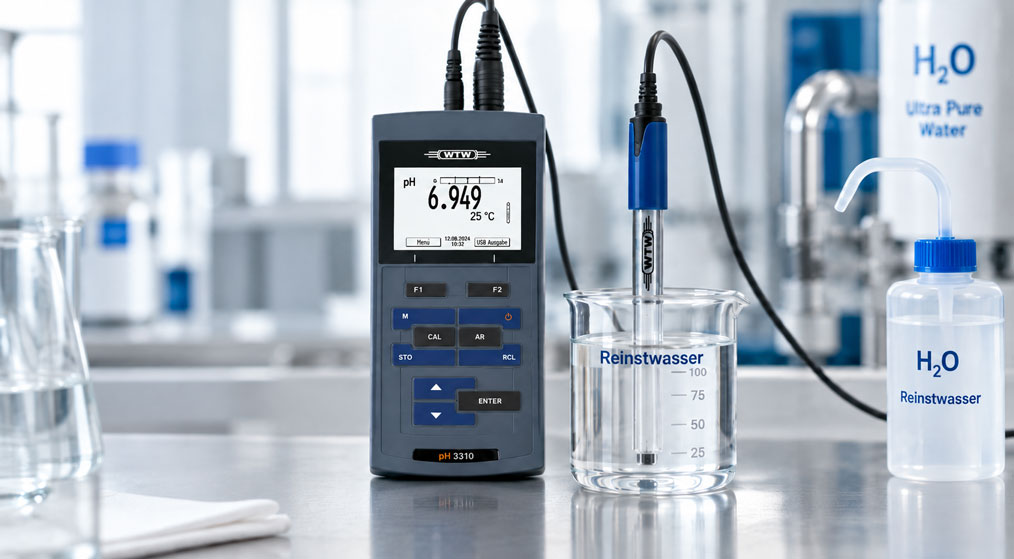
A pH electrode is immersed in freshly produced ultrapure water. The measuring instrument has been calibrated correctly, the electrode works perfectly in the buffer solutions and the temperature is stable. Nevertheless, the indication drifts, for example, from 6.8 via 6.4 to 6.1 and reacts sensitively to movement of the electrode. Is the pH sensor defective?
Not necessarily. Ultrapure water, deionized water and other media with very low conductivity are among the most challenging samples for conventional potentiometric pH measurement.
The low ion concentration increases the electrical resistance of the sample and makes it more difficult to establish a stable potential at the reference system. At the same time, ultrapure water has only a very low buffering capacity. Even the smallest amounts of foreign substances, electrolyte solution or carbon dioxide from the ambient air can therefore change the actual pH value of the sample.
With ultrapure water, it is therefore necessary to distinguish between an actual change in pH and an unstable electrochemical measurement signal. Measuring instrument, electrode, sampling, temperature, CO₂ ingress and contamination must be considered together.
How does pH measurement work?
Conventional pH measurement is a potentiometric measurement.
The glass electrode develops an electrical potential that depends on the activity of hydrogen ions in the sample.
This potential is measured relative to a reference system.
In simplified form, the measuring chain consists of:
glass membrane → sample → junction → reference electrolyte → reference electrode
At 25 °C, the theoretical Nernst slope of an ideal pH electrode is approximately:
59 mV per pH unit
The measuring instrument detects this very small voltage with a very high-impedance input and calculates the pH value from it.
For this to work reliably, both the potential of the glass electrode and the reference potential must be sufficiently stable.
Why is ultrapure water particularly difficult to measure?
Normal water contains numerous dissolved ions.
These include, for example:
- bicarbonate,
- chloride,
- sulfate,
- sodium,
- calcium,
- magnesium.
These ions increase electrical conductivity and stabilize the electrochemical conditions of the measurement.
Ultrapure water, by contrast, contains only extremely small quantities of dissolved ions.
This creates several difficulties at the same time:
- very high electrical resistance of the sample,
- less stable liquid junction potential at the junction,
- longer stabilization times,
- greater sensitivity to electrical interference,
- extremely low buffering capacity,
- high sensitivity to contamination and CO₂.
As a result, pH measurement becomes much more sensitive to details of the measuring setup.
What role does low conductivity play?
Conductivity describes how well water can conduct electrical current.
The fewer dissolved ions are present, the lower the conductivity and the higher the electrical resistance.
Although only extremely small currents flow during pH measurement, the high impedance still affects the stability of the potential measurement.
The system can become more sensitive to:
- electromagnetic interference,
- static charges,
- movement of the electrode,
- changes in contact at the junction,
- poorly shielded or long measuring cables.
A very high-resolution pH meter can make such fluctuations particularly visible.
A large number of displayed decimal places therefore does not automatically mean that the actual pH value of ultrapure water is known with the same resolution.
Why does the reference system become critical?
The reference electrode is electrically connected to the sample through its junction.
A so-called liquid junction potential is generated at this interface.
In solutions with normal ionic strength, this potential remains relatively stable when a suitable electrode is used.
At very low ionic strength, however, the difference between:
- highly concentrated reference electrolyte and
- extremely ion-poor ultrapure water
can become much more significant.
As a result, the reference potential can drift slowly or become poorly reproducible.
For ultrapure water, an electrode with a junction suitable for low ionic strength and offering a low-resistance, reproducible contact is therefore particularly important.
Why does the indication fluctuate more strongly?
A typical ultrapure-water measurement can, for example, show values such as:
6.42 → 6.47 → 6.39 → 6.45 → 6.41
even though the sample appears not to be changing.
Several effects can occur simultaneously:
- electrical noise,
- unstable reference potential,
- low ion mobility at the interface,
- slight temperature change,
- actual change caused by CO₂ absorption.
A fluctuating measured value is therefore not automatically an indication of a worn pH electrode.
An important cross-check is to test the same electrode again in a suitable calibration buffer.
If the signal is fast and stable there, the cause is more likely to be the special properties of the ultrapure-water sample or the measuring setup.
Why does the actual pH value change so easily?
Ultrapure water has a very low acid/base buffering capacity.
This means:
Even a very small quantity of an acidic or alkaline substance can visibly change the pH value.
Such contamination can originate, for example, from:
- residues of calibration buffer,
- reference electrolyte,
- rinsing water,
- contaminated vessels,
- residues of cleaning agents,
- skin contact,
- ambient air.
What would be quantitatively insignificant in normal tap water can already have a measurable effect in a small ultrapure-water sample.
Why is CO₂ from the air so important?
Carbon dioxide from the ambient air dissolves in water.
In simplified form:
CO₂(g) → CO₂(aq)
Part of it reacts further in the water and affects the acid-base equilibrium.
In a well-buffered process water, this input is often barely noticeable.
In ultrapure water with extremely low buffering capacity, however, CO₂ absorption can significantly change the pH value.
A freshly taken sample can therefore genuinely change its pH during prolonged measurement in an open beaker.
The indication does not necessarily drift because the electrode is faulty.
The sensor may be correctly indicating that the sample is changing due to contact with the ambient air.
Why does ultrapure water not necessarily remain at pH 7?
The common statement:
Pure water has a pH of 7
is valid only under clearly defined conditions and is often applied too generally in practice.
At 25 °C, the neutral point of ideally pure water is pH 7.
However, the neutral point itself is temperature-dependent.
In addition, a real water sample quickly absorbs substances when exposed to its surroundings.
Dissolved CO₂ in particular can cause an open ultrapure-water sample to reach a pH below 7.
A measured value below pH 7 is therefore not automatically proof that:
- the pH electrode is incorrectly calibrated,
- the water is technically contaminated or
- the measuring instrument is defective.
Sampling conditions, temperature and contact with the atmosphere must be known for a meaningful assessment.
What role does temperature play?
Temperature affects pH measurement on two different levels.
First, it changes the electrochemical slope of the pH electrode.
Second, temperature changes the chemical equilibria within the sample itself.
In ultrapure water, the dissociation equilibrium of water is particularly temperature-dependent.
The pH value of a neutral sample therefore does not have to be exactly:
pH 7.00
at every temperature.
For comparative measurements, the following should therefore be kept as consistent as possible:
- sample temperatures,
- calibration conditions and
- documented temperatures.
What can temperature compensation do – and what can it not do?
Many pH meters feature automatic temperature compensation, or ATC.
This mainly corrects the temperature-dependent Nernst slope of the electrode.
However, it does not mean:
the measured value is automatically converted to the pH value at 25 °C
.
The actual chemical change of a sample with temperature is not reversed by normal electrode temperature compensation.
For accurate documentation, pH value and sample temperature should therefore be stated together.
Which pH electrode is suitable for ultrapure water?
For low-conductivity media, the pH electrode should be selected specifically for the application.
Important characteristics can include:
- suitable reference system,
- low-resistance or well-flowing junction,
- reproducible electrolyte contact with the sample,
- sufficiently rapid ion exchange,
- suitable temperature range,
- suitable design for beaker or flow-through measurement.
A robust standard gel electrode that performs very well in wastewater is therefore not automatically the best electrode for ultrapure water.
The decisive factor is the combination of the measuring instrument and an electrode suitable for the specific medium.
How should the measuring system be calibrated?
The pH electrode is generally calibrated using defined pH buffer solutions.
Even if ultrapure water is measured afterwards, calibration should not simply be performed using undefined diluted buffers.
Important factors include:
- fresh, suitable buffers,
- clean calibration vessels,
- temperature stability,
- sufficient stabilization time,
- calibration points appropriate to the expected measuring range.
After calibration, the electrode assessment or the condition of the zero point and slope should also be checked.
If the electrode already behaves unstably in the buffers, this problem should be resolved first.
Why are buffer residues particularly critical?
Calibration buffer has a very high ion concentration compared with ultrapure water.
Even a small drop of residual buffer on the electrode can therefore significantly alter a small ultrapure-water sample.
After calibration, the electrode should therefore be rinsed thoroughly.
For particularly demanding measurements, a multi-stage procedure is advisable:
- Rinse the electrode thoroughly after calibration.
- Rinse again with a first portion of the ultrapure-water sample.
- Discard this rinsing portion.
- Place the electrode in a fresh measurement portion.
This prevents the actual sample from already being altered by residues from the calibration process.
Open beaker or flow-through cell?
A beaker is often used for simple routine measurements.
However, for very high-quality ultrapure water, this method has disadvantages.
The sample is in direct contact with:
- ambient air,
- CO₂,
- dust,
- the vessel surface.
A suitable flow-through measuring cell can therefore offer advantages.
Fresh water is continuously passed over the electrode while contact with the environment is minimized.
A possible setup is:
ultrapure-water line → sampling line → flow-through cell → drain
This allows the measurement conditions to remain closer to the actual process conditions.
The flow rate should be sufficiently constant and matched to the electrode or measuring cell.
Should ultrapure water be stirred during pH measurement?
Gentle movement can generally help renew the sample at the electrode surface and reduce response time.
With ultrapure water, however, reproducible measurement conditions with as little disturbance as possible should be selected.
Strong stirring can:
- introduce additional CO₂ from the air,
- generate air bubbles,
- change flow conditions at the junction,
- make the measured value less stable.
If stirring is used, it should therefore be gentle and as consistent as possible for each comparative measurement.
With controlled flow-through measurement, additional stirring is normally not required.
When is a measured value sufficiently stable?
In a normal buffer solution, a pH electrode can reach a stable value very quickly.
In low-conductivity water, the stabilization time can be considerably longer.
The measured value should therefore not be read after an arbitrary fixed period.
A stability criterion is more meaningful.
For example:
Change in pH value within a defined time window < permissible limit
Many modern instruments support such an assessment using an automatic stability or AutoRead function.
However, it remains important to note:
If the sample itself continuously absorbs CO₂, a completely stable chemical condition may never be reached.
In that case, sampling must be improved instead of simply waiting longer.
Why does additional conductivity measurement help?
Conductivity provides important information about the condition of the ultrapure water.
It does not replace pH measurement, but it helps with interpretation.
For example:
| Observation | Possible interpretation |
|---|---|
| pH drifts, conductivity remains extremely low | Check pH measuring principle / CO₂ / reference system |
| pH and conductivity change together | Sample may be absorbing foreign substances |
| Conductivity significantly higher than expected | Check ultrapure-water quality or sample contamination |
According to ICS, the WTW ProfiLine Cond 3310 is also suitable for ultrapure-water measurements and covers conductivity values down to 0.001 µS/cm.
Conductivity can therefore be documented as an additional process or plausibility parameter.
Practical example: pH value drifts after sampling
In a water treatment plant, the pH value is to be checked downstream of an ultrapure-water treatment stage.
A sample is filled into a clean beaker.
Immediately after immersing the electrode, the measuring instrument indicates:
pH 6.9
After one minute:
pH 6.5
and a few minutes later:
pH 6.1
The sensor is then checked again in a pH 7 buffer.
There, it stabilizes quickly and reproducibly.
The electrode calibration is also normal.
Further investigation reveals:
- very low conductivity of the sample,
- open beaker,
- long measurement duration,
- intensive stirring.
The measurement is then repeated using a fresh sample.
The electrode is first rinsed several times with sample water, the sample is exposed to ambient air for as little time as possible and the measurement is carried out under reproducible conditions.
The resulting measurement is considerably more stable.
The first measurement was not necessarily caused by a defective sensor. The sample and the measurement conditions had changed during the measurement itself.
Systematically diagnosing unstable pH measurement in ultrapure water
- First check the electrode in a fresh calibration buffer.
- Check the slope and zero point of the calibration.
- Determine the conductivity of the ultrapure-water sample.
- Check whether the electrode is suitable for low ionic strength.
- Check the junction for contamination or poor electrolyte contact.
- Completely rinse calibration buffer from the electrode.
- Pre-rinse the measuring vessel with sample.
- Use a fresh sample.
- Minimize contact with ambient air.
- Stabilize and document the temperature.
- Avoid strong movement or aeration.
- Observe the measured value until a defined stability criterion is met.
- If problems persist, consider flow-through measurement.
- If required, document pH and conductivity trends together.
Recommended measurement procedure
- Calibrate the pH meter with suitable fresh buffers.
- Check the calibration assessment.
- Thoroughly remove buffer residues from the electrode.
- Prepare a clean sample vessel or flow-through cell.
- Pre-rinse the electrode and vessel with one portion of the sample.
- Discard the rinsing portion.
- Take a fresh measurement sample.
- Minimize exposure time to ambient air.
- Measure the temperature.
- Immerse the electrode sufficiently deeply and reproducibly.
- If required, use only gentle, constant movement.
- Observe the development of the measured value.
- Document the value only after sufficient stability has been reached.
- Document the pH value together with temperature and, if applicable, conductivity.
- For series measurements, always use the same procedure.
Common mistakes
- Automatically expecting pH 7: Real ultrapure-water samples can show significantly different values due to temperature and CO₂.
- Interpreting every drift as a sensor fault: The sample itself can also change during measurement.
- Using a standard electrode without checking suitability: Not every reference or junction design is equally suitable for very low conductivity.
- Transferring buffer residues into the sample: Even small amounts can significantly alter ultrapure water.
- Rinsing the electrode only briefly: Residues of highly ionic solutions can distort the measurement.
- Leaving the sample open for a long time: CO₂ absorption changes the acid-base equilibrium.
- Stirring strongly: This can introduce additional air or CO₂.
- Interpreting ATC as complete chemical temperature correction: Automatic temperature compensation mainly corrects electrode behaviour.
- Equating many display digits with high measurement certainty: The complete electrochemical measuring chain determines the uncertainty.
- Simply waiting longer when the value is unstable: If the sample is changing due to CO₂ ingress, waiting longer does not improve the result.
- Not documenting temperature: pH values of ultrapure water are less comparable without a temperature value.
- Ignoring conductivity: It provides important additional information about ultrapure-water quality and measurement conditions.
ProfiLine pH 3310 for demanding pH measurements
A specific portable instrument for pH, mV and temperature measurements is the WTW ProfiLine pH 3310.
The instrument provides a pH measuring range of:
-2.000 ... 19.999
and, depending on the setting, enables a pH resolution down to:
0.001 pH
.
Features supporting reproducible measurements include:
- 1- to 5-point calibration,
- 22 stored buffer sets,
- calibration timer,
- CMC function for monitoring the calibrated measuring range,
- integrated data logger,
- memory for up to 5,000 GLP-compliant entries,
- USB interface.
For ultrapure water, however, one point is particularly important:
The accuracy of the measuring instrument alone does not define the accuracy of the complete pH measurement.
The electrode being used must be suitable for the low ionic strength and the specific sampling arrangement.
For supplementary conductivity measurement, the WTW ProfiLine Cond 3310 is available, for example.
ICS specifies a conductivity range of:
0.001 µS/cm ... 1000 mS/cm
for this instrument and explicitly lists ultrapure-water measurement as an application.
Further information can be found under WTW ProfiLine pH 3310, under WTW ProfiLine Cond 3310 and under pH / conductivity / oxygen / measuring instruments at ICS Schneider.
Conclusion
pH measurement in ultrapure water is considerably more demanding than pH measurement in normal process water, drinking water or wastewater.
The low ionic strength results in very low conductivity and makes it more difficult to establish a stable electrochemical potential. The reference system and the liquid junction potential at the junction become particularly critical.
At the same time, ultrapure water has virtually no significant buffering reserve against small amounts of contamination. Even small quantities of calibration buffer, reference electrolyte or carbon dioxide from the air can change the actual pH value.
A drifting indication therefore does not automatically indicate a damaged electrode. The measured value can drift both because of electrochemical instability and because the sample itself is actually changing.
A suitable electrode, careful rinsing, fresh samples, minimal exposure to air, reproducible flow conditions and stable temperature significantly improve measurement quality.
For particularly demanding applications, a flow-through measuring cell is often advantageous compared with measurement in an open beaker because contact with the environment is reduced and fresh sample is continuously supplied.
For reproducible pH measurements in ultrapure water, the following therefore applies: use an electrode suitable for low ionic strength, consistently avoid buffer contamination, minimize sample contact with the atmosphere, document temperature, allow sufficient – but not unnecessarily long – stabilization time and use conductivity as an additional plausibility parameter.
FAQ: pH measurement in ultrapure water
Why is pH measurement in ultrapure water so difficult?
Ultrapure water contains only very small quantities of dissolved ions. As a result, conductivity is low, the reference potential can be more difficult to stabilize and even very small amounts of contamination can alter the sample.
Why does the pH indication drift in ultrapure water?
Possible causes include an unstable liquid junction potential, high electrical impedance, CO₂ absorption, temperature changes or actual changes in the poorly buffered sample.
Must ultrapure water always have a pH of 7?
No. pH 7 corresponds to the neutral point of ideally pure water at 25 °C. Temperature and especially the absorption of CO₂ from the environment can cause different pH values in real ultrapure-water samples.
Why does CO₂ change the pH value?
Carbon dioxide dissolves in water and influences the acid-base equilibrium. Because ultrapure water has a very low buffering capacity, this effect can become visible quickly.
Which pH electrode should be used for ultrapure water?
A suitable electrode is one whose reference system and junction are specifically suitable for low ionic strength or low conductivity. The exact selection depends on the measuring range, temperature and sampling arrangement.
Can a normal pH electrode still work?
It can provide a value, but it may not achieve the same stability and reproducibility as an electrode optimized for low-conductivity media.
Why should the electrode be rinsed particularly thoroughly after calibration?
Calibration buffer contains significantly more ions than ultrapure water. Even small buffer residues can chemically alter a small ultrapure-water sample.
Should ultrapure water be stirred during measurement?
If movement is required, it should be gentle and reproducible. Strong stirring can increase CO₂ ingress and alter the electrochemical conditions at the junction.
Is a flow-through cell better than a beaker?
For very high-quality ultrapure water, a suitable flow-through measurement can offer advantages because fresh sample is continuously supplied and contact with ambient air is reduced.
Why must temperature be documented?
Temperature affects both the electrode slope and the chemical equilibria of the water. pH values measured at different temperatures are therefore not directly comparable without further consideration.
Does automatic temperature compensation automatically convert the pH value to 25 °C?
No. Typical ATC mainly corrects the temperature-dependent electrode slope. It does not reverse the actual temperature-induced chemical change in the sample.
How can I determine whether the electrode or the sample is causing the problem?
The electrode can be checked in a suitable buffer immediately before or after the ultrapure-water measurement. If it responds quickly and stably there, the cause is more likely to lie in the sample, sampling procedure or special measurement conditions.
Why should conductivity also be measured?
Conductivity shows how ion-poor the sample actually is and can provide indications of contamination or changes occurring during sampling.
Which measuring instrument does ICS offer for pH measurements?
One specific instrument is the WTW ProfiLine pH 3310 with pH, mV and temperature measurement, multipoint calibration, CMC function and integrated data logger.