


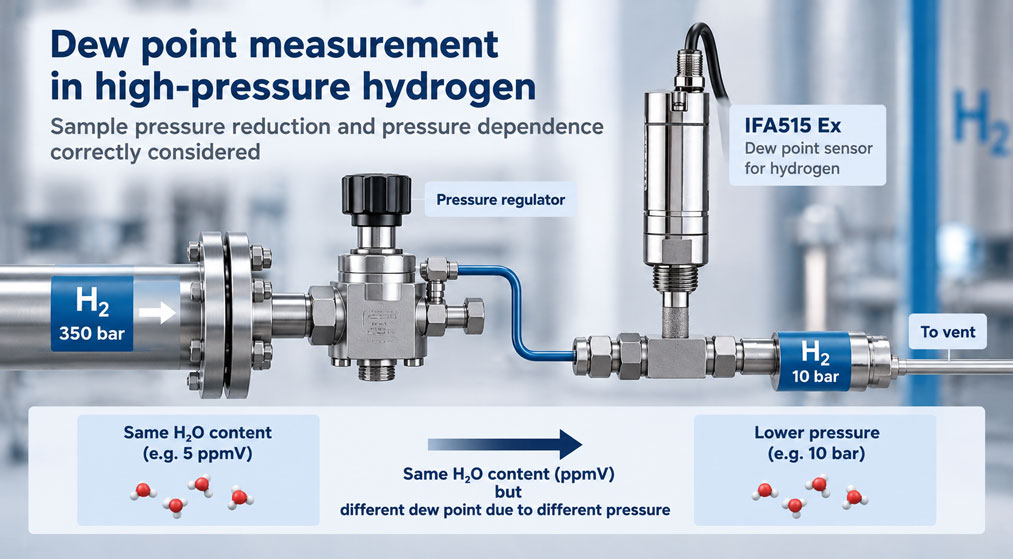
The residual moisture in a hydrogen system is to be monitored. The H₂ in the process line is, for example, at 350 bar. For dew point measurement, a small gas sample is taken and reduced to 10 bar via a pressure regulator. The dew point sensor then indicates a very low value. Does this value automatically correspond to the dew point of the hydrogen in the 350 bar line?
No. A dew point value is always linked to the pressure conditions of the gas sample. If the same hydrogen is expanded from a high pressure to a lower pressure, the molar moisture content can remain largely unchanged under ideal, loss-free sampling conditions. However, the partial pressure of the water vapour changes with the total pressure.
Because the dew point depends precisely on this water vapour partial pressure, the same gas composition has a different pressure dew point at 350 bar than after expansion to 10 bar or to atmospheric pressure.
When measuring dew point in high-pressure hydrogen, it must therefore always be documented at what pressure the measurement was actually performed. Pressure dew point, atmospheric dew point and moisture content in ppmV are different ways of describing the same moisture condition and must not be compared without taking pressure into account.
What does the dew point of a gas describe?
The dew point is the temperature to which a gas would have to be cooled under the relevant pressure conditions for the water vapour it contains to just begin condensing.
The drier the gas, the lower the dew point.
With very dry hydrogen, dew point values can therefore be far below:
0 °C
.
However, dew point is not a substance concentration that is independent of pressure.
The decisive factor for condensation is the partial pressure of the water vapour.
In simplified form:
pH₂O = xH₂O × ptotal
Where:
pH₂O= partial pressure of water vapour,xH₂O= molar or volumetric water content,ptotal= total pressure of the gas mixture.
The dew point is the temperature at which the saturation vapour pressure of water corresponds to this water vapour partial pressure.
What is pressure dew point?
Pressure dew point is the dew point that results at the actual gas pressure present.
For example, a sensor installed directly in a pressurized measuring line can determine the:
pressure dew point at 10 bar
.
This value must not simply be compared with a dew point determined at:
1 bar abs.
or approximately atmospheric pressure.
For documentation, it should therefore not simply be stated:
Dew point = -60 °C
but, for example:
Pressure dew point = -60 °C at 10 bar
if the measurement was actually performed under these conditions.
Why does the dew point depend on total pressure?
Assume that a hydrogen sample has a constant molar water content.
If the total pressure is increased while the composition remains unchanged, the partial pressure of the water vapour also increases.
In simplified form:
same ppmV + higher total pressure → higher H₂O partial pressure
A higher water vapour partial pressure means that condensation can begin at a higher temperature.
Therefore, as a general rule:
The same moisture concentration has a higher pressure dew point at a higher gas pressure.
Conversely, the dew point decreases when the same gas is expanded to a lower total pressure without loss of moisture.
What happens when an H₂ sample is depressurized?
A typical high-pressure gas sampling system can be represented in simplified form as:
H₂ process → sampling valve → pressure regulator → measuring chamber → dew point sensor → safe discharge
If the gas sample is reduced from a high process pressure to a significantly lower measuring pressure, the total pressure changes first.
With ideal sampling without condensation, leakage, adsorption or other mass transfer, the molar water content remains approximately unchanged.
However, the water vapour partial pressure decreases with the total pressure.
As a result, the measured pressure dew point also decreases.
A value measured after pressure reduction therefore describes the moisture condition:
at the dew point sensor at its measuring pressure
and not automatically the pressure dew point directly in the high-pressure line.
Why is ppmV a useful comparison value?
For dry gases, moisture is often also specified as a volume fraction or mole fraction.
A typical unit is:
ppmV
meaning parts per million by volume.
Under idealized conditions, ppmV describes the relative proportion of water molecules in the gas mixture.
If a gas is merely expanded and no water is added or removed, this proportion remains approximately unchanged.
This often makes ppmV particularly useful for comparing measurements at different pressures.
However, it must be ensured that:
- no moisture enters from the environment,
- no water condenses,
- no relevant adsorption or desorption occurs,
- the conversion takes the actual pressure into account.
A dew point value therefore cannot simply be converted to ppmV using a fixed table without knowing the reference pressure.
Measure directly at process pressure or after pressure reduction?
There are basically two possible measurement concepts.
1. Measurement at high process pressure
The dew point sensor or measuring chamber is operated at approximately the actual process pressure.
Advantage:
- the measured pressure dew point directly corresponds to the pressure conditions in the process line.
However, this requires that:
- the sensor is approved for the pressure,
- the measuring chamber is designed for the pressure,
- the fittings are suitable for H₂,
- the sampling line safely withstands the pressure,
- the entire setup is approved for the application.
2. Measurement after pressure reduction
The sample is first reduced to a defined lower pressure.
Possible advantages include:
- simpler sampling technology,
- lower mechanical loading of downstream components,
- lower gas consumption,
- easier use of certain measuring instruments.
However, the indicated pressure dew point then applies to the reduced measuring pressure.
For comparison with process values, it may therefore be necessary to convert the result to a defined reference quantity.
What must the pressure regulator provide?
In high-pressure H₂ sampling, the pressure regulator is a critical part of the measuring chain.
It must not only withstand the required inlet pressure.
The following must also be considered:
- suitability for hydrogen,
- materials,
- seals,
- permissible inlet and outlet pressure,
- leak rate,
- cleanliness of gas-wetted surfaces,
- required sample gas flow.
A regulator suitable for normal compressed-air applications is therefore not automatically suitable for high-purity high-pressure hydrogen.
At very low moisture levels, another factor is that the internal surfaces of the regulator itself can adsorb water molecules and later release them again.
Why is the sampling line critical with very dry H₂?
Very dry gases contain only extremely small quantities of water.
As a result, the sampling line itself can already have a measurable influence.
Potentially problematic factors include:
- long lines,
- large internal surface areas,
- unsuitable plastics,
- elastomers,
- contaminated lines,
- residual moisture after installation or cleaning.
For demanding residual-moisture measurements, short, clean metallic sampling lines suitable for the gas and pressure are therefore often used.
The complete gas-wetted measuring path must not only be pressure-resistant but also suitable for the required low moisture level.
Why can even very small leaks significantly affect the moisture value?
Ambient air normally contains considerably more water vapour than very dry hydrogen.
Even a small leak on a lower-pressure stage or under unfavourable flow conditions can therefore influence the moisture measurement.
Particularly critical points include:
- loose fittings,
- damaged seals,
- unsuitable hose connections,
- open bypass lines,
- diffusion or permeation through unsuitable materials.
If the dew point value suddenly becomes worse, it should therefore not automatically be assumed that the hydrogen quality in the process has actually deteriorated.
The complete sampling system should first be checked for leakage and condition.
What role do adsorption and desorption play?
Water molecules can adhere to surfaces in the sampling system.
This effect is referred to as adsorption.
If very dry gas is subsequently passed through a previously more humid line, stored water molecules can be released from the surfaces again.
This is desorption.
As a result, the sensor can initially indicate a moisture value that is too high even though the process gas is already significantly drier.
The measured value may, for example, slowly change as follows:
-35 → -45 → -55 → -62 °Ctd
even though the actual process quality changes very little during this period.
The sensor increasingly measures the dry gas sample while the measuring line itself is still releasing moisture.
Why does a dry measuring line require sufficient purging time?
At very low dew points, a measurement should therefore not be evaluated immediately after the sampling valve is opened.
First:
- old gas residues must be displaced,
- the measuring chamber must be purged,
- surfaces must release moisture,
- the pressure must stabilize,
- the dew point sensor must adapt to the new sample.
There is no universally applicable fixed purging time for every system.
A stability criterion is more meaningful.
For example:
Change in measured value within a defined time window < permissible change
The value should only be documented once the dew point remains sufficiently stable at constant pressure and constant sample gas flow.
What sample gas flow is appropriate?
The sample gas flow must match the measuring chamber and dew point sensor.
A flow that is too low can:
- extend purging times,
- make ambient influences more visible,
- increase response time.
An unnecessarily high gas flow, on the other hand, increases:
- hydrogen consumption,
- requirements for the pressure regulator and discharge system,
- potential safety requirements.
The optimum flow therefore depends on the manufacturer specifications of the sensor or measuring chamber used.
For reproducible comparative measurements, the same defined sample gas flow should be used wherever possible.
Why must temperature also be controlled?
The temperature of the sampling line and measuring chamber affects the moisture measurement in several ways.
Relevant factors include:
- adsorption and desorption behaviour,
- sensor response time,
- local surface temperatures,
- possible condensation at cold spots.
With very dry gas, condensation is normally less likely than with humid gas samples.
Nevertheless, no part of the measuring path should reach conditions under which water from the sample or from residual moisture could condense.
Pressure reduction can also change the temperature of the gas sample and the components involved.
For reproducible measurements, pressure and temperature should therefore remain sufficiently stable during the measurement.
Which H₂-specific requirements apply?
Hydrogen places additional demands on gas sampling.
Factors to be considered include:
- very small molecular size,
- high leak-tightness requirements,
- material compatibility,
- permeation through certain materials,
- possible hydrogen embrittlement of metallic components,
- flammability of the gas.
All pressurized components must therefore be suitable for hydrogen and for the respective pressure, temperature and purity conditions.
This applies not only to the sensor.
The measuring chain also includes:
- sampling valve,
- pressure regulator,
- pipes,
- fittings,
- seals,
- measuring chamber,
- drain or exhaust line.
What must be considered in hazardous areas?
Hydrogen can form an ignitable mixture with air.
Depending on the system, the dew point measuring point may therefore be located within a hazardous area.
In this case:
- sensor,
- electrical supply,
- safety barriers,
- wiring and
- installation
must be suitable for the specified hazardous zone.
The discharged sample gas must also be routed away safely.
The sampling line must not terminate in such a way that hydrogen can accumulate inside an enclosure, control cabinet or poorly ventilated room.
The specific design depends on the risk assessment and applicable plant regulations.
Practical example: sample from a 350 bar H₂ line
The residual moisture of the gas is to be monitored in a hydrogen test system.
Process pressure:
350 bar
However, the measuring setup is intended to operate at:
10 bar
.
The gas sample is therefore reduced to a constant outlet pressure via an H₂-compatible pressure regulator.
The setup is:
350 bar process → sampling valve → pressure regulator → 10 bar measuring chamber → dew point sensor → safe discharge
After opening the sampling line, the indicated dew point initially decreases continuously over several minutes.
At the same time, sample gas flow and measuring pressure stabilize.
After sufficient purging, the measured value remains largely constant.
For documentation, not only the dew point but also the following are recorded:
- measuring pressure
10 bar, - gas temperature,
- sample gas flow,
- measurement time.
If the value is to be compared with a limit at another reference pressure, an appropriate conversion is performed or the assessment is made using a more pressure-independent concentration value such as ppmV.
The pressure dew point measured at the sensor at 10 bar must not simply be documented as the pressure dew point of the 350 bar process line.
Why are measured values from different systems often not directly comparable?
Two systems can document the same hydrogen differently with regard to its moisture content.
For example:
| System | Measurement |
|---|---|
| System A | Pressure dew point at 20 bar |
| System B | Dew point at atmospheric pressure |
The two temperature values can differ significantly even though the hydrogen samples have the same molar water content.
For reliable comparisons, at least the following must therefore be known:
- dew point value,
- measuring pressure,
- reference pressure,
- where applicable, ppmV or another moisture unit.
The reference quantity should therefore be clearly defined, especially in supply and quality specifications.
Systematically diagnosing implausible dew point values
- Check at what pressure the measurement is actually being performed.
- Document process pressure and measuring pressure separately.
- Check whether pressure dew point or atmospheric dew point is being displayed.
- Check the sample gas flow.
- Check the sampling line for leaks.
- Check the pressure regulator for H₂ suitability and leak tightness.
- Check the measuring line for unsuitable plastics or elastomers.
- Purge the measuring path sufficiently.
- Wait for pressure and dew point to stabilize.
- Check the temperature of the measuring path.
- Check sensor condition and calibration status.
- For comparative measurements, use the same reference pressure or convert correctly.
Systematically designing the measuring point
- Determine the expected H₂ process pressure.
- Define the required moisture or dew point range.
- Specify which reference quantity is required.
- Determine whether to measure process pressure dew point or after pressure reduction.
- Select a suitable H₂-compatible dew point sensor.
- Check the pressure rating of the sensor or measuring chamber.
- Select an H₂-compatible sampling valve.
- If required, size a suitable pressure regulator.
- Design the sampling line to be short, dry and made of suitable materials.
- Avoid unnecessary elastomers and large dead volumes.
- Provide a defined sample gas flow.
- Plan safe discharge of the hydrogen.
- Check hazardous-area requirements.
- Measure or document measuring pressure and temperature.
- Define sufficient purging and stabilization time.
- Define conversion between dew point and the required reference quantity.
- Define calibration and maintenance strategy.
Common mistakes
- Documenting dew point without pressure: For pressurized gases, the value is then not clearly defined.
- Interpreting the measured value after pressure reduction as process pressure dew point: The dew point initially applies to the actual measuring pressure.
- Equating ppmV with dew point: ppmV describes composition, whereas dew point additionally depends on pressure.
- Using any pressure regulator: Material, pressure rating, leak tightness and H₂ suitability must match the application.
- Using a very long sampling line: Large surfaces and dead volumes extend stabilization time.
- Using moist plastic hoses: Adsorption, desorption and permeation can significantly influence very low moisture values.
- Reading immediately after opening the sampling line: Measuring path and sensor may not yet be sufficiently purged or stabilized.
- Underestimating small leaks: Ambient air can introduce very large amounts of water vapour compared with dry H₂.
- Checking only the sensor for H₂ suitability: The complete pressurized sampling chain must be suitable.
- Allowing measuring pressure to fluctuate: A changing pressure can directly cause a changing pressure dew point.
- Discharging exhaust gas uncontrolled into the room: Hydrogen must be routed away in accordance with the plant and safety concept.
- Equating an Ex version with complete system approval: Barriers, wiring and the rest of the installation must also comply with the explosion-protection concept.
IFA515 Ex for dew point measurement in hydrogen
A specific dew point sensor for moisture measurement in hydrogen is the IFA515 Ex.
The sensor measures dew point or pressure dew point and is intended for numerous non-aggressive gases.
ICS lists typical application gases including:
- air or compressed air,
- argon,
- nitrogen,
- biogas,
- natural gas,
- hydrogen.
The sensor is pressure-resistant up to:
500 bar
and provides a:
4 ... 20 mA
two-wire analog output.
Depending on the configuration or software, additional moisture variables can also be output, such as:
- relative humidity,
- g/m³,
- mg/m³,
- ppm V/V,
- g/kg.
For hazardous applications, the IFA515 Ex has ATEX approval for gas and dust areas.
The high permissible pressure rating means that the sensor is also suitable in principle for pressurized measuring lines. Whether direct measurement at process pressure or bypass measurement after pressure reduction is more appropriate must, however, be decided on the basis of the complete system, process conditions, connection components and required reference quantity.
Further information can be found under IFA515 Ex dew point sensor and under H² hydrogen applications at ICS Schneider.
Conclusion
When measuring dew point in high-pressure hydrogen, the indicated temperature value is inseparably linked to the measuring pressure.
If an H₂ sample is taken from a high-pressure line and then expanded, the molar water content remains approximately unchanged under ideal sampling conditions. However, the lower total pressure reduces the water vapour partial pressure and therefore also the dew point.
The pressure dew point measured after pressure reduction must therefore not be used as the dew point at the original process pressure without conversion.
In addition to this thermodynamic relationship, the real sampling system can significantly influence the result. Leaks, moist surfaces, adsorption, desorption, unsuitable materials and insufficient purging times can cause larger errors with very dry hydrogen than the dew point sensor itself.
The complete measuring chain must also be suitable for hydrogen. This applies to the pressure regulator, valves, piping, fittings, seals, measuring chamber and safe discharge just as much as to the sensor itself.
For reproducible H₂ moisture measurements, the following therefore applies: clearly define the actual measuring pressure, do not confuse pressure dew point with atmospheric dew point, correctly convert the reference quantity after pressure reduction, use a dry and low-leakage H₂-compatible sampling line and evaluate the measured value only after pressure, sample gas flow and dew point have stabilized.
FAQ: Dew point measurement in high-pressure hydrogen
Why does the dew point of hydrogen depend on pressure?
The dew point is determined by the partial pressure of the water vapour. At the same water content, this partial pressure changes with the total pressure of the gas mixture.
What is pressure dew point?
Pressure dew point is the temperature at which water vapour begins to condense at the actual gas pressure present.
What happens to the dew point when hydrogen is depressurized?
Under ideal sampling conditions, the molar water content initially remains approximately unchanged. However, the water vapour partial pressure decreases with the total pressure, causing the dew point to fall.
Does ppmV remain the same during pressure reduction?
With ideal expansion without material loss, leakage, condensation or moisture ingress, the molar or volumetric water content remains approximately the same. The dew point still changes.
Can I directly compare a dew point at 10 bar with a value at 350 bar?
No. The two dew point values have different pressure references. For a meaningful comparison, they must be converted to the same reference quantity or reference pressure.
Must high-pressure hydrogen always be depressurized before dew point measurement?
No. If the complete measuring setup, including the sensor, is suitable for the actual process pressure and hydrogen, measurement can in principle also be performed under pressure. Pressure reduction can nevertheless be useful for practical or system-related reasons.
Why should the measuring pressure remain as constant as possible?
A change in total pressure changes the water vapour partial pressure at the same gas composition and therefore changes the pressure dew point. A fluctuating measuring pressure makes reproducible measurement more difficult.
Why does dew point measurement in very dry H₂ sometimes take a long time?
Water molecules can be adsorbed on the surfaces of the sampling line and measuring chamber and can be slowly released again during purging. As a result, the indicated dew point can continue to decrease over a longer period.
Why are leaks particularly critical with very dry hydrogen?
Compared with very dry H₂, ambient air normally contains much more water vapour. Even small amounts of ingress can therefore significantly alter the measured moisture value.
Which materials are suitable for the sampling line?
The materials must be suitable for hydrogen, process pressure, temperature and the required gas purity. For demanding residual-moisture measurements, short, clean metallic lines are often used to minimize moisture ingress and surface effects.
Does the sample gas flow need to be defined?
Yes. A reproducible sample gas flow improves purging behaviour and comparability. The appropriate range depends on the sensor and measuring chamber.
Is an Ex dew point sensor automatically suitable for every hydrogen system?
No. Ex approval, H₂ compatibility, pressure rating and process conditions must all match. In addition, the power supply, safety barrier, wiring and complete installation must meet the relevant requirements.
Which dew point sensor is suitable for hydrogen?
One specific example is the IFA515 Ex. ICS explicitly lists hydrogen as a typical application gas. The sensor measures dew point or pressure dew point, is pressure-resistant up to 500 bar and is designed for hazardous areas.
Which additional moisture variables can the IFA515 Ex output?
Depending on the configuration, in addition to dew point or pressure dew point, it can output variables such as relative humidity, g/m³, mg/m³, ppm V/V and g/kg.