


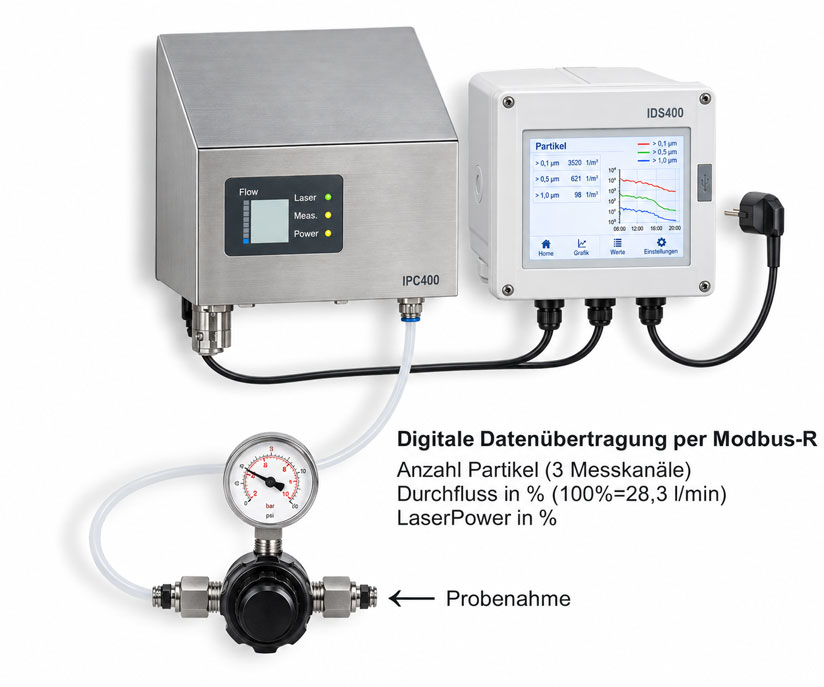
A compressed-air line operates, for example, at 8 bar. To check the compressed-air quality, a sample is routed through a pressure regulator to an optical particle counter. The instrument then displays the number of particles per cubic metre. Does this value refer to one cubic metre of compressed air at line pressure or to one cubic metre of expanded air?
This distinction is crucial. Particle concentration is specified as the number of particles within a defined gas volume. If the same gas is compressed or expanded, its physical volume changes – even though, ideally, the same number of particles remains contained in the gas.
In addition, in a real measurement only part of the compressed air is routed through the particle counter. Sample gas flow and measurement duration therefore determine the actual counting volume examined. Particularly with very clean compressed air, a counting volume that is too small can result in only very few particles being detected, causing the result to fluctuate significantly for statistical reasons.
For a reliable particle measurement, measuring pressure, volume reference, sampling point, sample gas flow and measurement duration must therefore be clearly defined. A numerical value such as “500 particles/m³” is only meaningfully comparable if it is known which reference conditions and measurement geometry it refers to.
How does an optical particle counter work?
An optical particle counter routes a defined gas flow through an optical measuring cell.
The particles contained in the gas pass through a laser beam.
Depending on the measuring principle, for example, the scattering or change in the light signal is evaluated.
In simplified form:
Sample gas → laser measuring cell → optical signal → particle counting
From the individual registered events, the electronics determine:
- the number of particles,
- the corresponding size class,
- the particle concentration based on a defined gas volume.
The instrument therefore does not simply measure “how dirty” the air is.
It counts individual optically detectable events within defined size channels.
What role does ISO 8573 play?
Compressed-air quality is often assessed according to the ISO 8573 series of standards.
ISO 8573-1 defines purity classes for, among other things:
- particles,
- water or moisture,
- oil
.
For measuring particle content, ISO 8573-4 describes methods for sampling and determining particle size and particle concentration.
A fundamental point is:
Particle concentration can only be calculated if the gas volume actually examined is known.
For partial-flow measurement, the sample volume must therefore either be determined directly or calculated from:
sample gas flow × measurement duration
.
Why are particles counted separately by size?
For compressed-air quality, the total number of all particles is not sufficient.
A large number of very small particles must be assessed differently from the same number of much larger particles.
Typical size channels for high-quality compressed-air measurements are, for example:
0.1 ... 0.5 µm,0.5 ... 1.0 µm,1.0 ... 5.0 µm.
The individual particles are assigned to the corresponding size classes.
This makes it much easier to assess:
- how effectively a filter is working,
- whether the required purity class is achieved,
- whether the particle-size distribution is changing.
A filter problem may, for example, initially become apparent through an increase in a specific size class before the overall compressed-air quality becomes obviously abnormal.
Why is pressure important in particle measurement?
One cubic metre of compressed air at high line pressure contains considerably more gas than one cubic metre of the same air at atmospheric pressure.
In an idealized consideration:
p × V / T ≈ constant
If the same amount of gas is expanded, its volume increases.
The number of particles contained in it is then distributed over a larger volume.
Therefore, a value of:
particles/m³ at line pressure
cannot simply be compared with:
particles/m³ of expanded air
.
For correct conversion, absolute pressures and temperatures must generally be taken into account.
In simplified form:
Vref ≈ Vprocess × pprocess,abs / pref × Tref / Tprocess
In practice, however, a measuring system should preferably be used that already correctly accounts for the intended volume reference.
What does the specification particles per m³ mean?
The unit:
particles/m³
is only fully defined if the reference condition of the cubic metre is also known.
With the PC 400, the particle count is, for example, referenced to expanded air at:
20 °C
and:
1000 hPa
.
This gives the stated cubic metre a defined common reference.
This is important because measurements from compressed-air networks operating at different pressures would otherwise not be directly comparable.
If the result is already output by the measuring instrument referenced to defined reference conditions, the user must not subsequently apply another pressure correction to the same value.
Why is compressed air expanded before the particle counter?
A compressed-air network may operate, for example, at:
6 ... 10 bar
or at considerably higher pressures.
However, the actual optical measuring cell of a particle counter requires defined flow and pressure conditions.
For this reason, a suitable pressure regulator may form part of the measuring system.
A typical setup is:
Compressed-air line → sampling → pressure regulator → particle counter → exhaust air
The pressure regulator performs several functions:
- protecting the measuring cell against excessive pressure,
- creating reproducible measuring conditions,
- providing the required sample gas flow.
However, it is also part of the sampling path.
Its geometry and flow characteristics must therefore not be changed arbitrarily.
What is the counting volume?
The counting volume is the gas volume that actually passes through the particle counter and is evaluated during a measurement.
In simplified form:
V = Q × t
Where:
V= examined volume,Q= sample gas flow,t= measurement duration.
With a sample gas flow of, for example:
28.3 l/min
the volume examined in one minute is:
28.3 litres
or:
0.0283 m³
.
After ten minutes, this becomes:
0.283 m³
.
The larger the volume actually examined, the higher the probability of detecting rare particles at the same particle concentration.
Why does measurement time affect the significance of the result?
With heavily contaminated compressed air, many particles are registered within a short period.
With very clean air, however, only a very small number of events may occur during a short measurement.
For example, during a short measurement only:
1 particle
may be registered.
Whether the next identical measuring interval detects:
0, 1 or 2
particles then has a major influence on the extrapolated result per cubic metre.
If measurement is instead carried out over a larger gas volume, the number of observed individual events increases.
The statistical significance therefore becomes more stable.
An adequately large sample or counting volume is therefore particularly important for very high compressed-air purity classes.
Why must the sample gas flow remain constant?
The sample gas flow is part of the volume determination.
If the volumetric flow fluctuates uncontrollably during the measurement, the gas volume actually examined is no longer clearly defined.
In addition, the optical measuring cell is designed for a specified flow range.
A sample gas flow that is too low or unstable can:
- change the measurement duration,
- change the particle transport conditions,
- reduce comparability.
A gas flow that is too high, on the other hand, may be outside the intended operating range of the measuring system.
For reproducible measurements, the sample gas flow specified by the manufacturer should therefore always be used.
Where should the compressed-air sample be taken?
The choice of measuring point depends on the information required.
Examples include:
- directly downstream of the compressed-air treatment system to check the filter system,
- at the inlet to a production network,
- directly upstream of a quality-critical consumer,
- at the point of use of a machine.
The results can differ considerably between these locations.
Particles can enter the network at a later stage, for example through:
- corrosion,
- ageing pipework,
- installation work,
- abrasion,
- contaminated hoses or couplings.
A measurement carried out only at the compressor outlet therefore does not automatically describe the compressed-air quality at the final consumer.
What influence does the sampling line have?
The line between the compressed-air network and the particle counter is also part of the measuring chain.
An unsuitable sampling line can lose particles or introduce additional particles.
Possible influencing factors include:
- length,
- internal diameter,
- material,
- bends,
- dead volumes,
- contamination,
- electrostatic properties.
Larger particles can, for example, be deposited at bends or on the walls due to inertia.
Very small particles can also be lost through transport and surface effects.
The sampling line should therefore be:
- as short as reasonably possible,
- clean,
- designed with as few unnecessary bends as possible,
- installed in accordance with the manufacturer’s specifications.
Why must no condensate form during pressure reduction?
A compressed-air sample can contain water vapour.
If the following change during sampling:
- pressure,
- temperature or
- flow conditions,
the condensation conditions can also change.
If water forms as small droplets, an additional particle population suddenly appears in the sample gas.
An optical particle counter may detect such droplets as optical particle events.
The measurement would then no longer assess exclusively the original solid-particle content.
The sampling system must therefore be designed so that the permissible moisture conditions of the measuring instrument are maintained and condensation is avoided.
Can an optical particle counter also detect droplets?
An optical particle counter initially detects optical events within the measuring volume.
It cannot automatically determine for every event whether it is:
solid or liquid?
Therefore, for example:
- water droplets,
- oil aerosols,
- other condensed liquid particles
can influence optical particle counting.
The current ISO 8573-4 also points out that the method described there detects particles collectively and does not fundamentally distinguish between solid and liquid particle fractions.
If a specific type of contamination is to be evaluated separately, the corresponding test methods from the ISO 8573 series must be used.
What happens at very high particle concentrations?
A particle counter also has a permissible concentration range.
If too many particles pass through the optical measuring volume at the same time, so-called coincidence effects can occur.
Several particles then pass through the measuring zone almost simultaneously.
The measuring system may then no longer be able to resolve these events cleanly as individual particles.
For heavily contaminated gases, suitable dilution or another sampling strategy may therefore be necessary depending on the measuring instrument.
For monitoring high-quality filtered compressed air, however, the focus is typically on low particle concentrations.
Why do very low particle counts fluctuate more strongly?
Particle counting is a single-event measurement.
At a constant mean concentration, individual particles do not occur at mathematically identical time intervals.
The fewer events counted in total, the greater the relative statistical influence of each individual particle.
Example:
If:
1000 particles
are registered, one additional particle changes the result only slightly.
If, on the other hand, only:
2 particles
are registered, one additional event already represents a change of:
50 %
compared with the original count.
A large counting volume is therefore particularly important when very low concentrations are to be assessed reliably.
Why must comparative measurements use the same setup?
Particle measurement is very suitable for:
- acceptance measurements,
- filter monitoring,
- trend analyses,
- comparisons before and after maintenance work.
However, the measuring conditions must remain as identical as possible.
The following should be documented, for example:
- measuring point,
- line pressure,
- sample gas flow,
- measurement duration,
- sampling line,
- measuring instrument,
- size channels,
- reference conditions.
If, for example, a much longer sampling line is used for a follow-up measurement, part of the observed difference may already be caused by the changed measuring setup.
Practical example: particle measurement downstream of a fine filter
An operator wants to check whether the compressed air downstream of a new filter stage meets the required particle purity.
Line pressure:
8 bar
The sample is taken directly downstream of the filter combination.
The particle counter has a suitable pressure regulator and a defined sample gas flow.
First, the sampling line is purged sufficiently.
The particles are then counted over a defined measurement period.
The results are recorded separately by particle size.
During an initial short measurement, only very few events occur in the largest size channel.
To improve statistical significance, the measurement is continued over a larger counting volume.
The values become increasingly stable.
The following are recorded in the documentation:
- measuring point downstream of the filter,
- line pressure,
- measurement duration,
- sample gas flow,
- particle concentrations of the individual size channels,
- reference conditions used.
This allows the later repeat measurement to be carried out under the same conditions and an actual change in the filter system to be identified.
Systematically diagnosing abnormal particle values
- Clearly identify the measuring point.
- Check the line pressure.
- Check the pressure regulator and sample gas flow.
- Check the sampling line for contamination.
- Purge the line sufficiently before the actual measurement.
- Rule out condensation.
- Check measurement duration and counting volume.
- Assess the individual size channels separately.
- Check the background or instrument function.
- If the concentration is unexpectedly high, consider possible aerosols.
- Check filter condition and differential pressure.
- Perform a comparative measurement at a second measuring point.
- Repeat the measurement under identical conditions.
Systematically planning a particle measuring point
- Define the required compressed-air purity class.
- Specify the particle sizes to be assessed.
- Select a suitable particle counter.
- Select the measuring point according to the required quality statement.
- Determine the maximum line pressure.
- Provide suitable pressure reduction.
- Observe manufacturer specifications for the sampling line.
- Keep the sampling line as short as possible.
- Prevent condensation in the sample.
- Ensure a constant sample gas flow.
- Define an adequate counting volume or measurement duration.
- Document the reference conditions of the concentration value.
- Check instrument function before measurement.
- Always use the same setup for trend measurements.
- Document the results separately by size channel.
Common mistakes
- Interpreting particles/m³ without reference conditions: One cubic metre at line pressure is not the same gas volume as one cubic metre of expanded air.
- Using gauge pressure instead of absolute pressure for conversion: Gas-volume relationships fundamentally require absolute pressure.
- Correcting an already normalized measured value again: If the measuring instrument already references the concentration to defined conditions, a second pressure conversion must not be applied.
- Selecting a measurement duration that is too short: With very clean compressed air, too few individual events may be detected.
- Ignoring sample gas flow: Without a known volume, the particle concentration cannot be determined unambiguously.
- Using a very long sampling line: Particles can deposit on the walls or the measurement can be delayed.
- Installing many sharp bends in the sampling line: Larger particles may preferentially deposit due to inertia.
- Not purging the sampling line before measurement: Residual particles from previous measurements can distort the result.
- Ignoring condensate: Liquid droplets can influence optical particle counting.
- Automatically interpreting every optical event as a solid particle: Aerosols or droplets can also be relevant.
- Performing only one short individual measurement: Particularly at very low concentrations, a longer measurement or repetition is useful.
- Measuring only at the compressor: Compressed-air quality at the point of use can differ due to the downstream piping network.
- Assessing a filter only by differential pressure: A mechanically unremarkable filter may still fail to achieve the required particle quality.
PC 400 for particle measurement in compressed air
A specific measuring system for particle monitoring in compressed air is the PC 400 particle counter.
For particularly demanding compressed-air classes, a version is available with a lower detection limit of:
0.1 µm
.
The three measuring channels of this version are:
0.1 ... 0.5 µm,0.5 ... 1.0 µm,1.0 ... 5.0 µm.
Alternatively, a version starting at:
0.3 µm
is available.
The measured variable is output as:
number of particles per m³
referenced to expanded air at:
20 °C and 1000 hPa
.
The sample gas flow is:
28.3 l/min = 1 cfm
.
This comparatively high sample gas flow is particularly helpful at very low particle concentrations because a larger gas volume is examined within a given measurement period.
According to the technical data, the pressure regulator belonging to the system permits a maximum inlet pressure of:
40 bar
.
The system is intended for compressed air downstream of filtration as well as for various technical gases.
The three particle channels can be transmitted digitally via:
RS 485 / Modbus RTU
and, for example, displayed and recorded using a DS 400 or DS 500.
A Class 1 filter is part of the intended system and can be used for functional testing or for detecting possible contamination of the optics.
Further solutions can be found under compressed-air quality at ICS Schneider.
Conclusion
Particle measurement in compressed air involves more than simply connecting a particle counter to a test port.
Because particle concentration is specified as a number per gas volume, the volume reference must be clearly defined. One cubic metre at line pressure is physically not identical to one cubic metre of expanded air.
Measuring systems such as the PC 400 solve this problem by referencing the particle concentration to defined reference conditions.
The actual counting volume examined is equally important. With very clean compressed air, only a few particles may occur during a short measurement. A higher sample gas flow or longer measuring time therefore improves statistical significance.
The sampling path itself must also not be underestimated. Long lines, unnecessary bends, contamination, condensation and unstable flow conditions can change the result.
With optical particle counters, it must also be considered that liquid droplets or aerosols can appear as optical particle events. Sampling and pressure reduction must therefore be carried out in such a way that no new liquid phase forms.
For reliable results, the following therefore applies: select the measuring point carefully, clearly define pressure level and reference volume, perform pressure reduction in a controlled manner, define sample gas flow and measurement duration, examine a sufficiently large counting volume and reproduce the same measuring setup for comparative and trend measurements.
FAQ: Measuring particles in compressed air
How are particles measured in compressed air?
For high-quality compressed air, an optical particle counter is often used. The gas sample is routed through an optical measuring cell at a defined volumetric flow, and the registered particles are counted according to size classes.
Why is line pressure relevant for particle measurement?
Particle concentration is specified as a number per gas volume. The same gas has a smaller physical volume at high pressure than after expansion. The volume reference must therefore be defined.
What does particles per m³ mean for compressed air?
The cubic metre must refer to defined pressure and temperature conditions. With the PC 400, the value is referenced to expanded air at 20 °C and 1000 hPa.
Does an already normalized particle value need to be converted again to line pressure?
No. If the measuring system already references the value to its specified reference conditions, no additional identical pressure correction should be applied.
What is the counting volume?
The counting volume is the gas volume that actually passes through the particle counter and is evaluated during a measurement. It results from sample gas flow and measurement duration.
Why is a large counting volume important?
With very clean compressed air, only a few particles occur. The larger the gas volume examined, the more individual events can be detected and the more stable the statistical result becomes.
Why should the sample gas flow remain constant?
Only with a known and reproducible gas flow is the examined volume clearly defined. In addition, the optical measuring cell is designed for a specific flow range.
Why should the sampling line be short?
Particles can deposit along long sampling lines or at bends and walls. A short, clean and defined sampling line therefore improves representativeness.
Can condensate distort particle measurement?
Yes. Water or oil droplets can also generate particle signals in an optical measurement. Condensation within the sampling path should therefore be avoided.
Does an optical particle counter count only solid particles?
Not necessarily. Optical methods respond to particles or droplets in the measuring volume. Interpretation must therefore take into account whether liquid aerosols may be present.
Why are several particle sizes reported separately?
Compressed-air purity assessment considers different size classes. In addition, the size distribution provides important information about filter performance and the type of contamination.
Which standard describes particle measurement in compressed air?
ISO 8573-4 describes methods for sampling and determining particle size and numerical particle concentration. Purity classes are defined in ISO 8573-1.
Which particle counter is suitable for high-quality compressed air?
One specific example is the PC 400. The version starting at 0.1 µm detects the size ranges 0.1 to 0.5 µm, 0.5 to 1.0 µm and 1.0 to 5.0 µm and is intended for monitoring very clean compressed air.
What is the sample gas flow of the PC 400?
The PC 400 operates at 28.3 l/min or 1 cfm. This allows a comparatively large sample volume to be examined within a given measurement period.
Up to what inlet pressure can the PC 400 be used?
A maximum inlet pressure of 40 bar is specified for the pressure regulator belonging to the system.