


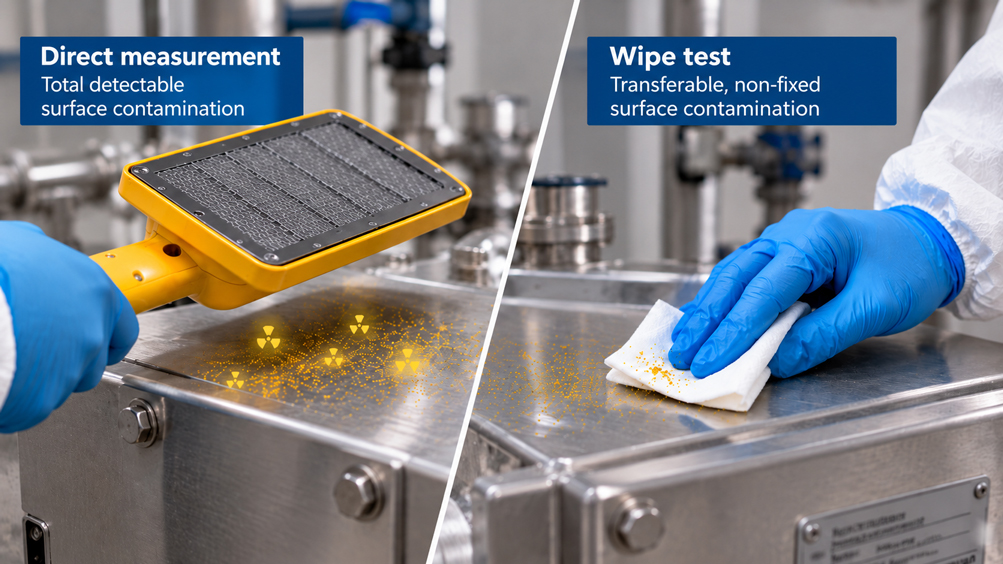
A work surface is checked with a contamination monitor and shows a significantly elevated count rate. This confirms that radioactive contamination can be detected. However, a second question initially remains unanswered: Are the radioactive substances firmly attached to the surface, or can they be transferred by touch, movement or further work to hands, clothing, tools and other surfaces?
This is precisely where direct measurement and wipe testing differ. Both methods are used for surface contamination measurement, but they do not answer the same question.
During direct measurement, a suitable contamination detector is moved as close as possible to the surface with a defined geometry or positioned at a measuring point. It detects the ionizing radiation that actually reaches the detector from the contamination present. Both removable and fixed activity fractions can contribute to the signal. Depending on radiation type, energy, surface condition and penetration depth, activity that has penetrated close to the surface can also contribute.
The wipe test takes a different approach. A defined surface area is wiped with a suitable material under conditions that are as reproducible as possible. The original surface is then no longer measured; instead, the activity transferred to the wipe material is measured. This specifically investigates the fraction that can be removed from the surface and spread elsewhere.
The wipe test is therefore particularly relevant when assessing the risk of spreading contamination or incorporation. However, it introduces an additional uncertainty: Not all removable activity is transferred completely to the wipe material. Material type, surface roughness, moisture, applied pressure, wiping technique and radionuclide all influence the removal factor.
Direct measurement is also affected by influencing factors. Particularly for alpha radiation and low-energy beta radiation, even a few millimeters of distance, a thin film, dust, moisture or an uneven surface can determine how many particles actually reach the detector.
The key point is: Direct measurement primarily answers the question of which contamination is directly detectable on a surface. The wipe test investigates the transferable, removable fraction. The two measurement results must not simply be subtracted from one another to calculate the fixed activity exactly.
Table of Contents
- What does surface contamination mean?
- What is removable contamination?
- What is fixed contamination?
- What does direct measurement detect?
- What does a wipe test measure?
- Direct comparison of direct measurement and wipe testing
- Why direct value minus wipe value does not equal fixed activity
- Why the removal factor is decisive in wipe testing
- How to control measurement geometry during direct measurement
- Assess alpha, beta and gamma radiation differently
- Correctly account for background and background count rate
- Why measurement time and counting statistics belong together
- Correctly distinguish count rate, Bq and Bq/cm²
- Why surface condition influences both methods
- When direct measurement and wipe testing should be combined
- Interpreting measurements before and after decontamination
- Correctly classifying radiation protection regulations and DIN ISO 7503
- Systematically diagnosing typical measurement errors
- Suitable contamination measurement technology from ICS Schneider
- Conclusion
- Frequently asked questions about wipe testing and direct measurement
1. What does surface contamination mean?
Radioactive contamination means that radioactive substances are present on or within a surface. It therefore differs fundamentally from radiation exposure caused solely by an external source.
The German Radiation Protection Ordinance distinguishes several components of surface contamination. These include removable activity, fixed activity and activity that has penetrated into the material through the surface.
This distinction is important for practical assessment. A radioactive substance firmly attached to a metal surface has a different potential for spreading than radioactive dust that can already be transferred to a glove by touching the surface.
The measured quantity for surface contamination is surface activity, typically expressed in Bq/cm².
However, this unit must not be confused with the count rate measured directly by the detector. A measuring instrument initially counts detection events. Only by applying a calibration appropriate to the radionuclide, radiation type, detector and measurement geometry can activity or surface activity be determined.
2. What is removable contamination?
The German Radiation Protection Ordinance defines removable surface contamination as radioactive contamination for which further spreading of the radioactive substances cannot be excluded.
In operational practice, terms such as “loose”, “wipeable” or “transferable” contamination are also commonly used.
This refers to an activity fraction that can, for example, be transferred to other surfaces through touching, wiping, resuspension of dust, contact with tools or movement.
This fraction is particularly important for radiation protection because contamination that is initially localized can spread. Radioactive substances can be transferred to protective clothing, carried into other work areas or, in an unfavorable case, incorporated into the body.
This is why certain provisions of the German Radiation Protection Ordinance explicitly refer to removable surface contamination.
3. What is fixed contamination?
Fixed contamination is bound much more strongly to the surface. Under the selected normal wiping conditions, it cannot be removed or only a small fraction can be removed.
However, this does not mean that it is insignificant from a measurement perspective.
A contamination monitor can also detect radiation emitted by fixed activity, provided that the radiation reaches the detector. Particularly with beta and gamma radiation, a clear direct-measurement signal may therefore be present even though a subsequent wipe test shows only low activity.
For alpha radiation, the situation depends more strongly on the surface. Even very thin layers of material, contamination deposits or penetration into the surface can absorb a considerable proportion of the alpha particles before they reach the detector.
The term “fixed” therefore does not mean that contamination is harmless. It initially describes how easily the radioactive substance can be transferred from the surface under defined conditions.
4. What does direct measurement detect?
During direct measurement, the contamination monitor is moved directly above the surface to be examined. The aim is to detect the radiation emitted from that surface and detectable by the instrument.
Direct measurement therefore generally responds to all activity fractions whose radiation can pass through the surface, the air gap, the detector cover and, where applicable, additional protective films to reach the sensitive detector area.
Direct measurement therefore cannot automatically distinguish between removable and fixed activity.
A high reading can be caused by loose radioactive particles. Likewise, contamination firmly embedded in the surface can generate the signal. In many cases, both fractions are present simultaneously.
The major strength of direct measurement is its spatial resolution. The user can scan surfaces, locate conspicuous areas and then perform longer measurements at the relevant points.
For quantitative measurement, the geometry must be as reproducible as possible. Detector distance, angle and measuring area should correspond to the calibration or specified measuring procedure.
5. What does a wipe test measure?
During a wipe test, a defined surface area is first mechanically wiped using a suitable wipe material. Radioactive substances that are removed from the surface under these conditions are transferred to the wipe sample.
The activity on this wipe material is then measured.
The main advantage is that the wipe material can be evaluated under more controlled conditions than many real surfaces. Pipes, gratings, structured sheet metal, machine housings or porous components often do not provide reproducible geometry for direct measurement. A wipe sample, by contrast, can always be positioned in a similar way relative to the detector in a dedicated measuring station.
The wipe test therefore primarily answers the question of whether and to what extent radioactive material can be transferred from the surface being examined.
However, it initially measures only the activity actually collected by the wipe sample. To calculate the removable activity on the original surface, the wiped area and the removal factor must be taken into account.
6. Direct comparison of direct measurement and wipe testing
| Characteristic | Direct measurement | Wipe test |
|---|---|---|
| Measured object | Original surface | Wipe sample after sampling |
| Primary information | Directly detectable surface contamination | Activity fraction transferable from the surface |
| Removable activity | Can contribute to the measurement signal | Specifically investigated |
| Fixed activity | Can contribute to the measurement signal | Largely not detected when the wipe procedure is performed correctly |
| Influence of measurement geometry | Very high | More reproducible when using a defined measuring station |
| Additional uncertainty | Mainly geometry and detector efficiency | Additional removal factor of the wipe sample |
| Typical strength | Rapid scanning and localization | Assessment of transfer and spread risk |
Neither of the two methods is fundamentally “better”. They answer different questions.
For a rapid inspection of a large, flat surface, direct measurement is often the most efficient method. If the objective is to assess whether contamination can be transferred, the wipe test provides more specific information.
For important decisions, both methods can be used together.
7. Why direct value minus wipe value does not equal fixed activity
An apparently obvious assumption is that direct measurement shows the total contamination and the wipe test shows the loose contamination – therefore, the difference between the two values should equal the fixed contamination.
From a metrological perspective, this simple calculation is generally not valid.
Direct measurement and wipe testing use different measurement geometries. Direct measurement is performed on the real surface, whereas during wipe testing a proportion of the activity is transferred to another material and subsequently measured in a different geometry.
The removal factor must also be considered. The wiping process usually does not remove 100% of the removable activity present.
The detection efficiencies may also differ. Alpha and beta radiation may, for example, be partially absorbed on the original surface but reach the detector much more effectively from a thin wipe sample.
A simple numerical comparison between direct measurement and wipe test can therefore be very useful qualitatively, but without a validated measuring procedure it should not be regarded as an exact mathematical separation of fixed and removable activity.
8. Why the removal factor is decisive in wipe testing
During wiping, only a certain proportion of the actual removable activity is transferred to the wipe material.
This proportion is commonly described by a removal or transfer factor.
A simplified principle is:
removable activity on the surface ≈ measured activity of the wipe sample / removal factor
If surface activity is to be determined from this value, the actual wiped area must also be taken into account.
The critical point is the removal factor itself. It is not a universal physical constant.
A smooth stainless-steel surface behaves differently from rough concrete. A dry wipe may collect a different amount of activity from a moistened wipe. The wipe material, applied pressure, number of wiping movements and surface contamination also influence the result.
This is precisely why a wipe test used quantitatively must be performed according to a defined procedure.
For simple search or comparative measurements, the measured activity of the wipe sample alone can already provide valuable information. However, as soon as Bq/cm² is to be derived for the original surface or regulatory decisions are to be made, the complete measurement methodology becomes decisive.
9. How to control measurement geometry during direct measurement
During direct measurement, the distance between the surface and the sensitive detector area is one of the most important influencing factors.
A large-area contamination detector is often moved only a few millimeters above the surface. It should not touch the surface because this could contaminate both the detector and the instrument itself.
At the same time, the distance should remain as small and constant as possible.
A change in distance changes the solid angle through which radiation reaches the detector. This effect is particularly significant for alpha and low-energy beta radiation.
Orientation is also important. If a large-area detector is held at an angle, different parts of the detector surface will have different distances from the measured surface.
During scanning measurements, movement speed is another factor. If the detector is moved too quickly across a small contamination spot, only a few statistical counting events are available and the area may be missed.
The best approach is therefore often to scan the surface in a controlled manner first and then evaluate conspicuous areas more precisely using a stationary measurement.
10. Assess alpha, beta and gamma radiation differently
The type of radiation has a considerable influence on the significance of a contamination measurement.
Alpha radiation has only a very short range in air. Even a few centimeters of air path are significant, and thin layers of material can completely absorb alpha particles. Measuring alpha contamination therefore requires measurement very close to the surface and a suitably sensitive detector with a thin entrance window.
Beta radiation has a greater range, but detectability depends strongly on beta energy. Low-energy beta emitters can be significantly attenuated by covers, dirt or even the wipe material itself.
Gamma radiation has a much greater range. Measurement is therefore less sensitive to a few millimeters of distance. At the same time, however, the influence of radiation from the surrounding environment increases.
For gamma radiation, a contamination monitor can therefore register a signal even if the radiation does not originate exclusively from the surface being examined.
For this reason, particularly where gamma background is elevated, it must be determined whether the indication is caused by local surface contamination or by a general radiation field.
11. Correctly account for background and background count rate
Even without radioactive contamination, a sensitive detector registers pulses.
These pulses arise, among other things, from natural environmental radiation, cosmic radiation, electronic effects and, in sensitive beta/gamma detectors, from sources in the surrounding area.
This background or background count rate must be known before low contamination values can be interpreted.
In simplified form, the net count rate is calculated as:
Net count rate = gross count rate − background count rate
At high contamination levels, a small background correction often plays only a minor role. Near the detection limit, however, it can be decisive.
The background should be measured under conditions that correspond as closely as possible to the actual measurement. If the environment changes – for example because of a nearby gamma source – the background count rate may also change significantly.
Automatic background measurement and subtraction can support practical work. However, they do not replace a plausibility check to determine whether the stored background still corresponds to the current measurement environment.
12. Why measurement time and counting statistics belong together
Radioactive decay is statistical. Even under completely constant conditions, exactly the same number of pulses will therefore not be measured in every identical time interval.
At high count rates, these fluctuations are relatively small. At low count rates, they can represent a substantial proportion of the measurement result.
A longer measurement time increases the number of detected events and therefore generally improves the statistical reliability of the result.
However, this does not mean that every measurement should be continued indefinitely. For surface monitoring, measurement time, detector area, required detection limit and available time must be balanced appropriately.
For qualitative scanning measurements, a short response time may be important. For a documented measurement close to a relevant decision level, a longer fixed measurement time may be required.
Alarm thresholds should therefore not be confused with the statistical detection limit. A freely programmable alarm threshold is an instrument function; the metrological decision as to whether activity has been reliably detected additionally depends on the measuring procedure and statistical evaluation.
13. Correctly distinguish count rate, Bq and Bq/cm²
A contamination detector initially registers pulses.
An indication in counts per second therefore directly describes the detected count rate. This is useful for scanning measurements, comparative measurements and defined alarm concepts.
One becquerel, on the other hand, corresponds to one radioactive decay per second.
A detector does not detect every decay. The efficiency depends on the radionuclide, radiation type, energy, measurement geometry and detector technology.
Therefore, the following principle applies:
1 count per second is not automatically equal to 1 Bq.
An indication in Bq or Bq/cm² requires the appropriate radionuclide-specific calibration or efficiency factor to be taken into account.
The GRAETZ CoMo-170 can use corresponding radionuclide-specific displays for stored radionuclides. However, efficiencies differ considerably between different nuclides. For this reason, when the radionuclide composition is unknown, an arbitrary nuclide factor must not be used as a universal conversion.
14. Why surface condition influences both methods
A smooth stainless-steel plate provides some of the most favorable conditions for contamination measurement. Real surfaces are often more complicated.
Cracks, recesses, corrosion, rough coatings, textiles, gratings or porous materials influence both direct measurement and wipe testing.
During direct measurement, radioactive particles can be located deeper in surface irregularities. Alpha and low-energy beta radiation in particular can then be more strongly shielded.
During wipe testing, the same irregularities can prevent the wipe material from reaching the contamination at all. A low wipe result on a highly structured surface therefore does not necessarily mean that little removable activity is present.
Moisture can also influence both methods. It can alter the transfer to the wipe material and additionally attenuate low-energy radiation.
Surface condition should therefore form part of the measurement documentation whenever results are to be compared later or evaluated quantitatively.
15. When direct measurement and wipe testing should be combined
In many practical situations, combining both methods provides particularly useful information.
A direct measurement can first indicate where conspicuous areas are located. This means that the entire surface does not have to be investigated using time-consuming wipe samples.
A wipe test can then be performed at selected points to assess what proportion of the contamination is transferable.
A high direct-measurement value together with a high wipe value indicates that a significant removable fraction is present.
A high direct-measurement value combined with only low wipe activity can, by contrast, indicate predominantly fixed contamination. However, a low removal factor or unfavorable wiping conditions are also possible explanations.
A low direct-measurement value combined with a conspicuous wipe test can also occur if the original direct-measurement geometry was unfavorable or if the contamination is detected in a much more favorable geometry on the wipe material.
Combining the two methods therefore provides a much more complete picture, provided that the results are not mechanically calculated against one another but are interpreted professionally.
16. Interpreting measurements before and after decontamination
Direct measurement and wipe testing are also useful for assessing a decontamination process.
Before work begins, direct measurement can document the spatial distribution of contamination. An additional wipe test indicates whether a significant proportion is readily transferable.
After an initial cleaning step, the wipe value may decrease substantially while the direct measurement remains elevated. This can indicate that the easily removable activity has been eliminated and that predominantly fixed contamination remains.
Conversely, aggressive mechanical treatment can release previously fixed radioactive material and temporarily increase the transferable fraction.
A decontamination process should therefore not be assessed solely on whether the surface appears visually clean.
Depending on the objective of the measure, both the remaining surface value and the risk of further spreading of radioactive substances must be considered.
17. Correctly classifying radiation protection regulations and DIN ISO 7503
The German Radiation Protection Ordinance defines surface contamination as contamination of a surface with radioactive substances, including removable, fixed and penetrated activity fractions.
For certain measures under § 57, removable surface contamination is particularly relevant because it is directly associated with the risk of spreading or intake of radioactive substances.
The specific surface-contamination values are listed by radionuclide in Annex 4 of the German Radiation Protection Ordinance. Where several nuclides are present, a summation assessment may be required.
The DIN ISO 7503 series describes the metrological procedure and evaluation in greater detail.
DIN ISO 7503-1 covers the general principles and, in particular, direct monitoring of surfaces. DIN ISO 7503-2 covers indirect determination using wipe samples. DIN ISO 7503-3 covers calibration of the measuring instruments used.
The law and standards therefore serve different purposes: The Radiation Protection Ordinance defines regulatory requirements and values; the standards series supports reproducible and traceable measurement of contamination from a metrological perspective.
18. Systematically diagnosing typical measurement errors
| Observation | Possible cause | Recommended check |
|---|---|---|
| High direct measurement, low wipe result | Predominantly fixed activity or low removal factor | Check wiping procedure, surface condition and measurement geometry |
| Wipe sample unexpectedly high | High removable fraction or large wiped area | Document wiped area and sampling procedure and repeat measurement |
| Alpha reading changes strongly with only a few millimeters of distance | Short range of alpha radiation | Check detector distance and parallel alignment |
| Reading increases similarly throughout the room | Elevated gamma background rather than local surface contamination | Check background on a clean reference surface or at another location |
| Reading on a rough surface is unexpectedly low | Self-shielding, unfavorable geometry or activity in recesses | Add a wipe test or alternative measuring method |
| Count rate fluctuates strongly at low values | Statistical fluctuation due to a low number of events | Extend measurement time and determine background separately |
| Bq/cm² indication appears implausible | Incorrect radionuclide or calibration factor selected | Check nuclide setting, efficiency and calibration |
| Repeated wipe tests give progressively lower values | The wiping process itself removes part of the contamination | Consider sampling as an intervention that changes the surface |
19. Suitable contamination measurement technology from ICS Schneider
ICS Schneider Messtechnik offers instruments and accessories for surface contamination measurements in radiation protection, industry, laboratories, fire brigades as well as civil protection and disaster response. An overview can be found under Radiation Measurement Technology and specifically under Contamination Monitors.
GRAETZ CoMo-170 for direct measurement
The GRAETZ CoMo-170 is a portable contamination monitor for highly sensitive measurement of alpha, beta and gamma contamination.
The thin-layer plastic scintillation detector has an active area of 170 cm². This allows comparatively large surfaces to be scanned quickly.
The measuring system can automatically identify alpha radiation and display alpha and beta/gamma readings either separately or together.
In addition to displaying counts per second, the instrument can also display Bq or Bq/cm² when appropriately parameterized for the relevant radionuclide.
This function in particular demonstrates why radionuclide information is important. The detector has different efficiencies for different nuclides. An activity indication must therefore be matched to the actually relevant radionuclide or to an appropriate technical calibration.
Wipe-test measuring station for the CoMo-170
A dedicated wipe-test measuring station is available as an accessory for the CoMo-170.
It enables defined positioning of a wipe sample relative to the detector. This makes the measurement geometry more reproducible than with a freely held sample.
The wipe-test measuring station does not replace a defined sampling procedure. Wiped area, wipe material and procedure must still correspond to the selected measurement method.
Its main purpose is to support subsequent radiometric evaluation of the wipe sample under controlled geometric conditions.
GRAETZ CoMo-170 ZS for civil protection and disaster response
The GRAETZ CoMo-170 ZS is based on the same fundamental detector technology and is adapted for civil protection and disaster response.
Depending on the firmware, different evaluation and display options are available. This allows the instrument to be adapted to the specific operational requirements.
CoMo-170 F for fire brigades
The CoMo-170 F version is available within the CoMo-170 family specifically for fire brigade applications.
This version is designed for fire brigade use and displays measured values in counts per second. It also provides an alarm threshold at three times the background count rate.
However, this device alarm threshold is not a general statutory contamination limit. It is an operational warning function and must be distinguished from radionuclide-specific regulatory assessment values.
Further technical article
The fundamental selection of detectors for alpha, beta and gamma contamination and the distinction from dose-rate measurement are covered in our article “Detecting Contamination: Reliably Identifying Alpha, Beta and Gamma Contamination”.
20. Conclusion
Direct measurement and wipe testing are not competing methods. They answer different questions about the same contaminated surface.
Direct measurement detects the radiation that reaches the detector from the existing surface contamination. Both removable and fixed activity fractions can contribute to the measurement signal.
The wipe test, by contrast, specifically investigates activity that can be transferred from the surface to a wipe material under defined mechanical conditions.
It therefore provides particularly important information about the risk of spreading contamination.
However, quantitative wipe measurement additionally requires an appropriate removal factor. The activity measured on the wipe is not automatically identical to the total removable activity originally present on the surface.
Similarly, direct measurement can quantify the actual surface activity reliably only if detector efficiency, radionuclide, distance, measuring area and surface condition are sufficiently known or taken into account.
Particularly for alpha and low-energy beta radiation, small changes in geometry can have a major influence on the result.
Background radiation and counting statistics must also be taken into account. A small difference from the background requires a different measurement time and evaluation than contamination that exceeds the background by orders of magnitude.
For a reliable assessment, the following principle therefore applies:
Direct measurement shows the immediately detectable contamination – the wipe test characterizes the transferable fraction – only the professional combination of both results allows the type of surface contamination to be assessed.
Especially during decontamination checks, workplace monitoring, fire brigade and hazardous-material operations, and regulatory measurements, it should therefore be defined before measurement which of the two questions actually needs to be answered.
21. Frequently asked questions about wipe testing and direct measurement
What is the difference between a wipe test and direct measurement?
During direct measurement, the original surface is examined directly using a contamination detector. During a wipe test, activity is first transferred from a defined surface area to a wipe material and this wipe sample is then measured.
What does removable contamination mean?
Under the German Radiation Protection Ordinance, it is surface contamination for which the further spreading of radioactive substances cannot be excluded. In practice, terms such as loose, wipeable or transferable contamination are also used.
Does direct measurement detect only fixed contamination?
No. Direct measurement can detect radiation from both removable and fixed activity. It does not automatically separate the two fractions.
Does the wipe test measure all removable activity?
Not automatically. During wiping, only part of the transferable activity is normally collected. An appropriate removal factor must therefore be considered for quantitative back-calculation.
Can I calculate direct measurement minus wipe-test result?
Generally not as an exact determination of fixed activity. The two methods use different geometries, efficiencies and additional uncertainty factors. The wipe test also removes only part of the removable contamination.
Why is distance important during direct measurement?
The distance affects what proportion of the emitted radiation reaches the detector. Alpha and low-energy beta radiation are particularly sensitive to additional distance and absorbing layers.
May the detector touch the surface?
During normal direct measurement, a sensitive contamination detector should not be dragged across the surface or allowed to become contaminated. A small, defined distance protects the detector window and prevents spreading contamination with the measuring instrument itself.
Why is alpha contamination particularly difficult to measure?
Alpha particles have a very short range and are strongly attenuated even by thin layers of material. Distance, dust, moisture and surface structure therefore have a particularly large influence.
Can gamma background interfere with contamination measurement?
Yes. A contamination monitor sensitive to alpha, beta and gamma radiation can also detect gamma radiation from the surrounding environment. With elevated background radiation, it must therefore be determined what proportion of the signal actually originates from the surface under investigation.
What is the background count rate?
The background count rate is the count rate registered by the measuring system without the contamination being investigated. It must be known and taken into account particularly for low measurement values.
Why does a low count rate fluctuate?
Radioactive decay is statistical. When only a small number of events are counted, the relative fluctuations are larger. A longer measurement time therefore improves statistical reliability.
Is an alarm threshold the same as a detection limit?
No. An alarm threshold is a configured instrument value at which an alarm is triggered. A detection limit or decision threshold results from the measurement method, background, measurement time and statistical evaluation.
Is one count per second equal to one becquerel?
No. One becquerel corresponds to one decay per second. A detector, however, records only a certain fraction of all decays. Conversion depends particularly on the radionuclide and detector efficiency.
When can an instrument display Bq/cm²?
A surface-activity indication requires corresponding calibration or radionuclide-specific conversion. The radionuclide, detector efficiency and measurement geometry must correspond to the actual measurement task.
Why is the wiped area important?
For surface-activity assessment, the measured activity of the wipe sample must be related to the area that was wiped. An unknown or strongly varying wipe area prevents a reliable quantitative statement in Bq/cm².
Why are rough surfaces more difficult to assess?
Radioactive substances can be located in recesses that are difficult for either the detector or wipe material to reach. As a result, both direct measurement and wipe testing can underestimate activity fractions.
Can the wipe test itself change the surface?
Yes. The wiping process removes part of the removable activity. A second wipe at exactly the same location may therefore produce a lower reading even though the rest of the process condition has not changed.
Which standard describes direct measurement?
DIN ISO 7503-1 covers the general principles for measuring and evaluating surface contamination and, in particular, direct monitoring using calibrated contamination meters.
Which standard describes wipe testing?
DIN ISO 7503-2 covers indirect determination of surface contamination using wipe samples and specifically takes into account the additional uncertainty caused by the removal factor.
Which standard covers instrument calibration?
DIN ISO 7503-3 covers the calibration of instruments used for surface contamination monitoring.
What role does the German Radiation Protection Ordinance play?
The German Radiation Protection Ordinance defines surface contamination and removable surface contamination and contains radionuclide-specific values and requirements for certain radiation protection areas and applications.
What information does ICS Schneider require to select a suitable contamination measurement system?
Useful information includes the expected radionuclides or radiation types, the surfaces to be examined, required detection limit, direct measurement or wipe testing, desired indication in counts per second or Bq/Bq/cm², background conditions, use in industry, laboratory, fire brigade or disaster response, and requirements for alarming, measurement-data storage and documentation.