


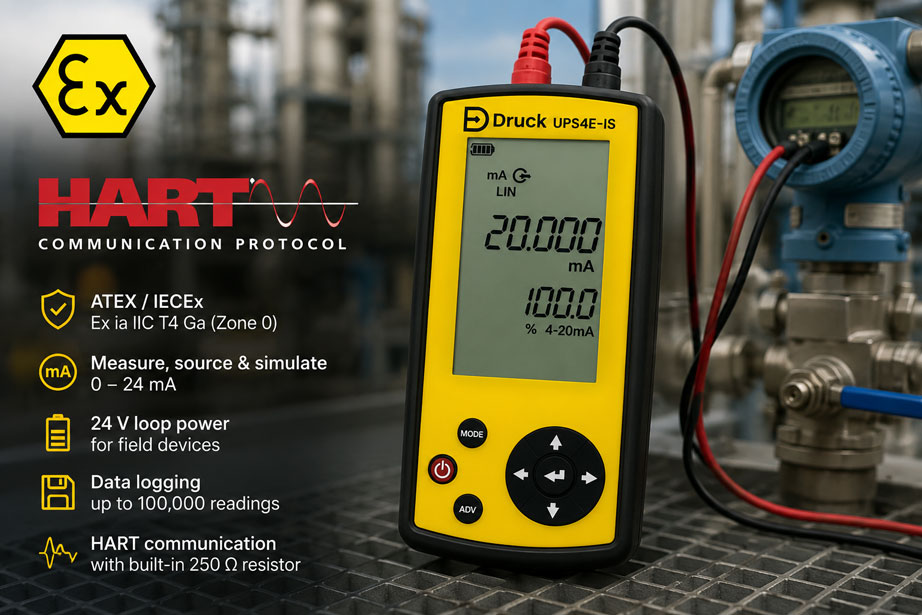
In the process industry, 4–20 mA current loops remain one of the most important signal standards. Pressure transmitters, temperature transmitters, level instruments, flow meters, control valves and process indicators often transmit their measured values via analog current signals. If these signals need to be tested, simulated or calibrated in hazardous areas, a suitable ATEX loop calibrator is required.
An ATEX loop calibrator must not only be able to measure and source precisely. It must also be approved for use in hazardous areas, be safe to operate and quickly support typical maintenance tasks. These include measuring mA signals, simulating a transmitter, supplying a passive loop, step tests, ramp functions, valve tests, HART support and traceable documentation.
This article explains when an intrinsically safe loop calibrator is required, which test tasks are typical in 4–20 mA loops and why the Druck UPS4E / UPS4E-IS is a very suitable solution for maintenance, commissioning and troubleshooting in demanding hazardous-area applications.
You can find suitable devices in our category
Process calibrators
as well as in the section
Simulators.
For 4–20 mA loops in hazardous areas, the
UPS4E Series loop calibrator
from Druck is particularly relevant.
Table of contents
- What is an ATEX loop calibrator?
- Why are 4–20 mA current loops so important?
- Why is ATEX essential for loop calibrators?
- Typical applications in hazardous areas
- Measure, source and simulate: the most important functions
- Testing active and passive current loops correctly
- Druck UPS4E: ATEX loop calibrator for demanding applications
- 24 V loop power: practical during plant shutdown
- Step, ramp function and valve test
- HART support with integrated 250 Ω resistor
- Data logger and documentation
- Troubleshooting in 4–20 mA loops
- Selection criteria for ATEX loop calibrators
- Product reference: UPS4E and suitable calibration technology
- Practical examples from chemical, petrochemical and process industries
- Checklist: selecting the right ATEX loop calibrator
- Conclusion
- FAQ: frequently asked questions about ATEX loop calibrators
What is an ATEX loop calibrator?
A loop calibrator is a test instrument for measuring, sourcing and simulating analog current signals. In process instrumentation, this mainly refers to 4–20 mA signals. With such a device, it can be checked whether a transmitter outputs correctly, whether an indicator is scaled correctly or whether a control system reacts correctly at a specific mA value.
An ATEX loop calibrator is additionally designed for use in hazardous areas. It is used where flammable gases, vapors or dusts may occur and where normal electrical test instruments may not be used.
| Term | Meaning | Practical example |
|---|---|---|
| Loop calibrator | Test instrument for mA signals. | Measure, source or simulate 4–20 mA. |
| ATEX version | Suitable for hazardous areas. | Maintenance in a chemical plant or refinery. |
| Measure mA | Record the current signal of a field device. | Pressure transmitter outputs 12 mA at 50 % of measuring range. |
| Source mA | Calibrator generates a defined current signal. | Test indicator or PLC input with 4, 12 and 20 mA. |
| Simulate mA | Calibrator behaves like a transmitter in the loop. | Test control system without a real field sensor. |
Why are 4–20 mA current loops so important?
The 4–20 mA signal is widely used in industry because it is robust, easy to evaluate and also suitable for longer cable runs. The measuring range of a transmitter is mapped to a current range. 4 mA usually corresponds to 0 % measured value, while 20 mA corresponds to 100 % measured value.
One advantage over a 0–20 mA signal is that 4 mA serves as a “live zero”. A cable break or failure can therefore be detected more easily, because a current of 0 mA is normally not a valid measured value.
| Signal value | Meaning with 4–20 mA | Example for 0 … 10 bar |
|---|---|---|
| 4 mA | 0 % of measuring range. | 0 bar. |
| 8 mA | 25 % of measuring range. | 2.5 bar. |
| 12 mA | 50 % of measuring range. | 5 bar. |
| 16 mA | 75 % of measuring range. | 7.5 bar. |
| 20 mA | 100 % of measuring range. | 10 bar. |
Why is ATEX essential for loop calibrators?
In hazardous areas, electrical test instruments may only be used if they are suitable for the respective zone and application. A normal loop calibrator can pose a safety risk in such areas if it is not appropriately approved.
An ATEX loop calibrator is therefore particularly important for maintenance and commissioning in hazardous areas. It allows electrical tests directly on field devices, signal cables and measuring loops without unnecessarily removing the measuring point or taking it to a safe area.
| Selection point | Why important? | Practical recommendation |
|---|---|---|
| Ex zone | Determines which device approval is required. | Check zone and explosion protection document. |
| Device approval | Calibrator must be suitable for the place of use. | Compare ATEX/IECEx marking with the application. |
| Intrinsic safety | Limits energy in the current loop. | Particularly important for field work. |
| Test task | Not every calibrator can measure, source and supply power. | Check mA functions and loop power. |
| Documentation | Ex work and calibrations must be traceable. | Document test results and device use. |
Typical applications in hazardous areas
ATEX loop calibrators are required wherever 4–20 mA signals need to be tested in hazardous areas. Typical industries include chemical, petrochemical, oil and gas, tank farms, refineries, pharmaceutical production, hydrogen applications, gas supply and process plants with flammable media.
| Application | What is tested? | Benefit |
|---|---|---|
| Transmitter test | mA output of a field device. | Detection of scaling errors or sensor drift. |
| Control system test | Reaction of PLC, DCS or indicator to mA signal. | Testing without process pressure, temperature or level. |
| Valve test | Actuator behavior at a defined mA signal. | Testing control valves, positioners or end positions. |
| Alarm limit test | Switching or alarm reaction at specific signal values. | Testing pre-alarm, main alarm or shutdown. |
| Troubleshooting | Cable break, loop power, voltage drop or input card. | Fast diagnosis in the field. |
Measure, source and simulate: the most important functions
A loop calibrator should support several operating modes. Only then can different fault patterns in a measuring loop be reliably distinguished. In practice, mA measurement, mA sourcing, transmitter simulation and loop power are especially important.
| Function | Description | Typical use |
|---|---|---|
| Measure mA | Calibrator measures the current in the loop. | Testing the output signal of a transmitter. |
| Source mA | Calibrator actively generates a current value. | Testing indicator, PLC input or DCS channel. |
| Simulate mA | Calibrator simulates a passive transmitter. | Testing an existing 24 V loop. |
| 24 V loop power | Calibrator supplies a passive measuring loop. | Testing a removed or unpowered transmitter. |
| % display | mA value is displayed directly as a percentage. | Fast evaluation of 0 %, 50 % and 100 %. |
Testing active and passive current loops correctly
With 4–20 mA loops, it must be distinguished whether the loop is active or passive. An active loop already has a power supply. A passive loop requires an external supply, for example from the calibrator.
This distinction is important because incorrectly connected test instruments or double loop power can lead to incorrect measurements or damage. A good loop calibrator therefore supports users with clear operating modes and simple operating logic.
| Loop type | Description | Test approach |
|---|---|---|
| Active loop | The 24 V supply is already present. | Measure mA or simulate transmitter. |
| Passive loop | No own loop power is present. | Use calibrator with 24 V loop power. |
| Active transmitter | Field device outputs a current signal itself. | Measure current signal and compare with process value. |
| Passive indicator / input | Indicator or input expects an external signal. | Actively source mA signal and check reaction. |
Druck UPS4E: ATEX loop calibrator for demanding applications
The
UPS4E Series loop calibrator
from Druck is a compact and robust loop calibrator for 4–20 mA loops. It is particularly interesting for users who need to test mA signals quickly and safely in the process industry, in hazardous areas and during demanding maintenance work.
The UPS4E is designed for typical maintenance tasks: measuring mA, sourcing mA, powering passive measuring circuits, displaying percentage values, carrying out valve tests, using ramp and step functions and documenting measured values. This makes the device suitable both for fast troubleshooting and for planned calibration and commissioning tasks.
| UPS4E function | Benefit | Typical application |
|---|---|---|
| ATEX/IECEx version | Safe use in Ex applications. | Chemical industry, petrochemicals, refinery, tank farm. |
| Measure and source 0–24 mA | Covers typical 4–20 mA tasks with reserve. | Transmitters, indicators, PLC and DCS inputs. |
| High accuracy | Reliable evaluation of signal deviations. | Calibration and maintenance of process measuring points. |
| Dual mA and % display | Fast evaluation of the measuring range. | 0 %, 25 %, 50 %, 75 % and 100 % testing. |
| Step, span, valve test and ramp | Fast functional testing without time-consuming manual setting. | Control system test, valve test, alarm limit test. |
| 24 V DC loop power | Testing passive measuring circuits and transmitters. | Maintenance during plant shutdown or on removed devices. |
| 250 Ω resistor for HART | Supports HART communication in the measuring loop. | Parameterization and diagnosis of smart field devices. |
| Data logger | Measured values can be recorded over time. | Troubleshooting sporadic signals or drift. |
24 V loop power: practical during plant shutdown
Integrated 24 V loop power is very helpful in the field. If a transmitter or measuring loop is not supplied by the plant, the calibrator can provide the necessary power. This allows field devices, indicators or measuring circuits to be tested independently of the plant supply.
This saves a lot of time, especially during commissioning, shutdown, troubleshooting or when testing removed devices. The technician does not need to carry a separate power supply and can test the measuring loop directly with the calibrator.
| Situation | Problem without loop power | Advantage with UPS4E |
|---|---|---|
| Plant shutdown | Measuring loop is not powered. | Calibrator provides 24 V. |
| Transmitter test in the field | Field device cannot deliver a signal. | Transmitter can be tested directly. |
| Testing an indicator | Signal source is missing. | Actively source mA signal. |
| Troubleshooting | Unclear whether supply or device is faulty. | Check loop power specifically. |
Step, ramp function and valve test
Many tests in 4–20 mA loops are performed repeatedly with the same signal points. Typical values are 4, 8, 12, 16 and 20 mA or the corresponding percentage values. A step function makes this test easier because defined values can be approached one after another.
A ramp function is particularly practical when the reaction of an indicator, controller or valve needs to be observed across the entire signal range. The valve test helps to test control valves and positioners in a targeted way.
| Function | What happens? | Typical application |
|---|---|---|
| Step function | Defined mA values are output step by step. | Testing 0–25–50–75–100 %. |
| Ramp function | Signal automatically runs through a range. | Observation of indicator, controller or actuator behavior. |
| Span test | Start and end value are checked. | Fast check of zero point and span. |
| Valve test | Control valve is driven with defined current values. | Testing travel, response and end positions. |
| Fast Set | Fast setting of precise output values. | Alarm limit test and fast troubleshooting. |
HART support with integrated 250 Ω resistor
Many modern field devices use HART communication in addition to the analog 4–20 mA signal. For this, a suitable resistor is often required in the measuring loop. An integrated 250 Ω resistor can make practical work much easier.
With the UPS4E, this support is particularly helpful when smart transmitters need to be tested or parameterized in the field. The technician has to carry fewer additional components and can evaluate diagnostics, mA signal and loop function together more quickly.
| HART-related point | Why important? | Practical benefit |
|---|---|---|
| 4–20 mA + digital | HART uses the analog signal additionally for communication. | Measured value and device diagnostics can be combined. |
| 250 Ω resistor | Often required for stable communication. | Less additional setup in the field. |
| Smart transmitter | Device parameters and diagnostics may be relevant. | Locate faults faster. |
| Commissioning | Signal and parameterization must match. | Check scaling, unit and output signal. |
Data logger and documentation
A data logger is particularly useful when faults do not occur continuously. Sporadic signal jumps, unstable mA values, drift or brief failures are often difficult to detect in the field. A calibrator with logging function can record measured values over a period of time and thereby support troubleshooting.
For maintenance and quality assurance, it is also important that measurement results are documented traceably. Especially in hazardous areas and safety-related process plants, tests, results and device settings should be recorded properly.
| Documentation task | Why important? | Example |
|---|---|---|
| Measured value recording | Sporadic faults become visible. | mA signal briefly drops. |
| Calibration points | Test result becomes traceable. | Document 4, 8, 12, 16 and 20 mA. |
| Troubleshooting | Trend helps with diagnosis. | Signal drifts with temperature change. |
| Audit capability | Tests must be verifiable. | Maintenance report or calibration record. |
Troubleshooting in 4–20 mA loops
Faults in current loops can have many causes. The transmitter may be incorrectly scaled, loop power may be missing, an input card may be parameterized incorrectly, cables may be damaged or a control valve may not respond correctly. An ATEX loop calibrator helps to narrow down these faults systematically.
| Fault pattern | Possible cause | Test with loop calibrator |
|---|---|---|
| 0 mA | Cable break, missing supply or defective device. | Check loop power and mA signal. |
| 3.6 mA or fault current | Transmitter reports fault. | Check device status and signal behavior. |
| Measured value does not match indication | Incorrect scaling in PLC or indicator. | Source defined mA values and compare indication. |
| Signal fluctuates | Contact problem, EMC, sensor fault or unstable supply. | Measure and log mA trend. |
| Valve does not move correctly | Positioner, air supply or signal problem. | Drive valve with 4–20 mA and observe response. |
Selection criteria for ATEX loop calibrators
When selecting an ATEX loop calibrator, price should not be the only consideration. Ex approval, measurement and simulation functions, accuracy, ease of use, loop power, HART support, robustness, display, data logging and accessories are decisive.
| Selection question | Why important? | Practical recommendation |
|---|---|---|
| In which Ex zone is work carried out? | Device approval must match the application. | Check ATEX/IECEx marking. |
| Which signals need to be tested? | Not every calibrator covers all tasks. | Plan for measuring, sourcing, simulating and powering mA signals. |
| Is 24 V loop power required? | Passive loops require a power supply. | Choose device with integrated loop power. |
| Are HART devices being tested? | HART requires suitable loop conditions. | Consider 250 Ω resistor and HART setup. |
| Are step and ramp functions important? | Recurring tests become faster. | Very useful during commissioning and service. |
| Is documentation or logging required? | Measurement trends and test values must be traceable. | Check data logger and export option. |
| How harsh is the place of use? | Field devices must be robust and easy to operate. | Consider compact design, display and battery operation. |
Product reference: UPS4E and suitable calibration technology
For the keyword ATEX loop calibrator, the UPS4E from Druck is the central product solution. It covers typical 4–20 mA tasks in Ex applications and is much more focused than a large multifunction calibrator when mainly current loops need to be tested.
| Product / category | Suitable for | Typical application |
|---|---|---|
| UPS4E Series loop calibrator | ATEX/IECEx loop calibration, measuring, sourcing and simulating mA. | 4–20 mA testing in hazardous areas, maintenance, commissioning, troubleshooting. |
| Process calibrators | Electrical and process-related calibration tasks. | Maintenance of transmitters, indicators, controllers and process measuring points. |
| Simulators | Simulation of process signals. | Testing PLC inputs, indicators and control systems. |
| DPI620 GENII pressure calibrator / process calibrator | Multifunction calibration tasks with pressure, temperature and electrical signals. | Comprehensive calibration tasks when more than just mA loops need to be tested. |
Practical examples from chemical, petrochemical and process industries
Example 1: Testing a pressure transmitter in an Ex zone
A pressure transmitter in a chemical plant supplies a 4–20 mA signal to the control system. With the UPS4E, the output signal is measured and compared with the process pressure. This makes it possible to determine whether the transmitter is correctly scaled or whether there is a deviation.
Example 2: Testing a PLC input without process signal
During commissioning, it needs to be checked whether the PLC input is correctly parameterized. The UPS4E sources defined values such as 4, 12 and 20 mA. The indication in the control system is compared with the expected percentage values.
Example 3: Testing a control valve in a hazardous area
A control valve needs to be checked for its actuator behavior. With the ramp function or defined step values, the valve is driven over the signal range. The technician observes whether travel, response time and end positions are plausible.
Example 4: Finding faulty loop power
A measuring point does not deliver an mA signal. Initially, it is unclear whether the transmitter, cable or power supply is faulty. With the calibrator’s integrated 24 V loop power, the measuring circuit can be powered and tested specifically.
Example 5: Documenting sporadic signal fluctuation
An mA signal fluctuates only occasionally. With the data logger function, the signal trend is recorded over a longer period of time. This allows the fault to be evaluated and narrowed down more effectively later.
Checklist: selecting the right ATEX loop calibrator
This checklist helps to systematically prepare the selection of a suitable loop calibrator for Ex applications.
| Check question | Why important? | Practical recommendation |
|---|---|---|
| Is there a hazardous area? | Normal test instruments may not be used there without suitable approval. | Clarify ATEX/IECEx requirement in advance. |
| Which Ex zone is relevant? | Device suitability depends on the zone. | Compare explosion protection document and device approval. |
| Do mA signals need to be measured? | Transmitter outputs must be directly testable. | Select mA measurement function with suitable accuracy. |
| Do signals need to be simulated or sourced? | Control systems, indicators and valves require defined input signals. | Plan for mA output and transmitter simulation. |
| Is 24 V loop power required? | Passive measuring circuits require external power. | Use calibrator with integrated loop power. |
| Are HART devices used? | Smart transmitters require suitable communication conditions. | Consider integrated 250 Ω resistor. |
| Are step and ramp tests required? | Recurring tests should be fast and reproducible. | Use UPS4E with step, span, valve test and ramp function. |
| Do measured values need to be documented? | Calibration and troubleshooting must remain traceable. | Check data logger and export option. |
| Is the device field-ready? | Maintenance in hazardous areas requires robust, simple operation. | Consider compact design, display, battery operation and one-hand operation. |
Conclusion: the UPS4E is the right ATEX loop calibrator for 4–20 mA field tasks
An ATEX loop calibrator is an important tool for maintenance, commissioning and troubleshooting in hazardous areas. Especially with 4–20 mA loops, transmitters, indicators, PLC inputs, control valves and loop supplies must be tested quickly and safely.
The
UPS4E Series loop calibrator
from Druck is a very suitable solution for this. It combines ATEX/IECEx suitability, 0–24 mA measurement and sourcing, dual mA and % display, 24 V loop power, step, span, valve test and ramp functions, HART support via integrated 250 Ω resistor and data logging in a compact field device.
This makes the UPS4E particularly suitable for users who regularly need to test 4–20 mA signals in hazardous areas, simulate transmitters, test control system inputs, drive valves or quickly narrow down faults in current loops. You can find an overview of suitable devices in the categories
Process calibrators
and
Simulators.
FAQ: frequently asked questions about ATEX loop calibrators
What is an ATEX loop calibrator?
An ATEX loop calibrator is a test instrument for measuring, sourcing and simulating mA signals that is suitable for use in hazardous areas.
What is the Druck UPS4E suitable for?
The UPS4E is suitable for testing 4–20 mA current loops, measuring and sourcing 0–24 mA, transmitter simulation, 24 V loop power, step and ramp tests, valve tests and troubleshooting in Ex applications.
Why is 4–20 mA used in the process industry?
4–20 mA is robust, can be transmitted reliably over long cables and provides a live zero. This allows measured values to be transmitted reliably and faults such as cable breaks to be detected more easily.
What is the difference between measuring mA, sourcing mA and simulating mA?
When measuring mA, the calibrator records the existing current signal. When sourcing mA, it actively generates a defined signal. When simulating, the calibrator behaves like a transmitter within an existing loop.
Why is 24 V loop power important?
24 V loop power allows passive measuring circuits or transmitters to be tested even if the plant itself does not provide power or is shut down.
Why is an integrated 250 Ω resistor helpful?
A 250 Ω resistor supports the setup of suitable HART communication in the current loop. This makes smart field devices easier to test and diagnose.
How does a loop calibrator help with valve testing?
The calibrator outputs defined mA values or a ramp. This allows testing whether the control valve or positioner reacts correctly to the input signal.
What is the benefit of a step function?
A step function approaches defined signal values automatically or semi-automatically. This makes typical tests at 0 %, 25 %, 50 %, 75 % and 100 % of the measuring range easier.
What is a data logger useful for in a loop calibrator?
A data logger helps detect sporadic faults, unstable mA signals or slow drift. The signal trend can be recorded over a period of time and evaluated later.
When is an ATEX loop calibrator necessary?
An ATEX loop calibrator is necessary when mA signals need to be tested, simulated or calibrated directly in hazardous areas and the test instrument must match the Ex zone.
Which product is suitable as an ATEX loop calibrator?
For 4–20 mA tasks in hazardous areas, the
UPS4E Series loop calibrator
from Druck is particularly suitable. It combines ATEX/IECEx suitability, mA measurement, mA output, 24 V loop power, step, span, ramp and valve test functions as well as HART support in a compact field device.