


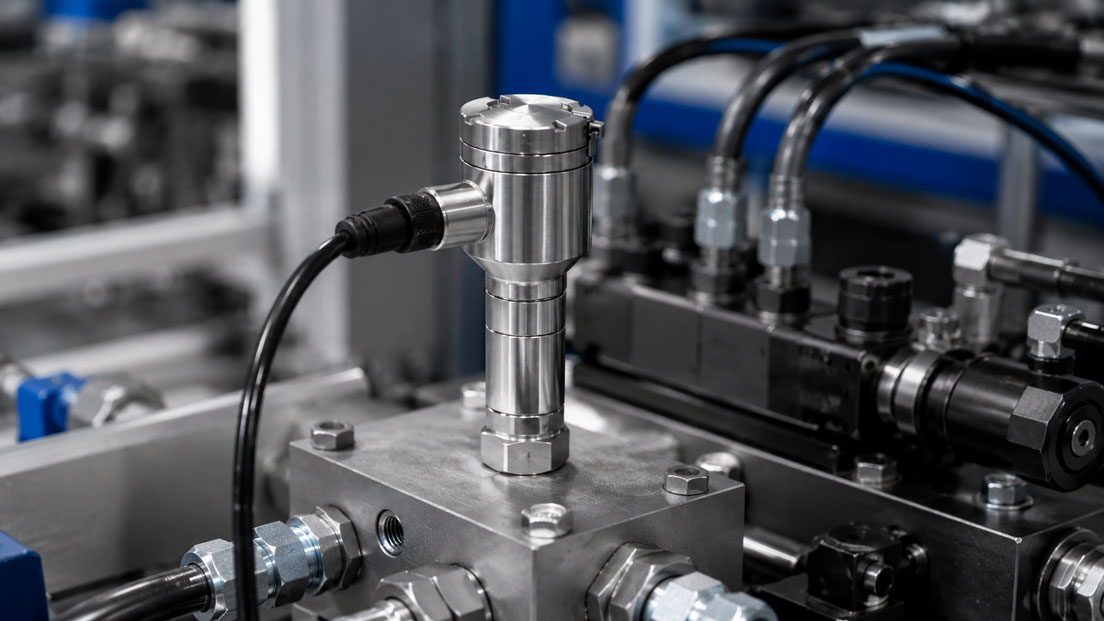
Hydraulic systems often operate with high pressures, rapid pressure changes and strong mechanical loads. Whether in mechanical engineering, presses, test benches, hydraulic power units, mobile machinery or industrial control systems: the pressure sensor must reliably detect what is actually happening in the system.
Selecting a suitable pressure sensor for hydraulics is therefore more than just choosing the right measuring range. Operating pressure, pressure peaks, overload resistance, burst pressure, vibration resistance, process connection, electrical interface, protection rating and installation situation are all decisive factors. This article explains what you should pay attention to when selecting, installing and evaluating pressure sensors for industrial applications in hydraulic systems.
Table of contents
- Why hydraulic systems place special demands on pressure sensors
- Choosing the correct measuring range: It is not only the operating pressure that matters
- Pressure peaks and overload: Why the sensor must withstand more than the nominal pressure
- Understanding overload pressure and burst pressure correctly
- Output signal: 4–20 mA, 0–10 V, ratiometric or digital?
- Process connection: G1/4, NPT and sealing concepts in hydraulic systems
- Electrical connection: M12 connector, cable outlet and protection rating
- Vibration, shock and mechanical stress
- Damping elements, snubbers and protection against pressure surges
- Installation position: Where should the pressure sensor be installed in the hydraulic system?
- Temperature, hydraulic oil and media compatibility
- Typical errors during selection and installation
- Suitable pressure sensors for hydraulic applications
- Practical example: Pressure sensor on a hydraulic power unit shows unstable values
- Conclusion: Pressure sensor and hydraulic application must match
- FAQ: Frequently asked questions about pressure sensors in hydraulic systems
Why hydraulic systems place special demands on pressure sensors
Hydraulic systems are demanding for pressure sensors because the pressure is rarely completely calm and constant. In many applications, the pressure changes within a very short time. Valves open and close, pumps deliver pulsating flow, cylinders move against load, presses build up force and mobile machines operate under changing conditions. This creates pressure profiles that are much more dynamic than in many simple process applications.
A pressure sensor in a hydraulic system must therefore not only measure the normal working pressure, but also withstand short-term loads. These pressure peaks are not always fully visible on the display or in the PLC, but they can still mechanically stress the sensor. Fast switching operations, hard end stops, suddenly closing valves, cavitation, pump pulsations and rapid load changes are particularly critical.
In addition, there are vibrations, temperature fluctuations, oil contamination, narrow installation spaces and, in some cases, harsh environmental conditions. In mobile machinery, shock loads, moisture, dirt, wide temperature ranges and often a challenging electrical environment are also present. A sensor that works well in a calm test bench application is therefore not automatically suitable for a strongly vibrating mobile hydraulic system.
For hydraulics, a robust industrial pressure sensor is therefore required whose measuring range, overload resistance, mechanical design and electrical interface match the application. Analogue pressure transmitters with 4–20 mA or 0–10 V are often used for continuous measurements. In modern machines, digital pressure sensors with IO-Link, diagnostic functions or switching outputs can also be useful.
Choosing the correct measuring range: It is not only the operating pressure that matters
A common selection mistake is choosing the measuring range only based on the normal operating pressure. If a hydraulic system typically operates at 250 bar, for example, it may seem obvious to select a sensor with 0…250 bar. In practice, however, this can be too tight if the system regularly generates pressure peaks or short-term overpressure.
The measuring range should be selected so that the normal working range is recorded well, without the sensor constantly operating close to the upper end of the range. At the same time, the range should not be unnecessarily large. A sensor with 0…600 bar in a system that normally only reaches 60 bar may appear mechanically robust, but it may provide less favorable resolution and accuracy for the actual measurement task.
Knowing the real pressure profile is therefore decisive. This includes working pressure, maximum system pressure, short-term pressure peaks, pressure fluctuations when valves switch and possible fault conditions. If these values are not known, a temporary measurement with a suitable reference instrument or data logger can help record the actual pressure profile.
| Application | Typical pressure range | What to pay particular attention to |
|---|---|---|
| Hydraulic power unit | Depending on the system, often from double-digit values up to several hundred bar | Pump pulsation, pressure peaks, oil temperature |
| Press | High pressures, often with load peaks | Overload resistance, stable mounting, fast pressure changes |
| Test bench | Depends on test task and test object | Accuracy, dynamics, documentation |
| Mobile machinery | High and strongly changing pressures | Vibration, shock, temperature, protection rating |
| Filter or differential pressure monitoring | Often smaller differences at high system pressure | Suitable measuring principle and correct pressure side |
A well-chosen measuring range is always a compromise between accuracy, reserve and load capacity. The design should therefore not be based on a single nominal pressure alone, but on the real pressure behavior of the hydraulic system.
Pressure peaks and overload: Why the sensor must withstand more than the nominal pressure
Hydraulic pressure peaks often occur very quickly and are not always visible in the control system. A pressure sensor with a slow signal filter or a PLC with a low sampling rate may display a smoothed value, even though significantly higher pressures occur briefly in the system. These peaks can still mechanically stress the sensor.
Typical causes include fast-switching directional control valves, sudden load changes, hard cylinder stops, pump pulsations or rapidly closing valves. Air in the hydraulic system can also change pressure behavior and lead to unstable measured values. In mobile machines, dynamic load changes caused by travel movements, vibrations and work cycles are added.
If the sensor is only designed for the normal operating pressure, these short-term overpressures can lead to zero-point shifts, signal drift, diaphragm deformation or, in extreme cases, failure. For hydraulic applications, it should therefore always be checked what overload resistance the sensor has and whether additional protective measures are required.
In particularly dynamic systems, a sensor with high overpressure resistance, fast frequency response and a robust measuring cell may be necessary. The UNIK5000, for example, is a configurable high-performance pressure measurement system for demanding applications with various pressure ranges and high overpressure resistance.
Understanding overload pressure and burst pressure correctly
When selecting a pressure sensor, measuring range, overload pressure and burst pressure are often specified. These values should not be confused. The measuring range describes the range in which the sensor measures as intended and provides its output signal. The overload pressure describes the pressure that the sensor can withstand briefly without permanent damage. The burst pressure describes a mechanical safety limit; if it is exceeded, destruction or leakage must be expected.
For the application, it is important to understand that overload pressure is not an invitation to operate the sensor regularly above its measuring range. If a sensor repeatedly comes close to its overload limit, the measuring range or protective measure is usually incorrectly selected. Service life may decrease and measured results may change over time.
The burst pressure is especially relevant from a safety perspective. It must not be reached during operation. Especially in hydraulic systems with high energy levels and small volumes, a mechanical failure can be dangerous. Sensors, adapters, hoses and fittings should therefore always be suitable for the maximum possible system pressure and the actual operating conditions.
If pressure peaks are known or expected, not only the sensor but the entire measuring point should be considered. This includes process connection, sealing concept, adapters, installation position and possible damping elements.
Output signal: 4–20 mA, 0–10 V, ratiometric or digital?
The output signal of the pressure sensor must match the control system, cable length and electrical environment. In industrial hydraulic systems, 4–20 mA is very common because current signals are relatively insensitive to voltage drops and interference. This is particularly advantageous with longer cable runs or in systems with motors, contactors, frequency inverters and other electromagnetic interference sources.
Voltage signals such as 0–10 V are also frequently used, especially for shorter cable runs or when the control system has corresponding analogue inputs. In mobile machinery or OEM applications, ratiometric signals can be useful because they scale with the supply voltage and fit well into certain control concepts.
Digital interfaces such as IO-Link offer additional possibilities. In addition to the measured value, parameterization, diagnostic information, switching points or device status can be transmitted. This is particularly helpful when pressure sensors are to be integrated into modern machine concepts or when service and commissioning are to be simplified. One example is the WIKA A-1200 pressure sensor with IO-Link.
| Signal type | Advantage | Typical use |
|---|---|---|
| 4–20 mA | Robust with longer cables and industrial interference | Mechanical engineering, hydraulic power units, process systems |
| 0–10 V | Simple evaluation via analogue inputs | Shorter cable runs, control systems with voltage input |
| Ratiometric | Suitable for certain mobile and OEM controls | Mobile machinery, compact machine controls |
| IO-Link / digital | Parameterization, diagnostics and additional information | Intelligent machines, service, condition monitoring |
Signal processing should also be considered during selection. Excessive smoothing can hide pressure peaks. A very fast measurement, on the other hand, can produce unstable values in highly dynamic systems. The key question is whether the sensor matches the task: control, monitoring, diagnostics, regulation or safety shutdown.
Process connection: G1/4, NPT and sealing concepts in hydraulic systems
Process connections such as G1/4, G1/2, NPT or other thread types are common in hydraulic systems. Which connection is suitable depends on the machine, hydraulic block, existing measuring port and sealing concept. A mechanically fitting thread alone is not enough. Sealing surface, thread engagement depth, pressure resistance and material must also match the application.
With cylindrical threads such as G threads, sealing is often achieved via a sealing surface with a profile seal, O-ring or flat gasket. With tapered threads such as NPT, sealing takes place via the thread. If the wrong sealing concept is used, the connection can leak or mechanically stress the sensor.
Adapter chains are particularly critical. If several adapters are used one after another, mechanical stress increases due to leverage and vibration. Additional dead volumes can also be created, where air can collect or dirt can accumulate. A mounting arrangement that is as short, stable and direct as possible is usually the better solution.
When replacing a sensor, not only the measuring range should be compared. Process connection, seal, material and installation length must also be checked. A sensor may fit electrically but still be mechanically unsuitable.
Electrical connection: M12 connector, cable outlet and protection rating
The electrical connection must match the environment. In stationary machines, M12 connectors, angled connectors or cable outlets are often used. M12 connectors are widely used in industry, robust and service-friendly. They make sensor replacement easier and reduce wiring errors if the pin assignment is correctly documented.
Cable outlets can be useful where space is limited or where a particularly sealed, pre-assembled solution is required. However, the cable must be protected against tension, bending, abrasion and oil exposure. In moving machine areas or mobile applications, cable routing is just as important as the sensor itself.
The protection rating is also decisive. IP65 can be sufficient for many industrial applications if the sensor is protected against water jets and dust. In wetter, dirtier or mobile applications, IP67 or an even more robust version may be required. It is important that the specified protection rating is only achieved if the connector, seal and cable gland are installed correctly.
In hydraulic systems, oil, cleaning agents, dust and vibration often occur together. The electrical connection should therefore not only be selected according to connector type, but according to the actual installation situation.
Vibration, shock and mechanical stress
Hydraulic systems often generate vibrations. Pumps, motors, valves, cylinder movements and pressure pulsations transfer mechanical loads to pipes, blocks and sensors. A pressure sensor mounted directly on a vibrating power unit is therefore exposed to different loads than a sensor installed at a quiet test connection.
Vibration can, over time, lead to loose connectors, cable breaks, cracks in the connection area or mechanical stress on the measuring cell. Long adapters, heavy sensor designs or mounting positions with leverage are particularly unfavorable. The further the sensor protrudes from the hydraulic block, the stronger the vibration forces acting on the connection.
These requirements are especially high for mobile machinery. Sensors such as the WIKA MH-3 / MH-3-HY OEM pressure sensor are designed specifically for extreme operating conditions and mobile machine environments. In such applications, not just any industrial sensor should be used, but one that mechanically and electrically matches mobile hydraulics.
Clean cable routing, strain relief and mechanically stable mounting are just as important as the sensor selection itself. Many failures are not caused by the measuring cell, but by damaged cables, vibrating plug connections or unfavorable installation.
Damping elements, snubbers and protection against pressure surges
In some hydraulic systems, pressure surges are so strong that a sensor is stressed over the long term despite a suitable measuring range and sufficient overload resistance. In such cases, damping elements, snubbers or restrictors can help reduce very fast pressure peaks at the sensor.
A snubber acts like hydraulic damping. It does not limit the static pressure, but slows down rapid pressure changes at the sensing element. This can make the measurement signal calmer and reduce stress on the measuring cell caused by short pressure surges. This is particularly helpful with pump pulsations, fast-switching valves or highly dynamic pressure profiles.
However, the damping must match the measurement task. If the sensor is supposed to detect fast pressure changes, excessive damping can distort the signal. If, on the other hand, the goal is only to monitor an average system pressure, damping can be useful. The key question is therefore: Should the sensor see fast peaks, or should it be protected from them?
The position of the damping element is also important. It should be installed in such a way that it protects the sensor but does not create unwanted dead volumes, air pockets or contamination problems. In heavily contaminated oil, small restrictor openings can also clog. For this reason, the maintenance situation should also be considered.
Installation position: Where should the pressure sensor be installed in the hydraulic system?
The installation position determines which pressure the sensor actually measures. A sensor directly at the pump outlet sees different pressure profiles than a sensor behind a valve, at a cylinder connection, in the return line or at a filter. The mounting location should therefore always match the measurement task.
If the system pressure is to be monitored, a position in the pressure line or on the hydraulic block is often suitable. If a single actuator function is to be monitored, the sensor must be closer to that actuator. For filter monitoring, depending on the task, the pressure before or after the filter or the differential pressure may be decisive.
Measuring points on dead-end lines, in poorly vented areas or at positions with strong local pressure surges that are not representative of the desired measured value are problematic. Thermal influences can also play a role. A sensor directly next to a hot power unit or in a poorly ventilated location is exposed to greater stress than a sensor in a more favorable position.
During troubleshooting, it is often helpful to compare the measured pressure with a reference pressure gauge or a temporary sensor at a second measuring point. This makes it possible to determine whether a problem is really related to system pressure or only caused by the selected measuring position.
Temperature, hydraulic oil and media compatibility
Hydraulic oil is generally a suitable medium for many industrial pressure sensors. Nevertheless, materials, seals and temperature range must be checked. Depending on the oil type, additives, temperature and operating conditions, seals can be stressed differently. FKM, EPDM or other sealing materials are not automatically equally suitable for every medium.
Oil temperature also plays an important role. High temperatures can stress the electronics, seals and measuring cell. In hydraulic power units, oil temperature often increases with runtime, load and ambient temperature. If the sensor is mounted close to hot components, the ambient temperature at the electronics housing can also be significantly higher than expected.
In addition to maximum temperature, temperature cycling is also relevant. Cold starts, warm operating conditions and rapid load changes can contribute to mechanical stress and signal drift. In mobile machines, outdoor climate, frost, sunlight and cleaning processes are also added.
For reliable measurement results, the pressure range should therefore not be the only factor checked. Medium, sealing material, process temperature, ambient temperature and installation location must also match the sensor design.
Typical errors during selection and installation
Many problems with pressure sensors in hydraulic systems are not caused by a fundamental sensor defect, but by incorrect design or unfavorable mounting. A typical error is selecting a measuring range that is too tight. The sensor initially works, but is overloaded over the long term by recurring pressure peaks.
The installation situation is also frequently underestimated. A sensor is installed at a strongly vibrating point, mounted via several adapters or not mechanically supported sufficiently. This creates loads that are not immediately apparent from the technical data. An unsuitable connector, poor cable routing or missing strain relief can also lead to failures later.
Another error is incorrectly interpreting unstable measured values. Not every fluctuating measured value means that the sensor is defective. Often, the sensor is actually detecting existing pressure pulsations, valve switching or air in the system. Conversely, a heavily smoothed signal can show an apparently calm system even though fast pressure peaks are present.
The process connection is also often given too little attention. An incorrect sealing concept, unsuitable sealants or an excessively long adapter chain can cause leaks, mechanical stress or measurement delays. Especially at high pressures, the measuring point should be designed cleanly from a mechanical point of view.
Suitable pressure sensors for hydraulic applications
Robust analogue pressure sensors and pressure transmitters are suitable for general industrial hydraulic applications. In the WIKA pressure sensors category, you will find sensors and transmitters for continuous pressure measurement with standard signals such as 4–20 mA or 0–10 V.
For demanding measurement tasks, test benches or applications with higher requirements for accuracy, dynamics and configuration, the UNIK5000 is a suitable solution. The modular pressure measurement system is designed for high requirements and offers various pressure ranges, output signals and connection options.
For mobile machinery and particularly harsh conditions, the WIKA MH-3 / MH-3-HY OEM pressure sensor is of interest. Such applications place particularly high demands on shock, vibration, temperature range and mechanical robustness.
If digital parameterization, diagnostics or switching functions are also required, digital pressure sensors or sensors with IO-Link such as the WIKA A-1200 can be useful. The right choice depends on whether the sensor is primarily intended to measure, monitor, switch, regulate or diagnose.
Practical example: Pressure sensor on a hydraulic power unit shows unstable values
A pressure sensor with 0…250 bar is used on a hydraulic power unit. During normal operation, the system pressure is around 180 bar. However, the PLC shows unstable values, and short-term faults occasionally occur in pressure monitoring. Initially, it is assumed that the pressure sensor is defective.
During inspection, it becomes clear that the measuring point is located directly at the pump outlet. Significant pulsations occur there, which are intensified by the pump and fast valve switching. In addition, the sensor is mounted via a longer adapter combination, causing vibrations to act on the connection. The sensor is therefore not necessarily displaying incorrect values; instead, it is installed at a very dynamic and mechanically unfavorable measuring point.
For evaluation, a second sensor is mounted at a quieter position in the hydraulic block. The pressure profile is also checked with a higher sampling rate. This reveals short-term pressure peaks that are only partially visible in the normal PLC trend. The original sensor was sufficient for the normal operating pressure, but not ideal for the actual pressure peaks and mechanical stress.
The solution consists of several measures: the sensor is mounted at a more suitable location, the adapter chain is reduced, the cable routing is strain-relieved and a sensor with suitable overload resistance is selected. In addition, it is checked whether a damping element is useful without excessively affecting the desired measurement dynamics.
Conclusion: Pressure sensor and hydraulic application must match
A pressure sensor in a hydraulic system must do significantly more than simply cover a suitable measuring range. Hydraulic systems generate high pressures, fast pressure peaks, vibrations, temperature changes and sometimes strong mechanical loads. Sensor and application must therefore be carefully matched.
Important selection criteria are measuring range, overload resistance, burst pressure, signal type, process connection, protection rating, electrical connection, media compatibility and installation position. Just as important is the question of whether fast pressure peaks should be detected or damped. A sensor can only operate reliably if it matches the actual pressure dynamics and mechanical environment.
Suitable solutions are available for different hydraulic applications – from industrial WIKA pressure sensors and the configurable UNIK5000 pressure measurement system to robust sensors for mobile machinery such as the WIKA MH-3 / MH-3-HY.
FAQ: Frequently asked questions about pressure sensors in hydraulic systems
Which pressure sensor is suitable for hydraulic systems?
A robust industrial pressure sensor with a suitable measuring range, sufficient overload resistance, suitable protection rating, matching process connection and compatible output signal is suitable. In dynamic or mobile applications, vibration and shock resistance are also important.
Which measuring range should a hydraulic pressure sensor have?
The measuring range should match the normal working pressure, but also take reserves for pressure peaks and maximum system pressures into account. A range that is too small can overload the sensor; a range that is too large can reduce resolution and accuracy in the relevant working range.
What is important for a 400 bar hydraulic pressure sensor?
At 400 bar, not only the measuring range but also overload pressure, burst pressure, process connection, sealing concept and mechanical mounting should be checked. In many hydraulic systems, short-term pressure peaks can occur significantly above the normal operating pressure.
Why does the pressure sensor in the hydraulic system show unstable values?
Unstable values can be caused by pump pulsations, valve switching, air in the system, pressure peaks, vibrations or an unfavorable measuring point. The sensor is not always defective; it often measures actual pressure dynamics.
What is the difference between overload pressure and burst pressure?
Overload pressure describes a pressure that the sensor should withstand briefly without permanent damage. Burst pressure is a mechanical safety limit; if it is exceeded, destruction or leakage must be expected. Neither value should be confused with the normal measuring range.
Is 4–20 mA or 0–10 V better for hydraulics?
4–20 mA is particularly robust in industrial systems with longer cables and interference. 0–10 V can be useful with shorter cables and suitable control inputs. The right choice depends on the control system, cable length, EMC environment and application.
When is an M12 connector useful?
An M12 connector is useful when a robust, service-friendly and industrial-grade connection is required. It is important that the pin assignment is correct and that the protection rating is only achieved with a suitable mating connector and correct installation.
When do you need a snubber or damping element?
A snubber or damping element is useful when very fast pressure surges stress the sensor or the signal fluctuates too strongly. However, the damping must match the measurement task because it can also delay or smooth fast pressure changes.
Where should the pressure sensor be mounted in a hydraulic system?
The mounting location depends on the measurement task. For system pressure, a point in the pressure line or on the hydraulic block is often suitable. For actuator functions, the sensor must be closer to the respective actuator. Measuring points on dead-end lines or strongly vibrating adapter chains should be avoided.
Which products are suitable for hydraulic pressure measurement?
Robust WIKA pressure sensors, configurable high-performance pressure sensors such as the UNIK5000, digital pressure sensors with diagnostic functions and robust sensors for mobile machinery such as the WIKA MH-3 / MH-3-HY are suitable for industrial hydraulic applications.