


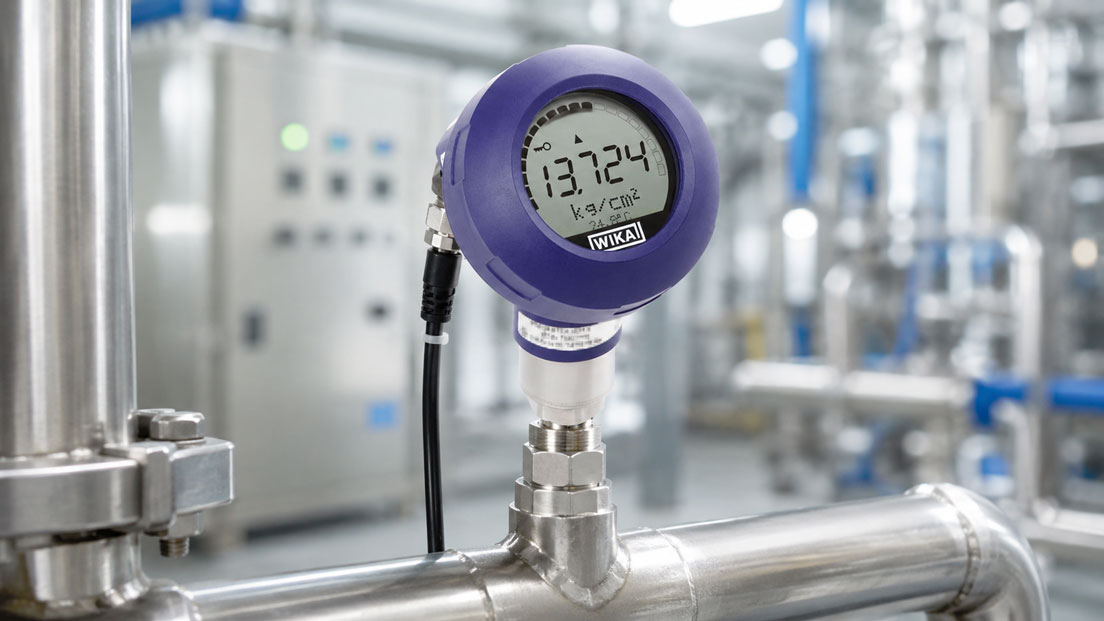
When selecting a pressure transmitter, it is not only the measuring range, accuracy, process connection or medium that matters. The correct output signal is just as important. In practice, users are often faced with the question of whether a pressure transmitter with 4–20 mA, 0–10 V or HART communication should be used.
At first glance, the decision may seem simple, but it has a major influence on wiring, interference immunity, PLC connection, diagnostic options and later maintenance. A 2-wire pressure transmitter with 4–20 mA is very common in industry, a 3-wire sensor with 0–10 V can be useful for short cable runs and simple controllers, and HART provides additional digital information without replacing the proven 4–20 mA signal. This article explains the differences and shows what you should pay attention to when selecting pressure sensors and pressure transmitters.
Table of contents
- Why the output signal of a pressure transmitter is so important
- 4–20 mA: The robust industrial standard for pressure transmitters
- 2-wire technology: Power supply and measurement signal via the same cable
- 0–10 V: When a voltage signal can make sense
- 3-wire technology: Why 0–10 V is wired differently
- HART: Digital communication in addition to the 4–20 mA signal
- Interference immunity, cable length and EMC in industrial systems
- Connection to PLC and evaluation unit: Which input is suitable?
- Diagnostics, parameterization and maintenance: When HART offers advantages
- Typical errors in wiring and signal selection
- Selection guide: Which signal is suitable for which application?
- Suitable pressure transmitters and pressure sensors
- Practical example: Pressure transmitter on a PLC provides implausible values
- Conclusion: The best output signal depends on the application and evaluation
- FAQ: Frequently asked questions about 4–20 mA, 0–10 V and HART for pressure transmitters
Why the output signal of a pressure transmitter is so important
A pressure transmitter converts the measured process pressure into an electrical output signal. This signal is then evaluated by a PLC, display unit, controller, data logger or control system. If the output signal does not match the system, problems quickly arise: incorrect measured values, unstable displays, wiring errors, missing diagnostic options or unnecessary effort during commissioning and maintenance.
In many industrial applications, 4–20 mA remains the preferred solution. The signal is robust, well standardized and suitable for longer cable runs. 0–10 V is easier to understand and also common in many control systems, but it reacts more sensitively to voltage drops, ground problems and electrical interference. HART, on the other hand, is not a replacement for the 4–20 mA signal, but additional digital communication that is superimposed on the analogue current signal.
The selection should therefore not be based only on the available sensor. The entire measuring chain is decisive: pressure transmitter, supply voltage, cable length, shielding, PLC input, EMC environment, desired diagnostics and maintenance concept. Only when these points match does the pressure transmitter provide a reliable signal that can be evaluated correctly.
4–20 mA: The robust industrial standard for pressure transmitters
The 4–20 mA signal is very common in industrial measurement technology. The pressure transmitter outputs a current that is proportional to the measured pressure. At the start of the measuring range, typically 4 mA flows; at the end of the measuring range, 20 mA flows. For example, with a pressure transmitter with 0…10 bar, this means: 4 mA corresponds to 0 bar, 20 mA corresponds to 10 bar and 12 mA corresponds to approximately 5 bar.
The major advantage is that current signals are less sensitive to cable resistance than voltage signals. The current in the measuring circuit remains the same within the permitted operating conditions, even if a certain voltage drop occurs across longer cables. This is precisely why 4–20 mA is frequently used in process plants, mechanical engineering, water and wastewater technology, hydraulic power units, test benches and general industrial applications.
Another advantage is the so-called live zero. The measuring range does not start at 0 mA, but at 4 mA. This makes it easier to detect a cable break or missing power supply because no valid measurement signal is then present. With a 0–10 V signal, this is more difficult because 0 V can represent either a real measured value or a fault condition, depending on the application.
Typical pressure transmitters such as the WIKA A-10 pressure transmitter or the WIKA S-20 high-quality pressure transmitter are used in many industrial applications with standardized output signals. For general pressure measurements, 4–20 mA is often the safest choice when cable lengths, industrial interference or robust PLC connection play a role.
2-wire technology: Power supply and measurement signal via the same cable
Many 4–20 mA pressure transmitters operate using 2-wire technology. This means that the power supply and measurement signal are routed through the same current loop. The transmitter is integrated into a current loop. It is powered via this loop and at the same time outputs the measured value as a current signal.
This wiring is particularly space-saving and robust. Only two wires are required, which simplifies installation and reduces costs over longer distances. In many process plants, this technology is standard because it can be easily combined with control systems, analogue inputs and explosion protection concepts.
However, it is important that the supply voltage is sufficient. Voltage drops occur in the current loop across the pressure transmitter, the cable, the input resistance of the PLC and, if applicable, additional loads. If the available voltage is not sufficient, the transmitter can no longer provide the 20 mA signal correctly. This then becomes visible through limited maximum values, unstable measurement signals or implausible displays.
When planning a 2-wire system, the nominal supply alone should therefore not be considered. Load, cable length, input resistance and additional devices in the measuring circuit must also be taken into account. The load also plays an important role, especially with HART communication.
0–10 V: When a voltage signal can make sense
The 0–10 V signal is well known in many control and automation applications. The pressure transmitter outputs a voltage that is proportional to the pressure. At the start of the measuring range, typically 0 V is present; at the end of the measuring range, 10 V is present. For simple machines, short cable runs and controllers with voltage inputs, this can be a useful and economical solution.
0–10 V is particularly practical when the controller already has suitable voltage inputs and the cable length remains manageable. In compact machines, test setups, OEM applications or laboratory applications, a voltage signal can be processed very easily. Depending on the device and controller, 0–10 V can also be suitable for fast signal evaluation.
The disadvantage lies in its higher sensitivity to voltage drops and interference. Since the measured value is output as a voltage relative to a reference potential, ground shifts, cable lengths, electrical interference or poor reference potentials can influence the measured value. In larger systems, with long cables or in harsh EMC environments, 4–20 mA is therefore often the more robust solution.
Another point is fault detection. If a pressure transmitter outputs 0 V at 0 bar, a cable break or missing power supply can also result in 0 V. Without additional diagnostics, it is not always immediately clear whether 0 bar is actually present or whether there is an electrical problem.
3-wire technology: Why 0–10 V is wired differently
Pressure transmitters with a 0–10 V output are often connected using 3-wire technology. There is one wire for the supply voltage, one common ground or 0 V and one separate signal wire for the voltage output. This differs significantly from the 2-wire current signal.
In practice, many errors occur because 2-wire and 3-wire devices are confused. A 3-wire pressure sensor cannot simply be installed in a current loop like a 2-wire transmitter. Conversely, a 2-wire 4–20 mA transmitter does not provide a voltage signal simply because it is connected to a voltage input.
In 3-wire systems, the common reference potential is particularly important. If the analogue value in the PLC is referenced to a different ground than the sensor, measurement errors can occur. Voltage drops on the ground wire can also influence the measured value. Power supply, ground routing and signal cable should therefore be planned cleanly and wired according to the manufacturer’s specifications.
| Signal | Typical wiring | Typical advantage | Typical disadvantage |
|---|---|---|---|
| 4–20 mA | Usually 2-wire current loop | Robust with longer cables and industrial interference | Load and supply voltage must match |
| 0–10 V | Usually 3-wire connection | Simple evaluation with short cables | More sensitive to ground problems and voltage drops |
| 4–20 mA HART | 2-wire current loop with digital communication | Analogue signal plus parameterization and diagnostics | HART-capable devices and suitable load required |
If you want to replace an existing pressure transmitter, you should therefore not only compare the measuring range and process connection. Output signal, number of wires, pin assignment and input type of the control system must also match exactly.
HART: Digital communication in addition to the 4–20 mA signal
HART is frequently used with process pressure transmitters. The analogue 4–20 mA signal remains available and continues to transmit the main measured value. In addition, a digital communication signal is transmitted over the same cable. The advantage: The pressure transmitter can be operated like a classic 4–20 mA transmitter, but offers additional information and adjustment options.
Depending on the device, parameters, measuring range, unit, damping, device status, diagnostic information or additional measured values can be read out and adjusted via HART. This is particularly helpful in process plants, Ex areas, hard-to-reach measuring points or applications with many measuring points. The technician does not always have to adjust settings directly on the device, but can access the transmitter using a HART communicator or via a control system.
However, HART is not required in every application. For simple pressure measurements on a machine where only an analogue measured value is transmitted to the PLC, a normal 4–20 mA or 0–10 V pressure transmitter is often sufficient. HART is worthwhile above all when diagnostics, parameterization, documentation, remote access or process integration are important.
Process pressure transmitters such as the WIKA UPT-20 / UPT-21 process transmitter, the WIKA CPT-20 / CPT-21 process transmitter or the IXMP i precision pressure sensor with HART communication are typical examples of measuring instruments where digital communication and process integration can play an important role.
Interference immunity, cable length and EMC in industrial systems
The electrical environment of a system has a major influence on signal selection. Near motors, frequency inverters, contactors, solenoid valves, pumps or long cable routes, electromagnetic interference often occurs. A measurement signal must remain stable and reliable under these conditions.
4–20 mA usually has an advantage here because the signal is transmitted as a current. As long as the measuring circuit is correctly designed, cable lengths and voltage drops have less effect on the measured value. This makes 4–20 mA particularly suitable for longer cables, larger systems and harsh industrial environments.
0–10 V, on the other hand, can react more sensitively with longer cable runs. Voltage drops on cables, different reference potentials or coupled interference can change the displayed measured value. This does not mean that 0–10 V is generally unsuitable. It only means that the application should be better controlled: short cables, clean grounding, suitable shielding and suitable input technology.
Regardless of the signal, professional wiring, shielding and grounding are important. A good pressure transmitter cannot compensate for incorrect cable routing. Especially when measured values fluctuate, the sensor should not immediately be suspected. The cause is often found in the electrical installation, grounding or the wrong signal type for the environment.
Connection to PLC and evaluation unit: Which input is suitable?
Before selecting a pressure transmitter, it should be checked which inputs are available on the PLC or evaluation unit. A current output requires a current input or a suitable measuring resistor. A voltage output requires a voltage input. HART also requires HART-capable evaluation, a communicator or a corresponding control system if the digital functions are to be used.
A common error is connecting a 4–20 mA transmitter to a 0–10 V input or a 0–10 V sensor to a current input. The result is incorrect or no measured values. Incorrect parameterization of the PLC is just as problematic. If the analogue input is set to 0–20 mA even though the transmitter provides 4–20 mA, the scaling is calculated incorrectly.
The scaling in the control system must also be correct. A pressure transmitter with 0…10 bar and 4–20 mA must be scaled accordingly in the PLC. 4 mA corresponds to 0 bar, 20 mA corresponds to 10 bar. If a different measuring range is accidentally stored, the system displays incorrect pressure values, even though the sensor and wiring are technically correct.
| Output at the pressure transmitter | Suitable input | Important check |
|---|---|---|
| 4–20 mA | Analogue current input | 2-wire wiring, supply, load, scaling |
| 0–10 V | Analogue voltage input | 3-wire wiring, ground reference, cable length, scaling |
| 4–20 mA HART | Current input plus HART communication | HART-capable evaluation, load, parameterization access |
| IO-Link | IO-Link master | Port configuration, IODD, process data structure |
For new systems, it is worth defining the signal type together with the control technology. For replacement devices, however, it should first be checked how the old device was connected and which input card is used.
Diagnostics, parameterization and maintenance: When HART offers advantages
HART offers advantages above all when a pressure transmitter is not only supposed to provide a measured value, but also needs to be parameterized, monitored or diagnosed. In process plants, it is often important to adjust measuring ranges, set damping, read device status or record transmitter data for documentation.
A major advantage is that analogue measured value transmission is retained. The control system can continue to process the 4–20 mA signal while a technician retrieves additional information via HART. This allows modern diagnostic functions to be used without converting the entire system to purely digital communication.
HART can also help during commissioning. If a transmitter is scaled incorrectly, the wrong unit has been set or damping is too strong, this can be detected more quickly via communication. Especially with many measuring points, this saves time because settings can be documented and in some cases checked remotely.
For simple machine controls, this advantage is not always necessary. If the pressure sensor is easily accessible, has only one fixed measuring range and does not require diagnostics, a classic 4–20 mA or 0–10 V signal can be completely sufficient. HART should therefore not be selected automatically, but when the additional functions are actually used during operation.
Typical errors in wiring and signal selection
Many problems with pressure transmitters are not caused by a defective sensor, but by incorrect signal selection or wiring. 2-wire and 3-wire technology are particularly often confused. A 2-wire 4–20 mA transmitter requires a current loop, while a 3-wire 0–10 V sensor requires a separate supply and signal wire.
The wrong input card also causes problems. A voltage input cannot correctly evaluate a current signal, and a current input cannot evaluate a voltage signal. If the PLC scaling is also set incorrectly, measured values may appear plausible but still be wrong. This is particularly dangerous because the error is not immediately obvious.
With 4–20 mA, the load is often forgotten. If the input resistance, cable length or additional devices in the measuring circuit cause too much voltage drop, the transmitter can no longer deliver the full current. With HART, the required communication conditions in the measuring circuit are sometimes also not observed. The analogue measured value is then present, but HART communication does not work reliably.
With 0–10 V, ground problems are particularly common. If the sensor, controller and power supply are not cleanly referenced to the same potential, measured value shifts occur. In systems with interference from frequency inverters or long cable runs, the voltage signal can additionally become unstable.
Selection guide: Which signal is suitable for which application?
The best signal type depends on the application. For many standard industrial applications, 4–20 mA is the most robust and universal solution. It is especially suitable for longer cables, harsh environments and classic PLC or control system connection. If a pressure transmitter is used in a process plant and diagnostics or parameterization are important, 4–20 mA with HART is often the better choice.
0–10 V can make sense if the cable is short, the electrical environment remains manageable and the controller already has voltage inputs. This applies, for example, to compact machines, simple test setups or applications where the sensors are located close to the controller.
HART is worthwhile above all in the process industry, for hard-to-reach measuring points, in Ex areas, with many measuring points or when maintenance and documentation play a greater role. For simple pressure monitoring, however, HART is often not necessary.
| Application | Recommended signal | Reason |
|---|---|---|
| Industrial machine with longer cables | 4–20 mA | Robust, interference-resistant and well suited for PLC connection |
| Compact machine with short cable | 0–10 V or 4–20 mA | 0–10 V is simple, 4–20 mA offers more robustness |
| Process plant with diagnostic requirements | 4–20 mA HART | Analogue signal plus digital parameterization and diagnostics |
| Ex area with process control system | 4–20 mA or 4–20 mA HART | Proven technology for process measuring points and remote access |
| Simple local display | Depending on display, 4–20 mA or 0–10 V | Signal must match the input of the display |
| Modern machines with diagnostic concept | HART or digital interface such as IO-Link | Additional information and parameterization simplify service |
In case of doubt, 4–20 mA is often the safe choice because this signal is widely supported in industrial pressure measurement technology. Nevertheless, the decision should not be made in general terms. What matters is which signal the existing control system can evaluate properly and what requirements exist for cable length, interference immunity and diagnostics.
Suitable pressure transmitters and pressure sensors
Robust pressure transmitters with analogue standard signals are suitable for general industrial pressure measurements. In the WIKA pressure sensors category, you will find pressure sensors and pressure transmitters with typical output signals such as 4–20 mA or 0–10 V for gauge, absolute and differential pressure applications.
For simple industrial applications, the WIKA A-10 pressure transmitter can be a suitable solution. If higher requirements for accuracy, robustness and variety of versions exist, the WIKA S-20 high-quality pressure transmitter is a suitable alternative.
For process applications with HART communication, corresponding process pressure transmitters are suitable. The WIKA UPT-20 / UPT-21 process transmitter is designed for applications with analogue technology and HART protocol. The WIKA CPT-20 / CPT-21 process transmitter offers various output signals such as 4–20 mA, 4–20 mA HART, PROFIBUS PA or FOUNDATION Fieldbus. For process industry, Ex applications and HART communication, the IXMP i precision pressure sensor with HART communication can also be of interest.
If digital diagnostics and modern machine integration are the focus, digital pressure sensors or IO-Link solutions such as the WIKA A-1200 pressure sensor with IO-Link can also be useful. The selection depends on whether the pressure value is only to be transmitted in analogue form or whether additional parameters, diagnostics and device status are required.
Practical example: Pressure transmitter on a PLC provides implausible values
A pressure transmitter with a measuring range of 0…16 bar is installed in a machine. After commissioning, however, the PLC shows implausible pressure values. At 0 bar, a negative value appears; as the pressure increases, the display does not match the reference pressure gauge. Initially, it is assumed that the pressure transmitter is defective.
During inspection, it becomes clear that the transmitter has a 4–20 mA output signal, but the analogue input of the PLC has been parameterized for 0–10 V. In addition, a measuring range of 0…10 bar is stored in the software, although the transmitter measures 0…16 bar. The sensor therefore correctly provides a current signal, but the controller evaluates it incorrectly.
After changing the analogue input to 4–20 mA and correctly scaling it to 0…16 bar, the measured values match the reference pressure gauge. At the same time, the signal type, measuring range and wiring used are documented. This prevents the same error from occurring again during a later sensor replacement.
The example shows why the entire measuring chain must always be considered with pressure transmitters. A correctly selected sensor only provides correct values if output signal, wiring, input card and scaling match.
Conclusion: The best output signal depends on the application and evaluation
Whether 4–20 mA, 0–10 V or HART makes sense does not depend on the pressure transmitter alone. The application is decisive. 4–20 mA is the most robust standard solution in many industrial systems, especially with longer cables, EMC loads and classic PLC connection. 0–10 V can be a practical solution for short cable runs and simple controllers, but it is more sensitive to voltage drops and ground problems.
HART supplements the 4–20 mA signal with digital communication. This is particularly useful when parameterization, diagnostics, device status, remote access or process integration are important. HART is not always required for simple machine applications, but it can offer significant advantages for process plants during commissioning and maintenance.
For reliable measurement results, pressure transmitter, output signal, wiring, PLC input, scaling and diagnostic concept must match. Suitable solutions can be found in the areas of WIKA pressure sensors, digital pressure sensors and HART-capable process pressure transmitters such as the WIKA UPT-20 / UPT-21.
FAQ: Frequently asked questions about 4–20 mA, 0–10 V and HART for pressure transmitters
Which is better: 4–20 mA or 0–10 V?
For industrial applications with longer cables, interference or classic PLC connection, 4–20 mA is often the more robust solution. 0–10 V can be useful for short cables and simple controllers, but it reacts more sensitively to voltage drops and ground problems.
Why is 4–20 mA often used for pressure transmitters?
4–20 mA is robust, well standardized and suitable for longer cable runs. In addition, the measuring range starts at 4 mA, which enables better fault detection because a cable break or missing power supply does not have to be confused with a valid zero value.
What does 2-wire pressure transmitter mean?
A 2-wire pressure transmitter is powered via the same current loop through which the 4–20 mA measurement signal is also transmitted. Power supply and signal therefore run through two wires.
What does 3-wire pressure sensor mean?
A 3-wire pressure sensor typically has one wire for the power supply, one ground wire and one separate signal wire. This technology is often used for voltage signals such as 0–10 V.
Can I connect a 4–20 mA transmitter to a 0–10 V input?
Not directly. A 4–20 mA transmitter requires a suitable current input or evaluation via a suitable measuring resistor. If it is connected directly to a voltage input, incorrect or unusable measured values will result.
What is HART in a pressure transmitter?
HART is digital communication that is used in addition to the analogue 4–20 mA signal. Depending on the device, parameters, diagnostic information, device status or measuring range data can be read out and configured.
Does HART replace the 4–20 mA signal?
No. With 4–20 mA HART, the analogue current signal remains available. HART supplements this signal with digital communication, but does not replace it.
When is a HART pressure transmitter worthwhile?
A HART pressure transmitter is particularly worthwhile in process plants, hard-to-reach measuring points, applications with many measuring points, Ex areas or when parameterization, diagnostics and documentation are important.
Why does my PLC show incorrect pressure values?
Common causes include an incorrectly parameterized analogue input, incorrect scaling, confusion between current and voltage signals, incorrect wiring, excessive load with 4–20 mA or ground problems with 0–10 V.
Which products are suitable for 4–20 mA, 0–10 V or HART?
For general industrial pressure measurements, WIKA pressure sensors are suitable, for example the WIKA A-10 or the WIKA S-20. For process applications with HART, the WIKA UPT-20 / UPT-21, the WIKA CPT-20 / CPT-21 or the IXMP i with HART communication are suitable options.