


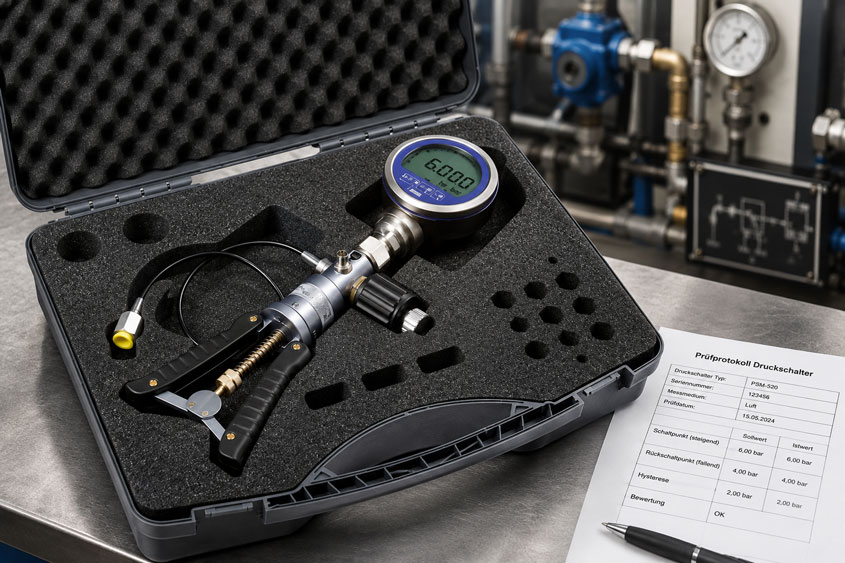
Pressure switches are used in many industrial systems to switch pumps, compressors, hydraulic systems, compressed air networks or process systems at defined pressure values. For example, they are intended to switch on at a defined pressure, switch off again at another pressure, or trigger an alarm in the event of overpressure or underpressure.
For a pressure switch to operate reliably, the switching point and reset point must be checked regularly and correctly adjusted if necessary. A digital pressure gauge serves as a reference instrument with which the actual pressure can be read precisely. This article explains how a simple test setup works, how the switching point and hysteresis are determined and why clean documentation of the measurement results is important. Suitable solutions can be found in the areas of digital pressure gauges / test pressure gauges, calibration kits / test kits and pressure switches / differential pressure switches.
Table of contents
- Why pressure switches should be checked regularly
- Why a digital pressure gauge is useful as a reference instrument
- Test setup: Connecting pressure switch, digital pressure gauge and pressure generation
- Checking the switching point: Slowly increase the pressure
- Checking the reset point: Slowly reduce the pressure
- Calculating and correctly assessing hysteresis
- Reliably detecting the contact status: Normally open, normally closed and changeover contacts
- Pneumatic or hydraulic testing: Which medium is suitable?
- Typical errors when setting pressure switches
- Documenting results: Why the measured value alone is not enough
- Practical example: Pressure switch should switch on at 6 bar and reset at 4 bar
- Suitable products for testing and setting pressure switches
- Conclusion: Safely checking switching point and hysteresis with a digital pressure gauge
- FAQ: Frequently asked questions about testing pressure switches with a digital pressure gauge
Why pressure switches should be checked regularly
A pressure switch performs an important monitoring or control function in many systems. It does not switch continuously like a pressure transmitter, but changes its contact status as soon as a defined pressure is reached or undershot. In pump systems, it can enable or shut down operation, monitor the pressure range in compressors, safeguard limit values in hydraulic systems or trigger an alarm in process systems.
If the switching point is not correct, the system may respond too early, too late or not at all. A pump may then run unnecessarily long, a compressor may start too frequently, a safety alarm may be triggered too late or a machine may operate outside the intended pressure range. In some cases, the fault is not immediately noticeable because the pressure switch still switches in principle. Only during a precise check does it become apparent that the actual switching point no longer matches the specification.
Pressure switches can change due to mechanical stress, vibration, ageing, temperature changes, contamination, media influence or frequent switching cycles. After installation, maintenance work or replacement of a pressure switch, it should also be checked whether the set switching point is actually reached. This is especially important in applications where the switching function is relevant for operational safety, process quality or system protection.
Regular testing therefore ensures not only reliable measured results, but also traceable operational safety. It is essential not only to check whether the pressure switch switches “at some point”, but at which pressure value it switches and at which pressure value it resets.
Why a digital pressure gauge is useful as a reference instrument
A digital pressure gauge is very well suited as a reference instrument for testing a pressure switch because the current pressure value is clearly readable and, depending on the device, can be recorded much more accurately than with a simple analogue pressure gauge. Especially when slowly approaching the switching point, a clearly readable and stable display is important. This makes it easier to assign the moment of switching to a specific pressure value.
Another advantage lies in the resolution and additional functions. Many digital pressure gauges offer min/max functions, tare or zero functions, different pressure units or a higher measuring rate. This is particularly helpful when the pressure is not completely stable or when short pressure peaks occur. When testing pressure switches, however, attention should not only be paid to the displayed value, but also to the accuracy of the reference instrument, the suitable measuring range and the calibration status.
A digital pressure gauge should match the pressure range to be tested. If a pressure switch is tested at 6 bar, a very large measuring range up to 1000 bar is usually not ideal because the usable resolution and accuracy in the lower range may be unfavorable. Conversely, the reference instrument must of course not be overloaded. The measuring range should therefore be selected so that the test point lies well within the measuring range and the accuracy is sufficient for the desired statement.
Digital pressure gauges and test pressure gauges are available for such tasks. For mobile testing in service or maintenance, complete test kits are also useful because pressure generation, reference instrument and connection accessories are available together.
Test setup: Connecting pressure switch, digital pressure gauge and pressure generation
The basic test setup is simple: the pressure switch and digital pressure gauge are connected to the same pressure circuit. The pressure is slowly increased using a hand test pump, calibration pump or suitable pressure source and then slowly reduced again. At the same time, the electrical contact of the pressure switch is monitored so that the switching moment can be clearly detected.
It is important that the pressure switch and digital pressure gauge actually see the same pressure. If narrow lines, valves, long hoses, restrictors or air pockets are located between the reference instrument and the pressure switch, the pressure at the switch may briefly deviate from the displayed reference pressure. For a clean test, the test circuit should therefore be as direct, tight and vented as possible.
The connection threads and seals must also be suitable. Leaking adapters, unsuitable sealants or mechanically stressed connections can falsify the test or cause damage. Especially in small pressure ranges, even a small leak can cause the pressure to drop slowly and prevent the switching point from being recorded reproducibly.
| Part of the test setup | Function | What to consider |
|---|---|---|
| Digital pressure gauge | Displays the reference pressure | Suitable measuring range, accuracy, calibration status |
| Pressure switch | Test item with electrical contact | Switching function, terminal assignment, setpoint |
| Hand test pump / pressure source | Slowly generates and reduces test pressure | Fine adjustment, medium, pressure range |
| Adapters and hoses | Provide the mechanical connection | Tightness, pressure resistance, suitable threads |
| Contact indicator / multimeter | Detects the switching status | Correctly evaluate normally open, normally closed or changeover contacts |
For mobile testing, complete calibration kits and test kits are particularly practical. They combine pressure generation, reference instrument and adapters in a portable set and thereby reduce the setup effort on site.
Checking the switching point: Slowly increase the pressure
To check the upper switching point, the pressure is slowly increased. The pressure should not be increased too quickly because the switching point may otherwise be overshot. Especially with mechanical pressure switches, the switching element does not always react exactly at the moment when the pressure value is briefly reached. A pressure increase that is too fast therefore often leads to inaccurate or poorly reproducible results.
In practice, the pressure is first built up to just below the expected switching point. The pressure is then slowly and carefully increased further. As soon as the contact switches, the pressure value displayed on the digital pressure gauge is noted. This value is the actual switching point at rising pressure.
If the pressure switch is adjustable, the switching point is corrected according to the specification. After each adjustment, the test should be repeated. It is not sufficient to set the adjustment screw to a scale marking and assume that the switching value is therefore exact. Scales on pressure switches are often only adjustment aids. The actual switching point must be checked with a reference instrument.
A stable pressure condition just before the switching point is particularly important. If the pressure in the test circuit fluctuates, the contact may switch several times or the switching point may appear unclear. In this case, it should first be checked whether there is air in the system, a leak, pressure adjustment that is too coarse or an unstable test setup.
Checking the reset point: Slowly reduce the pressure
After switching at rising pressure, the pressure is slowly reduced again. The pressure switch initially remains in the switched state. Only when the pressure falls below a certain value does the contact return to its original state. This value is the reset point.
The reset point is just as important in practice as the switching point. It determines when a pump switches on again, when a compressor restarts or when an alarm is reset. If the reset point is too close to the switching point, the system may switch on and off frequently. If it is too far away, the pressure range may become too large.
When reducing the pressure, work should also be carried out slowly and in a controlled manner. If the pressure is released too quickly, the reset point may be recorded inaccurately. The contact status should be observed continuously. As soon as the pressure switch resets, the pressure value on the digital pressure gauge is noted.
For pressure switches with adjustable switching differential, the reset point can be influenced specifically. In many simple mechanical pressure switches, however, the differential is design-related or can only be changed to a limited extent. Before adjustment, it should therefore always be checked whether the respective pressure switch can change only the switching point or also the switching differential.
Calculating and correctly assessing hysteresis
Hysteresis, also called switching differential, is the distance between the switching point and the reset point. It prevents the pressure switch from constantly switching on and off during small pressure fluctuations. Without sufficient hysteresis, a pressure switch would operate unsteadily in many systems, especially when the pressure fluctuates near the switching point.
The calculation is simple: the reset point is subtracted from the switching point. If a pressure switch switches at 6 bar at rising pressure and resets at 4 bar at falling pressure, the hysteresis is 2 bar.
| Switching point at rising pressure | Reset point at falling pressure | Hysteresis |
|---|---|---|
| 6.0 bar | 4.0 bar | 2.0 bar |
| 10.0 bar | 8.5 bar | 1.5 bar |
| 2.5 bar | 2.2 bar | 0.3 bar |
Whether a hysteresis is suitable depends on the application. In a pump control system, a larger differential can be useful so that the pump does not cycle constantly. For an alarm function, on the other hand, a smaller differential may be desired so that the alarm condition is reset as close to the limit value as possible. Different requirements apply in compressed air systems, hydraulic systems or filter monitoring.
It is important not to consider the measured hysteresis in isolation. It must match the function of the system. A pressure switch can work correctly from a technical point of view, but still be set unfavorably for the specific application. The test should therefore always be compared with the system requirements.
Reliably detecting the contact status: Normally open, normally closed and changeover contacts
Depending on the version, a pressure switch can be designed as a normally open, normally closed or changeover contact. With a normally open contact, the contact closes when the switching point is reached. With a normally closed contact, the contact opens. A changeover contact usually has a common contact as well as a normally closed and a normally open contact.
For the test, it is essential to understand the terminal assignment correctly. If the wrong contact is evaluated, the switching point may be interpreted incorrectly. In practice, this often happens when the pressure switch has several connection options or when it is not clear whether the contact should be considered at rising or falling pressure.
The contact status can be monitored with a multimeter, continuity test, signal lamp or a suitable switching input on the test instrument. It is important that the electrical part is set up safely and appropriately for the application. If the pressure switch is already connected to a control system in an installation, it should be clarified before testing whether the switch is removed, electrically disconnected or tested while installed.
Special care is required in safety-relevant applications. A pressure switch can be part of a shutdown, alarm or protective function. In such cases, the test must not cause the system to start, shut down or bypass a protective function unintentionally.
Pneumatic or hydraulic testing: Which medium is suitable?
The choice of test medium depends on the pressure range, the pressure switch and the application. For low to medium pressure ranges, pneumatic testing with air is often used. This is clean, simple and particularly obvious for compressed air or gas applications. For higher pressure ranges or hydraulic applications, hydraulic calibration pumps with oil or water are often used instead.
Pneumatic tests have the advantage that no liquid is introduced into the pressure switch or test setup. At the same time, air is compressible. This means that the pressure can behave differently with small volume changes than during a hydraulic test. Pressure generation can feel more elastic and fluctuate more quickly in the event of leaks.
Hydraulic tests enable more stable pressure generation at higher pressures. They are particularly suitable when pressure switches in hydraulic systems are tested or when the required test pressure should not reasonably be generated with air. However, it must be ensured that the test medium is compatible with the pressure switch and the later application.
Complete service kits such as the WIKA CPG-KITP pneumatic service kit are suitable for pneumatic test tasks. For higher pressures or hydraulic applications, corresponding hydraulic calibration pumps or hydraulic test kits can be useful.
Typical errors when setting pressure switches
Many incorrect settings are not caused by a defective device, but by the test procedure. A common error is increasing the pressure too quickly. The switching point is then exceeded before the actual switching moment is clearly detected. This makes the pressure switch appear less accurate than it actually is.
Another common error is a test setup that is not vented or is leaking. Air pockets, loose screw connections or unsuitable adapters can cause the pressure not to remain stable. This can lead to incorrect results, especially when testing the reset point, because the pressure is not reduced in a controlled manner.
The wrong measuring range of the digital pressure gauge can also be problematic. A reference instrument with a measuring range that is too large may be less suitable at the relevant test point than a device with a better matching range. Conversely, the digital pressure gauge must not be operated at its pressure limit. The decisive factor is the combination of measuring range, accuracy, resolution and calibration status.
In practice, it is also often forgotten to document the contact status clearly. If only one pressure value is noted, but it is not clear whether it was recorded at rising or falling pressure, the result is hardly usable later. For this reason, switching point, reset point and hysteresis should always be considered together.
Documenting results: Why the measured value alone is not enough
Clean documentation is particularly important when testing pressure switches. The pure switching point tells only part of the story. For a traceable test, the reset point, hysteresis, test medium, reference instrument, measuring range, calibration status, ambient conditions and, if applicable, the installation situation should also be documented.
If a pressure switch is tested again later, the results can be compared with previous values. This makes it possible to determine whether the switching point has remained stable or whether there is a gradual change. This is particularly helpful in systems where pressure switches perform an important protective or control function.
Complete documentation is also useful for complaints, maintenance records or internal test processes. It shows not only that the pressure switch was tested, but also how the test was carried out and whether the results were within the specifications.
| Documented value | Meaning for the assessment |
|---|---|
| Switching point at rising pressure | Shows when the pressure switch trips or switches on |
| Reset point at falling pressure | Shows when the contact returns to its original state |
| Hysteresis | Assesses the switching differential between both points |
| Reference instrument | Enables traceability of the measurement |
| Test medium | Helps assess dynamic behavior and compatibility |
| Assessment | Shows whether the specification has been met or whether adjustment is required |
Especially for recurring tests, it is worth recording the results consistently. This makes differences between several pressure switches, changes over time and possible setting errors visible much faster.
Practical example: Pressure switch should switch on at 6 bar and reset at 4 bar
In a system, a mechanical pressure switch should operate so that it switches on at 6 bar at rising pressure and resets at 4 bar at falling pressure. The desired hysteresis is therefore 2 bar. Since the system has been switching too frequently in the past, it needs to be checked whether the pressure switch is still correctly adjusted.
The pressure switch is connected to a hand test pump together with a digital pressure gauge. In addition, the electrical contact is monitored with a multimeter. First, the pressure is slowly increased. Shortly before 6 bar, pumping is continued particularly carefully so that the switching point is not overshot. The contact switches at 5.6 bar. The switching point is therefore below the specification.
The pressure is then slowly reduced. The contact resets at 4.3 bar. The measured hysteresis is therefore 1.3 bar. This explains why the system switches more frequently than desired: the pressure switch switches on too early and resets too early, and the switching differential is also smaller than intended.
After adjustment, the test procedure is repeated. During the new measurement, the pressure switch switches at 6.0 bar and resets at 4.0 bar. The hysteresis is 2.0 bar. The result is documented with reference instrument, test medium, switching point, reset point and assessment.
This example shows why testing both points is important. If only the switch-on point had been considered, the insufficient hysteresis might have remained undetected.
Suitable products for testing and setting pressure switches
Precise digital pressure gauges and test pressure gauges are suitable for testing pressure switches and are used as reference instruments in the test circuit. Depending on the pressure range, accuracy requirement and place of use, a compact digital pressure gauge for maintenance or a more precise reference instrument for calibration and service tasks may be useful.
If pressure switches are regularly tested or adjusted on site, complete test kits are particularly practical. The WIKA CPG-KITP pneumatic service kit, for example, combines pressure generation and a reference digital pressure gauge in a mobile test case and is suitable for pneumatic tests. For hydraulic applications, corresponding calibration kits and test kits as well as hydraulic calibration pumps are available.
The article is also relevant for the selection and testing of pressure switches and differential pressure switches. For mechanical pressure switches such as the WIKA PSM-520 pressure switch or other industrial pressure switches, the set switching point should always be checked with a suitable reference instrument after installation.
Conclusion: Safely checking switching point and hysteresis with a digital pressure gauge
A pressure switch should not only be set according to the scale, but checked with a suitable reference instrument. A digital pressure gauge makes the actual pressure value visible and helps to determine the switching point, reset point and hysteresis in a traceable way.
A clean test procedure is essential: the pressure is slowly increased, the switching point is noted, then the pressure is slowly reduced and the reset point is recorded. The hysteresis results from both values. Only when all three variables match the application can the pressure switch be reliably assessed.
For recurring tests, service work and maintenance, suitable digital pressure gauges, test kits and suitable pressure switches are essential. They enable reproducible testing and clean documentation of the measurement results.
FAQ: Frequently asked questions about testing pressure switches with a digital pressure gauge
Can a pressure switch be set with a digital pressure gauge?
Yes. The digital pressure gauge serves as a reference instrument and displays the actual test pressure. The pressure switch is then tested at slowly rising and falling pressure and adjusted if necessary.
What is the switching point of a pressure switch?
The switching point is the pressure value at which the pressure switch changes its contact status. Depending on the application, this can be a switch-on point, switch-off point or alarm point.
What is the reset point?
The reset point is the pressure value at which the pressure switch returns to its original state when the pressure is reduced. In many applications, it is below the switching point.
What does hysteresis mean in a pressure switch?
Hysteresis is the difference between the switching point and the reset point. It prevents the pressure switch from constantly switching on and off during small pressure fluctuations.
How do you check the hysteresis of a pressure switch?
First, the pressure is slowly increased and the switching point is noted. Then the pressure is slowly reduced and the reset point is noted. The difference between both values is the hysteresis.
Why should the pressure be increased slowly?
If the pressure is increased too quickly, the actual switching point can be overshot. A slow pressure change ensures that the switching moment can be detected and documented more accurately.
Why is the scale on the pressure switch not sufficient?
The scale on a mechanical pressure switch is often only an adjustment aid. The actual switching point depends on the device, installation situation and setting and should therefore be checked with a reference instrument.
Which measuring instrument is suitable for testing pressure switches?
Precise digital pressure gauges or test pressure gauges with a suitable pressure range, sufficient accuracy and valid calibration status are suitable.
When is a test kit useful?
A test kit is useful when pressure switches are regularly tested or adjusted on site. Depending on the version, it contains pressure generation, reference instrument, hoses and adapters in a mobile set.
Can pressure switches be tested while installed?
This may be possible depending on the system, but it must be professionally assessed. It is important that the pressure switch can be safely isolated from the process or pressurized in a controlled way and that no unintended switching operations are triggered in the system.
Which products are suitable for testing pressure switches?
Digital pressure gauges and test pressure gauges, complete calibration kits / test kits and, depending on the application, pneumatic or hydraulic calibration pumps are suitable for testing. Suitable pressure switches and differential pressure switches are available for use in systems.