→ PRODUCT
→ Datasheet
In modern production environments, components and assemblies must not only be manufactured quickly but also tested reliably. This is particularly important for products that are later exposed to pressure or that measure and process pressure signals. For such products, controlled end-of-line testing is an essential part of quality assurance.
End-of-line testing takes place at the end of the manufacturing process. It ensures that only tested and fully functional products are shipped or transferred to the next production stage. Typical test tasks include leak testing, functional testing, pressure stress testing, and verification of output signals at defined pressure points.
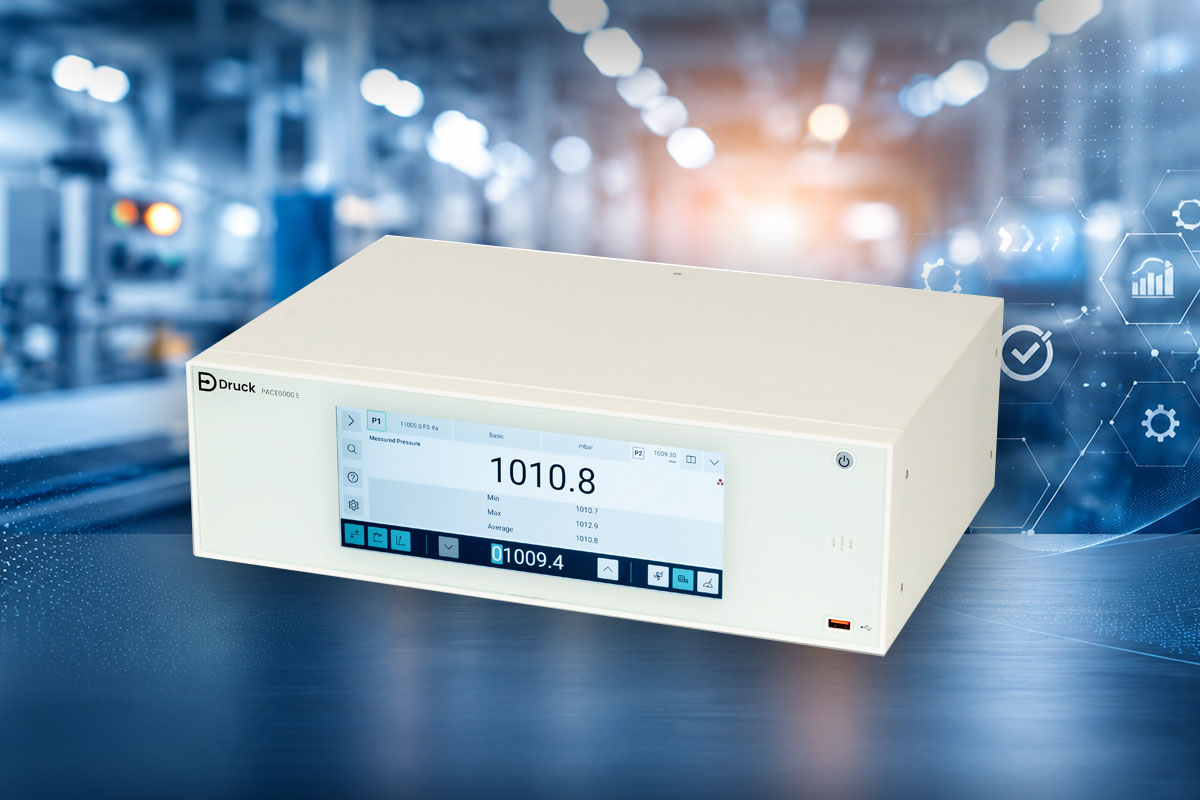
With the PACE6000E Precision Pressure Controller, such pressure tests can be performed automatically, reproducibly, and efficiently. Thanks to its fast pressure control, two independent control channels, auto-ranging functionality, and flexible communication interfaces, the PACE6000E is particularly suitable for automated production test benches and demanding end-of-line applications.
In this article, we explain how end-of-line pressure testing works, the advantages of automated test systems, and why the PACE6000E is a powerful solution for a wide range of industrial testing tasks.
What Does End-of-Line Testing Mean?
End-of-line testing (EOL testing) refers to the final quality inspection of a product immediately before shipment or before it moves to the next production stage. The objective is to ensure that every manufactured component meets the specified technical requirements and functions correctly.
In many industries, end-of-line testing has become one of the most important elements of quality assurance. Defective products not only result in warranty claims and complaint costs but can also cause production downtime or safety-critical situations for the end user.
For this reason, many tests are now carried out automatically. Automation reduces operator influence, increases repeatability, and enables complete documentation of all test results.
Depending on the product and industry, different testing methods may be used:
- Functional testing
- Leak testing
- Pressure testing
- Electrical testing
- Calibration verification
- Safety testing
Pressure testing is particularly common. It enables the rapid verification of sensors, pressure transmitters, valves, pneumatic and hydraulic components, as well as complete assemblies.
| Test Type |
Purpose of the Test |
| Leak Test |
Detect leaks |
| Functional Test |
Verify correct operation |
| Pressure Test |
Check measurement or load behavior |
| Calibration Verification |
Detect measurement deviations |
| Safety Test |
Meet standards and requirements |
Electronic precision pressure controllers are frequently used for pressure testing today. They generate defined test pressures, regulate them automatically, and enable reproducible testing independent of the operator.
A typical example is the PACE6000E Precision Pressure Controller. Thanks to its high control speed and automation capabilities, it is ideally suited for modern end-of-line test benches.
The Role of Pressure Testing at the End of Manufacturing
Pressure is one of the most important measured variables in industrial applications. Numerous products are designed to operate under pressure, withstand pressure, or accurately measure pressure values. Even minor deviations can affect functionality, service life, or safety.
For this reason, pressure testing is an integral part of end-of-line testing in many industries. It ensures that every product leaving the production line meets the specified requirements.
Pressure testing is used not only to verify pressure resistance but also to evaluate functionality, measurement accuracy, leak tightness, and switching behavior.
Why Pressure Testing Is So Important
Manufacturing processes always involve tolerances. Components, sensors, seals, electronic assemblies, and mechanical connections may differ slightly from one product to another.
Without final testing, these deviations may remain undetected and only become apparent during operation at the customer’s site.
Typical defects detected by pressure testing include:
- Leaks
- Incorrect sensor calibration
- Faulty pressure measurement
- Assembly errors
- Defective seals
- Incorrect switching points
- Mechanical damage
Detecting these issues before shipment significantly reduces quality costs.
Pressure Testing in Different Industries
End-of-line pressure testing is used across a wide range of industrial sectors.
| Industry |
Typical Test Objects |
| Process Industry |
Pressure transmitters, pressure sensors |
| Mechanical Engineering |
Valves, regulators, hydraulic components |
| Automotive Industry |
Fuel systems, brake systems, sensors |
| Medical Technology |
Pumps, pressure sensors, respiratory systems |
| Pneumatics |
Valves, cylinders, control units |
| Hydraulics |
Hydraulic valves, pumps, assemblies |
Depending on the application, the test pressures may range from a few millibars to several hundred bar.
Typical Objectives of a Pressure Test
Pressure testing can serve several purposes simultaneously. In many cases, multiple quality criteria are evaluated within a single automated test sequence.
| Test Objective |
Purpose |
| Leak Test |
Detect leaks |
| Functional Test |
Verify product operation |
| Pressure Resistance Test |
Verify mechanical stability |
| Calibration Verification |
Check measurement accuracy |
| Switch Point Test |
Verify pressure switch behavior |
As a result, end-of-line testing often combines several quality assurance measures within a single test station.
Increasing Requirements in Modern Production
Manufacturers today face growing demands regarding documentation, traceability, and production throughput. Customers increasingly expect complete records proving that each product was tested before delivery.
At the same time, production lines must achieve ever shorter cycle times.
This combination creates new challenges:
- Short test times
- High accuracy requirements
- Automatic documentation
- Reliable traceability
- High production volumes
- Multiple product variants
These requirements can only be met efficiently with automated test systems.
The Role of Precision Pressure Controllers
Modern precision pressure controllers such as the PACE6000E form the heart of many automated pressure test benches.
They generate highly accurate test pressures, control them automatically, and provide stable pressure conditions throughout the test cycle. Their high control speed significantly reduces testing time while maintaining excellent measurement performance.
As a result, manufacturers can increase throughput, improve product quality, and create complete digital records of all test results.
Typical Test Objects in End-of-Line Pressure Testing
Pressure testing is used in numerous industries and for a wide variety of products. The exact test sequence depends on the application, pressure range, and quality requirements. Nevertheless, many products share a common requirement: they must function reliably under defined pressure conditions.
Modern end-of-line test benches therefore test not only whether pressure can be applied but also whether the product reacts correctly to the specified pressure.
Pressure Sensors and Pressure Transmitters
One of the most common applications is the testing of pressure sensors and pressure transmitters. These devices are used throughout industry to measure pressure and convert it into electrical signals.
Typical end-of-line tests include:
- Zero point verification
- Span verification
- Linearity testing
- Output signal verification
- Repeatability testing
- Calibration checks
Pressure controllers such as the PACE6000E generate highly accurate reference pressures for these tests.
Pressure Switches
Pressure switches are designed to activate or deactivate an electrical contact when a predefined pressure level is reached.
End-of-line testing verifies:
- Switch-on pressure
- Switch-off pressure
- Switching hysteresis
- Response behavior
- Repeatability
Automated pressure ramps generated by the pressure controller allow these tests to be performed quickly and consistently.
Valves and Pressure Regulators
Valves and pressure regulators must also be tested before shipment. Even minor deviations can affect system performance and lead to failures in the field.
Typical test procedures include:
- Leak testing
- Opening pressure verification
- Closing pressure verification
- Control characteristic testing
- Pressure resistance testing
- Functional testing under operating pressure
Depending on the application, several pressure levels may be automatically approached and evaluated.
Pneumatic Components
Pneumatic systems are used in almost every industrial sector. Cylinders, valves, manifolds, regulators, and complete assemblies must operate reliably over their entire pressure range.
Typical end-of-line tests include:
| Test Criterion |
Purpose |
| Leak Tightness |
Detection of leaks |
| Response Time |
Verification of switching behavior |
| Pressure Resistance |
Verification of mechanical strength |
| Pressure Drop |
Evaluation of flow characteristics |
| Functional Testing |
Verification of operational readiness |
Fast pressure generation and stable pressure control are particularly important in these applications in order to achieve short cycle times.
Hydraulic Components
Hydraulic systems often operate at significantly higher pressures than pneumatic systems. As a result, the requirements placed on test equipment are correspondingly more demanding.
Typical test objects include:
- Hydraulic valves
- Hydraulic pumps
- Pressure control units
- Hydraulic cylinders
- Complete hydraulic assemblies
End-of-line testing verifies both functionality and mechanical integrity under defined pressure conditions.
Medical Devices
Pressure-controlled systems are also increasingly found in medical technology. Examples include ventilators, infusion systems, pumps, and medical sensors.
These applications place particularly high demands on reliability and documentation.
Typical testing requirements include:
- Pressure accuracy verification
- Leak testing
- Alarm function verification
- Sensor calibration checks
- Complete test documentation
Automated pressure testing supports manufacturers in meeting regulatory and quality requirements.
Complete Assemblies and Systems
Many companies do not only test individual components but complete assemblies before shipment. In these cases, end-of-line testing verifies whether all installed components function correctly together.
| Assembly Type |
Typical Test Objectives |
| Control Cabinet |
Functional testing |
| Pneumatic Unit |
Leak and functional testing |
| Hydraulic Power Pack |
Pressure and load testing |
| Measuring Instrument |
Calibration verification |
| Process Skid |
System functionality verification |
These tests are often significantly more complex than individual component tests and require flexible pressure control systems.
One Pressure Controller for Many Applications
The wide variety of test objects illustrates why modern production environments require highly flexible pressure control systems.
With its modular architecture, dual-channel capability, and auto-ranging functionality, the PACE6000E Precision Pressure Controller can be adapted to a wide range of testing applications. From pressure sensor testing and valve verification to complete assembly testing, a single system can cover numerous end-of-line testing requirements.
The PACE6000E as a Pressure Controller for End-of-Line Test Benches
The performance of an end-of-line test bench largely depends on the quality of the pressure control system used. While simple pressure sources often provide only an approximate test pressure, modern production test benches require fast, precise, and fully automated pressure control.
The PACE6000E Precision Pressure Controller was developed specifically for these requirements. The system combines high control speed, excellent pressure stability, and extensive communication capabilities in a compact instrument.
This makes the PACE6000E suitable for both simple production tests and complex automated test benches with demanding requirements for accuracy, traceability, and throughput.
Precise Pressure Generation and Control
Unlike manual pressure sources, the PACE6000E generates the desired test pressure automatically. The operator or test software simply specifies the setpoint. The system then regulates itself to the required pressure and maintains it with high stability.
This ensures reproducible test conditions for every individual device under test.
| Function |
Benefit for the Test Bench |
| Automatic Pressure Control |
Consistent test results |
| Rapid Setpoint Achievement |
Shorter cycle times |
| Stable Pressure Holding |
More accurate measurements |
| Programmable Pressure Profiles |
Automated test sequences |
| High Repeatability |
Comparable results |
Designed Specifically for Automated Test Processes
Production test benches often operate around the clock. Thousands of devices under test must be evaluated under identical conditions. Any variation in the test sequence can result in incorrect measurements or unnecessary product rejection.
The PACE6000E was developed specifically for these types of applications. Its fully digital pressure control system delivers exceptional repeatability over extended periods of operation.
Features that are particularly important in production environments include:
- Short settling times
- High control stability
- Low long-term drift
- High system availability
- Easy integration into test software
Flexible Adaptation to Different Test Tasks
Many manufacturing facilities produce different product variants or use multiple pressure ranges within a single production line. As a result, test benches must be as flexible as possible.
The PACE6000E can be equipped with different CM and CM3 control modules. This allows the system to be configured precisely to match the requirements of each individual application.
| Application |
Typical Pressure Range |
| Sensor Testing |
mbar to a few bar |
| Pneumatic Components |
0 to 10 bar |
| Process Instrumentation |
0 to 70 bar |
| Hydraulic Components |
Higher pressure ranges |
Thanks to its modular architecture, the same pressure controller can be used in a wide variety of test bench configurations.
Investment Protection Through a Modular Platform
Another major advantage is long-term flexibility. When testing requirements change or new product variants are introduced, it is often unnecessary to replace the entire test system. In many cases, simply changing or expanding the installed control modules is sufficient.
This reduces investment costs and increases the long-term viability of the testing solution.
Combined with its high control speed, extensive communication interfaces, and dual-channel technology, the PACE6000E is one of the most capable pressure controllers available today for automated end-of-line test benches and industrial pressure testing applications.
Why Fast and Stable Pressure Control Is So Important
In modern production environments, every second counts. Manufacturing lines are designed for short cycle times, and testing processes should not slow down product flow. At the same time, the quality requirements for test results continue to increase. This is where pressure control plays a critical role.
A pressure test bench is only as effective as its ability to provide a defined test pressure quickly, accurately, and repeatably. Long settling times, pressure fluctuations, or unstable control behavior directly increase testing time and can compromise measurement quality.
The PACE6000E Precision Pressure Controller was specifically designed to address these challenges. It combines very fast pressure control with exceptional stability, making it ideal for automated end-of-line test benches.
Short Cycle Times Require Rapid Pressure Changes
In many production lines, only a few seconds are available for the entire test sequence. The required test pressure must therefore be reached as quickly as possible without overshoot or instability.
Every second saved has a direct impact on overall production efficiency.
| Influencing Factor |
Impact on the Test Process |
| Long Pressure Build-Up Time |
Longer cycle time |
| Unstable Pressure Control |
Unreliable test results |
| Overshoot |
Additional waiting time |
| Fast Pressure Control |
More units tested per hour |
| Stable Pressure Holding |
Higher test quality |
Depending on production volume, even a few seconds of time savings per unit can produce significant economic benefits.
Why Pressure Stability Matters
Reaching a pressure setpoint quickly is only part of the requirement. The pressure must then remain stable so that sensors, transmitters, or assemblies can be tested under constant conditions.
Even small pressure fluctuations can influence measurement results and lead to unnecessary rejection of otherwise acceptable products. This is particularly important when testing high-accuracy pressure sensors or performing calibration checks directly in production.
Stable pressure control provides:
- Repeatable test results
- Reduced measurement uncertainty
- Lower reject rates
- Improved process reliability
- Better comparability of results
Impact on Overall Equipment Effectiveness (OEE)
In production environments, Overall Equipment Effectiveness (OEE) is often used as a key performance indicator. OEE combines availability, performance, and quality into a single metric.
Fast and stable pressure control positively influences all three factors simultaneously:
| OEE Factor |
Contribution of the Pressure Controller |
| Availability |
Fewer testing interruptions |
| Performance |
Shorter testing cycles |
| Quality |
More reliable measurement results |
As a result, pressure control directly contributes to the economic efficiency of the entire production line.
Particularly Important for Automated Test Benches
Automated end-of-line test benches often operate without continuous operator supervision. The pressure control system must therefore function reliably on its own and deliver identical results over thousands of test cycles.
The PACE6000E was specifically developed for these requirements. Its digital control architecture enables rapid pressure generation, stable pressure holding, and excellent repeatability over extended operating periods.
This allows manufacturers to reduce test cycle times, improve test quality, and further increase the automation level of their production processes.
Dual-Channel Technology for Flexible Test Sequences
One of the most important features of the PACE6000E Precision Pressure Controller is its dual-channel technology. Unlike conventional single-channel pressure controllers, the PACE6000E can accommodate two independent control modules simultaneously.
This provides two pressure ranges that are permanently available. Users do not need to switch pressure sources or exchange control modules. This significantly increases test bench flexibility while reducing downtime.
This architecture offers substantial advantages, particularly in production environments with multiple product variants.
Two Pressure Ranges in One Instrument
Many manufacturing facilities test products with different pressure requirements. One sensor may operate in the range of 0 to 1 bar, while another may be designed for pressures up to 70 bar.
Conventional testing systems often require multiple reference instruments or manual reconfiguration of the test bench.
The PACE6000E, by contrast, can accommodate two different control modules simultaneously.
| Control Module |
Example Range |
Typical Application |
| CM3 Module A |
0 … 1 bar |
Sensors, low-pressure testing |
| CM3 Module B |
0 … 70 bar |
Transmitters, industrial applications |
This enables a single test bench to test different products without requiring hardware changes.
Reduced Changeover Times in Production
Every test bench reconfiguration results in costs. Production equipment remains idle during this period and cannot perform testing operations.
Dual-channel technology significantly reduces these changeover times because multiple pressure ranges remain permanently available.
- No need to exchange reference instruments
- No removal or installation of pressure modules
- Faster product changeovers
- Higher equipment availability
- Greater flexibility for product variants
This can significantly increase productivity, particularly in production lines with frequent product changes.
Ideal for Multiple Product Families
Many manufacturers produce different product variants on the same production line. In many cases, the primary difference between these products is their pressure range.
The test bench must therefore be flexible enough to process different test specifications automatically.
| Product |
Test Pressure |
| Pressure Sensor Type A |
0 … 500 mbar |
| Pressure Sensor Type B |
0 … 1 bar |
| Pressure Transmitter Type C |
0 … 16 bar |
| Pressure Transmitter Type D |
0 … 70 bar |
With two installed control modules, the PACE6000E can handle these different products within the same test bench.
The Foundation for Auto-Ranging
Dual-channel technology also forms the technical basis for the PACE6000E’s auto-ranging functionality.
Because multiple pressure ranges are available simultaneously, the system can automatically select the optimum range. This not only increases flexibility but also improves measurement accuracy across a wide pressure range.
This represents a significant advantage over traditional single-channel systems, particularly in end-of-line test benches used to test different sensors or assemblies.
Advantages of Dual-Channel Technology at a Glance
| Advantage |
Benefit for the User |
| Two control modules |
Multiple pressure ranges available simultaneously |
| Reduced changeovers |
Higher productivity |
| Product changes without hardware modifications |
Greater flexibility |
| Auto-ranging capability |
Automatic pressure range selection |
| Automated test sequences |
Shorter testing times |
Dual-channel technology makes the PACE6000E a particularly powerful solution for modern end-of-line test benches where different products must be tested efficiently, accurately, and automatically.
Auto-Ranging for Changing Pressure Ranges
In many manufacturing facilities, different product variants must be tested on the same test bench. These products often differ not only mechanically or electrically, but also in their required pressure ranges. While one sensor may operate in the range of a few hundred millibars, another device under test may be designed for several dozen bar.
This is precisely where the auto-ranging functionality of the PACE6000E Precision Pressure Controller offers its greatest advantages. The system can automatically select the optimum pressure range, improving test accuracy without requiring any manual intervention.
This simplifies product changeovers while simultaneously accelerating testing procedures.
What Does Auto-Ranging Mean?
Auto-ranging refers to the automatic selection of the most suitable pressure range for a specific testing task. Instead of using one large pressure range for all applications, the pressure controller always utilizes the control channel that provides the highest accuracy and resolution.
This capability is enabled by the dual-channel architecture of the PACE6000E.
| Control Module |
Pressure Range |
| CM3 Module A |
0 … 1 bar |
| CM3 Module B |
0 … 70 bar |
Depending on the required test pressure, the system automatically selects the optimum control module.
Why Is Auto-Ranging Useful in End-of-Line Test Benches?
Production test benches frequently need to test different product variants in succession. Without auto-ranging, this would often require multiple pressure controllers or regular reconfiguration of the test bench.
Both approaches increase costs and operational complexity.
With auto-ranging, different pressure ranges can be utilized within a single system.
| Product |
Test Pressure |
Automatically Selected Range |
| Pressure Sensor |
0.2 bar |
0 … 1 bar |
| Pressure Sensor |
0.8 bar |
0 … 1 bar |
| Pressure Transmitter |
10 bar |
0 … 70 bar |
| Pressure Transmitter |
50 bar |
0 … 70 bar |
The operator or test software does not need to manage pressure range selection manually.
Improved Measurement Accuracy
One of the key advantages of auto-ranging is improved measurement performance. The accuracy of a pressure control system depends not only on the sensor itself but also on how well the selected measurement range matches the actual test pressure.
If a very low test pressure is generated using a large pressure range, resolution is reduced. Auto-ranging automatically prevents this issue.
- Higher resolution
- Improved repeatability
- Lower measurement uncertainty
- Optimal utilization of control modules
- Consistent test quality
Reduced Operator Intervention
Every manual intervention in an automated testing process consumes time and introduces the possibility of errors. Auto-ranging significantly reduces the need for operator involvement.
The test bench can automatically identify different products and start the appropriate test sequence. The PACE6000E then independently selects the optimum pressure range.
| Without Auto-Ranging |
With Auto-Ranging |
| Manual range selection |
Automatic selection |
| Higher training requirements |
Simplified operation |
| Greater risk of errors |
Fewer operator mistakes |
| Longer changeover times |
Faster product transitions |
Particularly Valuable in High-Mix Manufacturing
The greater the number of different products manufactured on a production line, the greater the impact of auto-ranging on productivity and test quality.
Manufacturers of pressure sensors, pressure transmitters, valves, or pneumatic assemblies can test multiple product families using a single test bench without requiring hardware modifications.
This reduces capital investment costs while significantly increasing manufacturing flexibility.
For many modern end-of-line test benches, auto-ranging has therefore become one of the most important pressure controller functions. Combined with its dual-channel technology, it makes the PACE6000E an exceptionally powerful solution for automated production testing.
Integration into Automated Production Test Benches
High pressure control accuracy alone is not sufficient for modern end-of-line testing. Equally important is the seamless integration of the pressure controller into existing test benches, production lines, and automation systems. Only when communication between test software, control systems, and the pressure controller functions reliably can fully automated testing processes be achieved.
The PACE6000E Precision Pressure Controller was specifically designed for these requirements. Thanks to its comprehensive communication interfaces and automation capabilities, it can be easily integrated into existing production environments.
This allows the pressure controller to be fully controlled by test software or a PLC without requiring operator intervention.
Automated Testing Without Operator Intervention
In modern manufacturing facilities, testing is often integrated directly into the production process. As soon as a device under test reaches the test station, the test software automatically starts the corresponding test sequence.
The pressure controller then handles pressure generation and pressure regulation. Once the test is complete, the results are automatically recorded and evaluated.
A typical sequence may look as follows:
- The device under test is placed in the test station
- The product is automatically identified
- The appropriate test program is loaded
- The PACE6000E generates the defined test pressures
- Measurement data is recorded and evaluated
- Test results are documented
- The product is approved or rejected
The entire process can be completed fully automatically within just a few seconds.
Communication with PLCs and Test Software
In most production systems, a PLC or central test software package controls the entire testing process. The pressure controller acts as a highly accurate pressure source while simultaneously providing the reference pressure values used for evaluating the device under test.
| System Component |
Function |
| Test Software |
Controls and evaluates the testing process |
| PLC |
Machine and process control |
| PACE6000E |
Pressure control and reference pressure generation |
| Measurement System |
Acquisition of test data |
| Database |
Storage of test results |
This clear distribution of tasks creates a powerful and scalable testing system.
Ideal for Inline and Offline Test Benches
The PACE6000E can be integrated into both inline test benches located directly within production lines and standalone testing stations.
- Automated production lines
- Robotic cells
- Semi-automatic test stations
- Laboratory test benches
- Calibration stations
- End-of-line test benches
This makes the system suitable for both small production batches and highly automated mass-production environments.
High Availability for 24/7 Operation
Production systems often operate around the clock or in multiple shifts. The components used must therefore function reliably and deliver stable results over extended periods.
The digital control architecture of the PACE6000E was specifically developed for continuous operation. Fast response times, excellent stability, and minimal drift support reliable operation even at high production volumes.
| Requirement |
Benefit for the Test Bench |
| 24/7 operation |
High system availability |
| Fast communication |
Shorter test cycles |
| Automated processes |
Reduced operator workload |
| High control stability |
Consistent test results |
| Comprehensive documentation |
Full production traceability |
The ease with which it can be integrated into existing automation environments is one of the key reasons why the PACE6000E is used in numerous automated end-of-line test benches today. It combines precise pressure control with modern communication technology, enabling efficient, repeatable, and fully documented testing processes.
Interfaces and Communication with Test Software
The performance of an automated end-of-line test bench is not determined solely by pressure control. Equally important is communication between the test software, the control system, and the pressure controller. Only when all components communicate reliably can fast, repeatable, and fully documented testing processes be achieved.
The PACE6000E Precision Pressure Controller was specifically developed for integration into modern automation environments. It supports multiple communication interfaces, allowing seamless integration into existing production and testing systems.
The Central Role of the Pressure Controller in the Test Bench
In an automated test bench, the pressure controller is responsible for generating defined pressure values and regulating them precisely. The higher-level test software controls the testing sequence and evaluates the results.
The PACE6000E acts as both a highly accurate pressure source and a reference pressure system.
| Component |
Function |
| Test Software |
Control and evaluation |
| PLC |
Machine and process control |
| PACE6000E |
Pressure control and reference pressure generation |
| Device Under Test |
Product being tested |
| Database |
Storage of test results |
This architecture enables fully automated and documented testing procedures.
Available Communication Interfaces
The PACE6000E offers several interfaces for integration into test benches and automation systems. This makes it suitable for both simple test stations and complex production environments.
| Interface |
Typical Application |
| Ethernet |
Network-based test systems |
| USB |
Direct connection to a test PC |
| RS232 |
Existing automation systems |
| IEEE-488 / GPIB (optional) |
Calibration and laboratory applications |
This flexibility allows the pressure controller to be integrated into a wide variety of system architectures.
Control via SCPI Commands
For automation purposes, the PACE6000E supports standardized SCPI commands (Standard Commands for Programmable Instruments). These commands have been widely established in testing and measurement systems for many years.
Using SCPI, test software can perform functions such as:
- Setting pressure setpoints
- Starting pressure profiles
- Reading measurement values
- Retrieving status information
- Performing leak tests
- Automating switch tests
This allows even complex testing procedures to be implemented without proprietary software solutions.
Automatic Data Acquisition
One of the major advantages of automated test benches is the complete documentation of all test results. Every test can be automatically stored and linked to the corresponding product.
This not only improves quality assurance but also supports traceability in the event of customer complaints.
| Recorded Data |
Benefit |
| Test pressure |
Proof of testing |
| Measurement values |
Quality evaluation |
| Timestamp |
Traceability |
| Serial number |
Product identification |
| Test result |
Approval or rejection |
The Foundation for Industry 4.0
More and more companies are digitizing their manufacturing processes. Production data must be available in real time and automatically transferred to quality management or ERP systems.
Thanks to its modern communication interfaces, the PACE6000E can be seamlessly integrated into Industry 4.0 environments. Test benches thereby become an active part of the digital production process.
The combination of precise pressure control, standardized communication protocols, and easy integration makes the PACE6000E a powerful platform for modern automated end-of-line testing and production test benches.
Typical Sequence of an End-of-Line Pressure Test
An end-of-line test is designed to ensure that every manufactured product meets the specified quality requirements before shipment or before moving to the next production stage. To achieve this economically at high production volumes, testing procedures are now largely automated.
The PACE6000E Precision Pressure Controller provides the required test pressures quickly and accurately. The test software controls the sequence, evaluates the results, and automatically documents all test data.
Whether testing a pressure sensor, pressure transmitter, valve, or complete assembly, the basic sequence of an automated pressure test is generally very similar.
1. Loading or Feeding the Device Under Test
First, the device under test is placed into the test station or automatically transferred from the production line. It is then connected to the required pressure ports and, if necessary, electrical interfaces.
Depending on the level of automation, this step may be performed manually, semi-automatically, or fully automatically using robotic handling systems.
2. Product Identification
Before testing begins, the device under test is uniquely identified. This is typically accomplished using:
- Barcodes
- QR codes
- Serial numbers
- RFID systems
- Production order information
The test software then automatically loads the appropriate test program.
| Product Information |
Use in the Test Bench |
| Serial Number |
Traceability |
| Product Type |
Selection of the test program |
| Production Batch |
Quality assurance |
| Customer Variant |
Test parameter selection |
3. Automatic Pressure Generation
After the test starts, the PACE6000E automatically generates the specified test pressures. Thanks to its fast control characteristics, target pressures are reached within a very short time.
Depending on the application, multiple pressure levels can be approached automatically.
| Test Step |
Pressure Value |
| Zero Point Verification |
0 bar |
| Functional Test |
25% of full scale |
| Functional Test |
50% of full scale |
| Functional Test |
100% of full scale |
| Pressure Hold Test |
Defined test pressure |
4. Acquisition of Test Data
Once the desired pressure has stabilized, the actual measurement process begins. The output signals of the device under test are recorded and compared with the reference values provided by the pressure controller.
Depending on the product, various criteria can be evaluated:
- Measurement deviation
- Linearity
- Hysteresis
- Repeatability
- Leak tightness
- Switch points
- Response behavior
5. Automatic Pass/Fail Evaluation
After the measurements are completed, the test software compares the results with the predefined acceptance limits.
Within milliseconds, the system determines whether the product meets the required specifications.
| Test Result |
Action |
| Pass |
Released for shipment |
| Fail |
Rejected or sent for rework |
| Borderline |
Additional inspection required |
6. Documentation and Traceability
All test results are automatically stored and linked to the corresponding product. This creates a complete record of the manufacturing process.
The data can be used for quality documentation, customer requirements, audits, or regulatory compliance.
- Test pressures
- Measurement values
- Timestamps
- Serial numbers
- Test results
- Operator information
7. Product Release
After successful testing, the product is automatically approved and leaves the test station. Products that do not meet specifications can be automatically diverted to a rejection or rework station.
In many applications, the entire testing process takes only a few seconds and can be performed automatically around the clock.
This combination of rapid pressure control, automatic data acquisition, and high repeatability is what makes the PACE6000E an ideal solution for modern end-of-line test benches in industrial manufacturing, medical technology, automotive production, and process instrumentation.
Practical Example: Pressure Testing Sensor Assemblies Before Shipment
A typical application for end-of-line test benches is the production of pressure sensors and pressure transmitters. Before these devices leave the factory, they must demonstrate that they operate within the specified accuracy limits and respond correctly under defined pressure conditions.
Since modern production lines often manufacture hundreds or even thousands of devices per day, testing must be not only precise but also extremely fast. This is exactly where automated test benches equipped with the PACE6000E Precision Pressure Controller come into play.
Initial Situation
A manufacturer produces electronic pressure transmitters for industrial applications. The devices are supplied in different pressure ranges:
| Product Variant |
Pressure Range |
| Type A |
0 … 1 bar |
| Type B |
0 … 10 bar |
| Type C |
0 … 16 bar |
| Type D |
0 … 70 bar |
Every device must be tested and documented automatically before shipment.
The Testing Process
After the sensor is loaded into the test station, the test software automatically identifies the product variant and starts the corresponding test program.
The PACE6000E then generates several pressure points that serve as reference values for evaluating the sensor.
| Test Point |
Pressure Value |
| Zero Point |
0% FS |
| Point 1 |
25% FS |
| Point 2 |
50% FS |
| Point 3 |
75% FS |
| End Point |
100% FS |
While the pressure controller automatically generates each pressure level, the sensor output signals are recorded and compared with the reference values.
Automatic Evaluation
The test software evaluates all measurement points immediately after acquisition. If all values are within the specified tolerances, the device is automatically approved.
If deviations are detected, the product is automatically rejected or sent for rework.
| Test Criterion |
Evaluation |
| Zero Point |
Within tolerance |
| Linearity |
Within tolerance |
| Hysteresis |
Within tolerance |
| Output Signal |
Within tolerance |
| Overall Result |
Pass / Fail |
Why the PACE6000E Offers Advantages Here
The high control speed of the PACE6000E reduces the time required to reach each pressure point. At the same time, its stable pressure control ensures that sensor measurements are taken under consistent conditions.
Especially in high-volume production environments, this delivers significant advantages:
- Shorter testing times
- Higher throughput per shift
- Reduced scrap rates
- Improved comparability of test results
- Automatic documentation
- Complete traceability
Multiple Product Variants on a Single Test Bench
Thanks to its dual-channel technology and support for different control modules, multiple sensor families can often be tested on the same test bench.
Switching between different pressure ranges is performed automatically by the test software. In many cases, no additional hardware modifications are required.
| Without Auto-Ranging |
With the PACE6000E |
| Multiple reference instruments required |
Single system |
| Frequent reconfiguration |
Automatic range selection |
| More operator involvement |
Fully automated operation |
| Higher testing costs |
Lower operating costs |
This practical example illustrates why more and more sensor manufacturers are adopting automated end-of-line test benches equipped with the PACE6000E. The combination of high accuracy, rapid pressure control, and simple automation enables efficient and reliable quality assurance directly at the end of the production process.
Advantages Compared to Manual Pressure Testing
In many companies, pressure tests are still performed partially or entirely manually. The operator generates the test pressure, reads measurement values, and documents the results. While this approach may be sufficient for low production volumes, it quickly reaches its limits as production quantities increase.
Modern end-of-line test benches equipped with the PACE6000E Precision Pressure Controller automate these procedures and provide significant advantages in terms of speed, accuracy, and process reliability.
Consistent Testing Conditions for Every Product
One of the main disadvantages of manual testing is that the results often depend on the individual operator. Different testing methods, reading errors, or varying waiting times can influence the outcome.
An automated test bench, on the other hand, always operates according to the same predefined parameters.
| Manual Testing |
Automated Testing |
| Operator-dependent |
Standardized procedures |
| Different testing methods |
Identical test sequences |
| Variable results |
High repeatability |
| Manual documentation |
Automatic data acquisition |
This improves comparability of results and increases process reliability.
Significantly Shorter Testing Times
Manual testing often requires individual pressure points to be generated and documented one after another. This process consumes time and ties up personnel resources.
The PACE6000E can automatically generate pressure points and execute complete test sequences without operator intervention.
- Rapid pressure generation
- Automatic pressure control
- Automatic result evaluation
- Automatic documentation
- Shorter cycle times
Especially in high-volume production environments, this leads to substantial productivity gains.
Fewer Operator Errors
Every manual action represents a potential source of error. Incorrect pressure settings, transcription mistakes, or incomplete documentation can compromise testing quality.
Automated test benches minimize these risks through standardized testing procedures.
| Potential Source of Error |
Automated Solution |
| Incorrect test pressure |
Automatic pressure generation |
| Reading errors |
Digital data acquisition |
| Documentation errors |
Automatic data storage |
| Incorrect test program |
Automatic product identification |
Complete Traceability
In many industries, test results must remain traceable for years. Manual documentation is often time-consuming and prone to errors.
Automated test benches automatically store all testing data in databases or quality management systems.
- Serial numbers
- Test pressures
- Measurement values
- Timestamps
- Test results
- Production information
This makes quality documentation, customer complaints, and audits significantly easier to manage.
Economic Benefits
In addition to technical advantages, economic efficiency also plays an important role. Automated test benches enable higher throughput while reducing labor requirements.
| Benefit |
Impact |
| Shorter testing times |
More products per shift |
| Reduced scrap rates |
Lower quality costs |
| Automatic documentation |
Reduced administrative effort |
| Fewer operator errors |
Higher process reliability |
| Higher equipment availability |
Improved utilization |
Particularly in medium- and high-volume production environments, investment in an automated end-of-line test bench often pays for itself within a relatively short period of time.
The combination of rapid pressure control, automatic data acquisition, and high repeatability makes the PACE6000E a powerful alternative to manual pressure testing and helps manufacturers improve production quality on a sustainable basis.
Quality Assurance, Traceability and Documentation
In modern manufacturing environments, quality control does not end with a successful test. Equally important is the complete documentation of all test results. Customers, certification bodies, and internal quality departments increasingly require full traceability of manufacturing and testing processes.
Automated end-of-line test benches equipped with the PACE6000E Precision Pressure Controller help companies meet these requirements efficiently. All test data can be recorded automatically, stored securely, and linked directly to individual products.
Why Traceability Is Becoming More Important
In many industries, manufacturers must be able to demonstrate at any time under which conditions a product was tested. This is particularly important for safety-critical applications, high-accuracy measuring instruments, and products with long service lives.
If testing records cannot be clearly documented, warranty claims, audits, and customer complaints can become significantly more complex and costly.
Typical requirements include:
- Proof that testing was performed
- Assignment to serial numbers
- Storage of measurement data
- Audit readiness
- Support for complaint investigations
- Compliance with standards and certifications
What Data Can Be Stored?
During an automated pressure test, a wide range of information can be captured automatically. This data is immediately available for analysis, reporting, and quality documentation.
| Stored Information |
Purpose |
| Serial Number |
Unique product identification |
| Test Pressures |
Proof of test conditions |
| Measurement Values |
Quality verification |
| Timestamps |
Chronological traceability |
| Test Result |
Pass/fail decision |
| Test Program |
Documentation of test parameters |
This information can be stored locally or transferred directly to higher-level quality management systems, databases, or ERP platforms.
Support for Audits and Certifications
Many companies operate according to quality management standards such as ISO 9001 or industry-specific regulations. Audits often require evidence that testing activities were performed and documented correctly.
Automated test benches simplify this process considerably because all relevant information is already available in digital form.
| Requirement |
Benefit of Automated Documentation |
| ISO 9001 |
Documented quality evidence |
| Customer Audits |
Fast access to testing records |
| Complaint Investigations |
Clear product traceability |
| Product Release |
Documented test results |
Real-Time Quality Assurance
Another major advantage of digital test data is the ability to identify quality issues at an early stage. Continuous analysis of test results often reveals trends before large quantities of defective products are produced.
Examples include:
- Sensor drift
- Changes in manufacturing tolerances
- Tool wear
- Assembly issues
- Leaks within assemblies
As a result, end-of-line testing evolves from a simple inspection step into an important process-monitoring tool.
Less Paper, More Transparency
In the past, test results were often recorded on paper or manually entered into databases. This process was time-consuming and susceptible to errors.
Modern automated test benches generate documentation automatically and make the data immediately available for analysis. This significantly reduces administrative effort while improving transparency throughout the entire manufacturing process.
The combination of automatic data acquisition, highly accurate pressure control, and seamless integration into existing IT infrastructures makes the PACE6000E a valuable component of modern quality assurance and documentation strategies in industrial manufacturing.
When Is an Automated End-of-Line Test Bench Worthwhile?
Not every manufacturing operation immediately requires a fully automated test bench. For low production volumes or very simple products, manual testing procedures may be sufficient. However, as production volumes increase, quality requirements become more demanding, and product diversity grows, manual processes quickly reach their limits.
An automated end-of-line test bench addresses these challenges. It provides repeatable testing conditions, reduces operator influence, and significantly increases productivity.
Especially when combined with a high-performance pressure controller such as the PACE6000E, testing procedures can be standardized and operated more economically over the long term.
Increasing Production Volumes Enhance the Benefits
The more products that must be tested each day, the greater the benefits of automation. Even a few seconds of time savings per product can result in substantial capacity gains when viewed over the course of a year.
| Production Volume |
Benefit of an Automated Test Bench |
| Low production volumes |
Limited |
| Medium production volumes |
High |
| Mass production |
Very high |
Particularly in multi-shift or 24/7 production environments, these advantages can have a significant economic impact.
High Quality Requirements
In many industries, requirements for quality assurance and documentation continue to increase. Customers frequently expect complete traceability of all testing results.
An automated test bench supports these requirements through:
- Automatic data acquisition
- Standardized testing procedures
- Repeatable measurement results
- Digital documentation
- Audit-ready testing records
This improves not only product quality but also security and transparency in the event of customer complaints.
Multiple Product Variants on a Single Production Line
Modern production lines often manufacture a wide range of product variants. These products may differ in pressure range, output signal, or testing requirements.
Manual testing processes can quickly become complex and increase the risk of errors.
| Situation |
Benefit of Automation |
| Many product variants |
Automatic test program selection |
| Different pressure ranges |
Auto-ranging and dual-channel technology |
| Frequent product changes |
Reduced changeover effort |
| High production volumes |
Shorter cycle times |
This is precisely where the flexibility of the PACE6000E demonstrates its strengths.
Reduced Scrap and Rework
Defective products generate more than just material costs. Additional expenses arise from rework, delivery delays, and potential customer complaints.
By identifying deviations immediately at the end of the manufacturing process, many of these costs can be avoided.
- Reduced scrap rates
- Less rework
- Earlier detection of production issues
- Higher customer satisfaction
- Lower quality-related costs
When Does the Investment Pay Off?
The economic viability of an automated test bench depends on several factors, including production volume, testing time per product, the number of product variants, and quality requirements.
In many cases, the investment pays for itself relatively quickly through:
| Cost Saving |
Impact |
| Reduced labor requirements |
Lower operating costs |
| Shorter testing times |
Higher throughput |
| Reduced scrap |
Material savings |
| Automatic documentation |
Lower administrative effort |
| Fewer customer complaints |
Higher customer satisfaction |
Conclusion for Manufacturers
An automated end-of-line test bench is particularly worthwhile when production volumes are high, multiple product variants must be tested, or extensive documentation requirements exist.
Thanks to its combination of rapid pressure control, dual-channel technology, auto-ranging, and seamless automation capabilities, the PACE6000E provides a powerful foundation for modern production test benches and helps manufacturers improve quality, productivity, and process reliability simultaneously.
In many industries, end-of-line testing has evolved from a simple quality control measure into a critical component of modern manufacturing processes. Increasing quality requirements, higher production volumes, and growing documentation demands require testing systems that operate quickly, accurately, and with a high degree of automation.
Manufacturers benefit not only from improved testing accuracy but also from shorter testing cycles and significantly enhanced traceability of results.
Particularly in production environments with multiple product variants, high throughput requirements, or demanding quality standards, automated end-of-line testing can deliver substantial gains in both productivity and quality.
For manufacturers looking to modernize quality control while simultaneously improving production efficiency, the PACE6000E represents a powerful and future-proof solution.
The combination of precision, automation, and flexibility makes it one of the most attractive pressure controllers available for modern production test benches and automated end-of-line testing applications.