


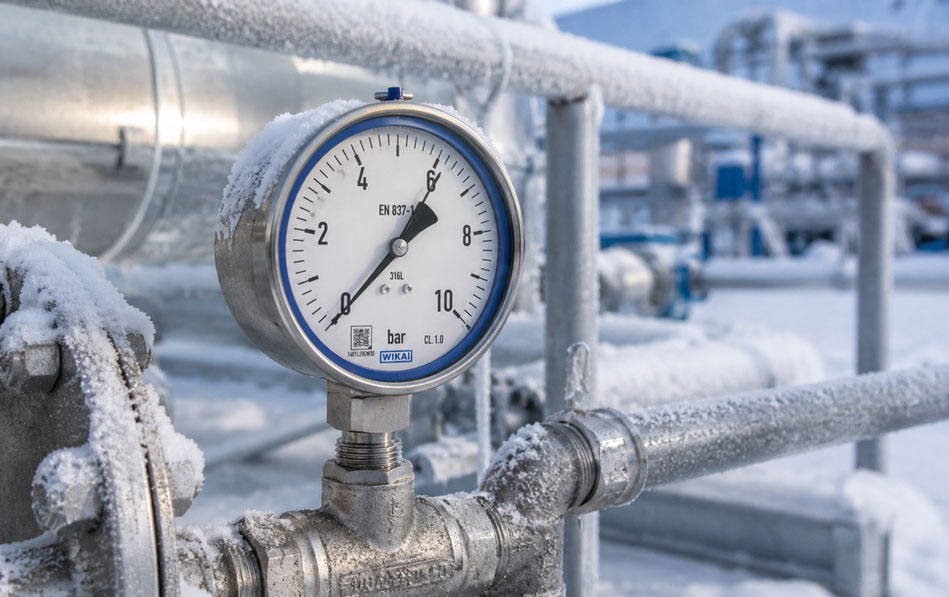
Liquid-filled pressure gauges are mainly used where vibrations, pulsating pressures or mechanical shocks cause the indication of an unfilled pressure gauge to become unstable. The liquid inside the case dampens the movement of the pointer and measuring mechanism, improves readability and reduces the mechanical stress on moving components.
However, the filling liquid should not be selected simply according to the principle that “filled is always better”. Ambient temperature in particular has a considerable influence on the viscosity of the filling liquid and therefore on the dynamic behavior of the pressure gauge.
At normal ambient temperatures, glycerin or a glycerin-water mixture is frequently used. For low temperatures, silicone oil is generally better suited because its viscosity increases less strongly in cold conditions. At extremely low temperatures, however, standard silicone fillings are also no longer sufficient; specially designed pressure gauges and low-temperature filling liquids are then required.
The filling liquid must therefore always be selected together with the ambient temperature, pressure dynamics, desired pointer response and the permissible temperature range of the specific pressure gauge type.
Suitable instruments can be found under pressure measurement technology at ICS Schneider. A typical liquid-filled industrial pressure gauge is, for example, the WIKA 213.53 for measuring points with high dynamic pressure loads and vibrations. For aggressive media and applications in the process industry, the WIKA 233.50 with stainless-steel measuring system and case filling is also available.
Table of Contents
- Why are pressure gauges filled with liquid?
- How does the filling liquid affect the measuring mechanism?
- When is glycerin the right choice?
- When should silicone oil be used?
- Glycerin and silicone oil in direct comparison
- Why is viscosity so important?
- What happens to a filled pressure gauge in cold conditions?
- What must be considered below -40 °C?
- Considering high ambient temperatures and process heat
- Balancing damping and pointer response correctly
- Can case filling eliminate pressure pulsations?
- Why is the pressure gauge not completely filled?
- Is a visible air bubble a fault?
- Considering case pressure and venting
- Does the filling liquid come into contact with the process medium?
- Special applications such as oxygen
- Pressure gauges with electrical contacts
- Practical example: outdoor hydraulic system
- Which filling is suitable for which application?
- Typical fault patterns
- Recommended selection procedure
- Suitable pressure gauges from ICS Schneider
- Conclusion
- FAQ
Why are pressure gauges filled with liquid?
A classic mechanical pressure gauge has an elastic measuring element, such as a Bourdon tube, and a mechanical pointer mechanism.
At steady pressure, the pointer moves to the corresponding pressure indication according to the deformation of the measuring element.
In real machines, however, additional influences frequently occur:
- vibrations,
- mechanical shocks,
- rapid pressure changes,
- pressure pulsations.
These influences can keep the measuring mechanism and pointer in constant motion.
Typical example
An unfilled pressure gauge is mounted directly on a hydraulic pump.
The pointer continuously oscillates, for example, between:
180 … 210 bar
.
An exact value can hardly be read.
Case filling dampens this movement
The pointer mechanism moves within a viscous liquid. This slows down rapid movement.
The result:
- steadier pointer indication,
- improved readability,
- reduced mechanical stress on the measuring mechanism,
- greater resistance to vibrations and shocks.
How does the filling liquid affect the measuring mechanism?
The damping effect is produced by the resistance of the liquid to movement.
The faster the:
- pointer shaft,
- gears,
- lever mechanism
move, the more strongly the liquid opposes this movement.
Slow pressure changes
can still be indicated by the pressure gauge.
Very rapid movements
are damped more strongly.
This effect is exactly what makes a filled pressure gauge appear much steadier on a vibrating machine than an unfilled version.
The case filling therefore mainly changes the dynamic behavior of the indication – not the actual measuring principle of the Bourdon tube.
When is glycerin the right choice?
Glycerin is one of the most commonly used filling liquids for mechanical pressure gauges.
Typical applications include
- hydraulic systems,
- mechanical engineering,
- pumps,
- compressors,
- mobile machines,
- general plant engineering.
Glycerin provides good damping of the measuring mechanism and is suitable for many normal industrial ambient conditions.
Typical temperature range
For various WIKA pressure gauges with glycerin filling, for example, an ambient temperature range of:
-20 … +60 °C
is specified.
However, this range is not universally valid for every pressure gauge.
The permissible temperature range stated in the datasheet of the specific instrument is always decisive.
The limitation at low temperatures
is mainly caused by the sharply increasing viscosity.
Glycerin does not have to freeze completely before problems occur.
A considerable increase in viscosity alone can significantly slow down the movement of the pointer mechanism.
When should silicone oil be used?
Silicone oil is particularly useful when a filled pressure gauge is to be operated outside the typical temperature range of a glycerin filling.
A common application is low temperatures
With suitable pressure gauge designs, standard silicone fillings often allow ambient temperatures down to approximately:
-40 °C
.
Silicone oil is therefore better suited, for example, for:
- outdoor installations in winter,
- refrigeration systems,
- mobile machines,
- pipeline measuring points,
- unheated plant areas.
Also at elevated temperatures
silicone oils are used depending on the instrument and application because they can offer more favorable temperature-dependent viscosity behavior than glycerin.
However, the maximum permissible temperature must not be derived solely from the filling liquid.
The following also limit the permissible temperature range of the complete pressure gauge:
- measuring mechanism,
- seals,
- window,
- case,
- process connection.
Glycerin and silicone oil in direct comparison
| Criterion | Glycerin | Silicone oil |
|---|---|---|
| Typical standard application | very well suited | suitable |
| Damping at normal temperatures | high | depends on viscosity grade |
| Low ambient temperatures | only suitable to a limited extent | significantly better suited |
| Typical lower temperature limit of standard versions | often approximately -20 °C | often approximately -40 °C |
| Temperature dependence of viscosity | comparatively high | more favorable |
| Very low temperatures below -40 °C | not suitable | special silicone filling or low-temperature instrument required |
| Standard solution for machinery and hydraulics | often the first choice | useful when temperature requirements apply |
The specified temperature values are typical ranges and do not replace the product specification of the selected pressure gauge.
Why is viscosity so important?
The damping effect of a filling liquid depends strongly on its viscosity.
High viscosity
means:
- stronger damping,
- steadier pointer movement,
- but also slower response.
Low viscosity
in contrast means:
- less damping,
- faster pointer response.
The problem is that the viscosity of a liquid is not constant.
As temperature decreases
viscosity increases.
As temperature increases
viscosity decreases.
A pressure gauge may therefore show completely normal dynamic behavior at:
+20 °C
but already respond noticeably more slowly at:
-15 °C
.
What happens to a filled pressure gauge in cold conditions?
At low ambient temperatures, the filling liquid becomes increasingly viscous.
This increases the mechanical resistance acting on the measuring mechanism.
Typical effects include
- slow pointer movement,
- delayed reaching of the final value,
- delayed return when pressure decreases,
- apparently “sticking” pointer.
Example
A pressure gauge is installed on a machine outdoors.
At:
+15 °C
it responds normally.
At:
-20 °C
the pointer suddenly follows a pressure change much more slowly.
This does not necessarily mean that:
- the Bourdon tube is damaged,
- the process connection is blocked,
- the pressure gauge is fundamentally defective.
The cause may simply be the strongly increased viscosity of the case filling.
What must be considered below -40 °C?
Silicone oil is not automatically suitable for arbitrarily low temperatures either.
With standard silicone fillings, the viscosity can already increase around:
-40 °C
to such an extent that pointer movement is significantly impaired.
For extremely low temperatures
specially designed instruments are therefore required.
One example is the WIKA PG23LT POLARgauge®.
The pressure gauge is designed for outdoor use at ambient temperatures down to:
-70 °C
.
A different liquid alone is not sufficient
At such temperatures, among other things, the following must also be suitable for low-temperature operation:
- seals,
- case design,
- venting or pressure compensation,
- mechanical components.
Simply filling a normal pressure gauge with a lower-viscosity oil does not turn it into a low-temperature pressure gauge.
Considering high ambient temperatures and process heat
Cold is not the only factor that can affect the filling.
High temperatures must also be considered.
Two temperatures must be distinguished
- ambient temperature at the pressure gauge,
- temperature of the process medium.
A hot process medium can transfer heat into the pressure gauge through the process connection and measuring element.
The permissible medium temperature can be lower for filled instruments
For the WIKA 233.50, for example, the following is specified:
max. +100 °C medium temperature for filled version
whereas the corresponding unfilled 232.50 version can be specified for higher medium temperatures.
The filling is therefore not a means of dealing with high process heat
If the medium is too hot, the following may be required depending on the application:
- cooling element,
- siphon for steam,
- capillary line,
- diaphragm seal,
- greater distance from the hot process line.
The specific solution must match the medium, pressure and temperature range.
Balancing damping and pointer response correctly
The strongest possible damping is not automatically an advantage in every application.
Example 1: Hydraulic power unit
The pressure fluctuates very rapidly and the operator mainly requires a stable operating-pressure value.
Relatively strong pointer damping is useful here.
Example 2: Test bench
A rapid pressure change must be recognized immediately on the pressure gauge.
Excessive damping can be undesirable here because the indication follows the actual pressure with a time delay.
This effect becomes stronger at low temperatures
A filling that is suitable at room temperature can suddenly provide much stronger damping when the temperature drops significantly.
The desired:
reading stability
must therefore be balanced against the required:
response speed
.
Can case filling eliminate pressure pulsations?
No.
The case filling primarily dampens the movement of the measuring mechanism and pointer.
The actual pressure pulsation in the process is still present.
This is an important distinction
If a piston pump generates strong pressure peaks, the filled pointer may appear steady.
The Bourdon tube is nevertheless still exposed to the dynamic pressure changes.
With strong pressure pulsations, the following may additionally be required
- restrictor orifice,
- damping element,
- pulsation dampener,
- snubber,
- suitable measuring line.
A steady indication therefore does not automatically mean that no pressure peaks are present.
Why is the pressure gauge not completely filled?
In many liquid-filled pressure gauges, the case is intentionally not filled with liquid to the very last cubic millimeter.
This is normally not a manufacturing defect.
The filling liquid changes its volume with temperature
When it warms up, it expands.
A suitable expansion space prevents this from creating an impermissibly high pressure inside the case.
Depending on the design
a visible gas space may therefore remain in the upper part of the pressure gauge.
The intended fill level is specified by the manufacturer.
A filled pressure gauge should therefore not be topped up independently until it is completely full.
Is a visible air bubble a fault?
Not necessarily.
In many liquid-filled pressure gauges, a limited air or gas space is intentionally provided by design.
The decisive point is
whether:
- the fill level corresponds to the intended condition,
- there is no visible leakage,
- the damping effect is maintained,
- the measuring mechanism operates correctly.
It would be problematic, however
if the liquid level decreases significantly over time.
In that case, the following should be checked for leakage:
- filling plug,
- window,
- seals,
- case.
Considering case pressure and venting
The case filling itself can cause pressure changes inside the pressure gauge when the temperature changes.
This can affect the indication, particularly with low pressure ranges.
Many filled pressure gauges therefore have
- a vent opening,
- a pressure compensation plug,
- an appropriate compensation design.
For instruments that are sealed for transport and must be vented after installation, the manufacturer’s instructions must be followed.
Typical fault pattern
After installation, a pressure gauge does not indicate exactly:
0 bar
when no process pressure is applied.
After the intended case pressure compensation is opened, the pointer returns to zero.
Whether and how a pressure gauge may be opened or vented depends on the specific instrument design.
Does the filling liquid come into contact with the process medium?
Not during normal operation.
The case filling is located inside the pressure gauge case and surrounds the measuring mechanism.
The process medium, on the other hand, is contained inside the:
- process connection,
- measuring element,
- connected diaphragm seal system, where applicable.
Do not confuse case filling with diaphragm-seal filling
A diaphragm seal system also contains a transmission fluid.
However, it serves a completely different purpose.
It hydraulically transfers the process pressure from the diaphragm seal to the connected measuring instrument.
In a liquid-filled pressure gauge, by contrast, the liquid in the case mainly serves to dampen and protect the measuring mechanism.
Special applications such as oxygen
For special process media, it must also be considered what could happen in the unlikely event of a measuring-element rupture.
In that case, process medium could enter the case and come into contact with the filling liquid.
With reactive media
a special or inert case filling may therefore be required.
A typical example is oxygen service.
Unsuitable oil- or grease-containing substances must not be used here.
For oxygen and other reactive media, the pressure gauge version and filling liquid must therefore be explicitly approved for the application.
Pressure gauges with electrical contacts
If the pressure gauge has:
- switch contacts,
- electronic contacts,
- other electrical components,
the electrical properties of the case filling must also be considered.
Electrically insulating oils may be required in such cases.
The filling liquid should therefore not subsequently be replaced with an arbitrary different liquid type.
Practical example: outdoor hydraulic system
A hydraulic machine operates at:
0 … 250 bar
and generates significant mechanical vibrations during operation.
The pressure gauge is mounted directly on the hydraulic power unit.
Location
The machine is partly located outdoors.
In winter, temperatures down to:
-30 °C
are possible.
Variant 1: Glycerin filling
At normal temperatures, it provides good damping.
At:
-30 °C
however, the ambient temperature is already outside the range intended for many standard glycerin-filled pressure gauges.
The pointer could respond very sluggishly.
Variant 2: Silicone filling
A suitably specified silicone filling is much better suited for this temperature range.
With a typical standard silicone-filled pressure gauge having a permissible ambient temperature down to:
-40 °C
there is still sufficient temperature reserve at:
-30 °C
.
Also check
- pressure range suitable for operating pressure,
- permissible alternating load,
- vibration load,
- process connection,
- material compatibility with the hydraulic medium,
- degree of protection.
Choosing silicone oil only solves the temperature and damping issue. It does not replace complete sizing of the pressure gauge.
Which filling is suitable for which application?
| Application | Typical selection | Particularly important |
|---|---|---|
| Hydraulic machine at room temperature | Glycerin | Vibration and pressure pulsation |
| Compressor in heated hall | Glycerin | Additional pressure-pulsation damping if necessary |
| Outdoor installation down to -30 °C | Silicone oil | Check product-specific temperature range |
| Outdoor installation down to -40 °C | Silicone oil or correspondingly specified instrument | Check complete pressure gauge design |
| Arctic application down to -70 °C | Special low-temperature filling | Special low-temperature pressure gauge required |
| Very rapid pressure changes must remain visible | Select damping specifically | Avoid excessively high viscosity |
| Hot process line | Do not solve through filling alone | Check medium temperature and thermal isolation |
| Oxygen application | Only explicitly approved special version | Material and liquid compatibility |
| Pressure gauge with switch contacts | Suitable insulating filling | Observe manufacturer specification |
Typical fault patterns
| Observation | Possible cause | Recommended check |
|---|---|---|
| Pointer responds very slowly in cold conditions | Filling liquid too viscous | Check temperature range and filling medium |
| Pressure gauge works in summer but is sluggish in winter | Strong temperature-dependent viscosity change | Check whether glycerin filling should be replaced by a suitable silicone version |
| Pointer oscillates strongly despite filling | Pressure pulsation too high or filling does not provide sufficient damping | Check pulsation damping and measuring point |
| Pointer is steady, but Bourdon tube still fails prematurely | Actual pressure peaks continue to act on the measuring element | Measure pressure pulsations or pressure peaks |
| Pointer does not return exactly to zero | Case pressure, temperature or mechanical damage | Check pressure compensation according to manufacturer instructions |
| Pressure gauge contains a small air bubble at the top | Expansion space provided by design | Compare fill level with manufacturer condition |
| Fill level decreases over several months | Leakage | Check filling plug, window and case |
| Pointer generally responds too slowly | Filling provides too much damping for the application | Define required response time |
| Pressure gauge is mounted on a hot process and filling becomes discolored | Possible thermal overload | Check medium and case temperature |
| Filled pressure gauge indicates a stable average value during pressure pulsation | Pointer damping | If required, measure the actual pressure dynamics separately |
| At -45 °C, standard silicone filling no longer works reliably | Temperature below specification range | Select low-temperature pressure gauge |
| Pressure gauge with electrical contacts no longer functions correctly after refilling | Unsuitable filling liquid | Check manufacturer approval of filling liquid |
| Filled pressure gauge is connected directly to very hot steam | Permissible medium temperature exceeded | Check siphon or thermal isolation |
Recommended selection procedure
- Determine the pressure range: Record operating pressure and possible pressure peaks.
- Determine the medium: Check material compatibility of the measuring element.
- Assess pressure dynamics: Distinguish between steady pressure, pulsation and strong vibration.
- Check whether case filling is required: Do not specify damping automatically.
- Determine minimum ambient temperature: Also consider shutdown periods and winter operation.
- Determine maximum ambient temperature: Consider control-cabinet, machine and solar heating.
- Determine medium temperature: Consider process heat separately from ambient temperature.
- Check glycerin: Often an economical standard solution at normal temperatures.
- Check silicone oil: Prefer for low or special temperature requirements.
- Identify extreme temperatures: Use a special low-temperature instrument below the standard range.
- Define response time: Avoid excessive damping when rapid changes must remain visible.
- Assess pressure pulsation separately: Provide additional damping at the process connection if required.
- Consider electrical components: Use a suitable electrically insulating filling.
- Check special media: For example, use only explicitly suitable instrument versions for oxygen.
- Do not alter the fill level independently: Maintain the manufacturer’s condition.
- Check pressure compensation: Observe venting and compensation instructions.
- Check the temperature datasheet of the specific pressure gauge: Do not apply general limits without verification.
- Check installation conditions: Consider vibration, mounting position and mechanical loads.
- Select the instrument: Define pressure range, material, filling and temperature range together.
Suitable pressure gauges from ICS Schneider
WIKA 213.53 – liquid-filled pressure gauge for machinery and hydraulics
The WIKA 213.53 is a mechanical Bourdon-tube pressure gauge with case filling.
Key features include:
- very good vibration resistance and shock resistance,
- robust design,
- stainless-steel case,
- wetted parts made of copper alloy,
- nominal sizes 50, 63 and 100 mm,
- scale ranges up to 0 … 1,000 bar.
Typical applications include:
- hydraulics,
- compressors,
- shipbuilding,
- measuring points with high dynamic pressure loads and vibrations.
WIKA 213.40 – robust filled industrial version
The WIKA 213.40 is also a liquid-filled Bourdon-tube pressure gauge for measuring points exposed to vibration and shock.
It is intended, among other applications, for:
- hydraulics,
- mining,
- shipbuilding.
The measured media must not attack the copper alloys used.
WIKA 233.50 – stainless-steel pressure gauge for the process industry
For aggressive media or applications with higher material requirements, the WIKA 233.50 is suitable.
The instrument offers:
- case filling for high dynamic pressure loads and vibrations,
- wetted components made of stainless steel,
- nominal sizes 63, 100 and 160 mm,
- scale ranges up to 0 … 1,600 bar,
- high load-cycle and shock resistance.
For the standard version with glycerin filling, an ambient temperature range of:
-20 … +60 °C
is specified, among other values.
This example shows why the specific temperature range must always be checked for the individual instrument version.
WIKA PG23LT POLARgauge® – for temperatures down to -70 °C
For extremely low temperatures, the WIKA PG23LT is available.
The instrument was specially developed for outdoor use at ambient temperatures down to:
-70 °C
.
Its features include:
- special low-temperature design,
- case filling for extreme cold,
- complete stainless-steel construction,
- IP66 and IP67 degrees of protection depending on version,
- scale ranges from 0 … 0.6 to 0 … 1,000 bar.
The PG23LT also demonstrates that at extreme temperatures, not only the filling liquid but the entire pressure gauge construction must be adapted.
Further instruments can be found under pressure measurement technology at ICS Schneider.
Conclusion
The case filling of a pressure gauge has a considerable influence on its dynamic behavior and temperature suitability.
Glycerin is suitable for many standard applications
On machines, hydraulic systems and other vibrating measuring points, it provides effective and economical damping.
At low temperatures, glycerin becomes increasingly problematic
The increasing viscosity can significantly slow down the pointer response.
Silicone oil is better suited for cold environments
Depending on the instrument, standard versions can, for example, be used down to approximately -40 °C.
Below -40 °C, standard silicone oil is not necessarily sufficient
Special fillings and appropriately designed pressure gauges are required for extreme temperatures.
Process heat must be considered separately
A more temperature-resistant filling liquid does not automatically make a pressure gauge suitable for arbitrarily high medium temperatures.
More damping does not always mean a better measurement
High viscosity steadies the pointer but simultaneously increases its response time.
The filling does not eliminate pressure peaks
It mainly steadies the indication. Strong process pulsations may additionally need to be damped at the process connection.
A visible gas space is not automatically a defect
The fill level specified by the manufacturer takes into account, among other things, thermal expansion of the filling liquid.
For practical applications
Determine pressure range and medium → assess vibration and pressure pulsation → define minimum and maximum ambient temperature → take process heat into account → define required pointer response → check glycerin for normal temperature ranges → use silicone oil at low temperatures → use a special low-temperature pressure gauge at extreme temperatures → consider special media and electrical contacts → check the product-specific temperature range → maintain fill level and pressure compensation according to manufacturer instructions.
FAQ: Glycerin or Silicone Oil in Pressure Gauges
Why is there liquid inside a pressure gauge?
The case filling dampens pointer and measuring-mechanism movements caused by vibrations, shocks and dynamic pressure loads.
What is the most common pressure-gauge filling?
For many standard industrial applications, glycerin or a glycerin-water mixture is used.
When should silicone oil be used?
Silicone oil is particularly useful when the pressure gauge is exposed to low or otherwise demanding ambient temperatures for which a glycerin filling is no longer suitable.
Down to what temperature can a glycerin-filled pressure gauge be used?
For various standard pressure gauges, an ambient temperature range of approximately -20 to +60 °C is specified for glycerin fillings. However, the datasheet of the specific instrument is always decisive.
Can a silicone-filled pressure gauge be used at -40 °C?
Appropriately specified standard silicone versions can often be used down to approximately -40 °C. The product-specific temperature range must be checked.
Can every silicone-oil-filled pressure gauge be used at -40 °C?
No. In addition to the filling liquid, seals, case, measuring mechanism and other components must also be suitable for this temperature.
What happens to glycerin at low temperatures?
Its viscosity increases strongly. This increases damping of the measuring mechanism and causes the pointer to respond more slowly.
Does glycerin have to freeze completely before the pressure gauge has problems?
No. A significantly higher viscosity alone can slow down pointer movement so much that the indication becomes too sluggish for the application.
Why is silicone oil better in cold conditions?
Depending on the grade, silicone oils have more favorable viscosity behavior at low temperatures.
Can silicone oil also be used at high temperatures?
Yes, depending on the oil and pressure gauge version. However, the permissible temperature range of the complete measuring instrument is decisive.
What does viscosity mean?
Viscosity describes, in simplified terms, the resistance of a liquid to flow. Higher viscosity means a more viscous liquid.
Why does a more viscous liquid provide stronger damping?
Because it offers greater resistance to the movement of mechanical components.
Can a pressure gauge be damped too strongly?
Yes. If damping is too strong, the pointer may respond too slowly to relevant pressure changes.
Why does my pressure gauge respond more slowly in winter?
One possible cause is the temperature-related increase in viscosity of the case filling.
Why does a filled pressure gauge oscillate less?
The filling liquid slows rapid movements of the pointer mechanism and thereby reduces visible pointer flutter.
Does the liquid filling protect the Bourdon tube from pressure peaks?
Not directly. The filling mainly dampens the measuring mechanism. Pressure peaks still act on the pressurized measuring element.
What can be used against strong pressure pulsations?
Depending on the application, restrictors, snubbers or special pulsation dampeners can be used.
Is an air bubble in a filled pressure gauge normal?
A limited gas space can be provided by design and is therefore not automatically a fault.
Why is the pressure gauge not completely filled with liquid?
Among other things, thermal volume expansion of the filling liquid must be taken into account.
May I completely refill a pressure gauge myself?
This should not be done without manufacturer instructions. Filling liquid, fill level and case pressure compensation are part of the instrument design.
Why can a filled pressure gauge fail to indicate exactly zero after installation?
One possible cause is a pressure difference between the pressure-gauge case and the surrounding atmosphere due to temperature changes.
Does a filled pressure gauge have to be vented?
That depends on the design. With certain instruments, an intended pressure-compensation opening must be opened after installation. The manufacturer’s operating instructions are decisive.
Does the glycerin inside the case come into contact with the process medium?
Not during normal operation. The process medium is located inside the measuring element, while the case filling is outside the measuring system inside the instrument case.
Is the case filling the same as the liquid inside a diaphragm seal?
No. A diaphragm-seal filling hydraulically transfers the process pressure. The case filling of a pressure gauge mainly dampens the measuring mechanism.
Is a special filling required for oxygen?
Yes. The complete pressure gauge version, including the filling liquid, must be explicitly suitable for oxygen and appropriately cleaned or specified.
Which filling is suitable for electrical switch contacts?
Depending on the instrument design, electrically insulating filling oils may be required. The manufacturer’s specifications for the contact pressure gauge must be followed.
Can process heat warm up the filling liquid?
Yes. Heat can be transferred into the pressure gauge through the process connection and measuring element.
Can I connect a filled pressure gauge directly to very hot steam?
Only if the specific pressure gauge version and installation are approved for this purpose. With steam, thermal isolation, for example using a suitable siphon, is often required.
Which WIKA pressure gauge is suitable for hydraulics and vibration?
The WIKA 213.53 is a liquid-filled Bourdon-tube pressure gauge for high dynamic pressure loads and vibrations.
Which filled pressure gauge is suitable for aggressive media?
The WIKA 233.50 has wetted parts made of stainless steel and is intended for numerous applications in the process industry.
Which pressure gauge is suitable for temperatures down to -70 °C?
The WIKA PG23LT POLARgauge® is specially designed for extreme ambient temperatures down to -70 °C.
Where can I find further pressure gauges?
Further instruments can be found under pressure measurement technology at ICS Schneider.