


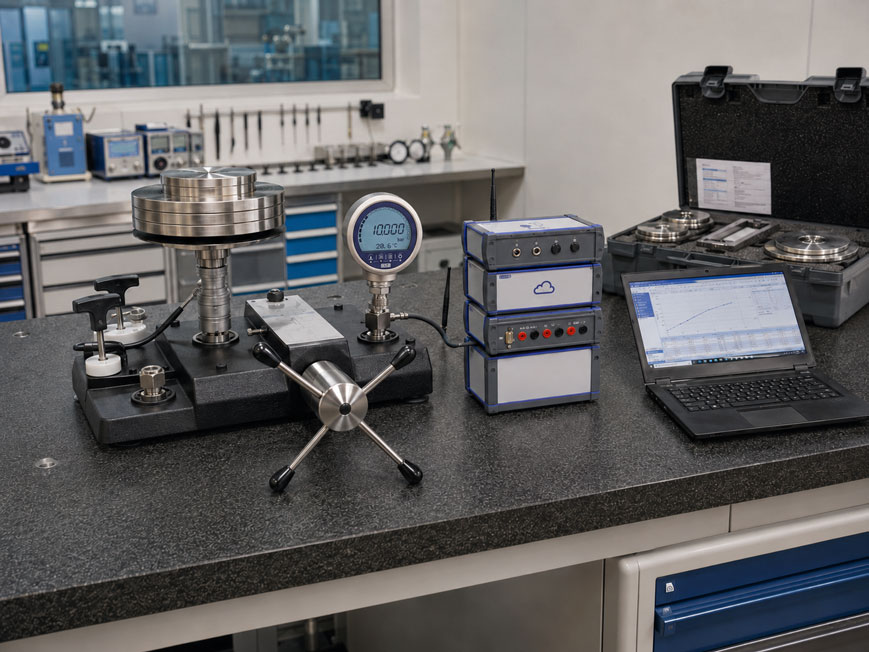
A pressure balance is operated with a mass set designed for the standard acceleration due to gravity of:
gn = 9.80665 m/s²
.
At the new operating location, however, the local acceleration due to gravity is, for example:
glocal = 9.811053 m/s²
If a nominal test point of 100 bar is set, the same mass does not generate exactly 100 bar there, but a slightly higher pressure due to the higher gravitational force.
For simple pressure gauges, this deviation may be insignificant. However, when a pressure balance is used as a high-accuracy pressure reference, it can already be larger than other components of the overall uncertainty budget.
The reason lies in the basic operating principle of the pressure balance: the reference pressure is derived from a force and the effective piston area. Since the force generated by the applied masses depends directly on the local acceleration due to gravity, a change in g affects the generated pressure almost proportionally.
For corresponding calibration tasks, ICS Schneider offers, among other products, the WIKA CPB3800 Pressure Balance. Its mass sets are manufactured as standard for the standard acceleration due to gravity of 9.80665 m/s², but can also be adjusted to the local gravity at the intended installation site. For computational consideration of influencing factors, the WIKA CPU6000 CalibratorUnits and the WIKA-Cal Calibration Software are also available.
Table of Contents
- How a pressure balance generates the reference pressure
- Why local gravity influences the pressure
- What does standard gravity of 9.80665 m/s² mean?
- Calculating the gravity correction
- Calculation example for 100 bar
- Why g changes with location
- Influence of altitude
- Mass sets adjusted to local gravity
- Using pressure balances at changing locations
- Which gravity value from the calibration certificate applies?
- Also consider the effective piston area
- Further corrections in addition to gravity
- Do not confuse local gravity with pressure head correction
- Gravity in the measurement uncertainty budget
- Typical errors when applying gravity correction
- Practical example: pressure balance moved to another location
- Systematically preparing the calibration
- Suitable calibration equipment from ICS Schneider
- Conclusion
- FAQ
How a pressure balance generates the reference pressure
A pressure balance – also referred to as a deadweight tester – generates pressure according to a directly traceable physical principle.
In simplified form:
p = F / A
Where:
p= generated pressure,F= force acting on the piston,A= effective piston area.
The force is mainly generated by the gravitational force of the applied masses.
For a mass:
F = m · g
This results in the simplified relationship:
p = m · g / A
The acceleration due to gravity is therefore directly part of the pressure equation
If:
- the same mass,
- is applied to the same piston-cylinder system
but the local acceleration due to gravity changes, the gravitational force acting on the piston also changes.
The actually generated reference pressure changes accordingly.
Why local gravity influences the pressure
A mass of, for example:
10 kg
remains a mass of 10 kg regardless of location.
Its gravitational force, however, is:
F = m · g
and therefore depends on the local acceleration due to gravity.
At a higher g
the same mass is accelerated more strongly toward the center of the Earth.
The gravitational force increases.
With an unchanged piston area, the generated pressure therefore also increases.
At a lower g
the gravitational force is correspondingly lower.
The same mass set generates a slightly lower pressure.
A mass set therefore has an unambiguously defined pressure effect only in combination with the gravity value on which it is based.
What does standard gravity of 9.80665 m/s² mean?
An international standard acceleration due to gravity has been defined for technical calculations:
gn = 9.80665 m/s²
This value is a defined reference quantity.
It does not mean that exactly:
9.80665 m/s²
is measured everywhere on Earth.
Standard mass sets for pressure balances are often referenced to this value
For the WIKA CPB3800, the masses are also manufactured as standard for:
9.80665 m/s²
.
If the pressure balance is used at a location with a different local gravity, this deviation must either:
- already be taken into account during manufacture or adjustment of the mass set
or:
- be corrected mathematically
.
Calculating the gravity correction
For a mass set referenced to a specific reference gravity value, the pure gravity correction can be calculated in simplified form using the ratio of the accelerations.
The following applies:
plocal = pnominal · glocal / gref
Where:
plocal= pressure actually generated due to local gravity,pnominal= nominal pressure value of the mass set,glocal= local acceleration due to gravity at the operating location,gref= gravity value to which the mass set is referenced.
If the mass set is referenced to standard gravity:
gref = 9.80665 m/s²
The pure gravity correction factor is therefore
kg = glocal / gref
and:
plocal = pnominal · kg
This relationship initially considers only the influence of gravity. For a high-accuracy pressure balance calculation, additional correction factors must be taken into account.
Calculation example for 100 bar
A mass set was manufactured for standard gravity:
gref = 9.806650 m/s²
At the actual operating location, the local acceleration due to gravity is:
glocal = 9.811053 m/s²
Masses corresponding to a nominal pressure of:
pnominal = 100 bar
are applied.
The actual pressure is calculated as
plocal = 100 bar · 9.811053 / 9.806650
which gives approximately:
plocal = 100.0449 bar
The deviation is therefore
+0.0449 bar
or:
+0.0449 %
For a normal operating pressure gauge, this difference would often be insignificant.
For a pressure balance with a measurement uncertainty in the range of a few hundredths of a percent, however, it is significant.
Without gravity correction, the local gravity in this example could cause a systematic error that is of the same order of magnitude as, or even greater than, the specified uncertainty of the reference.
Why g changes with location
The local acceleration due to gravity is not identical everywhere.
The most important influencing factors include:
- geographical latitude,
- altitude above the reference level,
- shape and rotation of the Earth,
- local mass distribution in the ground.
Latitude plays an important role
Due to the Earth’s rotation and shape, local gravity differs between regions near the equator and regions near the poles.
A pressure balance that is moved, for example, from Central Europe to a distant location should therefore not automatically continue to be used with the previous gravity value.
Even within one country, the deviation can already become relevant
How strongly it affects the calibration depends on the required measurement uncertainty.
The more accurate the pressure reference needs to be, the more important a reliable local g value becomes.
Influence of altitude
As the distance from the Earth’s center increases, the local acceleration due to gravity generally decreases.
The altitude of the calibration laboratory or operating location can therefore also be relevant.
For a rough technical application
local gravity can be approximately determined from:
- geographical position,
- altitude
.
For very low measurement uncertainties
an adequately accurate or traceably determined gravity value for the actual operating location should be used.
Not only the nominal value is important, but also the uncertainty with which this value is known.
Mass sets adjusted to local gravity
If a pressure balance is operated permanently at a fixed location, the mass set can already be adjusted to the local gravity.
This type of adjustment is available for the WIKA CPB3800.
The advantage
The nominal pressure values of the masses already correspond to the intended use at this location.
For example, the user can apply a mass set for:
100 bar
without having to manually recalculate the pure gravity deviation at every test point.
The disadvantage
The mass set is then adjusted to a specific gravity value.
If the pressure balance is later moved to another location, it must again be checked which:
g value
applies there.
The markings on the masses must not be interpreted as location-independent pressure values without verification.
Using pressure balances at changing locations
Especially for service companies or on-site calibrations, a pressure balance may be used at different locations.
In this case, a mass set referenced to standard gravity is practical
The mass set remains clearly defined and the actual generated reference pressure is calculated for the respective operating location.
Before calibration, the following values can be entered, for example:
- local gravity,
- ambient temperature,
- atmospheric pressure,
- relative humidity,
- piston or system temperature.
Software can significantly simplify this calculation
The WIKA-Cal Calibration Software can determine the required mass loads or the resulting reference pressure for pressure balances.
In combination with the CPU6000 series, relevant environmental and calibration parameters can be included in the calculation.
For changing operating locations, this is significantly more reliable than a manually maintained table without a documented gravity reference.
Which gravity value from the calibration certificate applies?
Before using a pressure balance, it should be clarified which gravity value is the reference for:
- mass set,
- calibration certificate,
- pressure tables,
- software configuration.
Possible cases include
| Configuration | Meaning |
|---|---|
| Mass set referenced to 9.80665 m/s² | Local gravity must be mathematically taken into account if the operating location differs. |
| Mass set adjusted to local gravity | Nominal pressure values apply to the defined local gravity value. |
| Individual mass values in the certificate | Calculation is performed using the certified masses and the relevant correction factors. |
| Software-based calculation | The gravity value must be correctly stored in the data record or calibration job. |
It is therefore not enough simply to know a local g value. It must also correctly match the gravity reference of the mass set being used.
Also consider the effective piston area
The equation:
p = m · g / A
already shows that gravity is only one part of determining the pressure.
Equally important is:
A = effective piston area
The effective area is not simply an assumed geometric area
It is determined for the specific piston-cylinder system and is a central calibration parameter of the pressure balance.
In high-accuracy systems, it can additionally depend on:
- temperature,
- pressure,
- deformation of the piston-cylinder system.
Therefore
A perfect gravity correction cannot compensate for an incorrect effective piston area.
The current data for the piston-cylinder system or calibration certificate must always be used for the reference pressure calculation.
Further corrections in addition to gravity
Local gravity is important, but it is not the only influencing factor for a high-accuracy pressure balance.
Depending on the device and accuracy requirements, the following may also be relevant
- actual mass of the weights,
- air buoyancy of the masses,
- air density,
- effective piston area,
- piston temperature,
- thermal expansion of piston and cylinder,
- pressure deformation of the piston-cylinder system,
- surface tension of the pressure medium,
- pressure head difference between reference and device under test.
The simple equation nevertheless remains important
p = F / A
It makes it easier to understand where the individual corrections come from.
For high-accuracy calibration, however, the simple relationship becomes an evaluation including the correction factors specified for the particular pressure balance.
Do not confuse local gravity with pressure head correction
Two effects are often confused when working with pressure balances:
altitude of the geographical operating location
and:
height difference between piston and device under test
The geographical altitude
influences, among other things, the local acceleration due to gravity.
The height difference within the calibration setup
causes a hydrostatic pressure difference.
For a liquid, the simplified relationship is:
Δp = ρ · g · Δh
Where:
ρ= density of the pressure medium,g= local acceleration due to gravity,Δh= height difference between the reference levels.
This pressure head correction is particularly relevant for hydraulic pressure balances.
Correctly setting the local gravity therefore does not replace the correction of a height difference between the piston reference level and the pressure connection of the device under test.
Gravity in the measurement uncertainty budget
Even when local gravity is correctly taken into account, its influence does not disappear completely from the uncertainty budget.
The g value used itself has an uncertainty.
In simplified form
because:
p ∝ g
the relative sensitivity is also:
Δp / p ≈ Δg / g
The relative uncertainty of the gravity value therefore transfers directly to the corresponding relative pressure contribution
If local gravity is only roughly estimated, this contribution can be greater than when a sufficiently accurate location-specific value is used.
For a reliable uncertainty budget, the following should therefore be documented:
- source of the local gravity value,
- associated location,
- altitude reference where applicable,
- uncertainty of the value,
- gravity reference of the mass set.
Important
A completely omitted gravity correction is initially not a random uncertainty contribution.
It causes a systematic error in the reference pressure.
Only after the correction has been properly applied does the uncertainty of the g value remain as part of the measurement uncertainty budget.
Typical errors when applying gravity correction
| Observation | Possible cause | Recommended check |
|---|---|---|
| Pressure balance shows systematically different results after relocation | Previous gravity value still being used | Check g value of the new operating location |
| Nominal 100 bar is assumed to be exactly 100 bar without verification | Gravity reference of the mass set not considered | Check certificate and mass set data |
| Gravity is corrected twice | Mass set already adjusted to local gravity | Check manufacturing and calibration data |
| Software value does not match manual calculation | Incorrect reference g value stored | Check software configuration |
| Only the geographical location is documented | No reliable g value available | Document source and uncertainty of the gravity value |
| After moving to another floor, only g is corrected | Pressure head difference in the calibration setup overlooked | Check reference levels of reference and device under test |
| Temperature deviation is attributed to gravity | Effective piston area changes with temperature | Check piston temperature and area correction |
| Mass set from another pressure balance is used | Masses and piston area do not belong to the same data set | Match serial numbers and certificates |
| Calculated correction is applied with the wrong sign | Ratio glocal/gref confused | Use the basic equation p = m·g/A |
| Very low overall uncertainty despite estimated g value | Uncertainty of gravity not taken into account | Complete the uncertainty budget |
Practical example: pressure balance moved to another location
A calibration laboratory operates a hydraulic pressure balance with a mass set referenced to standard gravity.
The data set specifies:
gref = 9.80665 m/s²
The device is taken to another geographical location for an on-site calibration.
Incorrect procedure
The operator continues to use only the nominal pressure values marked on the mass discs.
For example:
500 bar mass applied → reference pressure = exactly 500 bar
This implicitly assumes:
glocal = gref
even though this is not true at the new location.
Correct procedure
Before calibration begins:
- the gravity reference of the mass set is determined from the documentation,
- the local gravity for the new operating location is determined,
- the value is entered into the evaluation or software,
- the reference pressure for the respective mass combination is calculated,
- the other influencing factors of the pressure balance are taken into account.
After calibration
the measurement report should clearly indicate which:
g value
was used for calculating the reference pressure.
This ensures that the calibration remains technically traceable at a later date.
Systematically preparing the calibration
- Identify the pressure balance: Clearly assign type, serial number and piston-cylinder system.
- Check the mass set: Ensure that the masses used belong to the calibration system.
- Determine the gravity reference: Use the standard gravity or local adjustment value from the certificate or manufacturer data.
- Determine the operating location: Establish the location and required local g value.
- Document the local g value: Record the source and, where applicable, the uncertainty.
- Avoid double correction: Check whether the mass set has already been adjusted to the location.
- Record ambient conditions: Document temperature, atmospheric pressure and, if required, relative humidity.
- Consider piston temperature: Allow sufficient stabilization for the effective area correction.
- Define the reference level: Determine the height difference between piston and device under test.
- Check the pressure medium: Consider density and possible hydrostatic correction for liquids.
- Configure the mass table or software: Use the correct piston, mass and location data.
- Apply the gravity correction: Correctly calculate the reference pressure or required mass load.
- Bring the piston into a stable floating condition: Check friction and operating condition according to the manufacturer’s instructions.
- Allow the test point to stabilize: Take the reading only when the reference pressure is stable.
- Document the measured values: Fully record reference pressure and device-under-test value.
- Check the uncertainty budget: Include the uncertainty of the gravity value and other influencing factors.
Suitable calibration equipment from ICS Schneider
WIKA CPB3800 Pressure Balance
The WIKA CPB3800 is particularly suitable for this topic.
It operates as a hydraulic primary standard and is designed for calibration tasks up to:
1,200 bar
.
ICS specifies, among other things:
- total measurement uncertainty down to 0.025 % of reading,
- option for higher accuracy in combination with corresponding piston-cylinder systems,
- factory calibration traceable to national standards,
- stainless-steel mass sets,
- adjustment of the masses to local gravity.
The last point in particular is crucial for this technical article
As standard, the masses are referenced to:
9.80665 m/s²
.
For a fixed operating location, they can instead be adjusted to its local gravity.
WIKA CPU6000 CalibratorUnit
The CPU6000 series supports the recording and correction of relevant influencing factors when working with pressure balances.
The series includes:
- CPU6000-W weather station,
- CPU6000-S sensor box for pressure balances,
- CPU6000-M digital multimeter.
In combination with a pressure balance, the required masses or the actual reference pressure can be determined.
WIKA-Cal Calibration Software
The WIKA-Cal supports, among other things:
- determination of required mass loads for pressure balances,
- calculation of the reference pressure,
- recording of calibration-relevant data,
- creation of calibration certificates.
Especially when operating at changing locations, software-based calculation reduces the risk of overlooking an incorrect gravity reference or another correction factor.
Further devices can be found under Pressure Balances and Deadweight Testers at ICS Schneider and under Calibration Technology.
Conclusion
For a pressure balance, local gravity is not merely a theoretical secondary factor, but a direct component of pressure generation.
The basic principle is
p = F / A
and:
F = m · g
This gives the simplified relationship:
p = m · g / A
The same mass therefore does not generate exactly the same pressure everywhere
If local gravity changes, the gravitational force changes and with it the reference pressure.
9.80665 m/s² is a standard reference value
It must not automatically be equated with the actual acceleration due to gravity at the operating location.
For a mass set referenced to standard gravity
the pure gravity correction can be calculated in simplified form using:
plocal = pnominal · glocal / gref
.
For fixed laboratory locations, mass sets can be adjusted directly
This simplifies daily use, but ties the nominal pressure assignment to the local gravity value on which the adjustment is based.
For mobile pressure balances, mathematical correction is appropriate
The local g value is taken into account again whenever the operating location changes.
Gravity is only one of several correction factors
Effective piston area, temperature, air buoyancy, pressure deformation and pressure head difference can also be relevant depending on the accuracy class.
For practical applications
Clearly assign the mass set and piston-cylinder system → check the gravity reference in the certificate → determine the local g value for the operating location → avoid double corrections → calculate the reference pressure or required mass load using the correct g value → consider piston area and ambient conditions → correct pressure head difference separately → include the uncertainty of the gravity value in the measurement uncertainty budget → document the values used in the calibration report.
FAQ: Correctly Considering Local Gravity with Pressure Balances
Why does gravity influence a pressure balance?
The pressure is generated by the gravitational force of applied masses and the effective piston area. Since the gravitational force is F = m · g, the local acceleration due to gravity directly affects the generated pressure.
What is standard gravity?
The internationally defined standard acceleration due to gravity is exactly 9.80665 m/s² and serves as a reference value.
Is the acceleration due to gravity 9.80665 m/s² everywhere?
No. Actual local gravity depends, among other things, on geographical latitude, altitude and local geological influences.
How do I correct a mass set referenced to standard gravity?
For the pure gravity effect, the nominal pressure can be corrected using the ratio glocal/gref.
What is the simple formula?
plocal = pnominal · glocal / gref
What happens if local gravity is greater than the reference value?
The gravitational force of the masses is greater and, under otherwise identical conditions, the pressure balance generates a higher pressure.
What happens if local gravity is lower?
The gravitational force is lower and the actually generated pressure is correspondingly below the nominal reference value.
Can the influence of gravity really be significant?
Yes. With high-accuracy pressure balances, the deviation caused by an uncorrected local gravity value can be larger than other components of the measurement uncertainty.
What does a mass set adjusted to local gravity mean?
The masses have been adjusted so that their nominal pressure values correspond to the intended reference pressure at the specified local gravity value.
Do I need to correct such a mass set again?
Not again for the same already-accounted-for g value. Otherwise, the gravity correction would be applied twice.
What happens if the pressure balance is later moved to another location?
It must then be checked whether the previous gravity reference is still suitable. If necessary, the reference pressure must be recalculated.
Where can I find the reference value of the mass set?
It should be clearly stated in the manufacturer’s documentation, mass table or calibration certificate.
Can I determine local gravity from GPS coordinates alone?
For less demanding applications, a calculation based on geographical position and altitude may be sufficient. For very low measurement uncertainties, a correspondingly accurate and documented gravity value should be used.
Does altitude above sea level matter?
Yes. As the distance from the Earth’s center increases, local gravity changes. Altitude is therefore part of many models used to calculate local gravity.
Is gravity correction the same as pressure head correction?
No. Gravity correction accounts for the local gravitational force acting on the masses. Pressure head correction accounts for the hydrostatic pressure difference between different reference heights in the calibration setup.
How is the pressure head difference calculated?
In simplified form: Δp = ρ · g · Δh. This effect can be particularly relevant for hydraulic pressure balances.
What is the effective piston area?
It is the area of the specific piston-cylinder system that is effective for pressure generation and is determined during calibration or characterization.
Is the effective piston area constant?
In high-accuracy applications, depending on the system, the effects of temperature and pressure on the effective area may have to be taken into account.
Which other influences affect a pressure balance?
These include, among other things, mass values, air buoyancy, piston temperature, effective area, pressure deformation, surface tension and hydrostatic height differences.
What happens if gravity correction is forgotten?
A systematic error occurs in the generated reference pressure.
Does local gravity belong in the measurement uncertainty budget?
Yes. After applying the correction, the uncertainty of the local gravity value used remains as a possible uncertainty contribution.
How does the uncertainty of g affect the pressure?
Since pressure is directly proportional to the acceleration due to gravity, the relative uncertainty of g is transferred approximately directly to the corresponding relative pressure contribution.
Which ICS product is particularly suitable for this topic?
The WIKA CPB3800 Pressure Balance is particularly suitable because its masses are referenced as standard to 9.80665 m/s² and can also be adjusted to local gravity.
What pressure range does the CPB3800 cover?
Depending on the piston-cylinder system, the hydraulic CPB3800 is designed for measuring ranges up to 1,200 bar.
Can the CPB3800 be used on site?
Yes. Thanks to its integrated pressure generation and mechanical measuring principle, it is also suitable for on-site calibrations.
What does the CPU6000 do?
The CPU6000 series records calibration-relevant influencing factors and, in combination with a pressure balance, supports calculation of the required masses or reference pressure.
Can WIKA-Cal calculate the required mass load?
Yes. In combination with pressure balances, WIKA-Cal can be used to determine the required mass loads and the corresponding reference pressure.
Where can I find further pressure balances?
An overview is available under Pressure Balances and Deadweight Testers at ICS Schneider.
Where can I find further calibration equipment?
Further products can be found under Calibration Technology at ICS Schneider.