


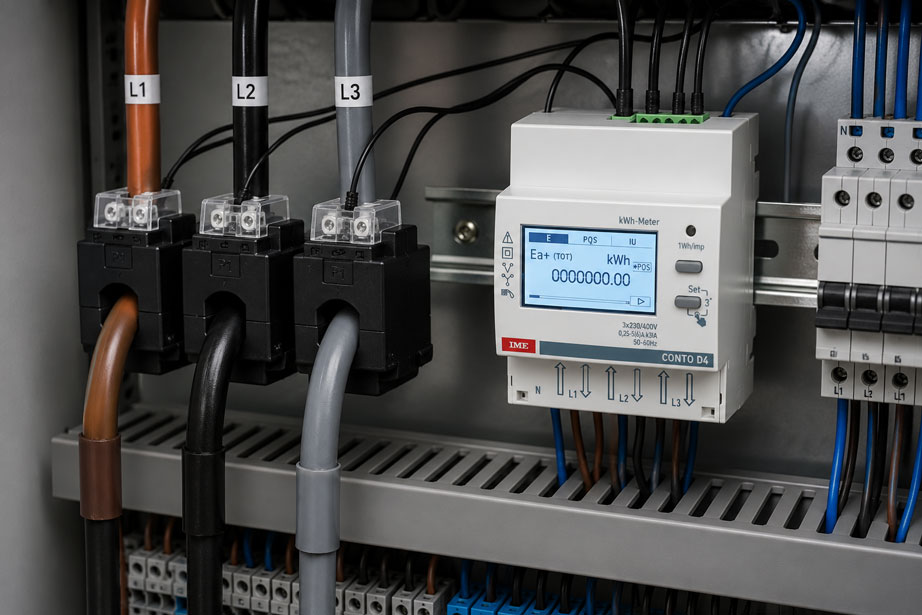
If an energy meter shows incorrect, too low or even negative values after installation, the cause is often not the measuring device itself. In many cases, current transformers, transformer ratio, phase assignment, current direction or parameterization do not match correctly.
Especially in three-phase energy measurements, small wiring or setting errors can lead to significantly incorrect consumption values. This article explains which errors occur particularly often in practice and what you should pay attention to when combining current transformers for measuring applications and energy meters.
Table of Contents
- Why are current transformers used for energy measurements?
- Incorrect current transformer ratio: A common cause of incorrect measured values
- 1 A or 5 A: Why the secondary current must match the measuring device
- Incorrect current direction: Why energy meters can display negative power
- Phase assignment: Why current and voltage paths must match
- Energy meter parameterization: Small setting, major measurement error
- Excessive burden: Measurement errors caused by long cables or incorrect design
- Incorrect measuring range: When the current transformer is oversized
- Practical example: Energy meter shows implausible consumption values
- Important safety note regarding current transformers
- FAQ: Frequently asked questions about current transformers and energy meters
Why are current transformers used for energy measurements?
In industrial plants, main distributions, machine supply lines and control cabinets, currents often flow that should not or cannot be routed directly through an energy meter. A current transformer reduces the high primary current to a smaller secondary current that the measuring device can safely detect.
Typical secondary currents are 5 A or 1 A. This means that the measuring device does not directly measure the actual system current, but the output current of the current transformer. In order to calculate the correct current, power and energy consumption value from this, the measuring device must know exactly which transformer ratio is being used.
| Current transformer | Meaning | Example application |
|---|---|---|
| 100/5 A | 100 A primary current corresponds to 5 A secondary current | Smaller machines or sub-distributions |
| 250/5 A | 250 A primary current corresponds to 5 A secondary current | Machine supply lines and control cabinet construction |
| 400/1 A | 400 A primary current corresponds to 1 A secondary current | Longer cable runs between transformer and measuring device |
| 1000/5 A | 1000 A primary current corresponds to 5 A secondary current | Main distributions and larger systems |
For energy measurements with external current transformers, suitable energy meters with transformer connection are used. One example is the Conto D4-Pd energy meter, which is designed for measurement via external current transformers.
Incorrect current transformer ratio: A common cause of incorrect measured values
One of the most common errors in energy measurements is an incorrectly set current transformer ratio. For example, if a current transformer with 250/5 A is used, but the energy meter is set to 100/5 A, the measuring device calculates the consumption incorrectly.
This problem is particularly tricky because the energy meter still displays values. At first glance, these values often appear plausible, but they are permanently too low or too high.
Typical signs of an incorrect transformer ratio
- The displayed consumption is significantly lower or higher than expected
- The current values do not match the known machine output
- Load peaks appear unrealistic
- Comparable systems show strongly different consumption values
- The displayed power does not match the nameplate of the connected machine
The solution is to check the nameplate of the current transformer and set exactly this ratio in the energy meter. It is important to consider not only the primary current, but also the secondary current.
1 A or 5 A: Why the secondary current must match the measuring device
Current transformers are often available with a secondary current of 1 A or 5 A. Both versions are common in practice, but they must match the input of the measuring device. If a 1 A current transformer is operated on a 5 A input, or if the measuring device is parameterized incorrectly, incorrect measured values will occur.
| Version | Typical use | What must be considered? |
|---|---|---|
| 5 A secondary current | Classic control cabinet and distribution measurements | The measuring device must be designed or parameterized for 5 A |
| 1 A secondary current | Measurements with longer cable runs | The measuring device must be designed or set accordingly for 1 A |
Especially when retrofitting, modifying or replacing individual components, it should therefore always be checked whether the current transformer and measuring device are electrically compatible. For existing systems, split-core current transformers can also be useful, as they can be installed later without disconnecting the conductor.
Incorrect current direction: Why energy meters can display negative power
Current transformers have a defined installation direction. This is often marked with P1/P2, K/L or an arrow direction. If the transformer is installed opposite to the intended energy flow direction or connected incorrectly on the secondary side, the energy meter may display negative power or implausible energy flow directions.
This is particularly noticeable in three-phase measurements if only one phase shows abnormal values or if consumption and feed-in appear to be reversed.
Typical signs of incorrect current direction
- The energy meter displays negative active power
- Consumption and feed-in appear to be reversed
- Only one phase shows abnormal values
- The total power is significantly lower than expected
- The power factor appears implausible
In this case, the installation direction and secondary connections of the current transformer should be checked. The current direction must match the energy flow direction and the voltage measurement.
Phase assignment: Why current and voltage paths must match
For correct power and energy measurement, each current path must correspond to the matching voltage. If the current of L1 is measured, the measuring device must also use the voltage of L1. If current and voltage paths are interchanged, incorrect power values occur.
This error is particularly common with three-phase energy meters. The current transformers are mechanically installed correctly, the transformer ratio is correct, but the voltage inputs are not assigned correctly.
| Current path | Matching voltage path | Typical error |
|---|---|---|
| Current transformer on L1 | Voltage L1 | Current L1 is calculated with voltage L2 |
| Current transformer on L2 | Voltage L2 | Current L2 is calculated with voltage L3 |
| Current transformer on L3 | Voltage L3 | Current L3 is calculated with voltage L1 |
The result can be incorrect active power, an incorrect power factor, negative power or a significantly deviating energy consumption.
Energy meter parameterization: Small setting, major measurement error
Modern energy meters offer numerous setting options. Depending on the device, not only the current transformer ratio must be set correctly, but also the network type, connection type, measuring mode, secondary current and communication parameters.
An incorrect basic setting can cause the measuring device to display values that do not match the actual system. It is particularly important to select correctly between direct measurement and transformer measurement, as well as between single-phase and three-phase measurement.
Typical parameters on the energy meter
- Current transformer ratio
- 1 A or 5 A secondary input
- Single-phase or three-phase measurement
- 3-wire or 4-wire network
- Direct measurement or transformer measurement
- Measurement of consumption, feed-in or bidirectional energy flow
- Pulse output, Modbus, M-Bus or other interfaces
For applications involving energy management, load monitoring or consumption recording, the parameterization should be carefully checked before commissioning. Suitable devices can be found in the energy meters category.
Excessive burden: Measurement errors caused by long cables or incorrect design
Between the current transformer and the measuring device, an electrical load is created by cables, terminals and the input of the measuring device. This load is known as the burden. If the burden is too high, the current transformer may operate outside its specification. This can cause measurement deviations.
Especially with long cable runs between current transformer and energy meter, it must be checked whether the transformer power is suitable for the cable length, cable cross-section and the connected measuring device.
Typical causes of excessive burden
- Very long secondary cables between current transformer and measuring device
- Cable cross-section too small
- Several measuring devices connected to one current transformer
- Transformer power unsuitable for the application
- Additional contact resistance caused by terminals or poor connections
When selecting solid-core current transformers for measuring applications, not only the transformer ratio should therefore be considered, but also power, accuracy class, design and installation situation.
Incorrect measuring range: When the current transformer is oversized
A current transformer should match the actual operating current of the system. If a very large current transformer is used for a permanently small load, the measurement operates in the lower range of the measuring signal. This can reduce accuracy.
Example: A machine only draws 20 A during normal operation, but is measured via a 1000/5 A current transformer. The secondary signal is then very small. Although the energy meter displays values, the informative value of the measurement may be limited.
The primary current of the current transformer should therefore not be selected unnecessarily high. At the same time, possible load peaks, starting currents and future expansions must be taken into account.
Practical example: Energy meter shows implausible consumption values
In a production plant, a new energy meter is installed to record consumption. The current transformers are mounted, and the display shows current, voltage and power. Nevertheless, the consumption values are significantly lower than expected. In addition, one phase occasionally shows negative power.
During inspection, it becomes clear that the current transformer ratio is set correctly, but the current and voltage paths were interchanged during wiring. The current transformer on L1 was calculated with the voltage from L2. As a result, the energy meter could not calculate the active power correctly.
After correcting the phase assignment, current, voltage, power and energy consumption provide plausible values. This example shows that in energy measurements, not only the current transformer itself must be considered, but always the entire measuring system.
Important safety note regarding current transformers
Work on electrical systems may only be carried out by qualified personnel. With current transformers, it is particularly important that the secondary circuit must not be operated open while in service. Depending on the design and operating condition, dangerous voltages may occur.
Before making changes to the wiring, replacing a measuring device or working on the secondary circuit, the manufacturer’s instructions and the applicable safety rules must be observed.
Conclusion
In energy measurements with current transformers, correct values do not depend only on the quality of the individual measuring device. The interaction between current transformer, energy meter, transformer ratio, secondary current, current direction, phase assignment and parameterization is decisive.
If an energy meter displays incorrect or implausible values, the entire measuring system should therefore always be checked. Suitable solutions for control cabinet construction, energy management and industrial consumption recording can be found in the energy meters section as well as in the current transformers for measuring applications category.
FAQ: Frequently asked questions about current transformers and energy meters
Why does my energy meter show incorrect values?
Common causes include an incorrectly set current transformer ratio, interchanged phases, incorrect current direction, an incorrect secondary current or unsuitable parameterization of the measuring device.
What does 250/5 A mean on a current transformer?
A 250/5 A current transformer converts a primary current of 250 A into a secondary current of 5 A. The measuring device must know this ratio in order to correctly calculate the actual system current.
Which is better: 1 A or 5 A secondary current?
Both versions are common. 5 A is often used in classic control cabinet applications. 1 A can be advantageous for longer cable runs. The decisive factor is that the current transformer and measuring device match.
Why does the energy meter display negative power?
Negative power can occur if the current direction at the current transformer is incorrect or if the current and voltage paths do not belong to the same phase. Incorrect parameterization can also be the cause.
Does the current transformer ratio have to be set in the energy meter?
Yes. Without the correct transformer ratio, the energy meter cannot correctly convert the measured secondary current into the actual primary current.
What happens if L1, L2 and L3 are interchanged?
If current and voltage paths are not assigned correctly, active power, power factor and energy consumption may be displayed incorrectly. Correct phase assignment is particularly important for three-phase measurements.
Can a current transformer be oversized?
Yes. If the actual operating current is permanently very low in relation to the rated current of the current transformer, the measuring accuracy may be reduced. The measuring range should match the application.
Why is the burden important for current transformers?
The burden describes the load on the secondary circuit. Long cables, small cable cross-sections, terminals or several connected devices can increase the burden and cause measurement errors.
May a current transformer be operated open while in service?
No. The secondary circuit of a current transformer must not be operated open while in service. Before working on the measuring device or wiring, the secondary circuit must be handled correctly by qualified personnel.
Which products are suitable for energy measurements with current transformers?
Suitable energy meters in combination with suitable current transformers are suitable for these applications. For retrofitting, split-core current transformers can also be a practical solution.