


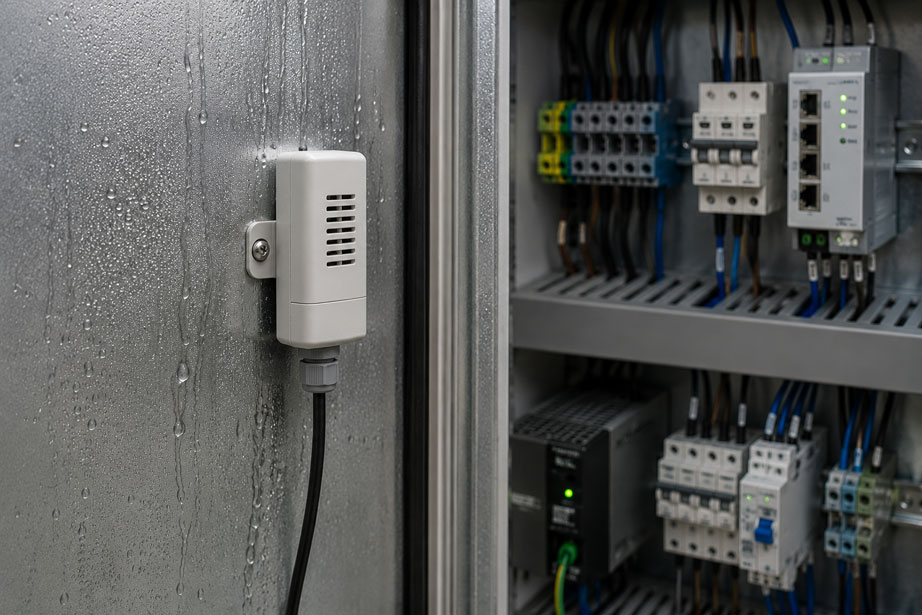
If a humidity sensor permanently displays values that are too high, too low or strongly fluctuating, the sensor is not automatically defective. In many industrial applications, implausible humidity readings are caused by incorrect placement, condensation, dust, oil mist, temperature differences, chemical exposure or missing calibration.
Especially when monitoring production areas, warehouses, control cabinets, compressed air systems or process environments, reliable humidity measurement is essential. This article explains the most common causes of incorrect measured values and shows what you should pay attention to when selecting, installing and checking humidity measuring devices and humidity sensors.
Table of contents
- Why humidity sensors can show incorrect values in industry
- Incorrect placement: The most common reason for implausible humidity values
- Condensation on the sensor: When the measured value is permanently too high
- Temperature gradients: Why humidity and temperature must be considered together
- Insufficient airflow: When the sensor does not measure the actual environment
- Dust, oil mist and deposits: Typical problems in industrial environments
- Chemicals and aggressive media: When the sensing element is damaged
- Ageing and drift: Why humidity sensors should be checked regularly
- Calibrating a humidity sensor: When testing makes sense
- Documenting humidity values: Why data loggers help with troubleshooting
- Practical example: Sensor permanently displays high humidity values
- Conclusion: Incorrect humidity values are often caused by the measuring point
- FAQ: Frequently asked questions about incorrect humidity readings
Why humidity sensors can show incorrect values in industry
Humidity sensors do not simply measure “the humidity of the entire environment”, but always the conditions directly at the sensing element. This is exactly why measured values can be incorrect or misleading even though the sensor is technically functioning.
In practice, even small differences at the installation location can have a major impact. A sensor mounted on a cold external wall measures different values than a sensor in the middle of the room. A sensor in a poorly ventilated control cabinet reacts differently than a sensor in an airflow. Dust, oil mist, condensation or chemical vapours can also influence the measurement result.
Different solutions are available for industrial applications – from stationary humidity sensors and combined humidity/temperature transmitters to mobile humidity data loggers for temporary measurements.
Incorrect placement: The most common reason for implausible humidity values
The position of the humidity sensor is decisive for the quality of the measurement. A technically suitable sensor can deliver incorrect values if it is installed in an unsuitable location.
Typical problematic installation locations include cold external walls, areas directly next to gates or doors, places with direct sunlight, heaters, air-conditioning units, ventilation outlets, dead zones without air movement or areas with local humidity exposure.
| Installation location | Possible problem | Effect on the measured value |
|---|---|---|
| Cold external wall | Local cooling and risk of condensation | Humidity value appears too high |
| Directly next to a gate or door | Influence from outside air | Measured value fluctuates strongly |
| Near a heater or air-conditioning unit | Non-representative temperature | Relative humidity is distorted |
| Dead zone without air movement | Sensor measures stagnant air | Response to changes is delayed |
| Directly in process mist | Sensor becomes wetted or contaminated | Measured value is permanently too high or unstable |
When planning a measuring point, the following question should always be asked: Should the general room humidity, the humidity in a process area, the humidity in a control cabinet or the humidity in an airflow be monitored? Depending on the measurement objective, a different installation location may be appropriate.
Condensation on the sensor: When the measured value is permanently too high
Condensation is one of the most common causes of permanently high or unstable humidity values. If water condenses directly on the sensing element, the filter or inside the sensor housing, the sensor can no longer reliably measure the actual air humidity.
Applications with temperature changes are particularly critical. This includes, for example, control cabinets after shutdown periods, production halls with cold external surfaces, storage areas with changing outside air or measuring points near cold pipework.
The relationship between relative humidity, temperature and dew point is important here. An environment may appear uncritical when the air is warm. However, if the air cools down locally, the dew point can be undershot. Condensation then forms – even if the measured room humidity at another location still appears uncritical.
For applications in which dew point or the risk of condensation is decisive, special dew point sensors can be useful.
Temperature gradients: Why humidity and temperature must be considered together
Relative humidity is strongly dependent on temperature. For this reason, in many cases it is not enough to consider only the humidity value. If temperature and humidity are not measured at the same point or under comparable conditions, incorrect interpretations can quickly occur.
A typical example is a hall with warm room air and cold wall surfaces. In the middle of the room, the relative humidity may be uncritical, while condensation may already be possible on a cold surface. A humidity sensor installed in the wrong location can therefore deliver values that are either too high or too low.
Combined humidity and temperature sensors such as the IFG80 / ITFG80 humidity-temperature sensor or industrial transmitter solutions such as the IAW with S-Series for humidity and temperature can help to record both measured variables together.
Insufficient airflow: When the sensor does not measure the actual environment
A humidity sensor needs sufficient connection to the surrounding air. If the air movement at the sensor is too low, the measuring point reacts only slowly to changes or shows local values that are not representative of the entire area.
This problem often occurs in control cabinets, corners of storage rooms, poorly ventilated housings, ducts with unfavourable airflow or behind covers. The sensor then does not measure the actual process or room air, but the air in a local zone.
Conversely, a sensor installed directly in a strong airflow can also be problematic if this airflow is not representative. Examples include warm air from a heater, cold supply air from an air-conditioning system or humid exhaust air from a process.
Dust, oil mist and deposits: Typical problems in industrial environments
In industrial applications, humidity sensors are often exposed to dust, oil mist, aerosols, fibres, particles or other deposits. These substances can accumulate on the sensing element or protective filter and influence the measurement.
The consequences are delayed response times, drifting measured values, permanently too high or too low humidity readings or strong fluctuations. Applications in workshops, production plants, painting areas, compressed air environments, machine rooms or processes with oil-containing air are particularly critical.
For harsh conditions, robust humidity and temperature sensors such as the IVC / IVR compact sensor for humidity and temperature can be useful. Nevertheless, the measuring point should be selected so that the sensor is not exposed to unnecessary contamination.
Chemicals and aggressive media: When the sensing element is damaged
Chemical vapours, solvents, cleaning agents, acids, alkalis or aggressive process gases can permanently affect humidity sensors. Depending on the sensor technology, the sensing element may age, drift or become damaged.
In such cases, it is not sufficient to consider only the measuring range of the sensor. Media compatibility, chemical exposure, temperature, airflow and possible condensation must also be taken into account.
If a sensor shows significantly deviating values after only a short operating time, it should be checked whether the environment is suitable for the sensor type used. In special applications, alternative sensor designs, protective filters, process probes or dew point measurements may be required.
Ageing and drift: Why humidity sensors should be checked regularly
Humidity sensors can drift over time. This means that the sensor does not suddenly fail, but gradually deviates from the actual values. In practice, this deviation is often only noticed when measured values no longer match comparison measurements, process conditions or experience-based values.
Drift can be caused by ageing of the sensing element, contamination, chemical influences, high humidity exposure, condensation or thermal stress. Especially in quality-relevant applications, not only the current measured value should be considered, but also the calibration status of the sensor.
An indication of drift can be that several sensors in comparable areas show different values or that one sensor permanently deviates from a reference measuring device.
Calibrating a humidity sensor: When testing makes sense
Calibration or comparison measurement is useful if humidity values appear implausible, if the sensor is used in a critical application or if the measured values are used for quality records, storage conditions, process monitoring or complaints.
A distinction should be made between a simple plausibility check with a reference device and documented calibration. For troubleshooting on site, a mobile humidity and temperature measuring instrument such as the testo 635-2 temperature and humidity measuring instrument can be helpful.
It is important that comparison measurements are carried out under stable conditions. If two sensors are compared immediately after a change of location, different response times, temperature differences and local air movements may initially lead to deviating values.
Documenting humidity values: Why data loggers help with troubleshooting
Many humidity problems do not occur permanently. Critical values often occur only at certain times, for example at night, after gates are opened, during cleaning processes, when a system is at a standstill or during temperature changes.
A single instantaneous value is often not enough to identify the cause. With a humidity data logger, humidity and temperature profiles can be documented over hours, days or weeks. This makes it visible whether jumps in measured values are related to specific operating states, outside temperatures, ventilation times or process sequences.
For industrial applications, warehouse monitoring or troubleshooting, the combination of a stationary sensor and a temporary data logger can be particularly useful. The sensor monitors continuously, while the data logger helps to narrow down the cause of abnormal values more precisely.
Practical example: Sensor permanently displays high humidity values
In a production hall, a humidity sensor permanently displays high values. The measured relative humidity is significantly above the experience-based values, although no obvious humidity source is present. Initially, it is assumed that the room air is generally too humid.
However, when the measuring point is checked, it turns out that the sensor was installed on a cold external wall. Due to temperature differences between the room air and the wall area, condensation temporarily forms on the sensing element. As a result, the sensor does not measure the representative room humidity, but a local humidity load directly at the installation position.
After relocating the sensor to a more suitable position and performing a comparison measurement with a mobile humidity measuring instrument, the values become plausible again. The example shows that the cause is often not the sensor itself, but the combination of installation location, temperature and local air movement.
Conclusion: Incorrect humidity values are often caused by the measuring point
If a humidity sensor displays incorrect, permanently high or strongly fluctuating values, it should not immediately be assumed that the sensor is defective. In many cases, the measurement errors are caused by incorrect placement, condensation, temperature gradients, insufficient airflow, contamination, chemical exposure or missing calibration.
For reliable measurement results, sensor, measuring point and application must match. Suitable solutions for industrial humidity monitoring can be found in the area of humidity measuring devices and humidity sensors. For temporary analyses and documentation, humidity data loggers are also suitable.
FAQ: Frequently asked questions about incorrect humidity readings
Why does my humidity sensor show values that are too high?
Common causes include condensation on the sensor, installation on a cold surface, insufficient air movement, contamination, incorrect placement or a local humidity source near the measuring point.
Why does the humidity value fluctuate strongly?
Strong fluctuations can be caused by changing airflows, open gates, air-conditioning systems, heaters, process air, temperature changes or an unsuitable installation position.
Can a humidity sensor be damaged by condensation?
Depending on the sensor type and protection design, condensation can lead to measurement errors, delayed response or long-term stress on the sensing element. Condensation at the measuring point should therefore be avoided as far as possible.
Why is temperature so important in humidity measurement?
Relative humidity strongly depends on temperature. If temperature and humidity are not considered at the same point, measured values can be misinterpreted. The dew point is particularly important on cold surfaces.
How can I tell whether the sensor or the measuring point is the problem?
A comparison measurement with a reference device at the same location can help. If the sensor delivers plausible values at another position, the problem is often the original measuring point.
When should a humidity sensor be calibrated?
Calibration is useful if measured values appear implausible, if the sensor is used in quality-relevant applications or if the measured values are subject to documentation requirements.
Can dust affect humidity measurement?
Yes. Dust, oil mist, aerosols or deposits can affect the filter and sensing element. This can impair response time, accuracy and long-term stability.
What is the difference between a humidity sensor and a dew point sensor?
A humidity sensor typically measures relative humidity and often also temperature. A dew point sensor is used when the risk of condensation or the pressure dew point, for example in compressed air systems, needs to be monitored.
Why does a sensor in the control cabinet show different values than in the room?
Different temperature and airflow conditions often prevail inside the control cabinet than in the room. Closed housings, heat loss, shutdown periods and condensation can significantly influence the measured values.
Which products are suitable for checking humidity readings?
Industrial humidity sensors are suitable for stationary measurements. For mobile checks and comparison measurements, humidity measuring instruments can be used. For time-based documentation, humidity data loggers are suitable.