


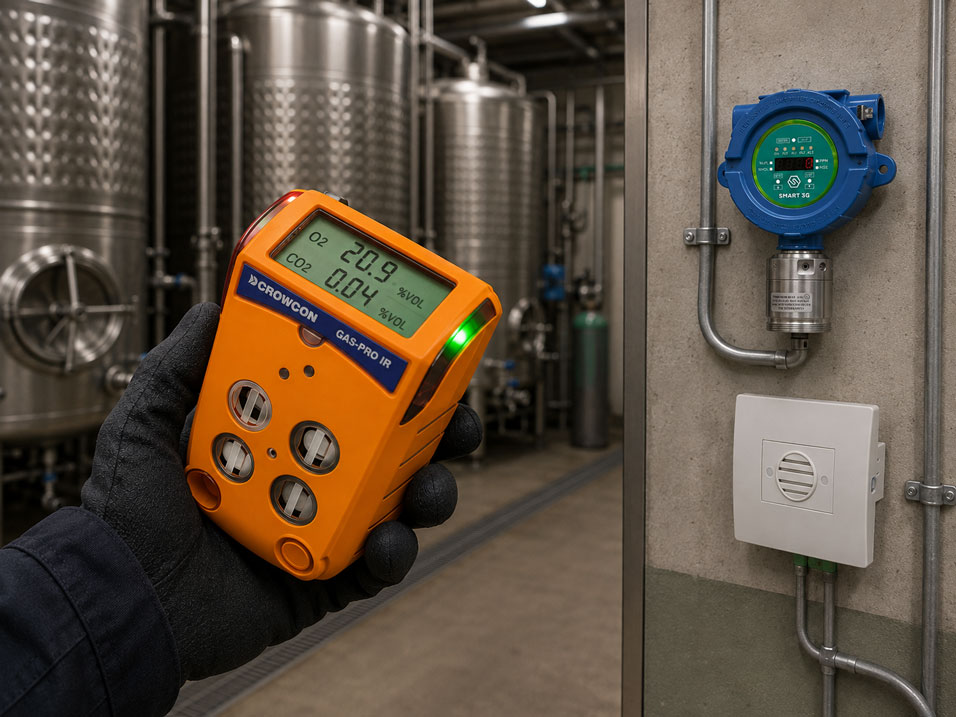
An oxygen sensor is installed in a cold room, fermentation cellar or laboratory. The display shows around 20 vol.% O₂ and therefore appears to be within a non-critical range. Does this rule out the possibility that a dangerous carbon dioxide concentration has developed?
No. An oxygen sensor only answers the question of how high the oxygen content of the atmosphere is. It does not measure which gas is displacing the oxygen, nor does it detect the independent physiological effects of carbon dioxide.
Especially with CO₂, this distinction can be safety-critical. An increased carbon dioxide concentration can already become hazardous while the oxygen level is still above a typical oxygen-deficiency alarm threshold. O₂ and CO₂ measurement therefore cannot generally be substituted for one another.
Suitable solutions can be found under Gas detectors / gas warning devices. Stationary monitoring systems with detector heads, alarm functions and control functions are grouped under Gas detection systems.
Table of Contents
- What do O₂ and CO₂ sensors measure?
- Why is an O₂ sensor not always sufficient for CO₂?
- Why can the oxygen reading still appear plausible despite a high CO₂ concentration?
- CO₂ is more than just an oxygen-displacing gas
- Where do typical CO₂ hazards occur?
- Correctly assessing gas density and stratification
- Where should CO₂ and O₂ sensors be installed?
- Portable or stationary gas detectors?
- Correctly defining pre-alarm and main alarm thresholds
- Connecting a gas detection system to ventilation control
- Special considerations for cold rooms and CO₂ refrigeration systems
- Special considerations for fermentation and beverage production
- Pre-entry testing in confined and low-lying areas
- Typical errors in gas monitoring
- Which sensor configuration is appropriate?
- Considering alarm and rescue concepts together
- Practical example from a fermentation cellar
- Which products and solutions are suitable?
- Conclusion
- Frequently asked questions
What do O₂ and CO₂ sensors measure?
An oxygen sensor measures the oxygen concentration in the atmosphere. In normal ambient air, this is approximately 20.9 vol.%.
If the oxygen concentration decreases, this may for example be caused by displacement by nitrogen, argon, carbon dioxide or another gas. However, an O₂ sensor only detects the change in oxygen concentration – not the identity of the displacing gas.
A CO₂ sensor, on the other hand, specifically measures the carbon dioxide concentration. Infrared measurement technology is frequently used for this purpose in industrial gas detectors.
| Sensor | Measures | Typical information provided |
|---|---|---|
| O₂ sensor | Oxygen concentration in vol.% | Is oxygen deficiency or oxygen enrichment present? |
| CO₂ sensor | Carbon dioxide concentration in ppm or vol.% | How high is the actual CO₂ exposure? |
The two measured variables therefore complement one another but answer different safety-related questions.
Why is an O₂ sensor not always sufficient for CO₂?
With a pure displacement gas such as nitrogen, oxygen deficiency is often the main focus of the risk assessment. If the oxygen concentration drops sufficiently, an O₂ warning device will trigger an alarm.
With carbon dioxide, the situation is different.
CO₂ also displaces air and therefore oxygen. At the same time, however, an increased carbon dioxide concentration has its own physiological effect on the human body.
An atmosphere can therefore already be hazardous because of its CO₂ content even though the oxygen concentration has not yet fallen to a level that would trigger a typical oxygen-deficiency alarm.
An oxygen sensor therefore cannot replace a CO₂ sensor when carbon dioxide itself is the hazard that needs to be monitored.
Why can the oxygen reading still appear plausible despite a high CO₂ concentration?
The relationship can be illustrated with a simplified example.
Normal air contains approximately 20.9 vol.% oxygen. If 4 vol.% of the room air is displaced by carbon dioxide, approximately 96% of the original air remains in this simplified example.
The oxygen concentration is then approximately:
20.9% × 0.96 ≈ 20.1 vol.% O₂
The O₂ value therefore remains relatively close to the normal ambient-air value. At the same time, however, the carbon dioxide concentration has already reached 4 vol.% or 40,000 ppm.
This simplified calculation demonstrates the key point: a safety-relevant CO₂ concentration does not necessarily have to be accompanied by an obvious oxygen deficiency.
The actual atmosphere inside a room can, of course, be more complex due to airflow, mixing, temperature and the nature of the release. The underlying principle nevertheless remains the same.
CO₂ is more than just an oxygen-displacing gas
Carbon dioxide is sometimes considered exclusively as an asphyxiant gas. This description is incomplete.
As the CO₂ concentration increases, the regulation of breathing and the body’s acid-base balance changes. Depending on concentration and exposure duration, effects may include accelerated breathing, headaches, dizziness, confusion and eventually loss of consciousness.
From a safety perspective, CO₂ therefore differs from a gas whose primary hazard lies solely in displacing oxygen.
In areas where carbon dioxide may be released, it should therefore be assessed whether the actual CO₂ concentration needs to be monitored directly.
Where do typical CO₂ hazards occur?
CO₂ can occur in a wide variety of applications:
- fermentation cellars and breweries,
- wine and beverage production,
- food processing,
- CO₂ refrigeration systems,
- cold rooms and machine rooms,
- laboratories with gas cylinders,
- dry ice applications,
- greenhouses,
- CO₂ fire suppression systems,
- biogas and fermentation processes, and
- technical gas supply systems.
The release can be caused by a normal process, a leak, depressurisation, a fermentation reaction or the evaporation or sublimation of CO₂.
Poorly ventilated, low-lying or partially enclosed areas are particularly critical.
Correctly assessing gas density and stratification
Under comparable conditions, carbon dioxide is significantly denser than air. Following a release, it can therefore preferentially accumulate in lower areas, pits, shafts or cellars.
However, this must not lead to the general rule that every CO₂ sensor should always be installed just a few centimetres above the floor.
The actual gas distribution is additionally influenced by:
- position and direction of the potential leak,
- temperature of the escaping gas,
- release pressure and flow velocity,
- room ventilation,
- doors and openings,
- machinery and installations,
- thermal convection, and
- room geometry.
With a cold or pressurised CO₂ release, the gas can spread particularly strongly in lower areas. With good mixing, however, a much more uniform concentration profile can develop.
Where should CO₂ and O₂ sensors be installed?
The position of the detector head should be derived from the actual hazard and not solely from the theoretical density of the gas.
For stationary CO₂ monitoring, for example, the following questions are relevant:
- Where can CO₂ be released?
- Where can dangerous concentrations accumulate?
- Where are people likely to be present?
- Are there pits, cellar stairways or depressions?
- How does the ventilation system operate?
- Where are the supply and exhaust air openings?
- Can released gas be distributed by machine-generated airflow?
Depending on the size of the room and the system geometry, multiple measuring points may be required.
An O₂ sensor should likewise be positioned where it measures an atmosphere that is representative and safety-relevant for personnel.
In complex applications, it may be appropriate to install CO₂ and O₂ sensors at different locations.
Portable or stationary gas detectors?
Portable and stationary gas detectors perform different functions.
Portable gas detectors
A portable device is typically worn on the body and therefore monitors the atmosphere in the immediate vicinity of the person.
It is suitable, for example, for:
- maintenance work,
- inspection rounds,
- temporary work in hazardous areas,
- pre-entry measurements, and
- personal protection at changing work locations.
Stationary gas detection system
A stationary system continuously monitors defined areas. Detector heads can be connected to a gas detection controller, visual and audible alarm devices and technical protective measures.
This can be used, for example, to:
- trigger a pre-alarm,
- activate ventilation,
- activate the main alarm,
- prevent access,
- shut off the gas supply, or
- transmit a signal to the building or process control system
.
In many installations, stationary gas detection technology and personal portable devices complement one another.
Correctly defining pre-alarm and main alarm thresholds
Alarm thresholds should not simply be copied from another installation.
Among other factors, they must be appropriate for the risk assessment, target gas, measuring range, exposure duration, applicable occupational exposure limit, ventilation and the intended response to the alarm.
A typical alarm strategy may, for example, be structured as follows:
| Level | Possible function |
|---|---|
| Pre-alarm | Early warning, activate ventilation, investigate the cause |
| Main alarm | Evacuate the area or prevent access and trigger defined protective measures |
| Fault | Report a sensor, cable or system fault |
The concentrations assigned to the respective levels must be defined for the specific application.
O₂ and CO₂ alarms should also be capable of being evaluated independently. A normal O₂ channel must not suppress an active CO₂ alarm on the assumption that it is implausible.
Connecting a gas detection system to ventilation control
A stationary gas detection system can be integrated into the plant control system via relays, analogue signals or bus interfaces.
In CO₂ applications, it is often assessed whether the pre-alarm should already activate mechanical ventilation.
The ventilation system must be designed so that the gas is actually removed from the hazardous area. With CO₂, extraction from lower areas may be particularly relevant.
However, ventilation control must not be considered in isolation. Ventilation failure, power supply, fan feedback and the response to sensor failure also form part of the safety concept.
A gas detection system is therefore more than just a measuring instrument. It can form part of a complete safety function consisting of sensors, evaluation, alarm signalling and countermeasures.
Special considerations for cold rooms and CO₂ refrigeration systems
CO₂ is used as a natural refrigerant under the designation R744.
In the event of a leak, a considerable quantity of gas can be released within a short period of time. Cold rooms and machine rooms also often have only limited natural ventilation.
Pure oxygen monitoring should therefore not automatically be regarded as a substitute for direct refrigerant or CO₂ detection.
When planning the system, factors such as room volume, possible leak quantity, system capacity, ventilation, detector position and the requirements applicable to the refrigeration system must be taken into account.
The low temperature of CO₂ released during depressurisation can also influence its initial dispersion.
Special considerations for fermentation and beverage production
Carbon dioxide is produced as a normal part of the process during alcoholic fermentation.
In fermentation cellars, breweries and wine cellars, a possible CO₂ hazard therefore exists not only in the event of a technical fault. The gas is continuously generated as part of the process.
Because CO₂ is colourless and odourless, a dangerous concentration cannot be reliably detected by human senses.
Low-lying work areas, tanks, shafts and poorly ventilated cellar areas are particularly critical.
For such applications, a combination of stationary CO₂ monitoring, ventilation and portable personal protection may be appropriate.
Pre-entry testing in confined and low-lying areas
Before entering a vessel, shaft or other potentially hazardous area, the atmosphere must be checked in accordance with the risk assessment.
Measuring only oxygen is not sufficient if CO₂ or other hazardous gases may also be present.
A standard multi-gas detector with O₂, CO, H₂S and combustible-gas channels, for example, does not automatically include a CO₂ sensor.
If CO₂ may be present, an appropriately configured measuring instrument or an additional CO₂ measurement method must be provided.
In stratified atmospheres, measurements at different heights may also be required. A single reading directly at the entrance to the area may not be representative of the lower part of the space.
Typical errors in gas monitoring
| Situation | Problem | Recommended measure |
|---|---|---|
| O₂ reads approximately 20%, therefore CO₂ is ruled out | CO₂ may already be elevated before a significant O₂ deficiency occurs | Measure CO₂ directly if it may represent a hazard |
| A standard four-gas detector is used | CO₂ is often not included in the sensor configuration | Check the gas configuration of the device |
| CO₂ detector is installed near the floor solely because of gas density | Airflow and the leak source are not taken into account | Plan measuring points according to the actual dispersion conditions |
| Only a stationary sensor is installed | A person may move outside the monitored area | Use additional portable personal protection if required |
| Only a portable device is available | An unoccupied room is not monitored continuously | Consider a stationary gas detection system |
| Alarm is acknowledged without eliminating the cause | The hazard may still be present | Apply a defined alarm and release procedure |
| Ventilation starts only at the main alarm | An early technical countermeasure is not being used | Review the pre-alarm strategy within the safety concept |
Which sensor configuration is appropriate?
The selection should always be based on the possible gas hazard and not on which sensors happen to already be installed in a device.
| Application | Measured variables to be considered |
|---|---|
| Nitrogen inerting | O₂ deficiency |
| CO₂ fermentation | CO₂ and, depending on the risk assessment, additionally O₂ |
| CO₂ refrigeration system | Direct CO₂/R744 monitoring, optionally supplemented by O₂ |
| Gas-cylinder laboratory with several gases | Sensor configuration corresponding to all possible releases |
| Unknown atmosphere before vessel entry | O₂, combustible gases and relevant toxic or process-specific gases |
If several hazards may occur simultaneously, a multi-gas detector may be more suitable than several individual devices.
The decisive point, however, is that the required CO₂ measurement is actually available as a dedicated measuring channel.
Considering alarm and rescue concepts together
A gas alarm is only effective if it has been defined what happens afterwards.
Employees must know what the pre-alarm and main alarm mean and whether the area must be evacuated immediately when an alarm occurs.
Particularly important: a person who has become unconscious in an area that may contain elevated CO₂ levels or insufficient oxygen must not be approached without an appropriate rescue and respiratory-protection concept.
Unprepared rescue attempts can result in additional people entering the hazardous atmosphere and becoming casualties themselves.
For such work areas, the risk assessment, alarm plan, access control, ventilation, suitable rescue equipment and, where necessary, supplied-air or self-contained breathing protection should therefore be planned together.
Practical example from a fermentation cellar
A production facility has a small fermentation cellar containing several vessels. An oxygen warning device is installed on the wall.
During an inspection, the device displays 20.0 vol.% O₂. The value is only slightly below normal ambient air and does not trigger an oxygen-deficiency alarm.
An employee therefore assumes that the atmosphere is not hazardous.
During a later measurement using a CO₂ detector, however, a significantly elevated carbon dioxide concentration is detected in the lower part of the room.
The cause is not a fault in the oxygen sensor. The device displayed exactly the measured variable for which it was designed.
The problem lies in the original choice of the monitoring concept: the specific process hazard was carbon dioxide. Monitoring solely by oxygen concentration was not sufficient to represent this hazard adequately.
The risk assessment is therefore revised. In addition to O₂ monitoring, direct stationary CO₂ measurement is introduced. The measuring point is selected according to the possible CO₂ dispersion and the ventilation conditions.
The pre-alarm activates the mechanical ventilation system. At a higher alarm level, a visual and audible alarm is also triggered and access to the room is restricted in accordance with the company’s alarm procedure.
A portable multi-gas detector with a dedicated CO₂ channel is also available for maintenance work.
Which products and solutions are suitable?
Gas-Pro IR – monitoring O₂ and CO₂ with a portable multi-gas detector
The Gas-Pro IR is particularly suitable for applications in which both oxygen and carbon dioxide are relevant.
Depending on the configuration, up to five measuring channels can be used. An infrared sensor with a measuring range of up to 5 vol.% is available for CO₂; oxygen can also be monitored.
This makes the device suitable, for example, for maintenance work, pre-entry measurements, technical gas areas and other applications in which several gas hazards must be assessed simultaneously.
An internal pump is optionally available, allowing samples to be drawn before entering an area.
SMART 3-H-FM LITE – stationary CO₂ monitoring
The SMART 3-H-FM LITE is a compact stationary infrared gas detector for carbon dioxide and various refrigerants.
It is particularly suitable for commercial buildings and refrigeration applications where continuous CO₂ monitoring is required.
The detector can be integrated into a stationary warning and control system and includes a local status or alarm indication.
SMART 3G-D2 – stationary O₂ or gas monitoring for industrial plants
The SMART 3G-D2 is a stationary industrial gas detector with various sensor options.
Electrochemical sensor versions are available for oxygen. Depending on the configuration, catalytic and infrared sensor versions are also available for numerous other gases.
Via 4–20 mA, optional relays or RS485, the detector can be integrated into gas detection controllers and process control systems.
Complete gas detection system
If several measuring points, different gases or automatic protective measures are required, a complete gas detection system is often appropriate.
CO₂ and O₂ detector heads can be positioned separately according to the respective gas dispersion conditions and evaluated together.
Visual and audible alarm devices as well as interfaces to ventilation, building automation or process control systems can form part of the overall concept.
Further portable and stationary solutions can be found under Gas detectors / gas warning devices.
ICS Schneider Messtechnik supports you in selecting O₂ and CO₂ sensors, measuring ranges, measuring-point locations, gas detection controllers and complete stationary and portable gas detection solutions.
Conclusion
An oxygen sensor and a CO₂ sensor perform different functions.
The O₂ sensor detects oxygen deficiency or oxygen enrichment. However, it cannot determine which gas caused a change and does not directly measure the carbon dioxide concentration.
This is particularly important with CO₂ because a hazardous carbon dioxide exposure can already occur while the oxygen concentration remains comparatively close to the normal ambient-air value.
A seemingly normal O₂ value is therefore not reliable proof that no CO₂ hazard is present.
In fermentation cellars, CO₂ refrigeration systems, laboratories, gas storage areas and comparable applications, the specific risk assessment should therefore determine whether CO₂ must be monitored directly and whether additional O₂ measurement is appropriate.
The correct detector position, staged alarm strategy, effective ventilation and a defined response to alarms are equally important.
Sensor selection should therefore always follow the actual hazard: not “which gas detector is already available?”, but “which gases may occur and which hazard must be detected reliably?”
Frequently asked questions about O₂ and CO₂ gas detectors
Can an oxygen sensor detect carbon dioxide?
No. An O₂ sensor measures the oxygen concentration in the atmosphere. It can detect a reduction in oxygen, but it does not directly determine the CO₂ concentration.
Why can CO₂ be dangerous even when there is still enough oxygen?
At higher concentrations, carbon dioxide has its own physiological effects. A CO₂ hazard can therefore already exist before the oxygen concentration falls below a typical oxygen-deficiency alarm threshold.
Does a normal oxygen reading prove that no hazardous gas is present?
No. Many toxic or combustible gases can be present at hazardous concentrations without significantly changing the oxygen concentration. An O₂ sensor therefore does not replace gas-specific monitoring.
Should O₂ always be monitored in addition to CO₂?
This depends on the risk assessment. In many applications, the combination may be useful because it allows both the specific CO₂ concentration and possible oxygen deficiency to be monitored.
Where should a CO₂ sensor be installed?
The position is determined based on potential leak points, gas distribution, room geometry, ventilation and occupied areas. Because CO₂ is denser than air, lower areas are often relevant. However, the installation height should not be determined solely on the basis of gas density.
Is a standard four-gas detector suitable for CO₂?
Not automatically. Typical four-gas detectors often measure oxygen, carbon monoxide, hydrogen sulphide and combustible gases. Whether CO₂ is also included must be checked based on the specific sensor configuration.
Which is more suitable for a fermentation cellar: O₂ or CO₂ monitoring?
Because carbon dioxide is deliberately generated during fermentation, direct CO₂ monitoring is particularly relevant. Whether additional O₂ monitoring should be used depends on the risk assessment and local conditions.
Can a gas detection system automatically switch on ventilation?
Yes. Suitable stationary systems can control technical measures such as ventilation or alarm devices via relays or other interfaces. The specific function must form part of the planned safety concept.
Why should a CO₂ gas detection system have two alarm levels?
Staged alarm levels allow different responses. For example, ventilation can already be activated at the pre-alarm level, while the main alarm triggers additional organisational or technical protective measures.
Can a room be entered immediately for rescue after a CO₂ alarm?
No, not without protection. If the atmosphere may be hazardous or unknown, the specified rescue and respiratory-protection concept must be followed. Unprepared rescue attempts can endanger additional people.