


When a machine, control cabinet, hydraulic unit or drive becomes too warm irregularly, the cause is often not immediately obvious. In many cases, the problem only occurs under certain conditions: during a specific shift, at high ambient temperatures, after longer operating times, under full load or after several start-up processes in succession.
This is exactly where temperature data loggers help. They record temperature profiles over hours, days or weeks and make it visible when temperature peaks occur, how quickly a component heats up and whether there is a connection with load conditions, ambient temperature or operating times. This article shows how you can systematically investigate temperature problems on machines and what role temperature data loggers, external probes and additional measuring instruments play in troubleshooting.
Table of contents
- Why temperature problems on machines should be taken seriously
- Why a data logger helps with sporadic temperature problems
- Defining measuring points correctly: Where is the heat generated?
- Surface temperature or ambient temperature: What should be measured?
- Choosing the measuring interval: Do not miss temperature peaks
- Measurement duration and runtime: Why a single measured value is rarely enough
- Comparing the temperature profile with load conditions
- Identifying temperature problems in the control cabinet
- Hydraulic unit becomes too warm: Evaluating the temperature profile correctly
- Motors, bearings and drives: Heating as an indication of wear
- Evaluating measurement data: Which patterns are suspicious?
- Suitable data loggers and measuring instruments for troubleshooting
- Practical example: Control cabinet only becomes too warm during the late shift
- Conclusion: Temperature profiles show more than momentary values
- FAQ: Frequently asked questions about temperature data loggers in maintenance
Why temperature problems on machines should be taken seriously
Temperature is one of the most important measured variables in maintenance. Many technical problems do not immediately announce themselves through a failure, but through gradually increasing heating. A bearing runs with more resistance, a motor becomes hotter under load, heat builds up in a control cabinet, hydraulic oil reaches excessive temperatures or a power supply operates permanently at its load limit.
Such changes often go unnoticed in everyday operation. A machine appears to run normally, even though individual components are already becoming significantly warmer than before. Only when the system shuts down, fuses trip, electronics fail or components are damaged does the temperature problem become obvious. By this time, the actual cause has often already been present for some time.
Sporadic temperature problems are particularly difficult. A machine may appear inconspicuous during a short inspection, but heat up significantly after several hours of operation. Likewise, a control cabinet may show normal values in the morning but become critical in the afternoon at higher hall temperatures. This is exactly why time-based recording is so important.
A single temperature measurement only shows the condition at the moment of measurement. A data logger, on the other hand, shows the trend. This makes it visible whether the temperature builds up slowly, rises abruptly, drops quickly after shutdown or only becomes critical under certain operating conditions.
Why a data logger helps with sporadic temperature problems
A temperature data logger automatically records measured values at defined intervals. This creates a temperature profile over the entire measurement period. In maintenance, this is particularly helpful because many faults do not occur exactly when a technician is on site.
A typical example is a hydraulic unit that only becomes too warm during long production runs. If the temperature is measured only once in the morning, the problem may remain hidden. However, if a data logger records over several days, it may become clear that the temperature always rises shortly before the end of the shift or that the cooling phase between two production cycles is not sufficient.
A data logger can also help make discussions more objective. Instead of relying on assumptions, concrete measurement data is available. This data shows when limit values were exceeded, how long the elevated temperature was present and whether the problem occurs repeatedly. This documentation is particularly valuable during service calls, complaints or internal quality issues.
For pure temperature recordings, temperature data loggers are suitable, for example. If additional variables such as humidity, pressure, current or voltage also need to be considered, multifunction measuring instruments as data loggers can also be useful.
Defining measuring points correctly: Where is the heat generated?
Before using a data logger, it should be clear which question needs to be answered. Is the ambient temperature too high? Should the temperature of a component be monitored? Is a motor, bearing, control cabinet, hydraulic block or heat sink suspicious? The choice of measuring points determines whether the later evaluation will actually be helpful.
A common mistake is to measure only where the data logger can be easily attached. This is practical, but it does not always provide the right information. If a control cabinet becomes too warm, the temperature at the top of the enclosure can be significantly higher than at the air inlet at the bottom. If a hydraulic unit is being examined, oil temperature, motor surface, pump housing and ambient air can provide very different information.
A combination of several measuring points is often useful. One measuring point records the ambient temperature, another the temperature at the critical component. This makes it possible to distinguish whether the problem is caused by external conditions or whether the machine itself is generating an unusual amount of heat.
| Application | Useful measuring point | Which question is answered? |
|---|---|---|
| Control cabinet | Upper interior area, near power supply, near frequency inverter | Is heat building up inside the enclosure? |
| Hydraulic unit | Oil tank, pump housing, motor surface, ambient area | Does the temperature rise with runtime or load? |
| Motor / drive | Motor housing, bearing area, ambient air | Is the heating load-dependent or permanently elevated? |
| Production machine | Critical assembly, control cabinet, ambient area | Is the temperature related to the production cycle? |
| Cooling / ventilation | Supply air, exhaust air, component temperature | Is the cooling capacity sufficient? |
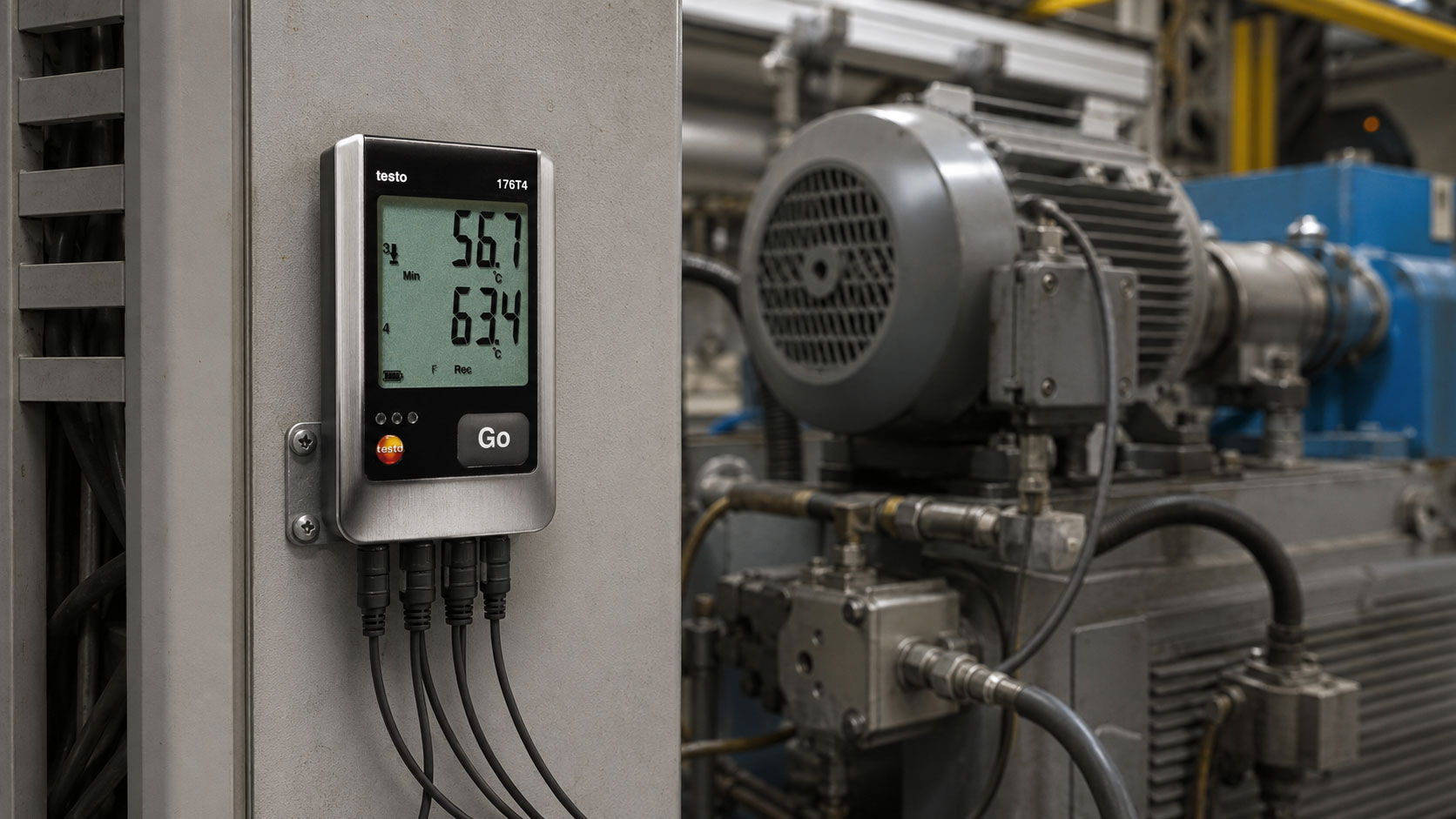
External probes are important for higher temperatures or hard-to-reach locations. For industrial measurement tasks with several measuring points, the testo 176T4 temperature data logger can be used, for example. If a particularly accurate measurement with Pt100 probes is required, the testo 176T2 temperature logger can be the right solution.
Surface temperature or ambient temperature: What should be measured?
When dealing with temperature problems, it is important to distinguish whether the surface temperature of a component or the ambient temperature should be measured. Both values can be important for troubleshooting, but they answer different questions.
The ambient temperature shows the thermal conditions to which a machine or control cabinet is exposed. It is important, for example, when a system is operated in a warm hall, next to a furnace, near a compressor room or in a poorly ventilated area. A high ambient temperature can cause components to dissipate heat less effectively and therefore reach their limits more quickly.
The surface temperature, on the other hand, shows how strongly a specific component heats up. It is useful for motors, bearings, pumps, hydraulic blocks, heat sinks, transformers or power supplies. A rising surface temperature can indicate increased friction, electrical overload, poor heat dissipation, contaminated cooling surfaces or mechanical problems.
In practice, the combination of both measurements is often the most informative. If the ambient temperature rises and the component temperature rises proportionally, the cause may be related to the environment or cooling. If the component temperature rises sharply while the ambient temperature remains stable, the component itself or its operating condition is more likely to be suspicious.
Choosing the measuring interval: Do not miss temperature peaks
The measuring interval determines how often the data logger stores a value. If the interval is too long, short temperature peaks may be missed. If it is too short, very large amounts of data are generated, the memory fills up faster and the evaluation becomes less clear.
For slowly changing temperatures, for example in a storage room or for the ambient temperature in a hall, an interval of several minutes may be useful. For machines, hydraulic units, control cabinets or motors, shorter intervals can be useful because temperature changes during start-up, load changes or faults can occur more quickly.
The decisive factor is the speed of the expected problem. If it is suspected that a power supply slowly overheats after several hours of operation, a longer interval is sufficient. If, on the other hand, a motor only becomes suspicious during start-up or short load peaks, recording must be denser. Otherwise, the temperature profile only shows a smoothed average and not the actual peak.
For many applications, it is advisable to start with a rather short interval and later condense the data. This prevents important events from being lost. For longer measurement campaigns, however, it should be checked in advance whether memory, battery and desired measurement duration fit together.
Measurement duration and runtime: Why a single measured value is rarely enough
Many temperature problems develop over time. A machine may initially be inconspicuous after switch-on and only reach a critical temperature after several hours. A control cabinet may cool down during a night shift, but overheat during the day due to sunlight and high production load. A hydraulic unit may remain stable during short movements, but slowly become too warm during continuous operation.
The measurement duration should therefore match the question. For an initial assessment, recording over one production cycle may be sufficient. If the problem occurs only occasionally, measurement over several shifts or several days is useful. For weather-dependent problems, it may even be necessary to compare different outside temperatures or operating weeks.
It is also important to supplement the measurement with operational information. The temperature profile alone shows when the temperature rises. It becomes much more meaningful if it is known when the machine was started, when full load was present, when breaks occurred, when doors were opened or when maintenance work was carried out.
A simple note on shift times, production cycles or load conditions can significantly improve the evaluation. Without this context, a temperature rise is visible, but not always clearly explainable.
Comparing the temperature profile with load conditions
Temperature problems are often directly related to the load on a machine. A motor heats up more when it is operated permanently close to its power limit. A hydraulic pump generates more heat when it works against high pressures or when valves are switched unfavorably. A control cabinet becomes warmer when frequency inverters, power supplies or contactors operate under high load for longer periods.
The data logger shows the temperature profile. To derive a cause from this, the profile must be compared with the load conditions. Does the temperature always rise during a specific production phase? Does it drop again after breaks? Is there a difference between early, late and night shifts? Does the temperature only become critical with certain products, tools or machine settings?
The combination of temperature recording and additional measured variables is particularly helpful. For electric drives, current consumption can also be considered. In hydraulic systems, pressure, runtime or oil temperature can play a role. In control cabinets, ambient temperature and fan runtime can provide important information.
If several measured variables are required at the same time, multifunction measuring instruments as data loggers or supplementary measuring devices can be useful. This makes it possible not only to identify that a temperature is rising, but also why it is rising.
Identifying temperature problems in the control cabinet
Control cabinets are a common place for temperature problems. Electronic components such as power supplies, frequency inverters, controllers, relays or communication modules generate heat. If this heat is not dissipated sufficiently, the internal temperature rises. This can shorten the service life of components and, in the worst case, lead to failures.
A typical mistake is to look only at the room temperature. The temperature inside the control cabinet can be significantly higher than the ambient temperature. Heat can build up especially in the upper area of the enclosure. Contaminated filters, failed fans, blocked air paths or excessive packing density can also increase the temperature.
A data logger can record over several days how the control cabinet temperature develops. This makes it visible whether the temperature rises with production time, whether it drops sufficiently after working hours or whether it becomes particularly high under certain operating conditions. If a second measuring point is also placed outside the control cabinet, the influence of the environment can be assessed more effectively.
For such applications, a compact temperature data logger is often sufficient. If several measuring points in the control cabinet or on individual components need to be considered, devices with external probe connections are useful.
Hydraulic unit becomes too warm: Evaluating the temperature profile correctly
Hydraulic units react sensitively to temperature. Excessive oil temperatures can change viscosity, stress seals, increase wear and influence the function of valves. At the same time, the cause of rising temperatures is not always clear. Several factors often come together: continuous pump operation, high system pressure, leakage losses, contaminated coolers, a tank that is too small, unfavorable valve positions or high ambient temperature.
A data logger can help make these relationships visible. If only one measurement is taken at the unit, it is not possible to see whether the temperature rises slowly over the day or whether short peaks occur. If recording is carried out over several shifts, however, it becomes possible to identify whether the temperature is related to runtime, specific machine movements or outside temperature.
The combination of several measuring points is particularly informative. The oil temperature shows the condition of the medium. The ambient temperature shows the external conditions. The temperature at the pump housing or motor can provide indications of mechanical or electrical load. If these values are considered together, the cause can be narrowed down much more effectively.
Motors, bearings and drives: Heating as an indication of wear
Motors, bearings, gearboxes and drives always heat up during operation. What matters is not only that a temperature rises, but whether it matches the operating condition. Uniform heating with increasing load can be normal. Unusually rapid heating, a permanently higher temperature than in comparable machines or a temperature increase without a recognizable load change is suspicious.
In bearings, rising temperature can indicate friction, lubrication problems, alignment errors or the beginning of wear. In motors, overload, poor ventilation, contamination, electrical problems or high ambient temperatures can play a role. In gearboxes, oil condition, load changes or mechanical stiffness may be decisive.
A data logger does not provide a complete diagnosis here, but it shows the time-based relationship. If a bearing heats up faster than before after every production start or if a motor reaches higher temperatures despite the same load, this is an important indication for maintenance. Such trends can be detected well through regular or temporary temperature recordings.
Depending on the application, thermocouples can also play a role when selecting suitable probes, especially when higher temperatures, fast changes or robust measuring points are required.
Evaluating measurement data: Which patterns are suspicious?
After measurement, evaluation is decisive. A temperature profile should not only be examined to see whether a limit value has been exceeded. The shape, speed and timing of the temperature rise often provide important clues to the cause.
A slow, continuous temperature increase over many hours often indicates insufficient cooling, heat build-up or continuous load. A rapid increase directly after switch-on can indicate high starting load, electrical problems or mechanical stiffness. Recurring temperature peaks at certain times often point to production processes, shift changes, environmental influences or auxiliary units.
The cooling behavior is also interesting. If a component cools down very slowly after shutdown, this can indicate poor heat dissipation or an unfavorable installation situation. If, on the other hand, it cools down quickly but becomes very hot again at every start, the cause is more likely to be in the operation itself.
| Observation in the temperature profile | Possible interpretation |
|---|---|
| Slow increase over several hours | Heat build-up, continuous load, insufficient cooling |
| Rapid increase after start-up | Starting load, mechanical stiffness, electrical overload |
| Temperature peaks only at certain times | Production cycle, shift operation, environmental influence |
| High temperature despite low load | Defective cooling, contaminated fans, unfavorable installation situation |
| Temperature rises more strongly than in a comparable machine | Wear, friction, incorrect setting or overload |
The best evaluation is created when temperature data is combined with observations from operation. Measurement data shows the trend, operational experience explains the context. Together, this creates a reliable basis for troubleshooting.
Suitable data loggers and measuring instruments for troubleshooting
For troubleshooting on machines, data loggers with external temperature probes are particularly useful. They enable measurements at several points and, depending on the probe type, can also record higher temperatures. The testo 176T4 temperature data logger is suitable, for example, for industrial temperature recordings with several measuring points.
If particularly accurate temperature measurements with Pt100 probes are required, the testo 176T2 temperature logger can be a suitable solution. It is particularly suitable when fewer measuring points are needed, but very precise temperature recording is the focus.
If humidity also needs to be considered in addition to temperature, for example in control cabinets, storage rooms or climatically influenced plant areas, combined temperature and humidity data loggers such as the testo 176H1 data logger for temperature and humidity are suitable.
Thermal imaging cameras can also be helpful for an initial visual inspection. They quickly show where heat is generated. However, for time-based analysis, they do not replace a data logger. The thermal imaging camera shows the moment, the data logger shows the trend. In many cases, the combination is ideal: First, a suspicious area is identified with a thermal imaging camera, then the temperature profile is documented with a data logger.
Practical example: Control cabinet only becomes too warm during the late shift
In a production plant, faults occur irregularly in a controller. During the morning inspection, the control cabinet appears inconspicuous. The room temperature is within the normal range, the fans are running and no external damage is visible. Nevertheless, the faults occur repeatedly, mostly in the late afternoon or during the late shift.
To narrow down the cause, two temperature data loggers are used. One measuring point is placed in the upper area of the control cabinet, a second outside the cabinet in the production hall. The measurement runs for several days so that different shifts and operating conditions are recorded.
The evaluation shows that the hall temperature rises in the afternoon. At the same time, the temperature inside the control cabinet rises much more strongly than the ambient temperature. Especially during a specific production process, frequency inverters and power supplies generate additional heat. After the end of the shift, the temperature drops only slowly.
The cause is not a single defective component, but the combination of high ambient temperature, dense equipment layout, insufficient air circulation and increased machine load. After cleaning the filters, optimizing the airflow and adjusting the control cabinet cooling, the temperatures remain stable. Without a data logger, this time-based relationship would hardly have been clearly verifiable.
Conclusion: Temperature profiles show more than momentary values
Temperature problems on machines, control cabinets and hydraulic units are often difficult to detect with single momentary measurements. Many critical conditions only develop after longer operating times, under load, under specific shift conditions or in connection with ambient temperature.
A temperature data logger makes these relationships visible. It does not only show how warm a machine is at a specific moment, but when the temperature rises, how long it remains elevated and whether it is related to load conditions, environmental influences or operating times. This turns an assumption into a traceable measurement basis.
Depending on the application, temperature data loggers, multi-channel data loggers such as the testo 176T4, high-precision Pt100 solutions such as the testo 176T2, combined temperature and humidity data loggers and suitable external temperature probes are suitable for industrial troubleshooting. The key factor is that measuring points, measuring interval and measurement duration match the actual question.
FAQ: Frequently asked questions about temperature data loggers in maintenance
Why is a data logger better than a single measurement for temperature problems?
A single measurement only shows the current condition. A data logger records the temperature profile over a longer period and shows when temperature peaks occur, how quickly components heat up and whether there is a connection with operation, load or environment.
Where should a temperature data logger be placed on a machine?
The measuring point should match the question. Critical components such as motor, bearing area, pump housing, control cabinet interior, hydraulic tank or heat sink are often useful. In addition, a second measuring point for ambient temperature can be helpful.
What is the difference between surface temperature and ambient temperature?
Surface temperature shows the heating of a component. Ambient temperature describes the thermal conditions around the machine. Both values are important because a component can become too warm either due to its own load or due to poor ambient conditions.
Which measuring interval is useful for machines?
This depends on how quickly the temperature changes. For slow temperature profiles, several minutes are often sufficient. For start-up processes, load changes or short temperature peaks, a shorter interval should be selected so that critical events are not missed.
How long should the temperature be recorded?
The measurement duration should at least cover the period in which the problem is suspected. For machines, one production cycle may be sufficient; for sporadic problems, several shifts or several days are useful.
Can a data logger directly show the cause of overheating?
A data logger shows the temperature profile, but not automatically the cause. The cause results from evaluating the measurement data together with information on load conditions, environment, runtime, maintenance condition and machine behavior.
How can I identify temperature peaks in the measurement data?
Temperature peaks appear as short or recurring increases in the profile. It is particularly interesting whether these peaks coincide with start-up processes, high load, specific production steps or external influences.
When is a multi-channel data logger useful?
A multi-channel data logger is useful when several measuring points need to be compared at the same time. This is helpful, for example, with control cabinets, hydraulic units, motors or complex machines because component temperature and ambient temperature can be considered in parallel.
When is the testo 176T4 useful?
The testo 176T4 is useful when several temperature measuring points need to be recorded at the same time. This is particularly helpful for machines, control cabinets, hydraulic units or systems with several critical components.
When is the testo 176T2 useful?
The testo 176T2 is useful when high-precision temperature measurements with Pt100 probes are required. It is particularly suitable for applications where precision is more important than a large number of parallel measuring points.
Can a thermal imaging camera replace a temperature data logger?
A thermal imaging camera is very good at showing where heat is generated, but usually only at the moment of the image. A data logger documents the time-based profile. For troubleshooting, the combination of thermal imaging and data logger is often particularly effective.
Which products are suitable for temperature monitoring on machines?
Temperature data loggers are suitable for industrial temperature recordings. For several measuring points, the testo 176T4 can be used. For high-precision Pt100 measurements, the testo 176T2 is a suitable solution. Corresponding climate data loggers are suitable for combined temperature and humidity measurements.