


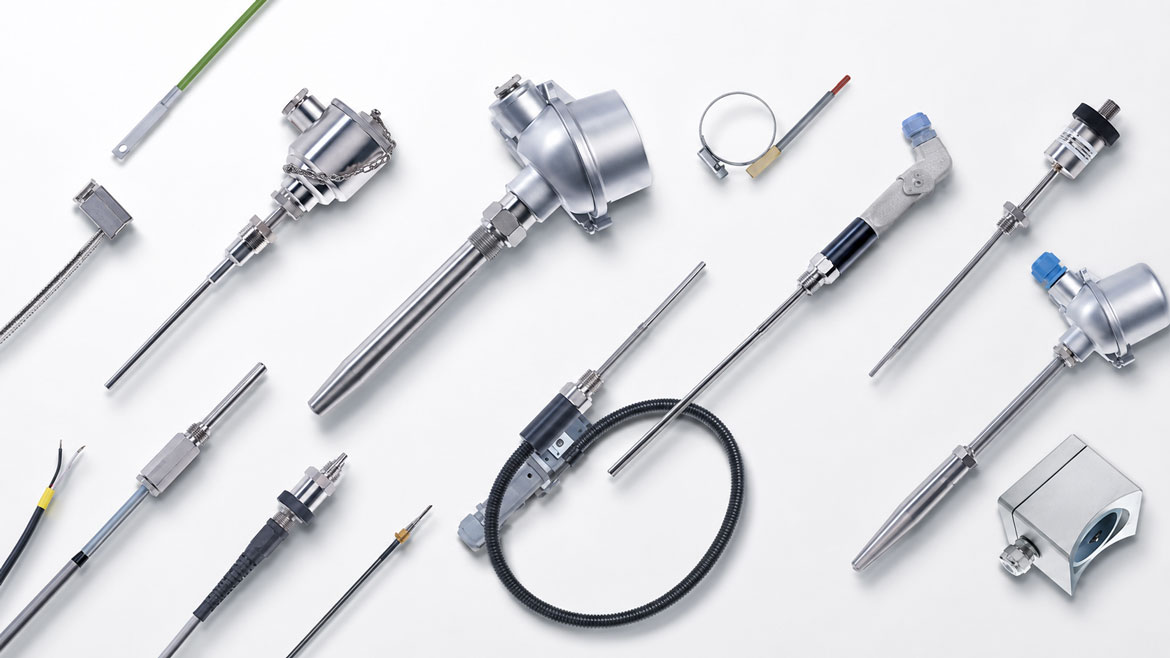
Thermocouple Type K, J, T or N: Which type is the right one?
Thermocouples are used in many industrial applications when temperatures need to be measured reliably, quickly and robustly. Especially at high temperatures, during rapid temperature changes or in harsh environments, thermocouples are often the right solution.
In practice, however, there is often uncertainty when selecting the correct thermocouple type. Type K, Type J, Type T and Type N differ not only in their temperature range, but also in their suitability for certain environments, processes and measuring tasks.
This article explains the most important differences between the common thermocouple types and shows what you should consider when making your selection.
You can find an overview of suitable versions in our category
Thermocouples.
Table of contents
- Why is the correct thermocouple type important?
- Basic principle: What does a thermocouple do?
- Thermocouple Type K, J, T and N compared
- Thermocouple Type K: The universal standard
- Thermocouple Type J: For many standard industrial applications
- Thermocouple Type T: For low temperatures and stable measurements
- Thermocouple Type N: For high temperatures and better long-term stability
- Which thermocouple type suits which application?
- It is not only the type that matters: design, thermowell and connection
- Measuring instrument, evaluation unit and cable must match the thermocouple
- Common mistakes when selecting thermocouples
- Checklist for technical selection
- Conclusion
- FAQ: Frequently asked questions about thermocouple types
Why is the correct thermocouple type important?
The thermocouple type determines which metal pairings the sensor consists of. This results in different temperature ranges, sensitivities, ageing behavior and application limits.
An incorrectly selected thermocouple type can lead to inaccurate measured values, faster ageing, drift, failures or incorrect process control. This is particularly critical in high-temperature applications, plastics processing, furnace construction, exhaust gas measurements or processes with rapid temperature changes.
- Type K is the most commonly used universal type for many industrial applications.
- Type J is suitable for many standard applications, but is more limited at higher temperatures.
- Type T is particularly interesting for low temperatures and stable measurements.
- Type N is an alternative to Type K when higher long-term stability at high temperatures is required.
Important: The thermocouple type is only one part of the selection. The design, thermowell, connection cable, measuring instrument, process connection and operating environment must also match.
Basic principle: What does a thermocouple do?
A thermocouple consists of two different metallic conductors. If the junction and the connection point are exposed to different temperatures, a small thermoelectric voltage is generated. This voltage is evaluated by the measuring instrument and converted into a temperature.
For this conversion to work correctly, the measuring instrument must be set to the correct thermocouple type. A Type K sensor connected to a measuring instrument set to Type J will result in incorrect temperature values.
| Selection point | Why important? | Typical mistake |
|---|---|---|
| Thermocouple type | Determines characteristic curve and permissible application range. | Sensor and measuring instrument are designed for different types. |
| Temperature range | The sensor must match the minimum and maximum process temperature. | Only the normal operating temperature is considered, not temperature peaks. |
| Operating environment | Atmosphere, moisture, chemicals and mechanical stress affect service life. | The thermocouple type is selected independently of the environment. |
| Design | Thermowell, sheathed cable or cable version determine response time and robustness. | The correct type is selected, but the wrong design is used. |
| Connection cable | Thermocouples require suitable thermocouple or compensating cables. | The thermocouple is extended with an unsuitable cable. |
Thermocouple Type K, J, T and N compared
The following table provides a practical overview. The actual operating limits always depend on the design, sheath material, thermowell, insulation, environment and manufacturer specifications.
| Thermocouple type | Typical application range | Strengths | Typical limitations |
|---|---|---|---|
| Type K | General industry, furnace construction, exhaust gas, mechanical engineering, plastics processing | widely usable, high temperature range, very common | drift can occur in certain atmospheres and over very long operating periods |
| Type J | Mechanical engineering, older systems, medium temperatures, industrial furnaces with limited temperature range | good sensitivity, often used in existing systems | not ideal for very high temperatures and oxidizing conditions over longer periods |
| Type T | Refrigeration, laboratory, low temperatures, stable measurements in the lower temperature range | good stability at low temperatures | not suitable for high temperatures |
| Type N | High-temperature processes, furnace construction, applications requiring high long-term stability | better stability at high temperatures than Type K in many applications | less common than Type K, compatibility with measuring instrument must be checked |
Thermocouple Type K: The universal standard
Type K thermocouples are among the most commonly used thermocouples. They are suitable for many industrial applications and cover a wide temperature range. For this reason, they are often selected as the standard solution if there are no special requirements against Type K.
Typical applications for Type K
- general mechanical engineering
- furnace construction and heat treatment
- exhaust gas and flue gas temperature measurement
- plastics industry
- pipelines and vessels
- motors, bearings and machine parts
- process monitoring at elevated temperatures
For many direct temperature measurements in mechanical engineering or on pipelines, cable thermocouples such as the
Type TC40 cable thermocouple
can be a suitable design.
When Type K is useful
| Situation | Assessment |
|---|---|
| High temperature range required | Type K is often an economical and robust standard solution. |
| Standard measuring instrument or controller available | Type K is supported by many evaluation units. |
| Rapid temperature changes | With a suitable design, Type K can respond quickly. |
| Harsh industrial environment | Suitable sheath or thermowell design must be considered. |
Thermocouple Type J: For many standard industrial applications
Type J thermocouples are often used in industrial systems with medium temperatures. They are particularly common in existing systems and can be suitable for many standard processes.
However, Type J should not automatically be used as a replacement for Type K. The usable temperature range and behavior in certain atmospheres differ. In addition, the measuring instrument must be explicitly set or suitable for Type J.
Typical applications for Type J
- mechanical engineering
- industrial systems with medium temperatures
- older temperature controls and existing systems
- thermal processes without extreme high-temperature requirements
- temperature monitoring on system components
| Type J is useful if … | Type J should be critically checked if … |
|---|---|
| an existing system is already designed for Type J. | very high temperatures occur. |
| measuring instrument, cable and sensor are clearly Type J. | oxidizing conditions are present at higher temperatures. |
| medium temperatures are monitored. | a Type K sensor is to be replaced without checking. |
| good sensitivity in the appropriate range is required. | long-term stability at high temperatures is decisive. |
Thermocouple Type T: For low temperatures and stable measurements
Type T thermocouples are often used for lower temperature ranges and applications where a stable measurement in the lower temperature range is important. However, Type T is not intended for high process temperatures.
Typical applications for Type T
- refrigeration and air-conditioning technology
- laboratory applications
- food-related temperature measurements
- low to medium temperatures
- measuring points with high requirements for stability in the lower temperature range
| Advantage of Type T | Limitation of Type T |
|---|---|
| well suited for low temperatures | not suitable for high temperatures |
| stable measurement in the lower temperature range | not the typical choice for furnace construction or high-temperature processes |
| suitable for many laboratory and refrigeration applications | measuring instrument and cable must explicitly support Type T |
If a thermocouple is connected to a display instrument or controller, the input must be designed for the correct thermocouple type. An example of a panel instrument with thermocouple input is the
IM1 digital panel instrument for thermocouples.
Thermocouple Type N: For high temperatures and better long-term stability
Type N thermocouples become interesting when Type K would generally be suitable, but better long-term stability at high temperatures is desired. In many high-temperature applications, Type N can be a technically sensible alternative.
Since Type N is less common than Type K, it should be checked before selection whether the measuring instrument, controller, transmitter and compensating cable support Type N.
Typical applications for Type N
- high-temperature processes
- furnace construction
- heat treatment
- long-term measurements at elevated temperatures
- applications where drift should be reduced
| Type N can be useful if … | Check beforehand |
|---|---|
| high temperatures are monitored over a long period. | Does the evaluation unit support Type N? |
| Type K drifts or ages too much. | Is the correct compensating cable available? |
| a robust high-temperature measurement is required. | Does the design match the mechanical and thermal load? |
| a new system is being planned. | Are controller, transmitter and documentation designed for Type N? |
Which thermocouple type suits which application?
The selection should always be based on the application. Not every thermocouple type is suitable for every temperature, atmosphere or design.
| Application | Often suitable type | Note |
|---|---|---|
| General mechanical engineering | Type K or Type J | Check existing system and measuring instrument. |
| High temperatures / furnace construction | Type K or Type N | Check Type N if long-term stability is important. |
| Plastics industry | often Type K | Design, insertion length and mechanical contact are decisive. |
| Refrigeration and laboratory applications | Type T | Suitable for low temperature ranges. |
| Exhaust gas or flue gas temperature | often Type K | Pay attention to thermowell material and temperature load. |
| Existing system with existing control | depending on the existing input | Do not change thermocouple type without checking. |
For high temperatures with a connection head, for example,
straight thermocouples according to EN 50446 with connection head
can be a suitable version.
It is not only the type that matters: design, thermowell and connection
The correct thermocouple type alone is not enough. Depending on the design, a Type K thermocouple can respond very quickly or very slowly, be mechanically sensitive or very robust, sit directly in the process or be separated from the medium by a thermowell.
Important designs and selection points
- Cable thermocouples: flexible use, often for mechanical engineering, bearings, motors, pipelines and direct measuring points.
- Screw-in thermocouples: suitable for fixed process connections on vessels, pipelines or machines.
- Measuring inserts: are inserted into thermowells or thermometer assemblies and can be replaceable depending on the design.
- Thermocouples with connection head: more robust design for industrial process applications.
- Thermowells: protect the sensor against pressure, flow, chemicals, abrasion or high mechanical stress.
For direct screw-in applications in vessels or pipelines, a
Type TC10-C screw-in thermocouple
can be a suitable design.
For applications in the plastics industry, for example on extrusion machines, the
Type TC47-MB screw-in melt thermocouple
may be relevant.
| Design | Typical strength | What to consider? |
|---|---|---|
| Cable thermocouple | flexible, compact, direct measurement possible | Cable material, temperature, mechanical stress |
| Screw-in thermocouple | fixed process connection | Thread, insertion length, thermowell, seal |
| Measuring insert | replaceable, can be combined with thermowell | Suitable length, diameter and connection head |
| Thermocouple with connection head | robust for industrial processes | Cable entry, ingress protection, environment |
| Thermowell version | protection against pressure, flow and aggressive media | Material, wall thickness, response time |
Measuring instrument, evaluation unit and cable must match the thermocouple
A common practical mistake is combining a suitable thermocouple with the wrong measuring instrument or the wrong cable. Thermocouples do not provide a universal voltage that can be evaluated independently of the type. The characteristic curve differs depending on the type.
These points must match
- thermocouple type of the sensor
- setting of the measuring instrument or controller
- suitable thermocouple cable or compensating cable
- correct polarity
- correct terminal assignment
- cold junction compensation of the evaluation unit
- suitable transmitter if a standard signal is required
If a thermocouple signal is to be converted into a standard signal, a thermocouple transmitter such as the
DT 45800 thermocouple transmitter
can be a suitable solution.
| Mistake | Possible effect | Solution |
|---|---|---|
| Measuring instrument set to wrong type | Temperature display is incorrect | Check type in device and set correctly |
| Thermocouple extended with wrong cable | Measurement error due to additional thermoelectric voltages | Use suitable thermocouple or compensating cable |
| Polarity reversed | Temperature value moves in the wrong direction or is implausible | Check terminal assignment |
| Cold junction compensation not considered | Systematic measurement deviation | Use suitable evaluation unit |
Common mistakes when selecting thermocouples
Many measurement problems are not caused by a defective sensor, but by an unsuitable combination of thermocouple type, design, cable, measuring instrument and installation situation.
- Wrong thermocouple type: Sensor and evaluation unit do not match.
- Temperature range selected too narrowly: Temperature peaks are not considered.
- Unsuitable design: The sensor is too slow, too sensitive or not mechanically protected enough.
- Wrong connection cable: Normal copper cable or wrong compensating cable causes measurement errors.
- Incorrect insertion length: The sensor does not measure the actual process temperature.
- Incorrect installation location: The sensor is located in an edge zone, at a thermal bridge or outside the main flow.
- Atmosphere not considered: Oxidizing, reducing or aggressive media affect service life and drift.
- Measuring instrument not checked: The desired thermocouple type is not supported by the input.
Checklist for technical selection
This checklist helps to prepare the selection of a suitable thermocouple in a structured way.
| Information | Example | Why important? |
|---|---|---|
| Desired thermocouple type | Type K, J, T or N | Determines characteristic curve and compatibility with measuring instrument |
| Temperature range | 0 to 800 °C, short-term 900 °C | Sensor and materials must withstand temperature peaks |
| Medium / atmosphere | Air, exhaust gas, plastic melt, oil, process gas | Influences thermowell, material and service life |
| Design | Cable sensor, screw-in sensor, measuring insert, connection head | Determines installation, robustness and response time |
| Insertion length | For example 100 mm, 250 mm or special length | Measuring point must be sufficiently deep in the process |
| Process connection | G 1/2, M18, compression fitting, bayonet | Mechanical compatibility with the system |
| Thermowell | with or without thermowell | Protection against pressure, flow, abrasion and chemicals |
| Response time | fast or robust | Thinner sensors respond faster, but are often more sensitive |
| Connection cable | Thermocouple cable or compensating cable | Prevents measurement errors caused by incorrect extension |
| Evaluation unit | Controller, display, PLC, transmitter | Must support the thermocouple type |
Conclusion: The thermocouple type must match the application
Type K, J, T and N each have their own strengths. Type K is the universal standard solution for many industrial applications. Type J is often found in standard and existing systems. Type T is particularly suitable for lower temperatures and stable measurements in the lower range. Type N is interesting when high temperatures and better long-term stability are required.
However, correct selection does not end with the thermocouple type. Design, thermowell, insertion length, connection cable, evaluation unit, medium and process conditions must also match. Only then will the thermocouple provide reliable and usable measured values.
You can find a suitable preselection in our category
Thermocouples.
FAQ: Frequently asked questions about thermocouple types
What is the difference between thermocouple Type K, J, T and N?
The types differ in their metal pairing and therefore in temperature range, characteristic curve, stability and operating environment. Type K is very common, Type J is often used in standard industrial applications, Type T is particularly suitable for low temperatures and Type N for higher temperatures with better long-term stability.
When should I use a Type K thermocouple?
Type K is often the first choice for general industrial applications, mechanical engineering, furnace construction, exhaust gas and flue gas temperature measurements as well as many high-temperature applications. A suitable design can be, for example, a
Type TC40 cable thermocouple
or a thermocouple with connection head.
When is Type J useful?
Type J is mainly used at medium temperatures and in many existing systems. It should be used when sensor, cable and evaluation unit are clearly designed for Type J. For very high temperatures or certain aggressive atmospheres, Type J should be critically checked.
When do you use a Type T thermocouple?
Type T is particularly suitable for low temperatures, laboratory applications, refrigeration applications and stable measurements in the lower temperature range. For furnace construction or high process temperatures, Type T is normally not the right choice.
When is Type N better than Type K?
Type N can be useful when high temperatures are measured over a long period and better long-term stability is desired. Before selection, it must be checked whether the measuring instrument, controller, transmitter and compensating cable support Type N.
What happens if the wrong thermocouple type is set?
If sensor and measuring instrument are not designed for the same thermocouple type, the thermoelectric voltage is interpreted incorrectly. As a result, the displayed temperature can deviate significantly from the actual value.
Can I extend a thermocouple with normal copper cable?
Usually not. Thermocouples require suitable thermocouple cables or compensating cables. Incorrect extension can generate additional thermoelectric voltages and lead to measurement errors.
When do I need a thermocouple transmitter?
A transmitter is useful when the thermocouple signal needs to be converted into a standard signal for PLC, display or process control technology. One example is the
DT 45800 thermocouple transmitter.
Which thermocouple is suitable for the plastics industry?
In the plastics industry, design, mechanical contact, insertion length and temperature range are particularly important. For applications on extrusion machines, for example, the
Type TC47-MB screw-in melt thermocouple
may be relevant.
Where can I find suitable thermocouples?
You can find a structured overview in our category
Thermocouples. There you will find different designs for industrial temperature measurements, high-temperature applications, plastics industry and process applications.