


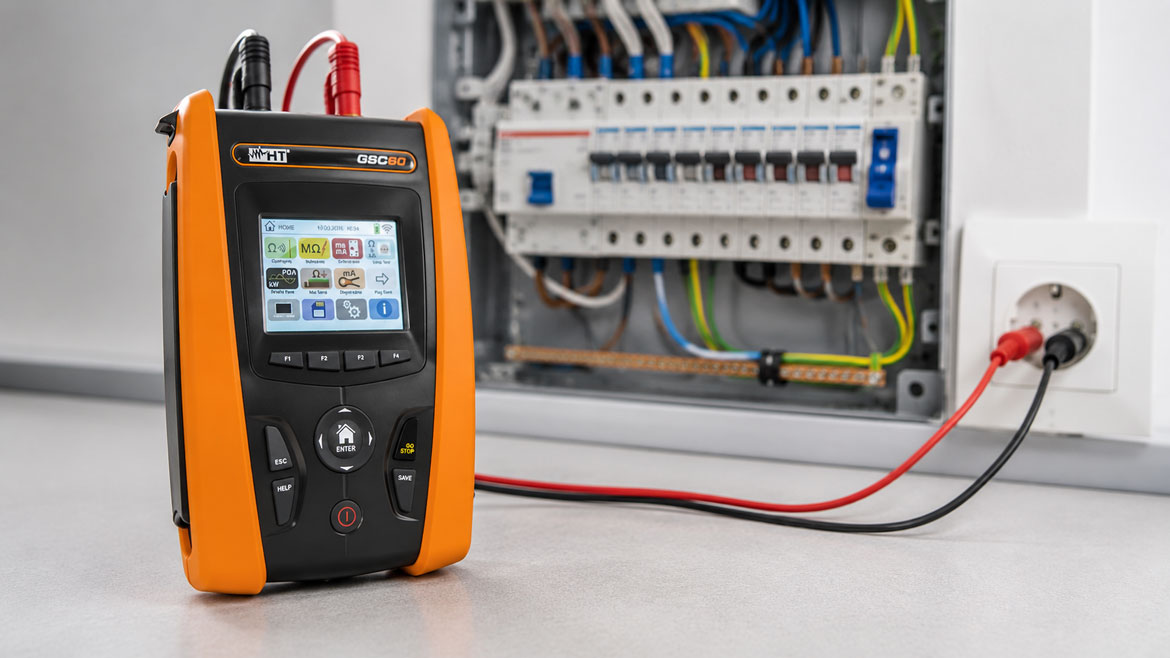
When testing electrical installations, loop impedance measurement is one of the important test steps. In practice, however, a common problem occurs: the residual current device, or RCD, trips during the measurement. This interrupts the test, costs time and can cause unnecessary disruptions in sensitive systems.
Especially when measuring final circuits, distribution boards, industrial installations or systems with sensitive loads, it is important to use a suitable test method and an appropriate installation tester. Modern installation testers offer special measuring functions for loop impedance measurement without RCD tripping.
This article explains why an RCD can trip during loop measurement, which errors frequently occur in practice and how qualified electricians can prepare the test safely and efficiently.
You can find an overview of suitable test instruments in our category
Installation testing VDE 0100.
Table of contents
- Why is loop impedance measurement important?
- Why does the RCD trip during loop impedance measurement?
- Typical symptoms during testing
- Measuring methods with and without RCD tripping
- Correctly considering RCD types
- Common errors during loop measurement
- Practical solutions for testing
- Which installation testers are suitable?
- Practical examples from installation testing
- Checklist before measurement
- Conclusion
- FAQ: Frequently asked questions about loop impedance measurement without RCD tripping
Why is loop impedance measurement important?
Loop impedance measurement is used to assess the effectiveness of the protective measure in the event of a fault. In simple terms, it checks whether a sufficiently high fault current can flow in the event of a fault so that the protective device disconnects within the required time.
The measurement is therefore an important part of installation testing. It helps to assess whether the cable, protective conductor, network impedance, fuse, circuit breaker and connection conditions match correctly.
- Check protective measure: Is the possible fault current sufficient for disconnection?
- Estimate short-circuit current: Many installation testers calculate the possible short-circuit current Ik from the impedance.
- Evaluate cable and network conditions: High impedances can indicate unfavorable cable runs or contact resistances.
- Detect sources of error: Poor connections, cables that are too long or unsuitable protection can become apparent.
- Document the test: Measured values may be relevant for test reports and repeat tests.
Important: Measurements on electrical installations may only be carried out by appropriately qualified electricians. The applicable standards, installation conditions and safety rules must be observed.
Why does the RCD trip during loop impedance measurement?
An RCD monitors whether a difference occurs between the outgoing and returning current. If a fault current above the tripping current occurs, the RCD disconnects the circuit. This is its protective function.
During certain loop impedance measurements, the test instrument briefly generates a test current. If this test current appears to the RCD like a fault current or reaches the tripping threshold, the RCD can trip.
| Cause | Why the RCD can trip | Practical consequence |
|---|---|---|
| Test current via PE | The RCD detects a difference between line conductor and neutral conductor. | The circuit is disconnected during the measurement. |
| Overly sensitive RCD | With 30 mA RCDs, certain measuring methods can lead to tripping. | The measurement must be repeated or carried out differently. |
| Existing leakage currents | Existing leakage currents in the installation add to the test current. | The RCD trips faster than expected. |
| Wrong measuring function | A loop measurement is selected that is not intended for measurements downstream of RCDs. | RCD tripping despite an intact installation. |
| Faulty connection conditions | Swapped conductors, poor contacts or unsuitable measuring points falsify the measurement. | Implausible values or tripping of the protective device. |
Typical symptoms during testing
If the RCD trips during loop impedance measurement, this can appear differently depending on the installation and test instrument. It is not always immediately clear whether the problem is caused by the installation, the measuring method or the device setting.
| Symptom | Possible cause | First check |
|---|---|---|
| RCD trips immediately when the measurement starts | Wrong measuring function or excessive test current | Check measuring mode for RCD-protected circuits |
| RCD only trips occasionally | Existing leakage currents or changing load conditions | Check loads and leakage currents |
| Measured value is implausible | Poor contact, wrong measuring point or incorrect conductor assignment | Check connection and test leads |
| Measurement works upstream of the RCD, but not downstream | RCD reacts to the measuring method | Use RCD-compatible loop measurement |
| Several RCDs trip | Unclear circuit assignment or upstream RCD structure | Check network structure and distribution board |
Measuring methods with and without RCD tripping
Not every loop impedance measurement is the same. Modern installation testers offer different measuring methods for different situations. The distinction between a normal loop measurement and a measurement downstream of RCDs without tripping is particularly important.
| Measuring method | Typical use | Note |
|---|---|---|
| Normal loop impedance measurement | Measurement in circuits without RCD or at suitable measuring points | Can cause tripping downstream of an RCD. |
| Loop measurement without RCD tripping | Measurement in RCD-protected circuits | Requires a suitable test instrument and the correct measuring function. |
| Network impedance measurement L-N or L-L | Assessment of network conditions without measurement via PE | Does not automatically replace every protective conductor or loop test. |
| RCD test | Testing tripping current and tripping time | Separate test with suitable RCD type and test current. |
| Measurement with short-circuit current display | Assessment of the possible short-circuit current Ik | Helps evaluate disconnection conditions. |
In RCD-protected circuits, the appropriate measuring function of the installation tester should always be used. An RCD must not simply be bridged or disabled just to carry out a measurement.
Correctly considering RCD types
Not all RCDs are the same. Depending on the installation, different types may be installed. The selection of the correct test function therefore also depends on the RCD type present.
- RCD Type AC: for sinusoidal alternating currents; in many new installations, this is no longer the typical standard solution.
- RCD Type A: for alternating currents and pulsating DC residual currents; commonly used in general installations.
- RCD Type F: for certain single-phase loads with frequency converters or electronic components.
- RCD Type B: for smooth DC residual currents and special applications, for example certain industrial loads.
- RCD Type B+ or EV: depending on the application, for example special requirements or charging infrastructure.
The test instrument must match the installed RCD type. An installation tester that only supports certain RCD types is not automatically suitable for every installation.
| RCD type | Typical relevance | What to check? |
|---|---|---|
| Type A / AC | General electrical installations | Does the test instrument support the installed RCD type? |
| Type B | Industry, frequency converters, special loads | Use an installation tester with RCD Type B testing. |
| Type F | Certain electronic loads | Compare test instrument and test requirements. |
| Type EV | Charging infrastructure / wallboxes | Consider suitable EVSE testing and adapters. |
For installations with different RCD types, a versatile instrument such as the
GSC60
can be useful, as it offers RCD tests for various types as well as network and loop impedance measurements in addition to VDE 0100 testing.
Common errors during loop measurement
Many problems during loop impedance measurement are not caused by a defective test instrument, but by an incorrect measuring function, unfavorable installation conditions or unclear circuit assignment.
- Wrong measuring function selected: Normal loop measurement instead of measurement without RCD tripping.
- RCD type not considered: The test instrument or setting does not match the installed RCD.
- Existing loads not considered: Leakage currents from power supplies, frequency converters or filters influence the measurement.
- Poor contact at the measuring point: Loose socket contacts or unsuitable test probes lead to implausible values.
- Circuit incorrectly assigned: Measurement is carried out on a different circuit than assumed.
- Neutral conductor or protective conductor problem: Faulty connections can falsify measured values or trip protective devices.
- Several RCDs in series: Upstream or selective RCDs are not considered.
- Measured value interpreted incorrectly: The displayed Ik or impedance is not compared with the protective device.
Practical solutions for testing
If the RCD trips during loop impedance measurement, the test should be prepared systematically. The aim is not to bypass the protective function, but to use the correct measuring method for the respective installation.
Possible measures
- Check measuring function: Is the function for loop measurement without RCD tripping selected?
- Identify RCD type: Check Type A, AC, B, F, B+ or EV.
- Clarify installation structure: Are there upstream RCDs, sub-distribution boards or several protection zones?
- Check measuring point: Are the socket, terminal or test probe clean and safely contacted?
- Assess loads: Can existing leakage currents influence the measurement?
- Check test leads: Are test leads, adapters and test probes suitable and undamaged?
- Plausibility check of measured values: Do impedance, Ik and protective device match?
- Prepare documentation: Save measured values and assign them clearly to the circuit.
| Problem | Check | Possible solution |
|---|---|---|
| RCD trips during every loop measurement | Check measuring function and RCD type | Use loop measurement without RCD tripping |
| RCD only trips in certain circuits | Check loads and leakage currents | Assess circuit individually and consider load condition |
| Measured value is implausibly high | Check contact point, test lead and conductor assignment | Clean measuring point, check connection, repeat measurement |
| Short-circuit current Ik appears too low | Check cable length, cross-section, contact resistances and network impedance | Compare measured value with protective device and disconnection conditions |
| Testing takes too long | Check memory, automatic functions and documentation workflow | Use installation tester with memory and clear measurement structure |
Which installation testers are suitable?
For loop impedance measurement in RCD-protected circuits, an installation tester should be used that offers a suitable measuring function without RCD tripping. Depending on the application, memory, touchscreen, auto sequences, RCD Type B testing or power quality functions may also be important.
| Test instrument | Especially relevant for | Note |
|---|---|---|
| COMBI G2 | VDE 0100 installation testing with touchscreen and loop resistance measurement without RCD tripping | Suitable for users looking for a clear installation tester with memory and convenient operation. |
| GSC60 | VDE 0100 testing, RCD tests Type A, AC, B, B+ and F as well as network and energy analysis | Useful when power quality, voltage drop or energy parameters need to be considered in addition to installation testing. |
| COMBI 420 | Loop and network impedance measurement with display of the short-circuit current Ik | Suitable for classic VDE 0100 and VDE 0105 test tasks with memory and USB interface. |
| EASYTEST | VDE testing with auto sequence, network and loop impedance, RCD Type A and AC | Practical when recurring test steps need to be carried out quickly and in a structured manner. |
| COMBI521 | Installation testing with RCD Type A, AC, B and EV as well as additional EVSE test sequence | Interesting for users who test charging infrastructure in addition to classic installations. |
| FULLTEST 3 | Machine and installation testing with loop resistance without RCD tripping | Particularly interesting when machine testing and safety tests according to EN 60204-1 are relevant in addition to installation testing. |
You can find a complete overview of the available instruments in the category
Installation testers and installation testing VDE 0100.
Practical examples from installation testing
Example 1: Loop measurement in an office installation
In an office installation, several final circuits are protected by 30 mA RCDs. During a normal loop impedance measurement, the RCD trips. The cause is not necessarily an installation fault, but often the measuring method used. With a suitable installation tester and the function for measurement without RCD tripping, the test can be carried out with fewer disruptions.
Example 2: Industrial installation with frequency converters
In an industrial installation, loads with filters, power supplies and frequency converters are connected. Existing leakage currents can cause an additional test current to trip the RCD. In this case, RCD type, leakage currents, load conditions and measuring methods should be checked particularly carefully.
Example 3: Distribution board with several RCD levels
If several RCDs are arranged in series, a measurement can unexpectedly trip an upstream RCD. Before testing, it should therefore be clear which protective devices are assigned to which circuit and whether selective or upstream RCDs are present.
Example 4: Testing with additional network assessment
In larger installations, it is often not sufficient to check only individual protective measures. Voltage drop, network impedance, phase sequence, power quality or load conditions can provide additional information. In such cases, an instrument such as the
GSC60
can be useful because it combines installation testing with network and energy analysis.
Checklist before measurement
This checklist helps to better prepare loop impedance measurement in RCD-protected circuits.
| Check question | Why important? | Assessment |
|---|---|---|
| Is the circuit RCD-protected? | A normal loop measurement can then trip the RCD. | Check measuring function without RCD tripping. |
| Which RCD type is installed? | The test instrument must match the RCD type. | Identify Type A, AC, B, F, B+ or EV. |
| Are there already leakage currents? | Existing leakage currents can add to test currents. | Check loads and installation condition. |
| Is the measuring point clear? | Incorrect circuit assignment leads to misinterpretation. | Label distribution board and circuit. |
| Are test leads and adapters suitable? | Damaged or incorrect leads falsify measured values. | Check accessories before testing. |
| Is the contact at the measuring point secure? | Poor contacts can cause high or fluctuating values. | Check socket, terminal or test probe. |
| Is the displayed Ik plausible? | The short-circuit current must match the protective device. | Compare measured value with protection and cable. |
| Is the measurement documented? | Test values must be clearly traceable. | Use memory, circuit designation and report. |
Conclusion: RCD tripping during loop measurement is often a measurement or application issue
If the RCD trips during loop impedance measurement, this does not automatically mean that the RCD or the installation is defective. Often, an unsuitable measuring function is used, the existing RCD type is not considered or the installation already has leakage currents.
A structured test is decisive: RCD type, measuring function, circuit, measuring point, load condition and measured values must be considered together. Modern installation testers with loop measurement without RCD tripping can make testing significantly easier and reduce disruptions during installation operation.
You can find a suitable preselection in our category
Installation testing VDE 0100.
FAQ: Frequently asked questions about loop impedance measurement without RCD tripping
Why does the RCD trip during loop impedance measurement?
With certain measuring methods, a test current flows that can be detected by the RCD as a fault current. Especially downstream of 30 mA RCDs, this can lead to tripping if no suitable measuring function without RCD tripping is used.
Is the RCD defective if it trips during the measurement?
Not necessarily. RCD tripping during loop measurement can also be caused by the measuring method, existing leakage currents, incorrect device settings or the installation structure. Nevertheless, the RCD should be tested professionally.
How can loop impedance be measured without RCD tripping?
This requires an installation tester with a suitable measuring function for RCD-protected circuits. Instruments such as
COMBI G2,
GSC60
or
COMBI 420
can offer suitable functions depending on the application.
May the RCD be bridged for loop measurement?
The RCD should not simply be bridged or disabled just to carry out a measurement. Instead, a suitable measuring method should be used. The safety rules and normative requirements must be observed.
Which installation tester is suitable for measurements downstream of RCDs?
Suitable installation testers support loop measurement without RCD tripping and match the existing RCD type. For classic installation testing, for example,
COMBI G2
may be relevant. For more comprehensive tests with network and energy analysis,
GSC60
can be a suitable solution.
What should be considered with RCD Type B?
RCD Type B is used in special applications, for example with certain industrial loads or smooth DC residual currents. The test instrument must support RCD Type B. Instruments such as
GSC60
or
COMBI521
can be interesting depending on the test task.
Can existing leakage currents influence the measurement?
Yes. Leakage currents from power supplies, filters, frequency converters or connected loads can add to the test current. As a result, the RCD can trip faster or the measurement can become conspicuous.
What does Ik mean in loop impedance measurement?
Ik is the calculated short-circuit current. It helps to assess whether the protective device can disconnect quickly enough in the event of a fault. The value must be considered in connection with cable, protection and disconnection conditions.
Is loop impedance measurement part of VDE 0100 testing?
Loop impedance measurement is an important part of testing electrical installations when the effectiveness of the protective measure and the disconnection conditions need to be assessed. The specific procedure depends on the installation, protective measure and normative requirements.
Where can I find suitable installation testers?
You can find an overview of suitable instruments in the category
Installation testing VDE 0100. There you will find various installation testers for loop impedance, RCD testing, insulation measurement, low-resistance measurement, auto sequences and documentation.