


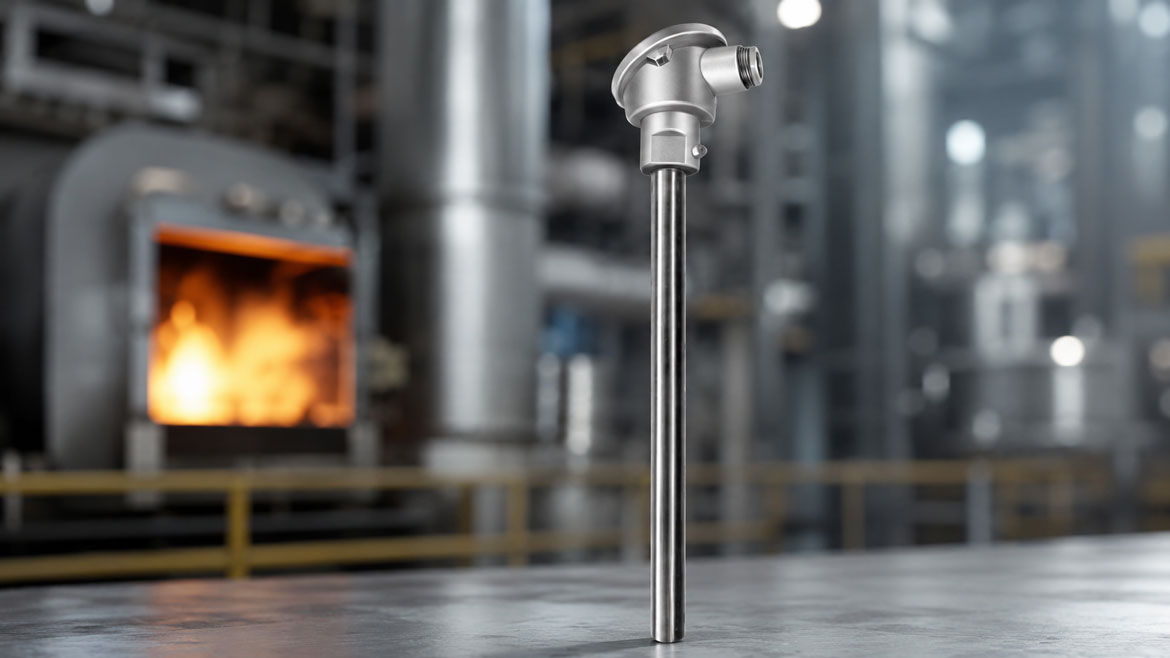
The Type K thermocouple is one of the most commonly used temperature sensors in industry. It is robust, fast, comparatively cost-effective and suitable for a wide temperature range. For this reason, Type K is frequently used in mechanical engineering, plastics processing, furnace construction, exhaust gas measurement, test benches, process plants, heating systems and mobile temperature measurements.
A Type K thermocouple is particularly useful when temperatures need to be recorded quickly, when the environment is harsh or when higher temperatures need to be measured where a Pt100 resistance thermometer is no longer ideal. At the same time, it must be considered that thermocouples work differently from Pt100 sensors and have special requirements in terms of accuracy, cable, connection, reference junction and calibration.
This article explains how a Type K thermocouple works, which temperature ranges are typical, what needs to be considered regarding accuracy, thermowell, sheathed cable, connection head, compensating cable, transmitter and calibration, and which products are suitable for industrial temperature measurements.
You can find suitable products in our category
Thermocouples
as well as in the general category
Temperature sensors / temperature probes.
For universal applications, for example,
WIKA Model TC40 cable thermocouples,
straight thermocouples according to EN 50446 with connection head,
Type TC47-MB screw-in melt thermocouples
or suitable
temperature transmitters and accessories
are relevant.
Table of contents
- What is a Type K thermocouple?
- How does a Type K thermocouple work?
- Material combination: nickel-chromium / nickel-aluminium
- Temperature range of Type K thermocouples
- Accuracy and tolerance classes
- Advantages and limitations of Type K
- Type K thermocouple or Pt100?
- Designs: cable thermocouple, sheathed thermocouple and screw-in probe
- Thermowell, sheathed cable and process connection
- Compensating cable, plug and connection head
- Transmitters: converting Type K to 4–20 mA or digital signals
- Display, handheld measuring instrument and evaluation
- Calibration of Type K thermocouples
- Typical sources of error in Type K measurements
- Product reference: suitable Type K thermocouples
- Practical examples from industry, plastics processing and furnace construction
- Checklist: selecting the right Type K thermocouple
- Conclusion
- FAQ: frequently asked questions about Type K thermocouples
What is a Type K thermocouple?
A Type K thermocouple is a temperature sensor consisting of two different metallic conductors. These conductors are joined together at the measuring junction. If a temperature difference occurs between the measuring junction and the connection point, a small thermoelectric voltage is generated. This voltage can be evaluated by a measuring instrument, transmitter or controller and converted into a temperature.
Type K is a very common thermocouple type for general industrial applications. It is frequently used when robust temperature measurement, fast response and a wide temperature range are more important than maximum accuracy.
| Feature | Meaning | Practical example |
|---|---|---|
| Type K thermocouple | Temperature probe with a defined material combination. | Temperature measurement on a furnace, extruder or exhaust gas line. |
| Thermoelectric voltage | Electrical signal generated by temperature difference. | Measuring instrument converts mV signal into °C. |
| Measuring junction | Connection point of the two thermocouple wires. | Probe tip in the process or on the surface. |
| Reference junction | Connection point whose temperature must be compensated. | Cold junction compensation in the measuring instrument or transmitter. |
How does a Type K thermocouple work?
The operating principle is based on the thermoelectric effect. Two different metals generate an electrical voltage when there is a temperature difference. This voltage is very small and depends on the temperature difference between the measuring junction and the reference junction.
To calculate the correct temperature from the voltage, the measuring instrument must know that a Type K thermocouple is connected. In addition, the temperature of the reference junction must be taken into account. This so-called cold junction compensation is an important part of every thermocouple measurement.
| Step | What happens? | Why important? |
|---|---|---|
| Temperature at the measuring junction | The probe tip is heated or cooled. | This is where the process temperature is to be recorded. |
| Thermoelectric voltage is generated | Temperature difference produces an mV signal. | This signal is the basis of the measurement. |
| Cold junction compensation | Connection point temperature is taken into account. | Without compensation, a temperature error occurs. |
| Linearization | Measuring instrument converts mV signal into temperature. | The Type K characteristic curve is not fully linear. |
| Display or output | Temperature is displayed or output as a signal. | For example display in °C or output 4–20 mA. |
Material combination: nickel-chromium / nickel-aluminium
Type K thermocouples consist of a nickel-chromium and a nickel-aluminium alloy. This material combination is the reason for the typical characteristic curve, the wide temperature range and the broad industrial usability.
In practice, Type K is often referred to as NiCr-Ni. It is important that probe, cable, plug, display and transmitter match the same thermocouple type. If incorrect cables or unsuitable connection materials are used, measurement errors can occur.
| Point | Description | Note |
|---|---|---|
| Positive leg | Nickel-chromium alloy. | Part of the standardized Type K material combination. |
| Negative leg | Nickel-aluminium alloy. | Together with the positive leg, determines the characteristic curve. |
| Characteristic curve | Voltage-temperature assignment for Type K. | Must be set correctly in the measuring instrument. |
| Compensating cable | Cable with suitable thermocouple characteristics. | Incorrect cable leads to measurement deviations. |
Temperature range of Type K thermocouples
Type K thermocouples are often used for a wide temperature range. Depending on design, sheath material, insulation, cable, plug, thermowell and application, very different operating limits may apply.
The sensor material alone does not determine the maximum operating temperature. In practice, design, cable material, thermowell, ambient conditions and mechanical load are at least just as important.
| Application | Typical range | Note |
|---|---|---|
| General industry | Wide temperature range up to high process ranges. | Select design according to the process. |
| Cable thermocouple | Limited by cable material and insulation. | PVC, silicone, PTFE or glass fibre have different limits. |
| Sheathed thermocouple | Suitable for harsh and higher temperature ranges. | Mineral-insulated sheathed cable improves robustness. |
| Thermowell probe | Suitable for process and furnace applications. | Check thermowell material and medium. |
| Handheld measuring instrument with Type K probe | Depends on measuring instrument and connected probe. | Consider instrument range and probe range together. |
Accuracy and tolerance classes
Thermocouples are robust temperature sensors, but they usually do not achieve the accuracy of high-quality resistance thermometers. Accuracy depends on thermocouple type, tolerance class, measuring range, measuring instrument, cold junction compensation, cable, installation and calibration.
For many industrial applications, the accuracy of Type K is sufficient. If very tight tolerances are required, it should be checked whether a Pt100, a calibrated thermocouple or a complete measuring circuit with reference measurement is more suitable.
| Influencing factor | Effect | Practical recommendation |
|---|---|---|
| Tolerance class | Determines the permissible deviation of the probe. | Select class according to the application. |
| Measuring instrument | Display or transmitter errors are added. | Consider probe and evaluation device together. |
| Cold junction compensation | Incorrect compensation causes offset. | Use a suitable measuring instrument or transmitter. |
| Installation | Heat dissipation or incorrect immersion depth distorts measured value. | Carefully design measuring point and insertion length. |
| Ageing | Thermocouple can drift at high temperatures. | Plan regular inspection or calibration. |
Advantages and limitations of Type K
The Type K thermocouple is a very versatile sensor, but it is not ideal for every application. The key advantages are wide temperature range, fast response, robust designs and broad availability. Limitations exist in terms of maximum accuracy, long-term stability and certain ambient conditions.
| Advantage / limitation | Evaluation | Practical relevance |
|---|---|---|
| Wide temperature range | Very good all-round sensor for industry. | Furnace, exhaust gas, mechanical engineering, test bench. |
| Fast response | Especially with small probe diameters. | Detect process changes quickly. |
| Robust designs | Available as sheathed probe, cable sensor or thermowell probe. | Harsh environments and higher temperatures. |
| Low signal voltage | mV signal is sensitive to errors in the measuring circuit. | Observe suitable cable, shielding and evaluation. |
| Lower accuracy than Pt100 | Not always the first choice for precision measurement. | Check Pt100 or calibration for tight tolerances. |
| Drift under high load | Sensor can change over time. | Define calibration intervals according to operating conditions. |
Type K thermocouple or Pt100?
Whether a Type K thermocouple or a Pt100 is more suitable depends on the application. Pt100 resistance thermometers are often more accurate and more stable at low and medium temperatures. Type K thermocouples, on the other hand, are often better suited when high temperatures, fast response or robust designs are the main focus.
| Criterion | Type K thermocouple | Pt100 |
|---|---|---|
| Temperature range | Very well suited for high temperatures. | Very well suited for low to medium temperatures. |
| Accuracy | Good for many industrial applications. | Usually more accurate and more stable. |
| Response time | Very fast with small design. | Depends on design, often somewhat slower. |
| Signal | mV signal with cold junction compensation. | Resistance signal with 2-, 3- or 4-wire connection. |
| Robustness | Very robust in suitable designs. | Robust, but more dependent on operating temperature and construction. |
| Costs | Often economical at high temperatures. | Varies depending on accuracy and design. |
Designs: cable thermocouple, sheathed thermocouple and screw-in probe
Type K thermocouples are available in many designs. The right version depends on whether measurements are taken in liquids, gases, solids, surfaces, melts, air flows or process lines.
| Design | Properties | Typical application |
|---|---|---|
| Cable thermocouple | Flexible, easy to install, various cable materials. | Mechanical engineering, storage, test bench, near-surface measurement. |
| Sheathed thermocouple | Mineral-insulated, bendable, robust, fast response. | Furnace construction, exhaust gas, process plants, laboratory. |
| Screw-in thermocouple | With thread or process connection. | Extruder, pipeline, vessel, machines. |
| Thermocouple with connection head | Robust industrial connection, optionally with transmitter. | Process industry, plant engineering, higher temperatures. |
| Surface thermocouple | For contact measurement on component surfaces. | Hot plates, housings, pipe wall, tools. |
Thermowell, sheathed cable and process connection
In industrial applications, the mechanical design often has a greater influence on service life than the thermocouple type itself. Thermowell, sheath material, diameter, immersion depth, process connection and mounting position must match the medium and temperature.
An incorrectly selected thermowell can lead to slow response, corrosion, mechanical failure or measurement errors. A probe that is too short can show incorrect temperatures due to heat dissipation.
| Selection point | Why important? | Practical recommendation |
|---|---|---|
| Thermowell material | Must withstand temperature, medium and corrosion. | Check stainless steel, Inconel or ceramic materials. |
| Diameter | Influences response time and stability. | Choose a compromise between fast measurement and robustness. |
| Immersion depth | Insufficient immersion depth causes heat dissipation errors. | Insert measuring point sufficiently deep into the process. |
| Process connection | Must fit mechanically and process-technically. | Check thread, flange, compression fitting or bayonet connection. |
| Flow and pressure | Mechanical load can damage the probe. | Check thermowell calculation or suitable design. |
Compensating cable, plug and connection head
With thermocouples, the connecting cable must not be selected arbitrarily. A suitable thermocouple cable or compensating cable is required between the thermocouple and the measuring instrument. Only this preserves the thermocouple characteristics up to the reference junction.
Plugs and terminals must also match the thermocouple type. If copper cables, incorrect plugs or unsuitable transitions are used, additional thermoelectric voltages can arise and distort the measurement.
| Component | Task | Note |
|---|---|---|
| Thermocouple cable | Consists of thermocouple material. | For high accuracy and direct extension. |
| Compensating cable | Has similar thermoelectric properties within a limited temperature range. | Select suitable Type K cable. |
| Miniature Type K plug | Quick connection to handheld measuring instruments or data loggers. | Observe polarity and Type K material. |
| Connection head | Robust field connection. | Can optionally be combined with transmitter. |
| Terminal point | Transition to evaluation device. | Avoid temperature gradients and incorrect materials. |
Transmitters: converting Type K to 4–20 mA or digital signals
In many industrial plants, the mV signal of a thermocouple is not routed directly to the PLC. Instead, a temperature transmitter is used. It converts the Type K signal into a robust standard signal such as 4–20 mA or a digital signal.
This is particularly useful for long cable runs, EMC-loaded environments, central control systems or when uniform signal transmission is required. It is important that the transmitter is configured for Type K thermocouple and that the required measuring span is set correctly.
| Output signal | Advantage | Typical application |
|---|---|---|
| Direct mV signal | Simple sensor connection. | Short cable to display, controller or data logger. |
| 4–20 mA | Robust and well suited for longer cable runs. | PLC, control system, process plant. |
| HART | Additional diagnostics and parameterization. | Process industry and smart measuring points. |
| RS-485 / Modbus | Digital integration of several measuring points. | Automation, test benches, data loggers. |
| IO-Link | Parameterization and diagnostics in modern plants. | Mechanical engineering and decentralized automation. |
Display, handheld measuring instrument and evaluation
Type K thermocouples can be evaluated with handheld measuring instruments, panel indicators, controllers, data loggers or transmitters. The decisive factor is that the input is explicitly suitable for Type K thermocouples.
Type K handheld measuring instruments are practical for mobile measurements. Digital panel instruments can be used for control panels and machines. For process plants, a transmitter with a standard signal is often the better solution.
| Evaluation device | Suitable for | Example |
|---|---|---|
| Type K handheld measuring instrument | Mobile temperature measurement and service. | Maintenance, commissioning, control measurement. |
| Digital panel indicator | Machines and control cabinets. | Display of Type K temperatures in °C or °F. |
| Temperature controller | Control of heaters or processes. | Furnace, heating tape, tool temperature control. |
| Data logger | Recording of temperature trends. | Test bench, laboratory, quality assurance. |
| Transmitter | Conversion to standard signal. | 4–20 mA to PLC or control system. |
Calibration of Type K thermocouples
Type K thermocouples can age, drift or be affected by high temperatures and process conditions. Regular calibration is therefore useful, especially in quality-relevant processes, test benches, heat treatments or applications requiring documentation.
During calibration, not only the sensor alone should be considered. In many cases, the complete measuring circuit consisting of thermocouple, cable, transmitter, display and controller is decisive. A comparison calibration at defined temperature points can show whether the entire measuring chain is within the required tolerance.
| Calibration point | Why important? | Practical recommendation |
|---|---|---|
| Sensor test | Detects drift or damage to the thermocouple. | Compare probe with reference temperature. |
| Measuring circuit test | Detects errors from cable, transmitter and display. | Check the complete measuring chain. |
| Multi-point calibration | Evaluates behavior across the operating range. | Select calibration points close to process values. |
| Documentation | Proof for quality assurance and audits. | Create calibration certificate or test report. |
| Calibration interval | Depends on load and requirement. | Define according to process risk and history. |
Typical sources of error in Type K measurements
Many measurement errors are not caused by the thermocouple itself, but by connection, cable, installation or incorrect device settings. Particularly common errors are wrong thermocouple type set in the measuring instrument, unsuitable connection cable, incorrect polarity, poor cold junction compensation or insufficient immersion depth.
| Error | Effect | Practical solution |
|---|---|---|
| Wrong sensor type set | Measured value deviates significantly. | Set measuring instrument to Type K. |
| Wrong cable used | Additional thermoelectric voltages occur. | Use Type K compensating cable or thermocouple cable. |
| Polarity reversed | Temperature trend appears wrong or implausible. | Check plus and minus. |
| Poor cold junction compensation | Offset error in measured value. | Use suitable display or transmitter. |
| Insufficient immersion depth | Heat dissipation distorts temperature. | Install probe sufficiently deep. |
| Unsuitable thermowell | Slow response or material damage. | Select thermowell according to temperature and medium. |
| EMC or interference signals | Unstable display. | Check shielding, cable routing and transmitter. |
Product reference: suitable Type K thermocouples
For the keyword Type K thermocouple, various product groups are relevant. Depending on the application, a simple cable probe, a robust thermocouple with connection head, a screw-in probe, a handheld measuring instrument or a transmitter can be the right solution.
| Product / category | Suitable for | Typical application |
|---|---|---|
| Thermocouples | Overview of thermocouples for industrial temperature measurement. | Preselection according to design, type, temperature range and application. |
| WIKA Model TC40 cable thermocouple | Cable thermocouples for insertion, screw-in mounting and flexible applications. | Mechanical engineering, plant engineering, mobile or fixed measuring points. |
| Straight thermocouples according to EN 50446 with connection head | Robust industrial temperature measurement with thermowell. | Process plants, furnace construction, high temperatures. |
| Type TC47-MB screw-in melt thermocouple | Temperature measurement on extrusion machines and plastics processes. | Melt and tool temperature in the plastics industry. |
| testo 925 temperature measuring instrument | Mobile temperature measurement with Type K thermocouple. | Service, maintenance, control measurement and commissioning. |
| IM1 digital panel instrument for thermocouples | Display of thermocouple signals in control panel or machine. | Machine display, temperature monitoring, limit value control. |
| Thermocouple transmitter DT 45800 | Conversion of thermocouple signals to standard signals. | Signal transmission to PLC, control system or data logger. |
| Temperature calibrators | Comparison and function testing of temperature sensors. | Calibration of thermocouples, displays and measuring chains. |
Practical examples from industry, plastics processing and furnace construction
Example 1: Type K probe on an extrusion machine
In plastics processing, the temperature in the melt or on the tool must be monitored reliably. A Type K screw-in melt thermocouple can be installed directly at suitable measuring points and provides fast temperature information for control and process monitoring.
Example 2: Temperature measurement on an industrial furnace
At higher temperatures, a robust thermocouple with thermowell is often the suitable solution. Type K is suitable for many furnace applications if temperature range, thermowell material and atmosphere match the application.
Example 3: Mobile control measurement in service
A service technician checks the temperature on a machine. With a Type K handheld measuring instrument and a suitable probe, it can be quickly checked whether display, controller or process value are plausible.
Example 4: Transmitting Type K signal to PLC
In a plant, a Type K thermocouple is to be connected to a PLC over a longer cable run. Instead of transmitting the sensitive mV signal directly, a transmitter is used that converts the signal into 4–20 mA.
Example 5: Measurement error caused by incorrect compensating cable
A temperature display shows implausible values. During inspection, it turns out that an unsuitable cable was used between thermocouple and display. After replacement with a suitable Type K compensating cable, the measured value stabilizes.
Checklist: selecting the right Type K thermocouple
This checklist helps to better prepare the selection of a suitable Type K thermocouple.
| Check question | Why important? | Practical recommendation |
|---|---|---|
| Which temperature range is required? | Sensor, cable and thermowell must match the range. | Consider process temperature and ambient temperature separately. |
| Which medium is present? | Medium influences thermowell and material selection. | Check gas, liquid, melt, exhaust gas or solid body. |
| How fast does the measurement need to be? | Design and diameter influence response time. | Small diameter for fast measurement, more robust design for load. |
| Which accuracy is required? | Type K is robust, but not always the most accurate solution. | Consider tolerance class, calibration and measuring chain. |
| How is the probe installed? | Installation influences measured value and service life. | Observe immersion depth, process connection and thermowell. |
| Which cable is used? | Wrong cable causes measurement errors. | Use Type K thermocouple cable or compensating cable. |
| How is the signal evaluated? | Measuring instrument must support Type K. | Select suitable display, controller, data logger or transmitter. |
| Is a standard signal required? | mV signal is sensitive over longer distances. | Check transmitter to 4–20 mA or digital interface. |
| Is calibration required? | Quality-relevant processes require proof. | Calibrate sensor or complete measuring chain. |
| Is the environment particularly harsh? | Vibration, temperature, EMC and moisture influence function. | Select robust design, degree of protection and shielding. |
Conclusion: Type K thermocouple is the robust all-rounder for many industrial applications
The Type K thermocouple is a very versatile solution for industrial temperature measurements. It is particularly suitable for applications with higher temperatures, fast response requirements and harsh operating conditions. Typical areas of application include mechanical engineering, plastics processing, furnace construction, exhaust gas, test benches and process industry.
However, for reliable measurement, design, temperature range, tolerance class, thermowell, cable, connection, cold junction compensation and evaluation must be selected correctly. Many measurement errors are not caused by the sensor itself, but by incorrect cables, wrong device settings or unsuitable installation.
You can find suitable solutions in the category
Thermocouples.
Depending on the application, for example,
WIKA Model TC40 cable thermocouples,
straight thermocouples according to EN 50446 with connection head,
Type TC47-MB screw-in melt thermocouples,
testo 925 temperature measuring instruments
or suitable
transmitters and accessories
can be considered.
FAQ: frequently asked questions about Type K thermocouples
What is a Type K thermocouple?
A Type K thermocouple is a temperature sensor consisting of two different metallic conductors. When there is a temperature difference, a thermoelectric voltage is generated and converted into a temperature by a measuring instrument.
What is a Type K thermocouple used for?
Type K is frequently used in industry, mechanical engineering, plastics processing, furnace construction, exhaust gas measurement, test benches, heating systems and process plants.
What temperature range does a Type K thermocouple have?
Type K is suitable for a wide temperature range. However, the specific operating limit depends on design, sheath material, cable insulation, thermowell, plug and application.
How accurate is a Type K thermocouple?
Accuracy depends on tolerance class, temperature range, measuring instrument, cold junction compensation, cable, installation and calibration. For many industrial applications, Type K is sufficiently accurate; for very tight tolerances, Pt100 may be more suitable.
Which is better: Type K thermocouple or Pt100?
Type K is often better suited for high temperatures, fast response and robust applications. Pt100 is often better when high accuracy and stability are required at low to medium temperatures.
Why do you need a Type K compensating cable?
A suitable compensating cable preserves the thermocouple characteristics up to the reference junction. Incorrect cables or unsuitable transitions can generate additional thermoelectric voltages and cause measurement errors.
What does cold junction compensation mean?
Cold junction compensation takes into account the temperature of the connection point. Without this compensation, the measuring instrument cannot correctly convert the thermoelectric voltage into an absolute temperature.
When do you need a transmitter for a Type K thermocouple?
A transmitter is useful when the sensitive mV signal is to be transmitted over longer distances or when a robust standard signal such as 4–20 mA, HART, Modbus or IO-Link is required.
Does a Type K thermocouple need to be calibrated?
Calibration is useful when the measurement is quality-relevant, high temperatures occur, drift is expected or proof is required for audits, test benches or process safety.
Which errors commonly occur in Type K measurements?
Common errors include wrong sensor type in the measuring instrument, wrong cable, reversed polarity, poor cold junction compensation, insufficient immersion depth, unsuitable thermowell or EMC interference.
Which products are suitable for Type K thermocouples?
Depending on the application,
WIKA Model TC40 cable thermocouples,
straight thermocouples according to EN 50446 with connection head,
Type TC47-MB screw-in melt thermocouples,
testo 925 temperature measuring instruments,
digital panel indicators, transmitters or temperature calibrators are suitable. You can find an overview in the category
Thermocouples.