


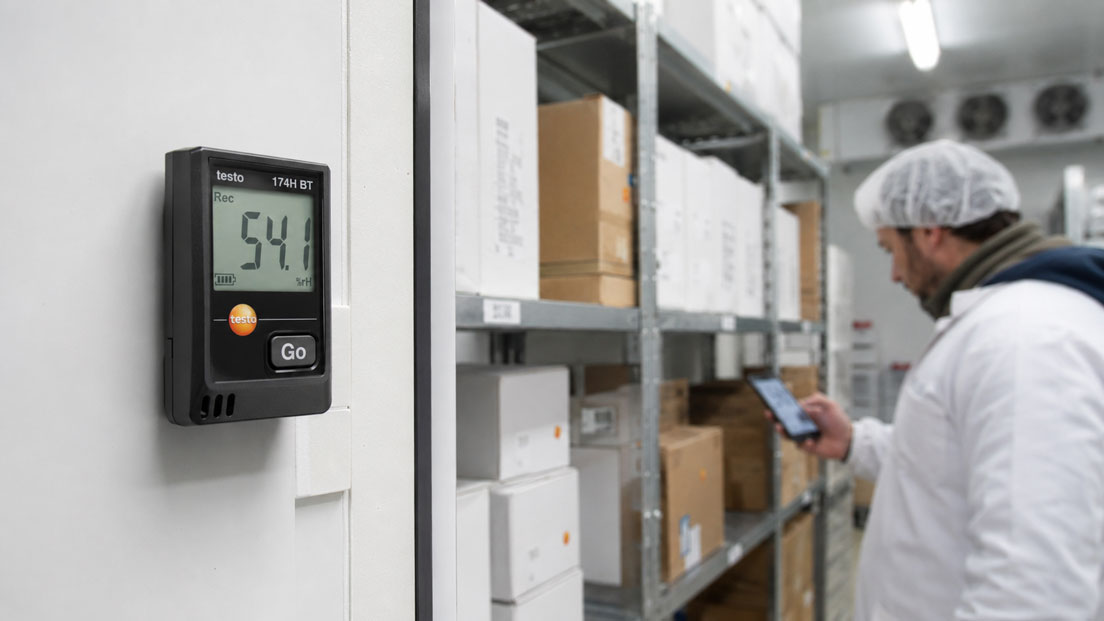
Temperature, relative humidity, pressure and other measured variables are often monitored over extended periods in warehouses, laboratories, production areas and technical installations. This raises an important question: Is a conventional data logger sufficient, or is a networked monitoring system with automatic alarm notifications required?
A standalone data logger initially stores the measured values in its internal memory. The data is later read out via USB, Bluetooth, memory card or a local interface. This solution is comparatively straightforward and is well suited to temporary measurements, spot checks and retrospective documentation.
An online monitoring system, on the other hand, regularly transmits the values to a central database, a local server solution or a cloud platform. Limit violations can therefore be detected immediately and reported by email, SMS or switching contact.
However, automatic alarm notifications are not necessary at every measuring point. They are particularly useful when a deviation must be detected while it is occurring and rapid intervention can prevent damage, loss of quality or production downtime.
This article explains the differences between offline data loggers and online monitoring, presents typical applications and describes the technical and organisational aspects that must be considered for alarms, data transmission and documentation.
Table of contents
- Data loggers and monitoring systems compared
- When an offline data logger is sufficient
- When online monitoring is useful
- When automatic alarm notifications are required
- USB, Bluetooth, radio, Wi-Fi and Ethernet
- What happens if the connection fails
- Defining limits and alarm delays
- Setting up a reliable alarm chain
- Central database and documentation
- Planning measured variables and the number of sensors
- Selecting measurement and transmission intervals
- Commissioning a monitoring system correctly
- Typical errors with data loggers and alarm systems
- Practical example: Temperature monitoring in a warehouse
- Which measuring instruments / products are suitable?
- Conclusion
- Frequently asked questions about data loggers and monitoring systems
Data loggers and monitoring systems compared
The main difference is not the measurement itself. Both systems can record temperature, humidity or other variables at fixed intervals. The decisive factor is when and how the data becomes available.
| Property | Offline data logger | Online monitoring system |
|---|---|---|
| Data storage | In the logger’s internal memory | Centrally on a server, base station or cloud platform |
| Data transmission | Via USB, memory card or Bluetooth when required | Automatically via radio, Wi-Fi, Ethernet or mobile network |
| Alarm notification | Usually only visible locally or retrospectively | Email, SMS, relay, app or control-room notification possible |
| Installation | Simple and quick | Requires a network, users, alarm rules and an IT concept |
| Typical application | Temporary analysis and documentation | Permanent monitoring of critical areas |
An online system is not automatically more accurate than an offline logger. Measurement quality still depends on the sensor, measuring range, accuracy, calibration and position.
The main advantage of a monitoring system is the rapid availability of data and the ability to respond immediately to a deviation.
When an offline data logger is sufficient
A local data logger is useful when the measured values only need to be evaluated after the recording has been completed. Typical tasks include investigating the indoor climate, temporary troubleshooting or documenting transport and storage conditions.
Suitable applications include:
- temperature measurement during a single transport
- investigation of humidity fluctuations in a building
- monitoring a cold room over several days
- comparing different sensor positions
- analysing a machine during a test phase
The offline logger records independently of a network. This is advantageous for mobile equipment, non-networked areas and temporary investigations.
However, a limit violation is often not detected until the logger is read out. If a storage room has already been too warm for several hours, the logger can document the event completely, but it can no longer trigger a timely countermeasure.
A display, LEDs or a local buzzer may indicate a deviation. However, this notification is only useful if someone is actually nearby while the event is occurring.
When online monitoring is useful
An online monitoring system is particularly suitable when measuring points must be monitored permanently and deviations require a rapid response.
Typical applications include:
- pharmaceutical and food warehouses
- cold-storage and deep-freeze rooms
- laboratories and cleanrooms
- server rooms and technical building services
- production areas with temperature-sensitive processes
- archives, museums and sensitive stored goods
The measuring instruments transmit their data automatically. Responsible personnel can assess the current condition and the trend over time from a central workstation.
This eliminates the need to collect and read out numerous individual loggers manually. It also reduces the risk of unnoticed full memory, battery failure or measurement data only being evaluated weeks later.
However, the monitoring system must fit the operational organisation. An automatically transmitted notification is of no benefit if nobody is clearly responsible for handling it.
When automatic alarm notifications are required
Automatic alarm notification is useful when only a limited amount of time is available between detecting a deviation and the resulting damage.
The key question is:
Can timely notification still enable effective intervention?
In a cold room, for example, a technician may be able to check the door, activate backup cooling or relocate sensitive goods. In a server room, an increased temperature may indicate a failure of the air-conditioning system.
Automatic notification is particularly relevant when:
- valuable or quality-critical products are being monitored
- the area is unattended outside working hours
- a deviation can progress rapidly
- legal or internal documentation requirements apply
- several remote locations are managed centrally
For pure root-cause analysis following an already known problem, however, an offline data logger may be sufficient.
USB, Bluetooth, radio, Wi-Fi and Ethernet
The interface determines how measured values are transmitted and which infrastructure is required.
USB and memory card
USB or a memory card are suitable for local data loggers. Transmission is reliable and independent of the network, but requires manual access to the device.
Bluetooth
Bluetooth allows the logger to be read out close to the measuring point, for example using a smartphone or tablet. The logger can remain installed, but permanent remote alarm notification over longer distances is not normally part of this concept.
Proprietary radio
Wireless data loggers transmit their data to a base station or gateway. Such systems can cover larger buildings, but require careful radio-network planning.
Walls, metal shelving, machinery and cold rooms can significantly reduce the range. The theoretical free-field range must therefore not be confused with the actual range inside a building.
Wi-Fi and Ethernet
Wi-Fi uses an existing network infrastructure and can be deployed flexibly if sufficient coverage is available. Ethernet provides a fixed and often very stable connection, but requires a network cable to the measuring point.
Before selecting a system, the IT department and operator should clarify which network access, security requirements and cloud connections are permitted.
What happens if the connection fails
A networked logger should not transmit measured values only in real time. If the Wi-Fi, radio connection or server temporarily fails, the data must be buffered locally.
Once the connection has been restored, the missing values should be transmitted automatically and assigned to the correct timestamps.
The following points should therefore be checked when selecting a system:
- How large is the internal memory?
- How long can measurements be recorded without a connection?
- Is the communication failure itself reported?
- Are data records transmitted automatically afterwards?
- What happens in the event of a power or battery failure?
Interrupted data transmission is not the same as a limit violation. Nevertheless, it is an important system fault because reliable remote monitoring is not possible during this period.
For particularly critical applications, an uninterruptible power supply, redundant communication paths or a local alarm relay may be required.
Defining limits and alarm delays
Limits should be derived from the actual application. A value that can technically be configured in the logger is not automatically the permissible process range.
Several stages are often used:
- Warning threshold: Early indication of an emerging deviation
- Action limit: A defined response or investigation is required
- Critical alarm: Immediate action or escalation is necessary
An alarm delay prevents notifications caused by very brief, non-critical events. In a cold room, for example, a brief temperature increase during a door opening may be permissible.
However, the delay must not be so long that an actual failure is detected too late. The limit, time delay and reset condition must therefore be defined together.
A return to the normal range should also be documented. This makes it possible to determine how long the deviation actually lasted.
Setting up a reliable alarm chain
An alarm consists of more than an email. The complete chain extends from the sensor to the response of the responsible person.
It includes:
- The sensor detects the measured-value deviation.
- The logger or software evaluates the limit and delay time.
- The system sends the notification.
- A responsible person receives and acknowledges the alarm.
- A defined measure is carried out.
- The alarm, cause and response are documented.
An escalation procedure should be provided for critical applications. If the first recipient does not respond within a defined time, the notification is forwarded to another person or an on-call team.
Email alone may be unsuitable if notifications are overlooked outside working hours. Depending on the risk, SMS, app notifications, telephone forwarding, an audible signal or a relay contact may also be required.
The alarm chain should be tested regularly. This includes not only simulating a measured value, but also checking whether the notification reaches the correct recipient and triggers the intended response.
Central database and documentation
With several loggers, a central database simplifies evaluation. Measuring points, limits and timestamps are managed in one common system.
Important functions include:
- trend display over freely selectable periods
- automatic reports
- export to common file formats
- documentation of alarms and acknowledgements
- user and rights management
- data backup and recovery
In regulated areas, an audit trail, electronic user management and software functions suitable for validation may additionally be required.
A cloud-based system does not automatically fulfil these requirements. The storage location, access rights, changes, backup concept and software licence must comply with the relevant quality and IT requirements.
Planning measured variables and the number of sensors
The number of loggers does not depend solely on the size of the room. The decisive factor is whether different climatic conditions can occur within the monitored area.
In a warehouse, external walls, doors, ceiling areas, heaters and densely occupied shelving can cause considerable temperature differences.
The following should be considered when defining measuring points:
- results of a temperature- or humidity-distribution measurement
- critical products and storage areas
- airflow and ventilation outlets
- doors, gates and external walls
- heat or moisture sources
- required redundancy
The sensor should represent the actual condition of the goods or process. An easily accessible position next to a door is not necessarily suitable.
Selecting measurement and transmission intervals
The measurement interval and transmission interval do not have to be identical. A logger may, for example, measure once every minute but only transmit the data to the database every 15 minutes.
A short measurement interval records rapid changes more effectively, but increases the required memory, data volume and energy consumption.
For slowly changing room temperatures, an interval of several minutes may be sufficient. For fast processes, door openings or dynamic machine conditions, a significantly higher time resolution may be required.
Alarm evaluation should be based on the values actually measured and not only take place during the next summarised data transmission. Otherwise, the notification may be delayed unnecessarily.
Commissioning a monitoring system correctly
The complete measuring and alarm chain should be tested before productive use.
- Check the sensors: Verify the measuring range, accuracy and calibration status.
- Assign the measuring points: Name and document the devices clearly.
- Test the connection: Check radio, Wi-Fi or Ethernet coverage.
- Configure the limits: Define warnings, alarms and delays.
- Simulate an alarm: Test the notification and escalation in practice.
- Interrupt the connection: Check local storage and subsequent data transmission.
- Check the reports: Verify timestamps, units and measuring-point designations.
After commissioning, the measured values should be compared with a suitable reference instrument. This makes it possible to detect unsuitable sensor positions, scaling errors and implausible deviations.
Typical errors with data loggers and alarm systems
| Error | Possible consequence | Better approach |
|---|---|---|
| Offline logger used for critical permanent monitoring | The deviation is only detected when the device is read out | Use a networked system with remote alarm notification |
| Alarm limit configured too tightly | Numerous unnecessary notifications | Take measurement uncertainty and normal fluctuations into account |
| Alarm delay too long | Critical condition is reported too late | Define the delay according to the permissible duration of the deviation |
| Only one recipient configured | The alarm remains unnoticed during the recipient’s absence | Define substitutes and escalation stages |
| Radio range assessed only theoretically | Transmission failures inside the actual building | Check radio coverage at the intended installation location |
| Sensor installed at an unsuitable location | The measured value does not represent the monitored area | Derive the position from a distribution measurement |
| Communication failure not monitored | Unnoticed gap in remote monitoring | Activate system and connection alarms |
| Alarm function never tested in practice | The fault is only discovered during an actual incident | Document regular functional tests |
Practical example: Temperature monitoring in a warehouse
Several standalone data loggers are initially used in a warehouse for temperature-sensitive materials. They store the temperature and are read out once a month.
During one evaluation, it is discovered that one logger had recorded a temperature above the permissible limit for several hours over a weekend. The cause was a failure of the ventilation system. By the time the data was evaluated, the fault had already been rectified, but the affected goods still had to be assessed retrospectively.
Because timely relocation would be possible if the event occurred again, the warehouse is converted to an online monitoring system.
The existing temperature distribution is checked first. Loggers are then installed at representative and particularly critical positions. The measured values are transmitted automatically to a central database.
A warning threshold and a higher action limit are configured for the alarm system. Brief temperature fluctuations while a gate is open do not yet trigger an alarm because of a defined delay time.
In the event of a prolonged exceedance, the building-services team receives a notification first. If it is not acknowledged, the alarm is forwarded to the responsible warehouse manager.
When the air-conditioning system fails at a later date, the fault is detected after only a few minutes. The cause can be corrected before the permissible product temperature is exceeded.
The example shows that automatic alarm notification offers the greatest added value when a specific and timely response is possible.
Which measuring instruments / products are suitable?
The data loggers and universal measuring instruments category contains devices for temperature, humidity, pressure, current, voltage and other measured variables.
The humidity data loggers category includes both locally readable instruments and radio- and cloud-based solutions for monitoring temperature and relative humidity.
testo 174 H BT for mobile and local measurements
The testo 174 H BT measures temperature and humidity and stores the values in its internal memory.
Configuration and evaluation are carried out via Bluetooth and an app close to the measuring point. The device is therefore particularly suitable for temporary measurements, commissioning and local climate investigations.
Permanent alarm notification over long distances is not the main purpose of a purely Bluetooth-based connection.
testo 175 H1 for extensive offline recordings
The testo 175 H1 records temperature, relative humidity and the calculated dew point over extended periods.
The measurement data can be transferred via USB or SD card and subsequently evaluated on a PC. The device is therefore suitable for warehouse, building and archive monitoring when immediate remote alarm notification is not required.
testo 160 for cloud monitoring
The testo 160 wireless data loggers transmit measured values via Wi-Fi to a cloud platform. Depending on the version, they can record temperature, humidity, CO₂, illuminance, UV radiation or external probes.
Depending on the licence used, limit violations can be reported by email or SMS. The devices are therefore suitable for distributed measuring points where the data must be available centrally.
Testo Saveris measurement-data monitoring system
The Testo Saveris measurement-data monitoring system is designed for larger stationary monitoring tasks with multiple measuring points.
The measured data can be transmitted to a central base via radio and Ethernet. Depending on the system configuration, alarms can be issued by email, SMS or relay.
The system is therefore suitable, for example, for warehouses, laboratories, production areas and quality-critical environments requiring central documentation.
Selecting the appropriate solution
At least the measured variable, number of measuring points, measuring ranges, accuracy, recording duration and required alarm notification are needed for product selection.
Network availability, radio conditions, data storage, user management and calibration requirements must also be considered.
ICS Schneider Messtechnik assists with the selection of data loggers, sensors, wireless systems and monitoring solutions, as well as with configuring a suitable measurement and alarm chain.
Conclusion: Automatic alarm notification is worthwhile for time-critical deviations
An offline data logger is well suited to temporary measurements, retrospective evaluations and areas where an immediate response is not required.
An online monitoring system is useful when measured values must be available centrally on a permanent basis and limit violations need to be detected promptly.
Automatic alarm notification offers the greatest benefit when the notification enables an effective countermeasure. Responsibilities, escalation stages and response procedures must therefore be clearly defined.
The sensor and measuring range are not the only decisive selection criteria. Local data buffering, communication failures, network structure, alarm path and documentation requirements must also be considered.
Reliable monitoring is only achieved through the interaction of a suitable sensor position, traceable limits, secure data transmission and a regularly tested alarm chain.
Frequently asked questions about data loggers and monitoring systems
What is the difference between a data logger and a monitoring system?
A data logger usually stores measured values locally and is read out later. A monitoring system automatically transmits the data to a central platform and can issue immediate alarm notifications.
Can an offline data logger trigger an alarm?
Many devices can indicate limit violations locally via a display, LED or acoustic signal. However, this does not automatically provide remote notification to people who are not on site.
When is automatic alarm notification useful?
When a deviation can cause damage within a short period and a timely response can prevent or limit that damage.
Is a cloud platform essential?
No. Monitoring systems can also use a local base station or an organisation’s own server. The appropriate solution depends on IT, security and documentation requirements.
What happens if the network fails?
Suitable loggers buffer the measured values locally and transmit them after the connection has been restored. The communication failure should also trigger an alarm.
Which alarm channels are available?
Depending on the system, possible channels include email, SMS, app notifications, relay contacts, acoustic alarms or forwarding to a building-management system.
How can excessive false alarms be avoided?
The limits, alarm delay and reset conditions must match the process. Normal door openings and brief fluctuations should be taken into account when defining them.
How many data loggers are required in a warehouse?
The number should be derived from the room size, temperature distribution, location of the goods, airflow and critical areas. A fixed number per square metre is generally not sufficient.
How often should the alarm system be tested?
The interval depends on the criticality. For quality-relevant applications, the complete alarm chain should be tested and documented regularly.
Which information does ICS Schneider require for selection?
The measured variables, measuring ranges, number of measuring points, accuracy, measurement interval, network conditions, required alarm channels and documentation requirements are required.