


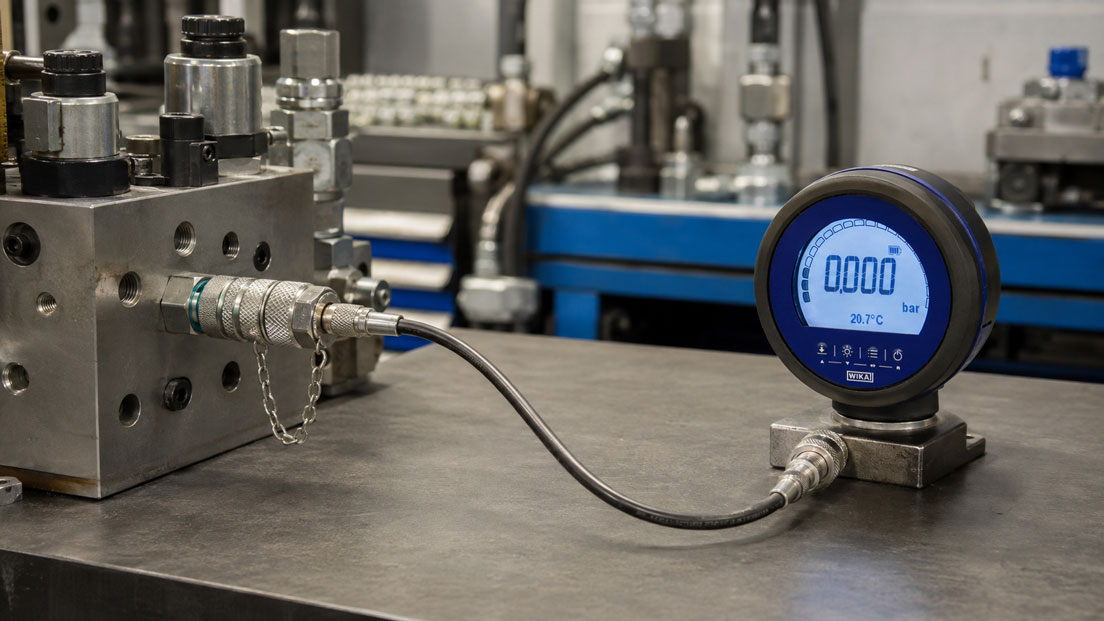
MINIMESS® test hoses enable rapid pressure measurements on hydraulic systems, mobile machinery and test benches. They connect a permanently installed test point to a pressure gauge, pressure sensor or portable measuring system without requiring a process fitting to be opened.
The small nominal diameter and low internal volume reduce fluid loss during connection and disconnection. Nevertheless, the hose is still exposed to high pressure. An incorrect pressure rating, an excessively tight bend radius, damaged fittings or an aged hose can cause leaks, a hazardous fluid jet or uncontrolled hose movement.
Before every measurement, it is therefore not sufficient to check only the measuring range and connection of the measuring instrument. The complete assembly consisting of the test point, mating coupling, hose, fittings, adapters and measuring instrument must be suitable for the pressure, temperature, medium and dynamic load.
Assembled hose lines can be found in the MINIMESS® hoses section. Suitable test points, couplings, adapters and additional accessories are grouped together in the MINIMESS® couplings and hoses category.
Contents
- How is a MINIMESS® test hose constructed?
- Distinguishing between operating pressure and burst pressure
- Considering pressure spikes and impulse loading
- Assessing temperature and medium together
- Avoiding tight bend radii, kinks and torsion
- Inspecting fittings and transition points
- How does hazardous hose whip occur?
- Connecting the test hose safely
- Fully releasing the pressure before disconnection
- Systematically inspecting the test hose
- Defining inspection and replacement intervals
- Correctly storing and marking hoses
- Typical errors during use
- Practical example: Damaged test hose on a construction machine
- Which products are suitable?
- Conclusion
- Frequently asked questions
How is a MINIMESS® test hose constructed?
A MINIMESS® test hose consists of a pressure-bearing microbore hose and permanently installed end fittings. Different hose materials, outer covers, nominal diameters and connection variants are available depending on the application.
Typical nominal diameters are:
- DN2: very low internal volume, compact routing and high available pressure ratings,
- DN4: higher flow rate and lower flow resistance for filling, venting or service tasks.
The hose normally connects a MINIMESS® test coupling to a pressure gauge, pressure sensor or portable measuring instrument. When the mating coupling is screwed on, the valve inside the test point is opened mechanically and the system pressure enters the measuring hose.
The small internal diameter limits the volume of escaping fluid. However, it does not eliminate the high pressure or the stored energy within the connected test assembly.
Distinguishing between operating pressure and burst pressure
The permissible operating pressure is the pressure for which the hose assembly is designed under the specified operating conditions. The burst pressure, by contrast, describes a mechanical failure limit under defined test conditions.
The burst pressure must never be used as an additional operating reserve. A hose must also not be operated regularly above its operating pressure merely because it withstood a higher pressure during a one-off test.
The following applies to the complete measuring assembly:
Maximum operating pressure of the measuring chain = lowest permissible pressure of all components
The following must be considered:
- hose material and nominal diameter,
- both hose fittings,
- test point and mating coupling,
- intermediate adapters and reducers,
- pressure gauge or pressure sensor,
- any shut-off and venting valves.
A DN2 hose with a high pressure rating does not automatically make the complete assembly suitable for high pressure if the connected adapter or measuring instrument is approved only for a lower pressure.
Considering pressure spikes and impulse loading
The nominal pressure stated on the type plate of a hydraulic system does not necessarily represent the highest pressure that actually occurs. Fast-switching valves, cylinder end stops, accumulators, pump pulsations or sudden load changes can generate short-term pressure spikes.
These impulses repeatedly load the hose, fittings and connections. A hose can therefore fail prematurely even if the static pressure appears unremarkable.
The following questions should be clarified before selecting the hose:
- What is the normal operating pressure?
- What pressure spikes have been measured or calculated?
- How frequently do load changes occur?
- Is the specified pressure rating valid for static or dynamic operation?
- Will the hose remain connected permanently or only be used temporarily?
The measuring dynamics must also be considered when diagnosing rapid pressure spikes. Long microbore hoses and trapped air can attenuate or delay short pressure events.
Assessing temperature and medium together
The permissible pressure rating applies only within the temperature and media limits specified for the relevant hose version. High temperatures can soften the hose material, accelerate ageing and reduce the permissible pressure load.
The medium also affects suitability. The following must be checked in particular:
- mineral oil or synthetic hydraulic oil,
- water-glycol mixtures,
- fuels or aggressive liquids,
- cleaning and flushing media,
- air or other gases.
The hose, inner liner, seals and fittings must all be resistant to the medium. An FKM seal, for example, may be suitable for a medium while the actual hose material is not approved for it.
Hot surfaces must also be considered. A hose with the correct pressure rating can still be damaged if it rests against an exhaust pipe, engine block or hot process line during measurement.
Avoiding tight bend radii, kinks and torsion
Every hose has a permissible minimum bend radius. If this is exceeded, the internal pressure channel becomes deformed and the pressure-bearing structure is subjected to local overloading.
The following are particularly critical:
- tight loops directly behind the fitting,
- permanent kinks,
- crushing by doors or covers,
- driving over or trapping the hose,
- twisting while the coupling is being screwed on,
- tensile loading caused by a freely suspended measuring instrument.
The hose should be routed in a natural curve. During connection, care must be taken to ensure that the hose does not rotate with the coupling. A heavy digital pressure gauge or data logger must be supported and must not hang from the hose.
An anti-kink spring can reduce the load at the transition to the fitting. However, it does not replace correct hose routing and does not make an already kinked hose safe again.
Inspecting fittings and transition points
Failures frequently occur in the transition area between the flexible hose and the rigid fitting. Bending, tensile forces and torsion are particularly high at this point.
The following must be checked before use:
- secure seating of the end fittings,
- no visible movement of the hose inside the fitting,
- no corrosion, cracks or deformation,
- clean and undamaged connection threads,
- intact sealing surfaces and seals,
- no traces of leakage around the crimped or screwed connection,
- freely moving union nuts or couplings.
A leaking or loose fitting must not be recrimped, bonded or temporarily repaired using a hose clamp. The complete hose assembly must be replaced.
How does hazardous hose whip occur?
If a pressurised hose is disconnected or a fitting tears off, the escaping medium can generate a recoil force. The hose can then move uncontrollably and strike people or components.
The low internal volume of a MINIMESS® microbore hose reduces the stored fluid volume compared with a large hydraulic hose. Hose whip is nevertheless possible, particularly if:
- the hose is long,
- a larger measuring instrument is attached to its end,
- gas or trapped air has been compressed,
- the system pressure is very high,
- the fitting fails suddenly,
- the hose is under tension.
During measurement, the hose should therefore not be routed through traffic routes or work areas. Where the risk is increased, suitable guards, restraints or hose-whip protection devices must be provided.
Leaks in high-pressure hoses must never be located by hand. A fine hydraulic-fluid jet can penetrate the skin and cause serious injuries.
Connecting the test hose safely
Even if a MINIMESS® coupling is designed for connection under system pressure, the work must still be carried out in a controlled manner.
- Clearly identify the system and measuring point.
- Check the maximum pressure, medium and temperature.
- Check the pressure rating of all components.
- Visually inspect the hose and fittings.
- Secure the measuring instrument and select a suitable measuring range.
- Remove the protective cap from the test point and clean the connection.
- Screw on the mating coupling straight and without cross-threading.
- Ensure that the hose does not become twisted.
- Apply the pressure to the measuring assembly slowly or in a controlled manner.
- Check the connections for leaks from a safe distance.
Wherever possible, the measuring instrument should already be connected to the hose before the test point is opened. Open hose ends must not be exposed to system pressure in an uncontrolled manner.
Fully releasing the pressure before disconnection
After the MINIMESS® test point has closed, pressure may remain trapped between the coupling, hose and measuring instrument. The local pressure gauge may therefore continue to indicate a value even though the process side has already been isolated.
The following must be clarified before disconnection:
- Has the process pressure been safely isolated?
- Can the fluid trapped inside the hose be released in a controlled manner?
- Where will the medium be discharged?
- Is the temperature of the medium safe?
- Is the measuring instrument mechanically supported?
In an assembly with a venting or drain valve, the residual pressure is released into a suitable container or return line. The measuring instrument and hose may only be disconnected once it has been confirmed that no pressure remains.
A connection must not be forcibly loosened if it is difficult to move while pressurised. Escaping medium, a coupling that suddenly releases or unexpected hose movement can cause serious injuries.
Systematically inspecting the test hose
A brief visual inspection should be carried out before every use. Recurring documented inspections must also be performed in accordance with the company’s inspection plan.
| Inspection area | Replacement criterion |
|---|---|
| Outer cover | Cracks, cuts, abrasion, blisters, severe discolouration or melted areas |
| Hose shape | Kinks, crushing, flattening or permanent deformation |
| Fittings | Corrosion, cracks, loose connection, deformation or leakage |
| Hose/fitting transition | Expansion, slipping out or visible material separation |
| Connection thread | Damaged threads, stiff connection or damaged sealing surface |
| Marking | Pressure rating, type or manufacturing date can no longer be identified clearly |
| Function | Unusual movement, pressure loss or visible fluid leakage |
An externally fault-free condition is not reliable proof that the hose assembly can still withstand its full internal load. Age, operating conditions and previous pressure exposure must also be considered.
Defining inspection and replacement intervals
A single replacement date for all MINIMESS® test hoses is not appropriate. The hose material, pressure rating, temperature, pressure impulses, storage conditions and frequency of use can differ considerably.
The operator should define the following for each hose type:
- inspection before every use,
- interval for documented recurring inspections,
- latest permissible replacement date,
- shorter intervals under severe operating conditions,
- immediate replacement if defects are detected.
Severe operating conditions include, for example:
- frequent pressure impulses,
- high temperatures,
- moving or vibrating installation,
- contact with chemicals,
- frequent connection and disconnection,
- outdoor use or UV exposure,
- an increased hazard in the event of hose failure.
The manufacturing date, commissioning date, inspections and replacement must be documented traceably. A hose of unknown age should not continue to be used solely because its external condition appears satisfactory.
Correctly storing and marking hoses
Unused test hoses should be stored in a clean, dry location protected from direct sunlight. Heat, ozone, aggressive vapours and mechanical deformation accelerate ageing.
Suitable storage conditions include:
- no permanently tight coils,
- no heavy objects placed on the hose,
- protective caps fitted to all open connections,
- contaminated hoses stored separately,
- protection from sources of sparks, UV radiation and heaters,
- clear marking of the pressure rating, medium and coupling series.
Colour coding can help prevent confusion. However, it does not replace legible technical marking and comparison with the inspection plan.
Typical errors during use
| Error | Possible consequence | Correct measure |
|---|---|---|
| Hose selected only according to the nominal system pressure | Pressure spikes exceed the permissible load | Assess the maximum and impulse pressures |
| Burst pressure used as an operating reserve | Premature damage or hose rupture | Use only the permissible operating pressure |
| Measuring instrument suspended freely from the hose | Tensile and bending loads on the fitting | Support the measuring instrument separately |
| Hose kinked directly behind the fitting | Local overloading and restriction of the internal diameter | Observe the minimum bend radius |
| Hose twisted while being connected | Torsional damage and premature ageing | Prevent the hose from rotating during connection |
| Residual pressure not released before disconnection | Fluid leakage and uncontrolled hose movement | Release the pressure from the measuring line in a controlled manner |
| Damaged hose repaired temporarily | Unpredictable failure under pressure | Replace the complete hose assembly |
| Age and inspection status unknown | Internal ageing is not taken into account | Remove the hose from service and assess or replace it |
Practical example: Damaged test hose on a construction machine
During troubleshooting on a mobile excavator, the pump pressure is to be measured through an existing MINIMESS® test point. The test hose stored in the service case has already been used for several years. The commissioning date is not clearly marked.
Before connection, a flattened abrasion point is noticed close to the end fitting. The outer cover is thinner at this point and the hose remains permanently deformed after bending. The union nut is also difficult to turn.
The technician does not continue using the hose. A correctly assembled replacement hose with a suitable pressure rating is installed and the digital pressure gauge is secured in a holder.
The subsequent inspection reveals that the old hose had regularly been trapped between tools and the lid of the service case. A separate holder with a large winding radius is therefore provided for the new hose.
All test hoses inside the service case are then marked with their commissioning date, pressure rating and next inspection date. The case demonstrates that a brief visual inspection before measurement can prevent a possible hose rupture.
Which products are suitable?
MINIMESS® hoses
The MINIMESS® hoses category includes configurable DN2 and DN4 microbore hose assemblies.
Depending on the version, the hose material, length, pressure rating, end fittings and protective components can be adapted to the application. At least the following information should be provided when ordering:
- maximum operating pressure and pressure spikes,
- medium and temperature,
- required nominal diameter,
- hose length,
- coupling series and connection thread,
- connection for the measuring instrument,
- required anti-kink, abrasion or heat protection.
MINIMESS® couplings and accessories
The MINIMESS® couplings and hoses section includes test points from the 1215, 1615, 1620 and 1604 series as well as adapters, protective caps and accessories.
The test point, mating coupling and hose connection must use the same compatible interface. Similar-looking couplings with different threads or valve geometries must not be forced together.
Conclusion: The test hose is a safety-relevant part of the measuring chain
A MINIMESS® test hose simplifies pressure measurement and reduces fluid loss when pressure gauges and sensors are connected temporarily. However, its compact dimensions must not lead to the mechanical and hydraulic load being underestimated.
The permissible operating pressure is determined by the weakest component in the complete measuring chain. Burst pressure, pressure spikes, temperature and media compatibility must be assessed separately.
Kinks, torsion, abrasion and damaged fittings are clear replacement criteria. Before disconnection, any residual pressure trapped inside the hose and measuring instrument must also be released in a controlled manner.
Visual inspection before every use, documented inspection intervals, clear marking and timely replacement prevent an inconspicuous service hose from becoming a safety risk.
Frequently asked questions about MINIMESS® test hoses
What pressure can a MINIMESS® hose withstand?
This depends on the nominal diameter, hose material and version. The pressure ratings of the fittings, adapters and measuring instrument must also be taken into account. The lowest permissible operating pressure within the complete measuring chain is always decisive.
Is the burst pressure a permissible pressure reserve?
No. The burst pressure is not a permissible operating limit. The hose may only be used up to the operating pressure specified for the particular version.
May a damaged test hose be repaired?
A damaged hose assembly must not be bonded, recrimped or reassembled from used components. It must be replaced completely.
Can a MINIMESS® hose be disconnected under pressure?
Depending on the version, the coupling technology is designed for connection under system pressure. Nevertheless, residual pressure may remain trapped inside the hose and measuring instrument. This pressure must be released in a controlled manner before complete disassembly.
How often must a test hose be inspected?
A visual inspection should be carried out before every use. The interval for documented inspections is defined according to the risk assessment, manufacturer specifications and actual operating conditions.
When must a test hose be replaced?
Immediately if cracks, kinks, abrasion, deformation, leaks, damaged fittings or an unclear pressure rating are found. A documented maximum replacement interval must also be defined.
Why must the minimum bend radius not be exceeded?
An excessively tight bend deforms the internal pressure channel and overloads the pressure-bearing structure. A bend directly behind the fitting is particularly critical.
Can a microbore hose cause hose whip?
Yes. The low internal volume reduces the stored fluid quantity, but it does not prevent uncontrolled movement if the hose or a fitting fails.