


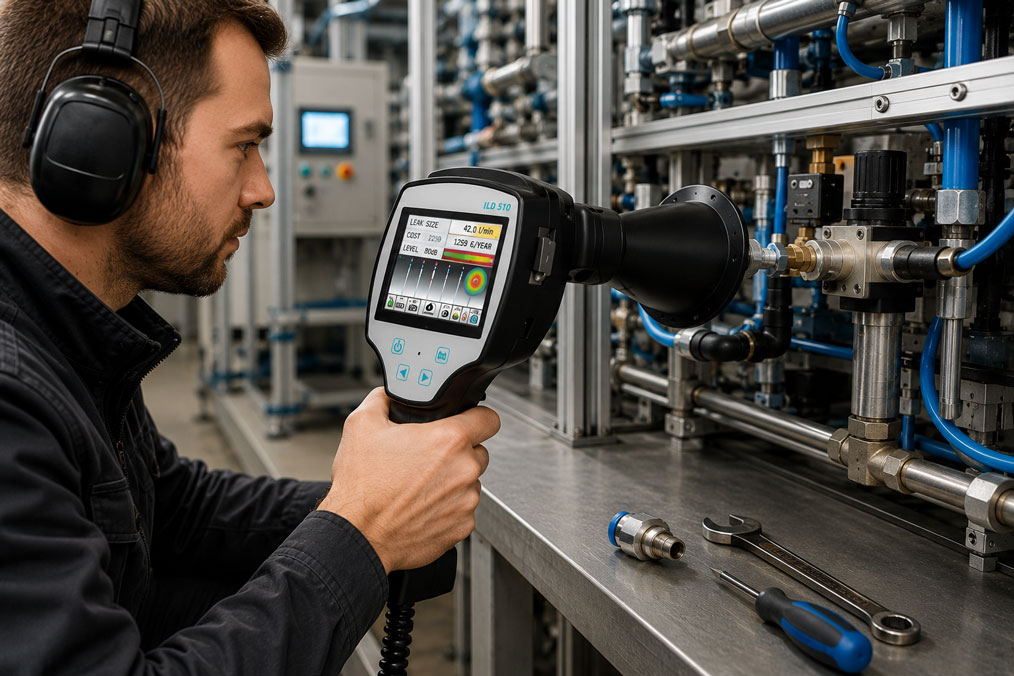
A compressed-air leak was located using an ultrasonic instrument, marked and subsequently repaired. During the follow-up inspection, the typical ultrasonic noise is barely audible. Does this mean that the repair has been successfully completed?
For maintenance purposes alone, such a statement may initially be sufficient. For energy management, prioritisation and a reliable before-and-after documentation, however, it should be assessed more precisely how large the original leak was, what residual leakage remains after the repair and what actual savings potential results from it.
Leak detection alone only answers the question of where compressed air is being lost. Only a quantitative assessment in l/min or m³/h and its correlation with operating hours and internal compressed-air costs shows how economically relevant the leak actually is.
Suitable instruments for detection and quantification can be found under Leak Detection / Leakage Measuring Instruments. Further measurement technology for evaluating compressed-air systems is grouped under Compressed-Air Quality.
Table of Contents
- Why is leak detection alone not sufficient?
- What does the leakage rate in l/min mean?
- Measuring before and after repair under comparable conditions
- Why is operating pressure so important?
- Correctly considering distance and ambient noise
- Calculating savings from leakage rate, operating hours and costs
- Prioritising leaks economically
- Correctly verifying the repair
- Documenting photos, identification and measurement data
- Using leakage reports in energy management
- Practical example: Before-and-after comparison
- Which leakage measuring instruments are suitable?
- Conclusion
- Frequently asked questions
Why is leak detection alone not sufficient?
Ultrasonic leak detectors are ideally suited for finding escaping compressed air during ongoing production. Gas flowing through a small opening generates turbulent flow components and therefore ultrasound that can be detected by the measuring instrument.
This makes it possible to determine, for example, whether a push-in fitting, hose, valve or air preparation unit is leaking. For maintenance purposes, the location is therefore known.
However, two equally noticeable leaks can have completely different energy-related consequences. A small loss of only a few litres per minute on a machine that operates for just 500 hours per year must be assessed differently from a larger leak in a main network that remains permanently pressurised.
A meaningful leakage assessment therefore requires at least three pieces of information: the leakage volume, the time during which the leak is actually under pressure and a reliable cost rate for generating the compressed air.
Only then can a meaningful repair priority be established.
What does the leakage rate in l/min mean?
Modern ultrasonic leakage measuring instruments can estimate the leakage volume based on the recorded ultrasonic signal and the configured or measured conditions. It is often stated in litres per minute.
This turns the qualitative statement “there is a leak here” into a quantitative statement such as “estimated leakage rate 38 l/min”.
This quantification is particularly useful for prioritisation and documentation. However, it should not be confused with a direct flow measurement in a closed pipeline. With the ultrasonic method, the leakage volume is derived from the acoustic behaviour of the escaping compressed air.
Reproducible measurement conditions are therefore particularly important. A before-and-after comparison is only meaningful if pressure, distance or measurement geometry are not changed significantly at the same time.
Measuring before and after repair under comparable conditions
The most important rule when verifying a repair is: the follow-up measurement should, as far as possible, be performed under the same conditions as the original measurement.
| Measurement Condition | Document Before Repair | Observe During Follow-Up Measurement |
|---|---|---|
| Operating pressure | Pressure at the machine or in the network | Restore approximately the same pressure |
| Measurement distance | Distance between sensor and leak | Use a similar measurement position |
| Sensor / accessories | Horn, directional tube, parabolic reflector or ultrasonic camera | Use the same measuring principle or accessories |
| Machine condition | Production, standstill, valve position | Reproduce the same operating condition |
| Ambient noise | Consider interference sources in the surroundings | Select comparable surroundings where possible |
| Measurement point | Photo, equipment identification and component | Check exactly the same location |
This prevents a typical error: before the repair, the measurement is performed at 7 bar, while after the repair it is carried out at only 4.5 bar. The significantly lower ultrasonic intensity would then be partly caused by the lower operating pressure and not solely by the repair.
For a reliable assessment, not only the two leakage rates but also the corresponding measurement conditions should therefore be stored.
Why is operating pressure so important?
The leakage volume through an opening depends strongly on the pressure difference between the compressed-air system and the surrounding atmosphere. A leaking fitting loses more air at a higher operating pressure than at a lower pressure.
Operating pressure therefore influences both the actual leakage and the generated ultrasonic signal.
A simple before-and-after comparison without a pressure value can therefore be misleading.
For recurring leakage audits, it is useful to define a system condition that is as comparable as possible. For example, it may be agreed that leaks are evaluated during normal production operation at a typical network pressure of approximately 6.5 bar.
This does not mean that the pressure must be exactly identical at every measuring point. However, larger deviations should be documented and taken into account during interpretation.
Correctly considering distance and ambient noise
The position of the measuring instrument also influences ultrasonic measurement. As the distance increases, the sound energy reaching the sensor decreases. Instruments with integrated laser distance measurement can therefore include the distance to the leak in the quantification.
In a production hall, numerous other ultrasonic sources may also be present. Pneumatic valves, open compressed-air nozzles, bearings, electrical components or neighbouring leaks can overlap the signal.
Automatic sensitivity adjustment helps adapt the measurement to the current environment. Nevertheless, the operator should verify whether the marked leak is actually being detected and not a stronger neighbouring source.
This is especially important when pneumatic components are installed close together. A directional probe or acoustic camera can make the assignment more reliable in such situations.
For a before-and-after comparison, the measurement should be performed from a similar position wherever possible. If the initial measurement is taken from two metres away and the follow-up measurement directly from ten centimetres away, the two results are only comparable to a limited extent.
Calculating savings from leakage rate, operating hours and costs
The leakage rate alone does not indicate how expensive a leak actually is. It is also necessary to consider how long the respective line remains pressurised during the year.
The annual compressed-air loss can first be calculated from the leakage rate:
Annual loss [m³/year] = Leakage rate [l/min] × 60 / 1000 × Operating hours [h/year]
For a leak of 40 l/min and 6,000 pressurised operating hours per year, for example:
40 × 60 / 1000 × 6,000 = 14,400 m³ of compressed air per year
An internal compressed-air cost rate is then required for the cost calculation.
The most meaningful value is one derived from the company’s own system. The electrical power consumption of the compressor station, generated compressed-air volume and electricity costs can be correlated for this purpose. For a simpler assessment, an internally defined cost rate in €/m³ can also be used.
Annual leakage costs = Annual loss [m³/year] × Compressed-air costs [€/m³]
A general value taken from the internet is less suitable for a reliable savings calculation because compressor type, network pressure, air treatment, part-load operation and electricity prices differ from system to system.
Prioritising leaks economically
During a larger compressed-air audit, it is common to find not five but several hundred leaks. Repairing them simply in the order in which they were discovered is rarely the most efficient approach.
A quantified leakage rate allows an economic priority order to be established.
An easily accessible push-in fitting with a high loss and only a few minutes of repair effort should, for example, receive a high priority. A small leak deep inside a machine that would require several hours of production downtime may be assessed differently.
This creates a connection between maintenance effort and energy-related benefit.
The cost value should therefore not be understood only as a theoretical euro amount. Its primary purpose is to make leaks comparable with one another and to enable repair measures to be planned sensibly.
Correctly verifying the repair
After the repair, the system should first be returned to its normal operating condition. Pressure and valve positions should stabilise before the measurement is repeated.
The previously documented measuring point is then checked again.
Ideally, a quantitative measurement is performed again. If, for example, a leakage rate of 52 l/min was determined before the repair and only 1.5 l/min afterwards, the savings can be calculated from the difference.
If no ultrasonic signal can be detected at all after the repair, the report should not automatically state “leakage rate 0.000 l/min”.
A technically more appropriate formulation is:
“Under the documented test conditions, no residual leakage was detectable using the applied measuring method.”
This avoids interpreting the detection limit of the measuring method as a physically exact leak-free connection.
In addition, the original point should not be the only location checked. With hose connections or pneumatic assemblies, a repair can alter mechanical forces and cause a new leak directly adjacent to the repaired point.
Documenting photos, identification and measurement data
The quality of a leakage audit depends not only on the measurement itself. It is equally important that maintenance personnel can later identify the leak unambiguously.
A meaningful data record should therefore include a unique leakage ID, plant or machine designation, exact position, photo of the leak, original leakage rate, operating pressure, required repair and responsible department.
After the repair, the same data record is supplemented with the repair date, follow-up measurement, remaining leakage rate or result of the verification measurement and the status “repaired”.
This makes it possible to trace which savings are actually attributable to a specific maintenance measure.
A simple spreadsheet containing entries such as “Hall 2 – leak repaired” is far less suitable for this purpose than image-supported documentation with clear assignment to the measuring point.
Using leakage reports in energy management
In an energy management system, it is not only important that measures have been implemented. Wherever possible, it should also be traceable how these measures contribute to improving energy performance.
A structured leakage report can be very useful for this purpose. It can combine, for example, the initial condition, identified leaks, priorities, repair status and the estimated savings resulting from the measures.
Repeatable key figures are particularly useful for evaluation. These can include the total leakage volume identified during an audit, the amount already eliminated through repairs and the resulting annual energy or cost savings.
If such audits are carried out regularly, a historical record is also created. This makes it possible to determine whether the leakage rate of the compressed-air system is actually decreasing in the long term or whether it starts rising again continuously after a repair campaign.
Such a report can support documentation within an energy management system according to ISO 50001. However, it does not replace the other requirements of an energy management system and does not constitute certification on its own.
Practical example: Before-and-after comparison
During a leakage audit, a leak is detected at a push-in fitting on a pneumatic air preparation unit. Under the documented operating conditions, the ultrasonic leakage measuring instrument determines a leakage rate of 42 l/min.
The respective production line remains pressurised for approximately 6,000 hours per year. In this example, the internally determined compressed-air cost rate for the system is €0.03/m³.
After the fitting has been replaced, the measuring point is checked again under almost identical conditions. The remaining leakage rate is assessed at 1.5 l/min.
| Assessment Parameter | Before Repair | After Repair |
|---|---|---|
| Leakage rate | 42 l/min | 1.5 l/min |
| Operating pressure | 6.5 bar | 6.5 bar |
| Difference | 40.5 l/min | |
| Compressed air saved per hour | 2.43 m³/h | |
| Operating hours | 6,000 h/year | |
| Compressed air saved per year | 14,580 m³/year | |
| Example internal compressed-air cost rate | €0.03/m³ | |
| Calculated cost savings | €437.40/year | |
The economic benefit can therefore be demonstrated far more clearly than by simply stating “the fitting was leaking and was repaired”.
For an even more reliable energy-related verification, the actual measured specific energy consumption of the compressor station can be used instead of a general compressed-air cost rate.
The saved compressed-air volume can then also be converted into electrical energy savings in kWh per year.
Which leakage measuring instruments are suitable?
ILD 500 / ILD 510
The ILD 500/510 instruments are particularly suitable for a structured leakage campaign because detection, quantification and documentation can be combined in a single workflow.
The instrument can determine the leakage volume in l/min as well as the resulting savings potential in €/year. An integrated camera enables clear photographic documentation of the leaking component. In addition, the distance to the leak can be measured automatically by laser, making the leakage-rate calculation more reproducible.
The recorded data sets can subsequently be processed further in CS Leak Reporter. There, leaks can be prioritised according to cost or savings potential and repair status can be documented.
UltraCam for ILD 500 / ILD 510
In complex machine areas with several neighbouring ultrasonic sources, the UltraCam can simplify localisation. It uses a microphone array to visualise the ultrasonic field and overlays the calculated ultrasonic information on the camera image.
This makes it easier, especially over longer distances or when pneumatic components are installed close together, to identify which location is actually causing the dominant leak.
LeakCam 600
The LeakCam 600 is also suitable for extensive leakage audits. Its larger ultrasonic microphone array can visualise several leaks simultaneously. This is particularly useful in large compressed-air installations because larger plant areas can first be surveyed quickly before individual leaks are quantified.
It also provides an estimate of leakage volume, annual costs and laser distance measurement. The measurement data can then be transferred to the corresponding Leak Reporter environment and documented.
Suitable instruments and accessories can be found under Leak Detection / Leakage Measuring Instruments.
ICS Schneider Messtechnik provides support in selecting ultrasonic leakage measuring instruments and in designing a traceable leakage detection process for maintenance and energy management.
Conclusion
A successful compressed-air leakage campaign does not end when the leaking point has been found.
Only a quantitative leakage rate shows which leaks are particularly relevant from an economic perspective. Together with the actual operating hours, the annual volume of compressed air lost can be determined.
For economic assessment, an internal compressed-air cost rate should be used wherever possible. The analysis becomes even more meaningful if the specific electrical energy consumption of the company’s own compressor station is known.
The before-and-after comparison should be performed under conditions that are as similar as possible. Operating pressure, measurement distance, sensor or accessories and machine condition should be documented.
After the repair, the original measuring point must be checked again. If no leakage is detected, it is better to document “not detectable under the test conditions” rather than claim a physically exact leakage rate of zero.
Photos, plant identification, original leakage rate, repair status and follow-up measurement ultimately create a traceable connection between the maintenance measure and the energy savings achieved.
This turns conventional leak detection into a measurable improvement process for maintenance and energy management.
Frequently asked questions about evaluating compressed-air leaks
Can an ultrasonic instrument measure the leakage rate in l/min?
Suitable instruments can estimate the leakage volume based on the ultrasonic signal and the measurement conditions and display it in l/min or cfm. For a reproducible comparison, pressure, distance and measurement geometry should be taken into account.
Why should operating pressure be documented?
The actual leakage volume depends on the pressure difference between the compressed-air system and the surrounding atmosphere. A comparison at significantly different pressures can therefore lead to incorrect conclusions.
How do I calculate the annual compressed-air volume lost through a leak?
The leakage rate in l/min is first converted into m³/h and then multiplied by the annual number of hours during which the respective line is actually pressurised.
Should I always calculate with 8,760 hours per year?
No. Only a system that remains continuously pressurised would theoretically reach 8,760 hours per year. For machines that are depressurised at night or on weekends, the actual pressurised operating hours should be used.
How do I calculate the cost of a compressed-air leak?
The simplest method is to multiply the annual lost compressed-air volume by an internally determined cost rate in €/m³. For an energy-related assessment, the specific electrical energy consumption of compressed-air generation can additionally be taken into account.
Can I measure from different distances before and after the repair?
This is possible for simple follow-up localisation. For a quantitative before-and-after comparison, however, measurement distance and geometry should be as similar as possible or taken into account by means of distance measurement.
What should be documented after a successful repair?
At minimum, a leakage ID, photo, plant location, operating pressure, leakage rate before repair, repair date and result of the follow-up measurement are useful.
Does a leak that is no longer measurable automatically mean the connection is completely leak-free?
Not necessarily. It initially means that the leakage lies below what can be detected under the respective test conditions using the applied measuring method. The wording “no residual leakage detectable” is therefore technically more appropriate than simply stating a leakage rate of zero.
Can a leakage report be used for ISO 50001?
Yes. A structured leakage report can support the documentation of energy-saving measures and their results within an energy management system. However, the report alone does not constitute ISO 50001 certification.