


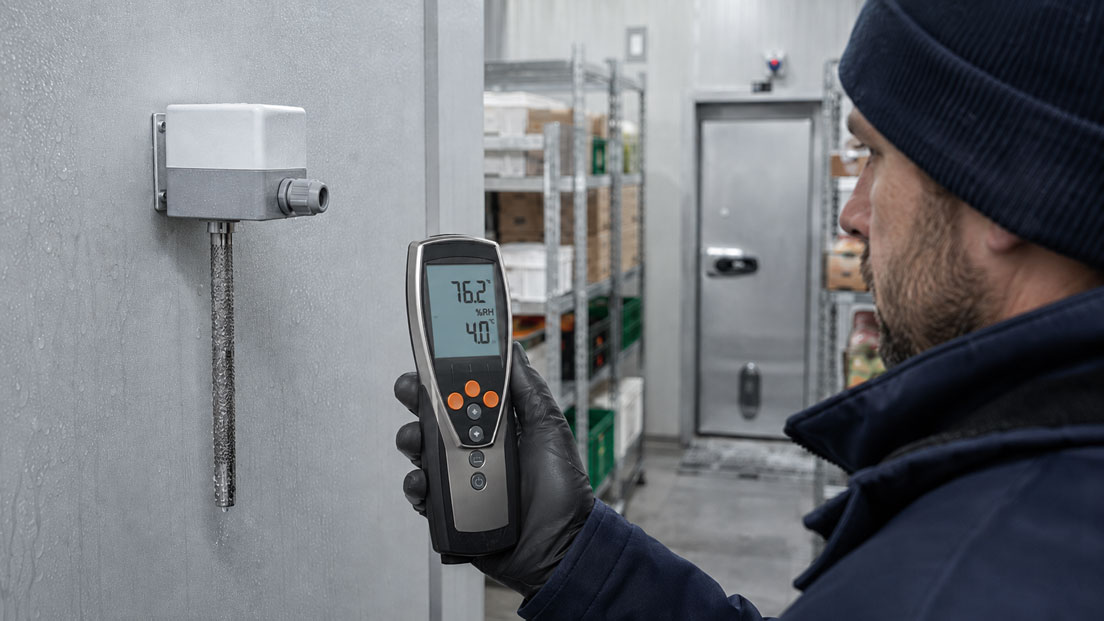
A humidity sensor has been continuously indicating 100% RH since a temperature change. The cold room is now dry again and other measuring instruments show normal values – yet the permanently installed sensor remains significantly too high for hours. Is the sensing element damaged, or does it simply need more time to dry?
This behaviour is not unusual in humidity measurements following condensation. As soon as water condenses directly on the sensing element, protective filter or inside the probe head, the sensor is no longer measuring only the water vapour in the surrounding air. A liquid film can saturate the humidity sensing element and cause the output to remain close to 100% relative humidity for an extended period even after the ambient conditions have changed.
This does not automatically mean that the sensor is defective. The decisive factor is whether the measured value returns reproducibly to normal after sufficient drying or whether a permanent deviation, unusually slow response or unstable indication remains.
Suitable sensors and measuring instruments can be found under Humidity measuring instruments / humidity sensors. Process and dew point sensors are grouped under Humidity sensors / dew point sensors.
Table of Contents
- What happens when condensation forms on a humidity sensor?
- Why does the sensor remain at 100% RH for so long?
- How long may the recovery time take?
- What role does the protective filter play?
- Recovery time or permanent drift?
- Why are salt and dust particularly critical?
- Preventing condensation through sufficient dew point margin
- Choosing the correct installation position and measuring point
- When does sensor or probe heating help?
- Drying the sensor correctly after condensation
- Functional check after condensation
- When should the sensor be replaced?
- Practical example from a cold room
- Which sensors are suitable?
- Conclusion
- Frequently asked questions
What happens when condensation forms on a humidity sensor?
A relative humidity sensor is fundamentally intended to evaluate the water vapour content of the air in relation to the current temperature. In a capacitive humidity sensor, the absorption of water molecules into a hygroscopic sensing layer changes its electrical properties. The relative humidity is calculated from this change.
This normal measuring process must not be confused with direct wetting.
If the temperature of the sensing element reaches or falls below the dew point, liquid water can condense on the sensor. Instead of being in equilibrium with the water vapour, a film of water is then present directly on the sensing element.
The sensor is therefore outside its normal dry measuring condition. The measured value often rises to approximately 100% RH and remains there as long as the sensing element or surrounding filter is still wet.
This occurs particularly frequently during rapid temperature changes. If, for example, a cold sensor from a cold room is exposed to warm, humid air, its surface may remain significantly colder than the surroundings for several minutes. Even though the air itself is not saturated, the sensor temperature may be below the dew point and condensation can form.
Why does the sensor remain at 100% RH for so long?
Once the environment has become drier again, the water does not disappear from the sensor immediately. The liquid film must first evaporate. At the same time, the filter cap, sensor protection and, where applicable, adjacent materials must dry out.
This creates an important difference between the actual room humidity and the local microclimate directly at the sensing element.
For example, the room air may already have returned to 65% RH. However, moisture may still be present in the porous filter of a sensor that was previously exposed to condensation. This water continues to evaporate directly at the sensing element. The sensor may therefore indicate substantially higher humidity values than a dry reference sensor positioned only a few centimetres away.
This behaviour is fundamentally plausible and should not immediately be interpreted as a calibration error.
It becomes critical if the sensor continues to measure permanently too high or too low even after it has completely dried.
How long may the recovery time take?
There is no universally applicable recovery time after condensation. It depends strongly on the sensor design and the ambient conditions.
An exposed sensing element in warm, dry, moving air can recover considerably faster than a sensor with a dense filter cap in an area with almost no air movement. If condensation has also entered the probe head, stabilisation may take considerably longer.
| Influence | Typical effect on recovery |
|---|---|
| Warm, dry air | Accelerates evaporation of the condensate |
| Good air movement | Often reduces drying time |
| Very high ambient humidity | Sensor dries only slowly |
| Wet or highly porous filter | Can retain moisture near the sensor for a long time |
| Water inside the probe head | Significantly longer stabilisation may be required |
| Heated sensing element | Can significantly accelerate recovery after condensation |
| Salt or dirt contamination | Measured value may remain distorted even after drying |
For this reason, a sensor should not be judged defective based on a fixed period of time. The trend is more important. If the measured value continuously decreases and approaches a plausible reference value, this initially indicates a normal drying process.
If, however, the value remains practically unchanged for a long time or stabilises with a significant deviation after drying, the sensor should be checked.
What role does the protective filter play?
The protective filter performs an important function. It keeps dust, particles and, depending on its design, droplets or other contaminants away from the sensitive sensing element.
After condensation, however, the filter itself can become a moisture reservoir.
A porous filter cap can absorb water or retain it within its structure. As a result, the air immediately surrounding the sensing element remains humid for longer than the actual process air.
A sensor may therefore appear to respond extremely slowly even though the sensing element itself is already largely functional again.
If recovery is unusually slow, the condition of the filter should therefore also be checked. A clogged, oily or heavily contaminated filter should be cleaned or replaced in accordance with the manufacturer’s instructions.
Continuing to operate the sensor completely without its intended protective filter is generally not a suitable solution. This may expose the sensing element directly to dust, spray mist or mechanical damage.
Recovery time or permanent drift?
A delayed return of the measured value is not yet considered drift.
Drift should rather be used to describe a permanent change in the sensor characteristic or measured value. For example, after complete stabilisation, a sensor may continuously indicate 56% RH in an environment that is actually approximately 50% RH.
A reference measurement is essential for distinguishing between the two cases.
A single comparison immediately after condensation is not sufficient. The sensor and reference instrument must first be operated for a sufficient period under the same stable temperature and humidity conditions.
Only then can it be determined whether the behaviour was merely caused by recovery time or whether a permanent offset has developed.
A check at several humidity points is even more informative. If, for example, the sensor still measures correctly at medium humidity but deviates significantly in the range of 80 to 90% RH, the sensor characteristic may have changed.
Why are salt and dust particularly critical?
Clean condensate is less problematic for many high-quality humidity sensing elements than contaminated water.
In industrial systems, however, a sensor is rarely exposed only to pure water. Dust, salts, aerosols, cleaning agents or process residues may be present on the filter and sensing element.
During condensation, water-soluble substances are dissolved. When the water subsequently evaporates, these substances remain behind.
Salts are particularly problematic because they are hygroscopic. This means they can absorb moisture from the surrounding environment. As a result, a local humidity load develops directly on the sensor that is no longer representative of the ambient air.
The typical result is a sensor that initially appears to function again after condensation but subsequently indicates values that are permanently slightly too high or responds much more slowly.
Repeated condensation cycles can also cause contaminants to become increasingly concentrated on the sensing element.
Preventing condensation through sufficient dew point margin
Relative humidity alone is not sufficient to assess the risk of condensation.
The decisive factor is whether the temperature of the sensing element or another surface is above or below the dew point of the surrounding air.
A measuring point may, for example, initially appear uncritical at 80% RH. However, if the probe head is several Kelvin colder than the air, its surface temperature may already have reached the dew point.
This is particularly relevant in cold rooms, outdoor air measuring points, air-conditioning ducts downstream of cooling coils and for sensors that are thermally coupled to a cold component through metallic process connections.
For critical applications, a sufficient temperature margin above the dew point should therefore be provided. The actual temperature of the probe head must be taken into account, not merely the air temperature measured at a remote location.
Choosing the correct installation position and measuring point
A sensor may be designed for high humidity and still regularly become wet due to an unfavourable installation position.
A typical example is a vertical pipe or duct from which condensation can run directly onto the filter cap. Droplets may also fall onto the sensor underneath a cooling coil or humidifier even though the average air humidity is still within the intended measuring range.
The measuring point should therefore be representative while avoiding direct exposure to dripping water wherever possible.
For outdoor measurements, it must also be ensured that rainwater or condensate cannot run along the cable directly towards the sensor or into a cable gland.
The permissible installation position depends on the specific sensor type and should be determined from the installation instructions.
When does sensor or probe heating help?
Active heating can be useful in applications involving continuously very high humidity or frequent temperature changes.
The sensing element or entire probe head is heated slightly so that its temperature remains above the dew point. This can prevent a film of water from forming on the sensor in the first place.
However, the technical implementation is more complex than simply heating a conventional humidity sensor. Relative humidity is temperature-dependent. If the sensor is heated, it locally measures a different relative humidity than the unheated process air.
Suitable systems therefore take the probe temperature and, where applicable, an additional ambient temperature into account in order to calculate the required process variable.
Installing an arbitrary external heater directly next to an existing humidity sensor is therefore not a suitable retrofit solution. Although it may prevent condensation, it can simultaneously introduce a significant systematic measurement error.
Drying the sensor correctly after condensation
Once condensation has been identified, the cause should first be eliminated. As long as the sensor remains below the dew point, genuine recovery cannot take place.
The probe should then be allowed to stabilise under clean, drier conditions that remain within the permissible operating conditions. Moderate air movement can support the drying process.
Improvised measures such as using a heat gun, oven, solvents or compressed air directly on the sensing element should be avoided unless explicitly approved by the manufacturer. Excessive temperatures or mechanical stress can damage the sensing layer, filter or electronics.
A heavily contaminated sensing element should likewise only be cleaned according to the manufacturer’s specified procedure.
If the filter is separately replaceable and remains visibly wet or contaminated, replacing the filter may be considerably more appropriate than aggressive cleaning.
Functional check after condensation
Once the sensor has fully stabilised, it should not be returned to service solely because the indication appears plausible.
A simple comparison with a known reference instrument is sufficient for many service applications. The sensor and reference should be positioned as close together as possible and given sufficient time to reach the same temperature.
| Observation after drying | Likely assessment | Recommended action |
|---|---|---|
| Measured value slowly approaches the reference and then remains stable | Normal recovery after condensation is likely | Continue monitoring and document the event |
| Constant offset compared with the reference | Possible drift or contamination | Calibration check or adjustment |
| Extremely slow response | Wet, contaminated or clogged filter possible | Check the filter and replace it if necessary |
| Highly fluctuating or implausible measured value | Moisture inside the probe head or an electrical problem possible | Take the sensor out of service and inspect it |
| No meaningful response to significant changes in humidity | Sensing element may be damaged | Consider recalibration or replacement |
For quality-critical or regulated processes, a documented calibration check should be carried out after a severe condensation event. Only this can determine whether the sensor still meets its specified accuracy.
When should the sensor be replaced?
A single condensation event does not automatically mean that the entire humidity sensor must be replaced.
If the sensor can recover completely and subsequently remains within the permissible deviation, there is little technical reason not to continue using it.
Replacement or recalibration becomes advisable if a reproducible deviation remains after sufficient drying, the response behaviour has deteriorated significantly or the output signal remains unstable.
Visible corrosion, liquid in the electronics area or recurring humidity errors despite dry conditions are also warning signs.
For sensors with replaceable sensing modules, it may be sufficient to replace only the sensing module or probe head. With other designs, the complete transmitter must be replaced or sent in for inspection.
The decisive factor is not whether the sensor has at some point indicated 100% RH, but whether it can reproducibly perform its specified measuring function again after the event.
Practical example from a cold room
In a cold room, the relative humidity is monitored using a permanently installed temperature/humidity sensor. During cleaning, the door remains open for an extended period. Warm, humid air from the surrounding hall enters the still-cold room.
At this point, the probe head has a temperature of only approximately 4 °C. The incoming air is significantly warmer and has a dew point above the sensor temperature. Condensation forms on the filter and probe.
The sensor rises to 100% RH.
After the door is closed, the cold room stabilises again. A portable reference instrument already indicates 76% RH, while the permanently installed sensor still remains at 98 to 100% RH.
Instead of immediately readjusting the sensor, condensation is first considered as a possible cause. The protective filter is visibly wet. After complete drying, the measured value slowly decreases over several hours and approaches the reference sensor value.
The following day, both instruments are compared again under stable conditions. The deviation is only approximately 1.5% RH and therefore remains within the defined tolerance.
An adjustment performed immediately after condensation would instead have introduced an error: the still-wet sensor would have been artificially corrected downwards and would have indicated values that were too low after complete drying.
Because the event may recur in the cold room, the sensor itself is not the only aspect considered. The measuring point is modified so that condensation cannot drip directly onto the filter cap. In addition, it is assessed whether a sensor type better suited to high humidity or condensation risk would be more appropriate for the application in the long term.
Which sensors are suitable?
IFG80 / ITFG80 for high-humidity environments
The IFG80 and ITFG80 are designed for measuring relative humidity or humidity and temperature in rooms and air ducts.
The Polyga® humidity sensing element used in these devices is characterised in particular by its robustness and suitability for high-humidity environments. This makes the series suitable, for example, for climate chambers, industrial halls, containers and indoor or outdoor areas in which continuously elevated humidity levels may occur.
Even with a sensor designed for high humidity, however, direct and continuous condensation should not be regarded as equivalent to normal humidity operation. A suitable installation location and protection against direct dripping water remain important.
IVC / IVR for harsh environmental conditions
The IVC and IVR compact sensors use a capacitive Mela® humidity sensing element in a robust stainless-steel housing with IP65 protection.
They are therefore particularly suitable for industrial applications in which mechanical robustness and a durable probe design are important.
However, the degree of protection of the housing must not be confused with unlimited resistance of the actual sensing element to condensation. The filter, process conditions and specified humidity range must also be taken into account.
IFA510 / IFA515 for dew point measurements
If the objective is not to measure the relative humidity of a room but rather the residual moisture or dew point in compressed air or gases, dedicated dew point sensors are the more appropriate solution.
Depending on the version, the IFA510 / IFA515 are intended for refrigeration or adsorption dryers. The sensing element is described as insensitive to condensation and is protected from direct contact with contaminated particles by a stainless-steel sintered cap.
These sensors are therefore particularly suitable for applications in which significantly higher humidity levels may occur temporarily, for example following a dryer malfunction.
Under Humidity measuring instruments / humidity sensors you will find additional sensors for room, duct and process applications. Dew point and process sensors are grouped under Humidity sensors / dew point sensors.
ICS Schneider Messtechnik supports you in selecting the appropriate humidity sensor, filter, measuring range and installation position, as well as with calibration and the assessment of critical high-humidity and condensation applications.
Conclusion
A humidity sensor that continues to indicate 100% RH for a long time after condensation is not automatically defective. Liquid water on the sensing element or in the protective filter can cause the probe to measure a highly humid local microclimate for a considerable period even after the surrounding conditions have changed.
How quickly the sensor recovers depends on the sensor design, filter, temperature, air movement and extent of condensation. There is therefore no universally applicable recovery time.
Condensation becomes more problematic when dust, salts or process residues are also present. After the water evaporates, hygroscopic deposits may remain and cause permanent drift or slower response behaviour.
The sensor should therefore only be assessed after it has completely dried. A subsequent comparison measurement with a suitable reference can then show whether it is once again operating within the permissible tolerance.
Adjustment immediately after condensation is risky, however, because a temporary moisture film may incorrectly be interpreted as a permanent sensor offset.
In applications where condensation occurs regularly, simply replacing the sensor is not sufficient. The measuring point, dew point margin, filter, installation position and, where appropriate, an actively heated measuring system or one specifically designed for high humidity must be considered together.
Frequently asked questions about humidity sensors after condensation
Is a humidity sensor defective if it gets wet?
Not automatically. Many sensor technologies can recover after a single condensation event. Whether the sensor can continue to be used should be assessed after complete drying by means of a comparison measurement or calibration check.
Why does the sensor still indicate 100% RH even though the room is dry?
Water may still be present on the sensing element or in the filter. This creates a substantially more humid microclimate directly at the sensor than in the surrounding environment.
How long does a humidity sensor need to dry?
There is no universal time period. Depending on the sensor, filter, temperature, air movement and amount of condensate, recovery may take anywhere from a relatively short period to several hours.
Should I recalibrate the sensor immediately after condensation?
No. It should first be allowed to dry completely and stabilise. Adjusting a sensor while it is still wet can subsequently result in an incorrect offset.
Can condensation cause permanent measurement errors?
Yes, particularly if the water leaves salts, dust or other contaminants on the sensing element. These can affect long-term stability and response behaviour.
Does a protective filter prevent condensation?
A filter protects against particles and, depending on its design, also against droplet ingress, but it does not necessarily prevent condensation caused by the sensor temperature falling below the dew point. In addition, a wet filter can extend the recovery time.
How can I identify permanent drift?
If the completely dry and stabilised sensor reproducibly deviates from a suitable reference instrument under the same conditions, a calibration check or recalibration should be carried out.
Why are heated humidity sensors helpful in high-humidity environments?
Controlled heating can keep the sensor temperature above the dew point, thereby preventing condensation or accelerating recovery. However, the temperature dependence of relative humidity must be taken into account by the measuring system.
When should a humidity sensor be replaced?
Replacement is advisable if an unacceptable and reproducible deviation remains after complete drying, the response behaviour has deteriorated significantly, the signal remains unstable or visible damage or corrosion is present.