


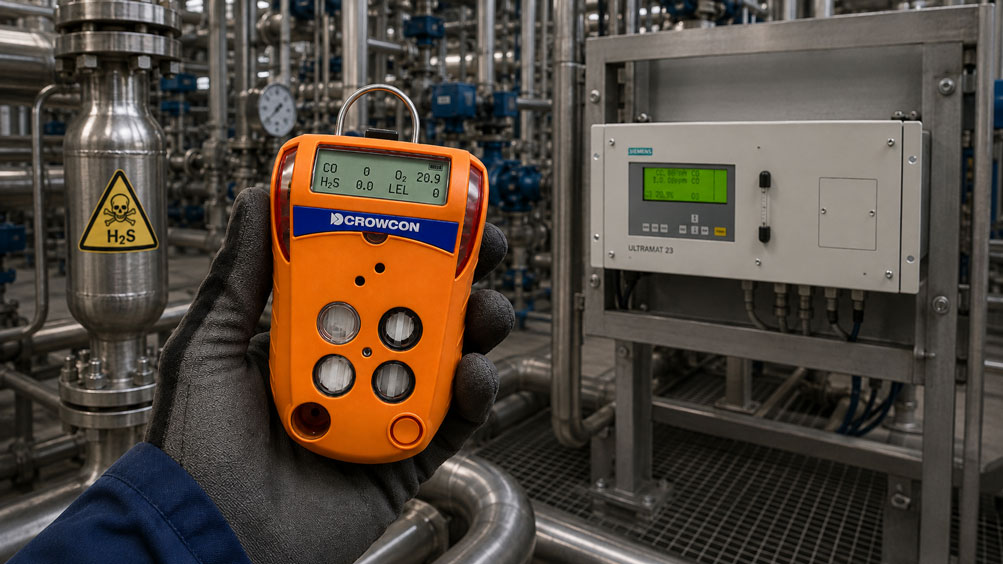
A portable gas detector suddenly triggers a CO alarm even though, according to the operator, there is no source of carbon monoxide in the work area. At the same time, hydrogen is being used in the plant. In another case, a toxic gas is actually present in the atmosphere, but the indicated measured value remains unexpectedly low.
Such situations can be caused by cross-sensitivity of the gas sensor being used. Electrochemical sensors in particular do not react exclusively to their intended target gas under all conditions. Depending on sensor chemistry, electrodes, filters and operating conditions, other gases can also generate a signal or influence the sensor’s response to the target gas.
Cross-sensitivity can therefore have different effects:
- false or premature alarms due to positive interference,
- excessively high concentration readings for the target gas,
- excessively low concentration readings due to negative interference,
- and, in the worst case, a partially masked actual gas hazard.
It is therefore particularly important that an unusual alarm is not simply reset as a “false alarm”. First, it must be determined which specific sensor is installed, which gases may occur in the application and which cross-sensitivities the manufacturer specifies for exactly this sensor.
Suitable devices for personal protection can be found at ICS Schneider under portable gas detectors. For detailed process and comparison measurements, additional systems can be found under gas analyzers.
Table of Contents
- What does cross-sensitivity mean in a gas detector?
- Why the sensor principle is decisive
- Electrochemical sensors and interfering gases
- Distinguishing between positive and negative cross-sensitivity
- What does inhibition of a gas sensor mean?
- Why a CO sensor can respond to hydrogen
- Cross-sensitivities of H2S sensors
- How to read cross-sensitivity tables correctly
- Can cross-sensitivity be calculated?
- Why gas mixtures are particularly critical
- Sensors for the same target gas can respond differently
- Selective filters against interfering gases
- Considering temperature and humidity
- Considering sampling and hose systems
- Distinguishing correctly between bump testing and calibration
- Using the correct calibration gas
- What should you do in the event of an apparent false alarm?
- Masked gas hazards caused by negative interference
- Comparison measurement using a different measuring principle
- Check sensors for interfering gases during device selection
- Do not shift alarm limits to compensate for cross-sensitivities
- Documenting cross-sensitivities
- Typical fault patterns
- Systematic investigation of unexpected gas alarms
- Practical example: CO alarm in a hydrogen-containing atmosphere
- Suitable gas detection and analysis instruments
- Conclusion
- FAQ
What does cross-sensitivity mean in a gas detector?
A gas sensor is normally selected for a specific target gas.
Examples:
- CO sensor for carbon monoxide,
- H2S sensor for hydrogen sulfide,
- NH3 sensor for ammonia,
- O2 sensor for oxygen.
In an ideal world, a CO sensor would respond exclusively to CO and completely ignore all other components in the atmosphere.
In practice, however, other gases can also cause a response in the sensing element.
These gases are often referred to as:
- interfering gases,
- cross gases,
- interference gases
.
Cross-sensitivity refers to the response of a sensor to a gas for which the measuring channel was not actually intended.
The instrument may then, for example, indicate a CO value even though at least part of the sensor signal was actually caused by another gas.
Why the sensor principle is decisive
Gas detectors can use different sensor technologies.
| Sensor principle | Typical application | Selectivity |
|---|---|---|
| Electrochemical | Toxic gases and oxygen | Relevant cross-sensitivities may occur depending on sensor chemistry |
| Catalytic | Combustible gases in % LEL | Generally responds to various oxidizable combustible gases |
| Infrared | CO2 and certain combustible gases | Selectivity depends on absorption wavelength and gas |
| PID | Volatile organic compounds | Responds to numerous ionizable substances and is often not component-specific |
| Thermal conductivity | For example hydrogen or noble gases in defined gas mixtures | Other gas components can influence the measurement result |
It is therefore not sufficient to ask only:
“Can the instrument measure CO?”
It is equally important to ask:
“Which sensor principle is being used and which other gases are present in the application?”
Electrochemical sensors and interfering gases
Electrochemical sensors are particularly common for toxic gases.
The target gas diffuses into the sensor cell and participates in an electrochemical reaction at an electrode. The resulting electrical current is evaluated and converted into a concentration reading.
The problem:
Other chemically reactive gases can also cause a reaction at the electrodes.
The strength of such a response depends, among other things, on:
- electrode material,
- electrolyte,
- electrical operating potential of the sensor,
- diffusion barrier,
- internal filters,
- temperature,
- gas composition.
Two electrochemical CO sensors of different designs can therefore respond very differently to the same interfering gas.
Cross-sensitivity is therefore a characteristic of the specific sensor and not merely of the target gas.
Distinguishing between positive and negative cross-sensitivity
For safety assessment, it is particularly important to determine whether an interfering gas produces a positive or negative sensor signal.
Positive cross-sensitivity
With positive cross-sensitivity, the interfering gas increases the indicated value.
Example:
A CO sensor is located in an atmosphere with no relevant CO concentration. However, another gas also generates a positive signal.
The instrument may therefore indicate, for example:
- 10 ppm CO,
- 30 ppm CO,
- or a value above an alarm threshold
even though this indication was not caused entirely by CO.
Possible consequence:
False alarm or overestimation of the target gas.
Negative cross-sensitivity
With negative cross-sensitivity, the interfering gas generates a signal with the opposite sign.
This can reduce the indication of the actual target gas.
This is particularly critical from a safety perspective.
In simplified form, the following relationship may apply:
Total signal = target gas signal + interfering gas signal
If the interfering gas signal is negative, it can compensate for part of the positive target gas signal.
A hazardous concentration may therefore actually be present while the gas detector indicates a considerably lower value.
What does inhibition of a gas sensor mean?
In addition to positive and negative cross-sensitivities, another effect may occur with certain sensor types: inhibition.
In this case, a substance influences the sensor chemistry in such a way that the response to the actual target gas is temporarily reduced or blocked.
Depending on the sensor and substance, the sensor may subsequently recover or may remain impaired for a longer period.
In practice, this effect is particularly dangerous because the sensor may appear normal afterward.
Following unusual or very high exposure, it should therefore be checked:
- which gases were present,
- whether the manufacturer describes possible inhibition,
- whether another functional test is required,
- whether the sensor may need to be replaced.
Why a CO sensor can respond to hydrogen
A particularly well-known cross-sensitivity concerns certain electrochemical carbon monoxide sensors and hydrogen.
Hydrogen can also be oxidized at certain CO sensor electrodes and therefore generate a positive sensor signal.
This means:
A CO alarm in a hydrogen-containing atmosphere does not necessarily have to be caused exclusively by carbon monoxide.
Typical applications in which this relationship may be relevant include:
- battery rooms,
- electrolysis plants,
- hydrogen production,
- fuel-cell systems,
- steel industry,
- certain chemical processes.
However, the opposite conclusion must not be drawn:
“If hydrogen is present, every CO alarm is automatically false.”
CO and H2 may be present at the same time.
When selecting the instrument, it should therefore be checked whether:
- hydrogen can occur in the process,
- the CO sensor being used has relevant H2 cross-sensitivity,
- a filtered or compensated CO sensor version is available,
- an additional H2 measuring channel may be useful.
Cross-sensitivities of H2S sensors
An electrochemical hydrogen sulfide sensor can also respond to other gases.
Possible interfering gases depend strongly on the specific sensor chemistry.
Particularly in:
- wastewater treatment plants,
- sewers,
- biogas plants,
- refineries,
- chemical plants
several sulfur, nitrogen or carbon compounds may be present simultaneously.
An H2S indication should therefore not be assessed as correct or incorrect solely on the basis of process knowledge.
The decisive factor is the cross-sensitivity table for the H2S sensor actually installed.
With certain H2S sensors, for example, other sulfur compounds can generate a positive signal. Depending on the sensor version, other oxidizing gases may also produce negative contributions.
How to read cross-sensitivity tables correctly
Manufacturers publish tables of typical cross-sensitivities for many electrochemical sensors.
A simplified table might look like this:
| Interfering gas | Test concentration | Indicated response as target gas |
|---|---|---|
| Gas A | 100 ppm | +40 ppm target gas |
| Gas B | 20 ppm | -5 ppm target gas |
| Gas C | 500 ppm | no relevant response |
The table does not state that Gas A is actually present as the target gas.
It merely describes which signal the sensor generated when exposed to a defined concentration of the interfering gas.
The following must also be considered:
- The values may be typical values and may have a certain scatter.
- They may refer to new sensors.
- Aging can change the behavior.
- Temperature and humidity may differ.
- Filter condition may play a role.
- Other gases not listed may also cause a response.
A cross-sensitivity table is therefore an important basis for assessment, but it is not a complete gas analyzer.
Can cross-sensitivity be calculated?
Some manufacturers specify cross-sensitivities as a percentage.
In simplified terms, this can be understood as the ratio between the displayed target gas equivalent and the interfering gas concentration:
Cross-sensitivity [%] ≈ indication as target gas / interfering gas concentration · 100
Example:
Assume that a cross-sensitivity of +40% to an interfering gas is specified for a particular sensor under defined conditions.
At 100 ppm of this interfering gas, the following approximate result could occur under the same conditions:
100 ppm · 0.40 = 40 ppm target gas equivalent
However, this calculation may only be used if the manufacturer’s specification is actually defined in this way.
In particular, it must not automatically be assumed that:
- the response is linear over every concentration range,
- different interfering gases can simply be added together,
- the values apply to other sensor variants,
- used sensors respond identically.
Why gas mixtures are particularly critical
In real plants, more than one gas is often present.
For example, the following may be present simultaneously:
- CO,
- H2,
- H2S,
- SO2,
- NO2,
- VOC,
- water vapor.
By contrast, a sensor’s cross-sensitivity table is often generated using individual defined test gases.
A real gas mixture can therefore be more difficult to assess.
Particularly critical is the combination of:
- positive interferences,
- negative interferences,
- different sensor dynamics,
- selective filters.
Without explicit approval from the manufacturer, it should therefore not be assumed that all contributions from a complex gas mixture can be calculated by simple linear addition.
Sensors for the same target gas can respond differently
The statement:
“CO sensors respond to hydrogen.”
is too general.
A more accurate statement would be:
Certain CO sensors have relevant hydrogen cross-sensitivity, while other sensor versions may be considerably more selective due to special electrodes, filters or compensation methods.
For an assessment, it is therefore not sufficient to know only the device designation.
Where possible, the following information is required:
- device model,
- installed sensor version,
- target gas,
- measuring range,
- sensor or spare-part number, if applicable,
- associated sensor data sheet.
Especially with configurable multi-gas detectors, the same basic instrument can be equipped with different sensor combinations.
Selective filters against interfering gases
Some electrochemical sensors have a chemical filter upstream of the actual sensing element.
The filter is intended to:
- absorb certain interfering gases,
- chemically convert them,
- or reduce their entry into the measuring cell.
This can significantly reduce the cross-sensitivity of a CO sensor to certain gases, for example.
However, a filter is not universal protection against all interfering gases.
With certain filter types, the absorption capacity may also be limited.
After high or prolonged exposure, the cross-sensitivity behavior can therefore change.
The following points should therefore be checked for the application:
- Which gases does the sensor filter?
- Which gases pass through the filter?
- Is there a defined filter capacity?
- Does the filter influence response time?
- How is filter condition assessed during maintenance?
Considering temperature and humidity
Electrochemical sensors operate using chemical reactions and an electrolyte.
Temperature changes can therefore influence, among other things:
- zero signal,
- sensitivity,
- response speed.
Modern gas detectors can partially compensate for such influences within their specified operating range.
Nevertheless, extreme operating conditions should not be ignored.
Humidity may also be relevant.
Problematic conditions include:
- rapid humidity changes,
- condensation,
- very dry atmospheres,
- wet or contaminated sensor openings.
An unexpected measured value should therefore always be assessed together with the ambient conditions.
Considering sampling and hose systems
With a pumped gas detector, an additional sampling system is located between the atmosphere and the sensor.
This may include:
- probe,
- hose,
- filter,
- pump,
- water trap.
Certain gases can adsorb onto hose materials or filters.
This can:
- increase response time,
- reduce the measured concentration,
- influence a subsequent measuring point through desorption.
For strongly adsorbing or reactive gases, the sampling system must therefore also be suitable for the measurement task.
Otherwise, what appears to be cross-sensitivity may actually be a sampling problem.
Distinguishing correctly between bump testing and calibration
A bump test or functional test and a calibration serve different purposes.
Bump test
During a bump test, the sensor is exposed to a suitable test gas.
In particular, the following are checked:
- whether the sensor responds to gas,
- whether the measured value increases,
- whether the alarm functions are triggered,
- whether audible, visual and, where applicable, vibration alarms operate correctly.
Calibration
During calibration or adjustment, the sensor indication is compared with a known test gas concentration and adjusted if necessary.
However, successful calibration to the target gas does not mean:
“The sensor now responds exclusively to this gas.”
The fundamental cross-sensitivity of the sensor principle remains.
Using the correct calibration gas
When testing a gas detector, the test gas or calibration procedure specified by the manufacturer for the respective sensor should generally be used.
For some sensors, calibration using a substitute gas may be possible.
In this case, a conversion factor defined by the manufacturer is used.
Such a factor should not be estimated independently.
A particularly problematic example would be:
A sensor responds to Gas A and Gas B. Because Gas B is more readily available, calibration is carried out using Gas B without a manufacturer’s specification, while assuming that sensitivity is identical.
The subsequent target gas measurement may then be incorrectly scaled.
What should you do in the event of an apparent false alarm?
A gas alarm must not be ignored solely because cross-sensitivity is suspected.
In the event of an alarm, the safety procedure defined for the plant or workplace should first be followed.
Only afterward should the cause be investigated technically.
A useful analysis includes:
- Document the alarm event: Record gas type, concentration, time and location.
- Check the process condition: Which substances and equipment were active at that time?
- Check for possible target gas sources: Do not prematurely rule out an actual leak.
- Identify possible interfering gases: Which other gases may be present simultaneously?
- Determine the sensor version: Do not check only the device designation.
- Check the cross-sensitivity table: Use the manufacturer’s data for the specific sensor.
- Check instrument functionality: Verify bump-test and calibration status.
- Perform a comparison measurement: If necessary, use a more suitable or more selective measuring principle.
Only after these points have been investigated should an event actually be classified as a false alarm caused by cross-sensitivity.
Masked gas hazards caused by negative interference
Positive cross-sensitivities are quickly noticed because they trigger an alarm.
Negative interferences are more dangerous because there may be no alarm.
As a simplified example:
- actual target gas signal: +20 ppm,
- signal from an interfering gas: -12 ppm,
- displayed total signal: approximately 8 ppm.
The indicated concentration could therefore be considerably lower than the actual target gas concentration present.
This calculation is only a simplified example, but it illustrates the basic risk.
Negative cross-sensitivities must therefore be taken at least as seriously during sensor selection as false positive alarms.
Comparison measurement using a different measuring principle
If cross-sensitivity is suspected, a measurement using a different measuring principle can be very helpful.
Example:
An electrochemical sensor indicates an unexpected value.
For investigation, a suitable gas analysis method is used whose selectivity with respect to the suspected interfering gases is better known.
Depending on the gas and application, possible methods include:
- NDIR infrared measurement,
- paramagnetic oxygen measurement,
- UV photometry,
- thermal conductivity measurement with cross-gas correction,
- other component-selective analysis methods.
Important:
A process gas analyzer does not automatically replace an approved personal gas detector.
However, the analysis can assist in identifying the technical cause.
Check sensors for interfering gases during device selection
The best solution is not to investigate cross-sensitivities only after the first false alarm.
A list of possible gases should already be prepared before selecting the instrument.
This includes:
- target gases,
- process gases,
- cleaning chemicals,
- exhaust gases from vehicles and combustion engines,
- by-products of chemical reactions,
- gases produced during battery charging,
- purge and inert gases.
The following can then be checked:
| Question | Meaning |
|---|---|
| Which target gas must be reliably detected? | Basis for sensor selection |
| Which interfering gases may be present? | Assess cross-sensitivities |
| Can the target gas and interfering gas occur simultaneously? | Consider negative and positive signal overlap |
| Is a selective filter available? | Potentially reduce the response to interfering gases |
| Would another measuring principle be more suitable? | For example IR instead of a less selective principle |
| Are several measuring channels required? | Monitor several hazards separately |
Do not shift alarm limits to compensate for cross-sensitivities
If a sensor frequently triggers alarms because of an interfering gas, a simple solution may initially seem attractive:
“We will simply increase the alarm threshold.”
However, this is generally not an appropriate way to deal with cross-sensitivities.
Doing so would also change the response to the actual target gas.
Instead, it should be checked:
- whether the correct sensor is being used,
- whether a more selective sensor version is available,
- whether a filter is intended,
- whether the instrument should be positioned differently,
- whether several gases need to be monitored separately.
Alarm limits must be based on the risk assessment and the requirements applicable to the application and must not be changed solely to suppress nuisance alarms.
Documenting cross-sensitivities
In quality-critical or safety-relevant applications, known cross-sensitivities should form part of the measuring-point documentation.
Useful information includes:
- device type,
- sensor designation,
- serial or sensor number,
- target gas,
- measuring range,
- relevant interfering gases,
- positive cross-sensitivities,
- negative cross-sensitivities,
- filters used,
- calibration gas,
- calibration interval,
- bump-test procedure.
After replacing a sensor, this documentation should be reviewed again.
A compatible replacement sensor may have a different cross-sensitivity profile from the previous sensor generation.
Typical fault patterns in gas detectors
| Observation | Possible cause | Recommended check |
|---|---|---|
| CO alarm without an obvious CO source | Cross-sensitivity to another gas, for example H2 with certain CO sensors | Check the exact sensor version and cross-sensitivity table |
| Alarm always occurs during a particular process step | Interfering gas is released during this process step | Document process substances and timing |
| Several identical devices show different values | Sensor aging, different sensor variants or calibration status | Compare sensor designation, bump test and calibration |
| Gas detector indicates target gas, but selective analyzer indicates significantly less | Possible positive cross-sensitivity | Investigate possible interfering gases specifically |
| Sensor indicates unusually little despite a known target gas source | Negative cross-sensitivity, inhibition or sampling problem | Check sensor function and gas mixture |
| Measured value responds unusually slowly after high gas exposure | Filter or sensor effect or temporary impairment | Follow manufacturer’s instructions and perform a functional test |
| Abnormalities occur only at high humidity | Humidity, condensation or filter influence | Check ambient conditions and sensor opening |
| Measurement with a long sampling line is significantly lower than diffusion measurement | Adsorption or delay in the sampling system | Check hose material, length and gas compatibility |
| New false alarms occur after sensor replacement | New sensor version has a different cross-sensitivity profile | Compare old and new data sheets |
| Bump test works, but process measurement remains implausible | Bump test confirms function with test gas, not selectivity in the process gas mixture | Check cross-sensitivities and actual atmosphere |
Systematic investigation of unexpected gas alarms
A structured procedure is useful when unexpected alarms occur repeatedly.
- Treat the alarm as a real hazard: First follow the plant’s safety measures.
- Document the measured value: Record gas type, maximum value, alarm duration and time.
- Document the device position: Where was the sensor located?
- Record the process condition: Which machines, reactions or cleaning activities were taking place?
- Check the target gas source: Do not prematurely rule out an actual release.
- List possible interfering gases: Consider all substances that may be present simultaneously.
- Identify the sensor precisely: Determine the sensor version, not just the instrument model.
- Check the cross-sensitivity table: Consider both positive and negative interferences.
- Consider filters: Check presence, age and possible saturation.
- Document ambient conditions: Temperature, humidity and condensation.
- Check the sampling system: Inspect hose, filter and pump.
- Perform a bump test: Verify the function of the target gas channel.
- Check calibration status: Verify due date and test gas concentration.
- Perform a comparison measurement: Use another measuring principle if required.
- Evaluate the results together: Do not consider only a single measured value.
- Change sensor selection if necessary: Consider a more selective version or another measuring principle.
- Document the result: Record cause and measures for future use.
Practical example: CO alarm in a hydrogen-containing atmosphere
In an industrial plant, a portable multi-gas detector is used for work in an area where hydrogen, among other gases, may occur.
The instrument monitors carbon monoxide, among other gases.
During a particular process step, the CO reading regularly increases and reaches the configured alarm range.
At first, there is no obvious source of CO.
Step 1: Do not ignore the alarm
The work area is evacuated or secured in accordance with the plant’s operating procedures.
The alarm is not simply reset with the comment “The sensor is probably reacting to hydrogen.”
Step 2: Check process data
The process analysis shows that an increased hydrogen concentration can occur precisely during the alarm period.
Step 3: Identify the sensor version
Not only the gas detector but also the specific CO sensor version is identified.
The manufacturer’s documentation shows that this sensor has a positive cross-sensitivity to hydrogen.
Step 4: Comparison measurement
A suitable additional measuring method is used to check whether CO is actually present.
The investigation shows:
- elevated hydrogen concentration,
- significantly lower CO concentration than indicated by the portable CO channel.
Step 5: Review sensor selection
For future use, it is checked whether a CO sensor version with reduced hydrogen cross-sensitivity or a suitable alternative measuring concept can be used.
The alarm threshold, however, is not simply increased.
Step 6: Update documentation
The hazard and measuring-point documentation is updated to state that hydrogen must be considered a relevant interfering gas for the existing CO sensor type.
Result: The gas detector was not necessarily defective. The sensor had responded to an interfering gas that was actually present.
At the same time, the example shows why the term “false alarm” can be problematic:
The instrument detected a real sensor signal – only the interpretation of that signal as being caused exclusively by CO was incorrect.
Suitable gas detection and analysis instruments for applications with possible interfering gases
Gas-Pro – portable multi-gas detector with different sensor technologies
The Gas-Pro is a portable multi-gas detector for simultaneous monitoring of up to five gases.
Depending on the version, the instrument can be combined with different sensor technologies, including:
- electrochemical sensors,
- infrared sensors,
- PID sensors.
An optional integrated pump also enables sampling, for example for pre-entry testing.
The availability of different sensor technologies illustrates an important point of this article:
The suitability of a multi-gas detector depends not only on the basic instrument, but to a large extent on the actual sensor configuration installed.
When ordering, target gases, possible interfering gases and ambient conditions should therefore be considered together.
Further information can be found under Gas-Pro at ICS Schneider.
Gasman – single-gas detector for targeted personal monitoring
The Gasman is available as a personal single-gas detector for various combustible gases, toxic gases or oxygen.
A single-gas detector is particularly straightforward when one clearly defined individual hazard needs to be monitored.
However, the same rule applies here:
Selectivity is determined by the specific sensor version.
Before use in complex atmospheres, it should therefore be checked which interfering gases are relevant to the selected sensor.
Further information can be found under Gasman at ICS Schneider.
ULTRAMAT 23 – multi-component gas analysis with high selectivity
For more detailed process and comparison measurements, a gas analyzer may be useful.
The Siemens ULTRAMAT 23 is a multi-component gas analyzer that combines different measuring principles depending on the configuration.
Possible technologies include:
- IR measurement for IR-active gases,
- UV photometry for corresponding components,
- electrochemical H2S measurement,
- electrochemical or paramagnetic O2 measurement.
The multilayer detectors used are designed for high selectivity and, for suitable measurement components, enable low water-vapor cross-sensitivity, for example.
Such an analysis system can be particularly useful when process gas mixtures need to be investigated in greater detail than is possible with a simple personal gas detector.
Further information can be found under ULTRAMAT 23 at ICS Schneider.
CALOMAT 6 – gas analysis with integrated cross-gas correction
The Siemens CALOMAT 6 is intended particularly for the continuous analysis of hydrogen and noble gases.
The measuring principle is based on the different thermal conductivities of gases.
This also demonstrates why cross gases remain relevant with other measuring principles:
If the composition of the background gas changes, the thermal conductivity of the gas mixture also changes.
The CALOMAT 6 therefore provides integrated cross-gas correction.
Defined binary gas mixtures can be evaluated directly in particular. If additional components are present, their separately determined concentrations can be taken into account for internal cross correction.
Further information can be found under Siemens CALOMAT 6 at ICS Schneider.
Which measuring concept is suitable for the application?
| Requirement | Suitable measuring concept |
|---|---|
| Personal protection against several gas hazards | Portable multi-gas detector with appropriately selected sensors |
| Monitoring of a single defined gas | Suitable single-gas detector |
| CO measurement in a hydrogen-containing atmosphere | Specifically check the CO sensor for H2 cross-sensitivity |
| Several unknown or changing process gases | Analyze sensor principle and possible cross gases before selection |
| Detailed process analysis of several components | Suitable multi-component gas analyzer |
| H2 analysis in changing gas mixtures | Check measuring principle with suitable cross-gas correction |
| VOC screening | PID may be useful, but is not automatically component-selective |
An overview of suitable instruments can be found under portable gas detectors at ICS Schneider and under gas analyzers at ICS Schneider.
Conclusion
Cross-sensitivities are among the most important factors when selecting and evaluating gas detectors.
Electrochemical sensors in particular can respond not only to their actual target gas but also to other chemically reactive gases.
Three effects must be distinguished:
- positive cross-sensitivity: the indication increases,
- negative cross-sensitivity: the indication decreases,
- inhibition: the sensor response to the target gas may be temporarily impaired.
A well-known practical case is the possible response of certain CO sensors to hydrogen. However, this must not lead to the conclusion that every CO sensor responds strongly to H2 or that a CO alarm in a hydrogen-containing atmosphere is automatically false.
The decisive factor is always the specific sensor version.
Cross-sensitivity tables should therefore already be checked before selecting the device. All gases that may occur in the process, during cleaning, combustion or as by-products must be taken into account.
Negative interferences deserve particular attention. While a positive error usually becomes noticeable as an unexpected alarm, negative cross-sensitivity can partially mask an actual target gas concentration.
A bump test confirms basic sensor and alarm functionality, but it does not eliminate cross-sensitivity. Correct calibration does not automatically make an electrochemical sensor completely selective either.
If measured values are unclear, a comparison measurement using a different, more selective measuring principle may be useful.
For practical applications, the following procedure therefore applies:
Determine target gas → identify possible interfering gases → select specific sensor version → check cross-sensitivities → use suitable calibration gas → perform bump test → document unusual alarms → verify with another measuring principle if required.
FAQ: Cross-sensitivities in gas detectors
What does cross-sensitivity mean in a gas detector?
Cross-sensitivity means that a sensor does not respond only to its intended target gas, but can also be influenced by other gases.
What is an interfering gas?
An interfering gas or cross gas is a gas that influences the measured value of a sensor even though it is not the actual target gas of the measuring channel.
Can cross-sensitivities cause a false alarm?
Yes. With positive cross-sensitivity, another gas can generate a positive sensor signal and thereby cause an elevated target gas indication or an alarm.
Can cross-sensitivity also cause too little gas to be indicated?
Yes. Negative cross-sensitivities can partially compensate for a target gas signal. The indication can therefore be lower than the actual target gas concentration present.
Which is more dangerous: positive or negative cross-sensitivity?
Both effects are relevant. A positive error can cause unnecessary alarms. Negative interference can be particularly critical, however, because an actual gas hazard may be underestimated.
What does inhibition mean?
Inhibition describes an influence on the sensor that can temporarily reduce or block its response to the actual target gas.
Does a CO sensor respond to hydrogen?
Certain electrochemical CO sensors have relevant positive cross-sensitivity to hydrogen. Other sensor versions use filters or compensation methods that can significantly reduce this influence.
Why does a CO sensor respond to H2?
With certain electrochemical sensor designs, hydrogen can also produce a reaction at the measuring electrode. The resulting current is then interpreted by the measuring instrument at least partially as a CO signal.
Is every CO alarm in a battery room caused by hydrogen?
No. Hydrogen is only one possible cause of a cross-response in certain sensors. Actual carbon monoxide must still be considered as a possible cause.
How can I determine whether my CO sensor is cross-sensitive to H2?
The specific sensor designation must be identified and the associated cross-sensitivity table or manufacturer documentation checked. For configurable gas detectors, the device designation alone is often insufficient.
Can H2S sensors respond to other gases?
Yes. Which gases influence an H2S sensor depends on the electrochemical sensor chemistry, filters and design used.
What information is contained in a cross-sensitivity table?
It typically describes which indication a sensor produces at a defined concentration of another gas or the relative influence that this interfering gas has on the sensor.
Are the values in cross-sensitivity tables exact?
Not necessarily. Depending on the manufacturer, they may be typical or indicative values. Sensor variation, aging and operating conditions must be taken into account.
Can the actual gas composition be calculated from a cross-sensitivity table?
An estimate may be possible under simple, defined conditions. With unknown gas mixtures, however, it should not be assumed that all sensor effects can be added together exactly linearly and independently.
What happens when positive and negative cross-sensitivities occur simultaneously?
The sensor signals may partially overlap or compensate for each other. This can produce an apparently plausible measured value even though several gases are involved.
Can a filter prevent cross-sensitivities?
Selective filters can significantly reduce certain interfering gases. However, they do not automatically provide protection against all gases and, depending on their design, may have limited chemical capacity.
Can an exhausted filter cause false alarms?
If a chemical filter loses its intended effect, the cross-sensitivity behavior of the sensor can change. Whether and how this occurs depends on the specific sensor version.
Does temperature influence cross-sensitivity?
Temperature influences electrochemical reactions and can therefore change zero point, sensitivity and dynamic behavior of a sensor. The manufacturer’s permissible operating conditions must therefore be observed.
Does humidity influence a gas detector?
Depending on the sensor, very high or very low humidity, rapid humidity changes or condensation can influence the measured value or response behavior.
What is a bump test?
During a bump test, the gas detector is exposed to test gas in order to verify the sensor response and alarm functions.
Is a bump test the same as calibration?
No. A bump test primarily confirms functionality. During calibration or adjustment, the measured value is compared with a known reference concentration and adjusted if necessary.
Does calibration eliminate cross-sensitivities?
No. Calibration sets the sensor sensitivity for the intended calibration gas. The chemically induced cross-sensitivities of the sensor generally remain.
Can another gas be used for calibration?
Only if the manufacturer specifies substitute-gas calibration or a corresponding factor for the specific sensor application.
What should I do in the event of an unexpected gas alarm?
First, the plant’s safety procedures must be followed. The process condition, actual gas sources, possible interfering gases, sensor version, calibration status and cross-sensitivities can then be investigated systematically.
Can I ignore an alarm if I suspect cross-sensitivity?
No. Suspected cross-sensitivity is initially only one possible explanation. The actual target gas may also be present.
Should the alarm threshold simply be increased if frequent false alarms occur?
No. The cause should first be investigated and, if necessary, a more suitable sensor or measuring principle should be selected.
What must be considered with gas mixtures?
Several gases can generate positive or negative sensor signals at the same time. Interpreting the measured value can therefore be considerably more difficult than with a single known gas.
Can a comparison measurement help?
Yes. A suitable second measuring method with different or higher selectivity can help determine whether a measured value is actually caused by the target gas or by cross-interference.
Can a process gas analyzer replace a personal gas detector?
Not automatically. Personal protection instruments meet different requirements for alarm functions, approvals and use. Process analyzers can nevertheless be useful for detailed root-cause analysis.
Which portable instrument is suitable for multi-gas monitoring?
The Gas-Pro, for example, is available as a portable multi-gas detector for up to five gases and can use different sensor technologies such as electrochemical, IR and PID sensors depending on the configuration.
Why is the exact Gas-Pro sensor configuration important?
Because cross-sensitivities depend on the specific sensor version used. Two instruments of the same basic type can behave differently toward interfering gases if they are equipped with different sensors.
Which ICS instrument is suitable for more detailed multi-component gas analysis?
For process and analytical applications, the Siemens ULTRAMAT 23 is available, for example. Depending on the configuration, it combines different measuring principles for multi-component analysis.
Is there a gas analyzer with cross-gas correction?
The Siemens CALOMAT 6, for example, provides integrated cross-gas correction. This is particularly relevant for thermal conductivity measurement when additional components are present in the gas mixture alongside the target gas.
Which information should I provide when requesting a gas detector?
At minimum, the target gas, measuring range, possible additional gases or interfering gases, temperature, humidity, installation location, required number of measuring channels, hazardous-area requirements and planned operating mode should be specified.