


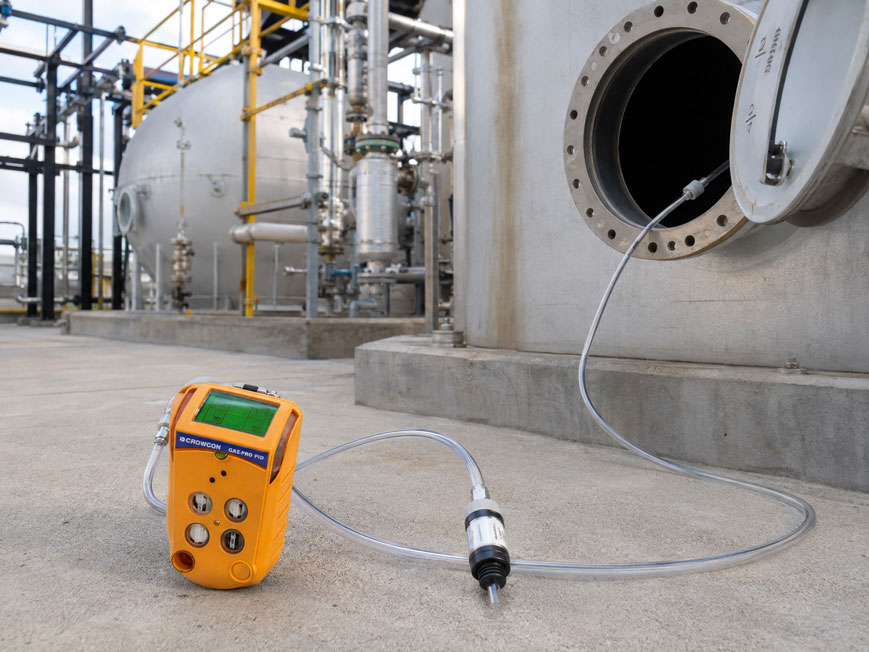
Before entering a vessel, the atmosphere must be checked for oxygen deficiency, combustible gases, hydrogen sulfide and carbon monoxide. The available multi-gas detector has the appropriate sensors. Can it therefore simply be switched on at the vessel opening and held there for a few seconds?
In many applications, this is not sufficient. The atmosphere directly at a manhole opening can differ significantly from the conditions deeper inside the vessel. Depending on the type of gas, temperature, air movement, vessel geometry and possible release sources, different concentrations can occur at different heights or in dead zones.
For pre-entry testing, a sample is therefore often transported from the area that is not yet considered safe to the gas detector. A detector with a pump, probe and suitable sampling hose is used for this purpose. The operator remains outside the potentially hazardous area while the atmosphere is actively sampled at the designated measuring points.
During the subsequent work, the task changes. The objective is no longer to examine a remote atmosphere, but to monitor as closely as possible the air in the immediate working or breathing zone of the person. For this purpose, a portable multi-gas detector operating in diffusion mode may be the more appropriate solution.
The question is therefore not simply “pump or diffusion?”. Both operating modes perform different tasks and are used consecutively in many applications. At the same time, when using a pump, it must be considered that a gas sample does not reach the sensor instantaneously from the end of the sampling hose.
The longer the sampling hose and probe, the greater the transport delay. Only after the gas previously contained in the sampling system has been sufficiently displaced does the new atmosphere reach the sensor. The sensor itself then also requires its specific response time.
In addition, not every gas can be transported through every hose material without losses. Reactive or adsorption-sensitive gases can be partially retained on the inner surface of the hose. Filters, water traps, moisture and partial blockages can additionally influence the sample flow.
For reliable gas measurement, it must therefore first be clarified where the atmosphere needs to be measured. If a sample has to be transported from a remote or not yet safely accessible area to the sensor, a suitable pumped sampling system is required. If, on the other hand, the atmosphere immediately around the person carrying the detector is to be monitored, diffusion mode is often the more appropriate operating mode.
How Does a Gas Detector Work in Diffusion Mode?
In diffusion mode, ambient air is not actively drawn in by a pump. Gas molecules reach the sensor openings through natural molecular movement, existing air currents and movement of the person carrying the detector.
The gas detector therefore measures the atmosphere directly at its own location. This is precisely what makes diffusion mode particularly suitable for personal gas monitoring.
If the detector is worn in the breathing zone in accordance with the manufacturer’s instructions, it continuously monitors the atmosphere to which the person is actually exposed. If the local gas concentration changes, that atmosphere reaches the sensor inlets directly. A long sampling hose does not first have to be flushed with the new atmosphere.
However, the sensor openings must remain unobstructed. If they are covered by clothing or personal protective equipment, gas transport to the sensors may be impaired. Audible, visual and vibration alarms must also remain clearly perceivable by the user.
Diffusion mode is therefore particularly suitable for continuous personal monitoring during maintenance, servicing and other work in areas where the atmosphere may change while personnel are present.
How Does Pumped Sampling Work?
In pumped mode, the gas sample is actively drawn from a remote measuring point. The typical sampling path can be simplified as measuring point → probe → sampling hose → filter/water trap → pump → sensors.
This makes it possible to take measurements in tanks, pits, silos, ducts or process vessels without requiring the person to enter the area before its atmosphere has been assessed as safe.
This is particularly important for a pre-entry test. The probe is positioned at the intended measuring point while the gas detector and operator remain outside the potentially hazardous area.
The pump does not change the actual measuring principle of the installed sensors. An electrochemical H2S sensor, for example, remains an electrochemical sensor. The pump merely transports the sample from the remote measuring point to the sensor.
This leads to an important consequence: although the pump transports the gas sample to the detector, it does not make the sensor itself respond faster. After the transport delay, the response time of the respective sensor must still be taken into account.
Pump or Diffusion: Direct Comparison
The two operating modes differ less in terms of which gases are measured than in where the relevant atmosphere is to be sampled.
| Feature | Diffusion Mode | Pumped Mode |
|---|---|---|
| Measuring location | directly at the gas detector | remote measuring point possible |
| Sample transport | passive | active via pump |
| Sampling hose | normally not required | required for remote sampling |
| Hose transport time | not applicable | depends on hose, probe and pump system |
| Personal breathing-zone monitoring | very well suited | not automatically the most suitable operating mode |
| Pre-entry test | only if the required measuring point can be safely reached directly | targeted remote sampling possible |
| Measurement at several depths | limited | easy to perform with probe and hose |
| Influence of hose material | not applicable | can be significant for certain gases |
| Risk of blockage | no external sampling path | hose, probe or filter can become blocked |
Pumped and diffusion modes are therefore not competing solutions for exactly the same task. In many applications, the atmosphere is first tested remotely using the pump, while personal exposure is subsequently monitored in diffusion mode during the work.
Why Diffusion Mode Is Suitable for Personal Monitoring
A personal gas detector should monitor as closely as possible the atmosphere that the person carrying it is actually breathing. For this reason, it is worn in the breathing zone in accordance with the manufacturer’s and site-specific requirements.
A long sampling hose would perform a different task. The detector would no longer measure the atmosphere immediately around the person, but rather the air at the remote end of the hose.
The measured value would also be delayed. If the atmosphere directly at the workplace changes, the new sample must first travel through the entire sampling system before the change reaches the sensor.
Such a delay is normally undesirable for immediate personal warning. A correctly worn detector operating in diffusion mode is therefore often the more suitable solution for continuous breathing-zone monitoring.
Why a Pump Is Often Required for Pre-Entry Testing
Before entering a vessel, it is not yet known whether the atmosphere inside is safe. It would therefore be contradictory to place the head or upper body into the opening simply so that a diffusion detector can reach the atmosphere inside.
A pump enables sampling from a safe distance. A suitable probe or sampling hose is inserted into the area to be assessed while the operator and gas detector remain outside.
This makes it possible to test different areas of the vessel one after another. The decisive point, however, is that after every repositioning of the probe, the gas sample must first travel through the entire sampling path to the sensor.
A measured value should therefore only be assessed once the new sample has actually reached the sensor and the sensor relevant to the safety assessment has had sufficient time to respond.
Why Measurements Must Be Taken at Several Locations
The atmosphere inside a vessel does not necessarily have a uniform composition. Depending on gas properties, temperature, air movement, vessel geometry, internal structures and the actual release source, concentrations can vary locally.
A single measurement directly at the vessel opening therefore does not automatically represent the complete atmosphere inside.
Depending on the risk assessment and operating conditions, it may be necessary to test different heights and additional critical areas. These may include the upper, middle and lower sections of the vessel, depressions, dead spaces or areas behind internal structures.
The specific sampling strategy should not be based solely on the simplified assumption that a particular gas is “heavier” or “lighter” than air. Temperature, mixing, ventilation and the actual release conditions also influence the atmosphere.
How Does Sampling Hose Length Affect the Measurement?
Every sampling hose has an internal volume. When the probe is moved from one measuring point to another, the atmosphere from the previous measuring point initially remains inside the hose.
The new gas sample must first displace this volume and be transported to the sensor. In general, the longer the sampling system, the longer this process takes.
The total waiting time can be simplified as sample transport + sensor response + additional stabilization if required.
A common mistake is to evaluate the displayed value only a few seconds after inserting a long sampling hose. At that time, the displayed concentration may still completely or partially represent the atmosphere that was previously inside the hose.
In addition to hose length itself, pump flow rate, hose internal diameter, probes, filters, water traps, leaking connections and partial blockages can influence actual sample transport.
Distinguishing Sample Transport Time from Sensor Response Time
Two fundamentally different time components must be considered during pumped sampling.
Sample transport time describes how long the sample takes to travel from the remote end of the hose or probe to the gas detector. It is influenced, among other things, by the length and internal volume of the sampling system and the actual pump flow rate.
Only when the target gas has reached the sensor does the second relevant phase begin: the sensor response. The sensor requires a certain amount of time for its output value to approach the new concentration level.
| Time Component | What Happens? | Important Influencing Factors |
|---|---|---|
| Hose transport | new sample travels from the measuring point to the detector | hose length, internal volume, pump flow rate |
| Flushing | previous atmosphere is displaced from the sampling path | dead volume, probe, filter, water trap |
| Sensor response | sensor approaches the new concentration value | sensor principle, target gas, T90 |
| Additional stabilization | display reaches a sufficiently stable condition | gas type, adsorption, process conditions |
A powerful pump must therefore not be confused with a fast overall measuring system. Even if the sample reaches the detector quickly, the sensor’s intrinsic response time remains unchanged.
Example: 20 m Sampling Hose
A multi-gas detector is used for a pre-entry test with a 20 m sampling hose. For the system in use, the manufacturer specifies, for example, a minimum waiting time of 3 seconds per meter of hose in addition to the normal sensor response time.
For sample transport alone, this gives 20 m × 3 s/m = 60 s. For this reason alone, the reading should not be evaluated after only ten or twenty seconds.
If the sensor relevant to the safety assessment has, for example, a T90 of 30 to 40 seconds, the overall order of magnitude is at least approximately 90 to 100 seconds before a largely stabilized reading can be evaluated.
| Step | Example Value | Meaning |
|---|---|---|
| Hose length | 20 m | distance to measuring point |
| Manufacturer specification | min. 3 s/m | pre-pump / transport time |
| Transport time | min. 60 s | until the new sample reaches the sensor |
| Example sensor T90 | 30…40 s | additional sensor response time |
| Overall order of magnitude | min. approx. 90…100 s | before evaluating the stabilized reading |
This calculation is not a universal specification for every gas detector. The manufacturer’s instructions for the actual instrument, sampling configuration and relevant sensors are always decisive.
The example nevertheless makes one point very clear: With such a manufacturer specification, a 20 m sampling hose and a waiting time of only a few seconds are not compatible.
What Role Does Sample Volume Play?
The sample volume does not consist only of the hose itself. The probe, filter housing, water trap and internal gas path inside the detector also have volumes that must be flushed with the new sample when the measuring point changes.
In simplified form, the theoretical exchange time can be estimated from volume / volumetric flow rate. However, such a calculation provides only an initial physical estimate.
In a real sampling system, gas exchange does not occur as an ideal instantaneous replacement. Flow profiles, dead volumes, mixing, adsorption and desorption can cause the old and new samples to overlap for a certain period of time.
In addition, the actual sensor response only begins once the target gas has reached the sensor. For safety-related applications, the waiting and sampling times specified by the manufacturer should therefore be followed.
Why Reactive Gases Can Be Lost in the Hose
Not every gas is transported through every hose material without change. Certain gases and vapors can be adsorbed on the inner surface of the hose.
This means that some molecules initially attach to the surface. As a result, the sensor may receive a lower concentration or may require considerably more time to reach the actual final value.
This effect can be particularly relevant for reactive or adsorption-sensitive substances. Depending on the hose material, these can include ammonia, chlorine, hydrogen sulfide, ozone, hydrogen chloride, nitrogen oxides or certain VOCs.
In safety-related measurements, such losses are particularly critical. An artificially low reading can suggest that the atmosphere is less hazardous even though a higher concentration is present at the actual measuring point.
Hose material and hose length are therefore part of the measuring system and not merely mechanical accessories.
Selecting the Correct Hose Material
A sampling hose should not be selected only according to length, outside diameter and matching connector. It is also essential to determine whether the material is suitable for the target gases and the prevailing environmental conditions.
For certain reactive or adsorption-sensitive gases, manufacturers may offer special low-adsorption or reactive-gas hoses. The appropriate version must be selected according to the manufacturer’s instructions and the target gases.
Even with a suitable hose, the length should be limited to what is actually required for the sampling task. Every additional meter increases the sample volume and therefore the transport and flushing time. With adsorption-sensitive gases, it also increases the available internal surface area.
A 30 m hose is therefore not automatically a better choice than a 10 m hose simply because the pump is technically capable of operating with 30 m.
Using Filters and Water Traps Correctly
During remote sampling, the probe may come into contact with dust, particles, condensation or splash water. These substances can affect the sensors, place additional load on the pump or reduce gas flow through the sampling system.
Depending on the detector and measuring task, filters, water traps or suitable probes can therefore be used. They protect the measuring instrument but also become part of the gas path themselves.
A contaminated or moisture-saturated filter can significantly reduce sample flow. The fact that the pump can be heard running does not prove that the specified volumetric flow is actually passing through the complete system.
Filters and water traps must therefore be inspected and maintained according to the manufacturer’s instructions. Their suitability for the target gas must also be considered.
What Happens If the Sampling Hose Is Blocked?
A sampling line can become blocked by a kinked or crushed hose, a contaminated filter, aspirated water or a blocked probe.
As a result, either too little sample or no sample at all reaches the sensor. Detectors with suitable pump monitoring may identify and report such a condition.
Functional testing should therefore not consider only the gas detector itself. The complete sampling path consisting of the probe, hose, filter or water trap and pump must also be operational.
A successful detector test without the sampling hose connected does not automatically prove that subsequent remote sampling through the complete accessory system will function correctly.
Flushing the Hose Sufficiently Between Different Measuring Points
When the probe is moved from one measuring point to the next, the previous atmosphere initially remains inside the sampling hose. The gas detector may therefore continue to display the concentration from the previous location for a certain period of time.
If, for example, the upper and then the lower section of a vessel are tested, the new atmosphere must first be drawn through the sampling system after lowering the probe.
Only then can the measured value reliably be assigned to the new measuring point. The same applies when moving from a contaminated atmosphere back to clean air.
With adsorbing gases, the effect can last even longer because previously adsorbed molecules may later be released again from the hose surface.
What Does T90 Mean for a Gas Sensor?
T90 describes, in simplified terms, the time a sensor needs after a sudden concentration change to reach 90% of its eventual final value.
If the actual test-gas concentration is, for example, 100 ppm and the sensor has a T90 of 30 s under the specified conditions, this means in simplified terms that the indication should have reached approximately 90 ppm after around 30 seconds.
T90 must not be confused with the time until the first visible response. A sensor may begin reacting after only a few seconds while the displayed value is still significantly below the actual concentration.
For pumped measurements, it is also important to remember that T90 effectively becomes relevant only once the target gas has reached the sensor. The sampling-hose transport time is additional.
Why Different Sensors Respond at Different Speeds
A multi-gas detector can contain several different sensor technologies at the same time. Depending on the configuration, these may include electrochemical sensors, catalytic sensors, infrared sensors or PID sensors.
These sensors differ in response time, measuring range, cross-sensitivities and susceptibility to environmental influences. Therefore, not every displayed gas channel necessarily reaches a sufficiently stable value at the same time.
For a safety-related assessment, the slowest relevant measurement channel may therefore be decisive. It would not be sufficient, for example, to end the measurement merely because the oxygen sensor has stabilized if another sensor that is important for the risk assessment has not yet responded sufficiently.
The actual required waiting time depends on the detector, its sensors and the relevant manufacturer specifications.
Switch Back to Diffusion Mode After Pre-Entry Testing?
A successful pre-entry test describes the atmosphere at a specific point in time. It does not guarantee that the conditions will remain unchanged throughout the subsequent work.
Welding, cleaning agents, process leaks, renewed gas release from residues, changes in ventilation or oxygen consumption can change the atmosphere while personnel are inside.
Depending on the risk assessment, continuous personal gas monitoring may therefore be required.
If the multi-gas detector supports both operating modes, it can be switched back to the diffusion mode intended for personal monitoring after remote sampling, in accordance with the manufacturer’s and site-specific procedures.
The tasks can therefore be clearly separated: pump = transport sample from remote area to sensor and diffusion = monitor atmosphere directly around the person carrying the detector.
Practical Example: Pre-Entry Test on a 6 m Deep Vessel
A maintenance team is required to enter a process vessel approximately 6 m deep. Before entry, the atmosphere must be checked using a suitable multi-gas detector.
First, the measuring instrument is prepared in accordance with the applicable operating procedures and manufacturer specifications. This includes checking the battery status, calibration status, sensor and alarm functions and, for remote sampling, pump operation.
A sampling hose suitable for the target gases, the specified probe and any required filters or water traps are then connected.
The first sample is taken from the upper section of the vessel. After positioning the probe, the specified sample transport and sensor response times are allowed to elapse completely. Only then are the readings evaluated and documented.
The probe is then lowered into the middle section. At this point, the atmosphere from the upper measuring point is initially still present inside the hose. A sufficient flushing and waiting period is therefore required again.
The same procedure is then carried out in the lower section of the vessel. Depending on vessel geometry and the risk assessment, additional measurements may be required in depressions, dead spaces or behind internal structures.
The results are evaluated and documented according to the pre-entry testing procedure applicable to the installation. Only then can the next steps be determined.
If continuous personal gas monitoring is required during entry, the appropriate gas detector is then worn in the breathing zone in the specified position.
This clearly separates two different measurement tasks: pumped sampling for safe remote testing of the vessel before entry, and personal monitoring of the actual breathing zone during the work.
Systematic Selection and Procedure
- Review the risk assessment and identify the possible target gases for the application.
- Ensure that the gas detector has suitable sensor technologies for all relevant hazards.
- Determine whether the atmosphere must be measured directly at the detector or at a remote measuring point.
- For remote sampling, use a suitable pump system or approved sampling arrangement.
- Check that the hose material is suitable for the gases to be measured.
- Use only as much sampling hose as is actually required for the measurement task.
- Use suitable filters or water traps where moisture, condensation or particles may be present.
- Inspect the hose, probe and connections for kinks, damage and contamination.
- Check pump operation with the complete sampling system connected.
- Allow for the sample transport or pre-pump time specified by the manufacturer.
- Additionally consider the T90 or sensor response time of the relevant measurement channels.
- For reactive gases, consider possible adsorption losses in the hose.
- Take samples at representative points defined by the risk assessment.
- After every change of measuring point, flush and sample again for a sufficient period.
- Evaluate readings only after sufficient sample transport and sensor response time.
- Document measuring points, waiting times and results according to the specified procedure.
- After successful pre-entry testing, determine whether continuous personal monitoring is required during the work.
- For personal monitoring, wear the detector in the breathing zone according to the manufacturer’s instructions.
- Do not cover the sensor inlets with clothing or protective equipment.
- Review measurement, testing and maintenance procedures regularly.
Common Mistakes
- Holding a diffusion detector only at the vessel opening: The atmosphere deeper inside the vessel can be significantly different.
- Putting your head into the vessel to take a measurement: This already exposes the breathing zone to an atmosphere that has not yet been assessed.
- Reading the value immediately after connecting a long hose: The new gas sample may not yet have reached the sensor.
- Considering only sample transport time: Once the sample arrives, the sensor itself still requires time to respond.
- Considering only T90: With remote sampling, transport time through the hose is additional.
- Always using the maximum possible hose length: Unnecessary length increases delay and possible adsorption losses.
- Using any plastic hose: Certain target gases can be retained by unsuitable hose materials.
- Ignoring reactive gases: Adsorption can cause readings that are too low or severely delayed.
- Failing to inspect filters: Dirty or wet filters can significantly reduce sample flow.
- Drawing water into the sampling line: Liquid can interfere with the pump and sensors.
- Measuring at only one point inside the vessel: The atmosphere can vary significantly from one location to another.
- Not waiting again after changing the measuring point: The previous sample initially remains inside the hose.
- Assuming pumped mode makes the sensor faster: The pump does not change the intrinsic sensor response time.
- Assuming a pre-entry test guarantees permanent safety: The atmosphere may change during the subsequent work.
- Assuming pumped mode is always better for personal monitoring: A correctly worn diffusion detector is often more appropriate for breathing-zone monitoring.
- Testing only the basic detector: For pumped measurements, the complete sampling path must also be functional.
- Looking only at the number of sensors: Sensor technology and target gas must match the actual hazard.
Suitable Multi-Gas Detector
For applications requiring both personal gas monitoring and remote sampling, the Crowcon Gas-Pro, for example, is a suitable option. Depending on the configuration, the portable multi-gas detector can monitor up to 5 gases.
| Feature | Importance for the Application |
|---|---|
| Multi-gas measurement | monitoring of up to five gases depending on configuration |
| Diffusion mode | for personal gas monitoring in the specified wearing position |
| Optional integrated pump | remote sampling and pre-entry measurements possible |
| Sampling hoses and probes | targeted measurements from remote areas |
| Water traps and filters | protection of the sampling system when used appropriately |
| Special hose options | for certain reactive or adsorption-sensitive gases |
| Audible, visual and vibration alarms | alert the user to hazardous concentrations |
Particularly relevant is the ability, depending on the version, to distinguish between personal diffusion monitoring and active sampling. For remote measurements, the specified pump or sampling configuration is used. Hose length, transport time, sensor T90, hose material, filter condition and target gas must all be considered together.
Suitable special sampling hoses are available for reactive or adsorption-sensitive gases depending on the application. Sampling hoses, probes, water traps, filters and additional sampling components are also available.
Further portable and fixed gas detectors can be found under Gas Detectors and Gas Warning Systems at ICS Schneider.
Further information on testing before entering vessels can be found in the article Gas Detector for Confined Spaces: Performing a Pre-Entry Test Correctly Before Entry.
The article Bump Test Passed, Calibration Failed: Interpreting Response Time and Sensor Deviation Correctly also explains why a successful functional test does not automatically confirm measurement accuracy.
Conclusion
Diffusion and pumped modes perform different tasks in portable gas detection. In diffusion mode, the detector measures the atmosphere directly at its own location. This is particularly suitable for continuous personal monitoring in the breathing zone.
In pumped mode, a sample is transported from a remote area to the sensor. This operating mode is particularly important when a vessel, pit or other area that has not yet been assessed as safe must be checked before access.
However, using a pump does not mean that a valid reading is available immediately after positioning the probe. The new atmosphere must first travel through the hose, probe and any additional accessories to the detector. The sensor then requires its own response time.
As hose length increases, pre-pump time, flushing time and the internal volume of the sampling system become increasingly important. Filters and water traps can also influence gas flow and must remain functional.
For reactive or adsorption-sensitive gases in particular, the hose material is an additional critical factor. An unsuitable sampling hose can cause the concentration at the sensor to appear lower or later than the concentration at the actual measuring point.
When testing the atmosphere inside a vessel, it must also be considered that gas concentrations may vary spatially. A measurement at the opening alone is therefore not automatically sufficient. The required representative measuring points are determined by the risk assessment and the applicable pre-entry testing procedure.
A successful pre-entry test also does not necessarily guarantee safe conditions throughout the complete duration of the work. The atmosphere may subsequently change because of work activities, residues, leaks or changing ventilation. Continuous personal monitoring may therefore be required.
The correct choice is therefore often not “pump or diffusion?”, but rather: “Pump for targeted sampling from an area that is not yet safely accessible – diffusion for direct personal monitoring during entry and work.”
FAQ: Gas Detector with Pump or Diffusion
What is the difference between diffusion mode and pumped mode?
In diffusion mode, ambient air reaches the detector’s sensors directly and passively. In pumped mode, the gas sample is actively transported to the detector through a probe or sampling hose. This makes it possible to test remote areas or locations that are not yet safely accessible.
When do I need a gas detector with a pump?
A pump is particularly useful when a sample must be taken from a remote area, such as a tank, pit or vessel before entry. The specific sampling strategy depends on the risk assessment and applicable operating procedures.
When is diffusion mode more suitable?
For continuous personal monitoring, a portable gas detector is often worn in diffusion mode in the breathing zone. This allows it to monitor the atmosphere directly at the person’s location.
Can I use a diffusion detector for pre-entry testing of a vessel?
Only if the required representative measuring points can be reached safely without entering the potentially hazardous area. For deeper or not yet safely accessible locations, remote sampling with a pump, hose and suitable probe is often required.
Why do I have to wait when using a sampling hose?
After positioning the probe, the previous atmosphere is initially still present inside the hose. It must first be displaced by the new sample. Only then does the new gas reach the sensor, which subsequently also requires time for its own response.
How long do I have to wait when using a sampling hose?
This depends on the detector, pump, hose length, hose material, accessories, target gas and sensor. The manufacturer’s specifications for the actual system being used are decisive.
How long does a measurement take with a 20 m sampling hose?
With an example manufacturer specification of at least 3 seconds per meter, a 20 m hose requires at least 60 seconds of transport time. If the relevant sensor additionally has a T90 of 30 to 40 seconds, the total order of magnitude is at least approximately 90 to 100 seconds. Depending on the gas and sampling system, additional time may be required.
Does a stronger pump make the gas sensor respond faster?
No. A pump influences how quickly the sample reaches the sensor. It does not change the sensor’s intrinsic chemical or physical response time.
What does T90 mean?
T90 describes, in simplified terms, the time after which a sensor has reached approximately 90% of its eventual final value following a concentration change. The first visible response can occur considerably earlier.
Can every sampling hose be used for every gas?
No. Certain reactive or adsorption-sensitive gases can be partially retained by unsuitable hose materials. Only hose materials suitable for the detector and target gas, or those specified by the manufacturer, should therefore be used.
Why can H2S or NH3 read too low when a long hose is used?
Certain gases can be adsorbed on the inner hose surface. Part of the gas therefore reaches the sensor later or initially at a lower concentration. Hose material and hose length are particularly important for these gases.
What is a water trap used for?
A suitable water trap reduces the risk of liquid entering the pump or sensors through the sampling line. Depending on the measurement task, additional filters or special sampling probes may also be required.
Do I have to wait again after every change of measuring point?
Yes. The atmosphere from the previous measuring point initially remains inside the hose. The sampling system must be flushed with the new atmosphere before the new measuring point can be assessed reliably.
Why should measurements be taken at several locations inside a vessel?
The atmosphere inside a vessel does not necessarily have a uniform composition. Gas concentrations can vary locally depending on substance properties, temperature, air movement, vessel geometry and release source. The required measuring points are therefore defined by the risk assessment.
Is a pre-entry test sufficient for the entire period inside the vessel?
Not necessarily. Pre-entry testing describes the atmosphere at the time of the test. Conditions may change during the subsequent work. Depending on the risk assessment, continuous personal gas monitoring may therefore be required.
Can the Crowcon Gas-Pro be used both with a pump and in diffusion mode?
Yes, with the corresponding version featuring the optional integrated pump. The specified pump or sampling configuration is used for remote sampling. For personal monitoring, the detector can be worn in diffusion mode according to the manufacturer’s instructions.
Who is permitted to perform pre-entry gas testing of a vessel?
Pre-entry gas testing requires appropriate competence in accordance with the applicable occupational safety requirements and operating procedures. This includes knowledge of the measuring instruments used, the relevant hazardous substances, the appropriate sampling strategy and the specific operating conditions.