


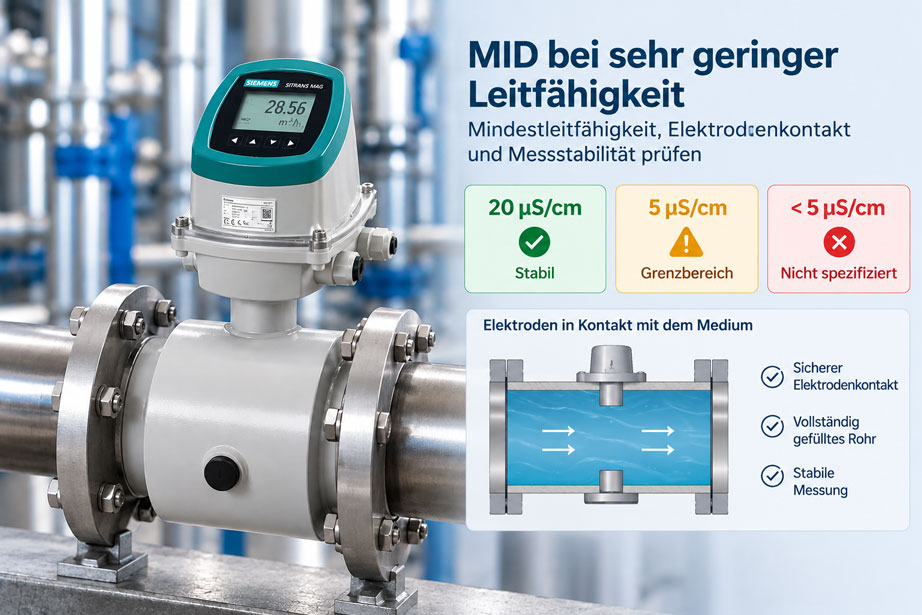
According to its datasheet, an electromagnetic flow meter is suitable for liquids with a conductivity of at least 5 µS/cm. The medium actually being conveyed has a conductivity of approximately 7 µS/cm. Nevertheless, the indicated flow fluctuates more than expected and occasionally drops to zero. Is the electromagnetic flow meter defective, or is the conductivity simply too low in practice?
The specified minimum conductivity initially describes the limit within which the manufacturer specifies the measuring principle or the particular device. However, it does not mean that an application operating only slightly above this limit will automatically be as robust as a measurement at 100 or 500 µS/cm.
The lower the electrical conductivity of the medium, the more demanding it becomes to detect the very small induced measuring voltage at the electrodes. Electrode wetting, potential equalization, electrical interference, deposits, air bubbles and, in remotely mounted systems, cable conditions therefore become increasingly important.
When an electromagnetic flow meter is operating close to its minimum conductivity, it is therefore not sufficient to check only whether the numerical value is just above the datasheet limit. Stable electrode contact, a completely filled pipe, correct grounding or potential equalization and a sensor-to-transmitter connection suitable for the conductivity are equally important.
Why does an electromagnetic flow meter require a conductive medium?
An electromagnetic flow meter operates according to Faraday’s law of electromagnetic induction. A magnetic field is generated inside the measuring tube. When an electrically conductive liquid moves through this magnetic field, an electrical voltage is induced.
In simplified form:
U ∝ B × v × D
Where:
Uis the voltage measured at the electrodes,Bis the magnetic flux density,vis the average flow velocity andDis the effective pipe diameter.
The measuring electrodes pick up the induced voltage from the liquid. For this electrical signal to be transmitted reliably, the medium must have sufficient electrical conductivity.
Non-conductive media such as many mineral oils, hydrocarbons or organic solvents are therefore fundamentally unsuitable for a conventional electromagnetic flow meter.
What does minimum conductivity mean?
Minimum conductivity is a device-specific technical limit. It defines the electrical conductivity above which the measuring system can be operated according to the manufacturer’s specification.
For the Siemens SITRANS FMS500 in compact mounting, for example, the following is specified:
Conductivity ≥ 5 µS/cm
This means that liquids with a conductivity below this value are outside the specified operating conditions for this configuration.
However, this limit must not be interpreted as a universal limit for all electromagnetic flow meters. Other devices may require 20 µS/cm, 50 µS/cm or other minimum conductivity values.
| Conductivity | Example assessment for an electromagnetic flow meter specified for ≥ 5 µS/cm |
|---|---|
200 µS/cm |
Well above the minimum requirement |
50 µS/cm |
Typically an uncritical range |
10 µS/cm |
Close to the lower specification limit |
5 µS/cm |
Specified lower limit in this example |
2 µS/cm |
Outside this device specification |
Why does measurement become more sensitive near the minimum conductivity?
An electromagnetic flow meter processes a comparatively small electrical measuring voltage. The lower the conductivity of the medium, the more demanding the transmission of this signal between the liquid and the measuring electrodes becomes.
Disturbances that are barely noticeable with a highly conductive medium can therefore become significantly more apparent in the lower conductivity range.
Examples include:
- electrical interference voltages,
- unstable electrode contact,
- air bubbles at the electrode,
- deposits on the electrode surface,
- unfavourable potential equalization,
- high cable capacitance with remote mounting.
A measured value only slightly above the minimum conductivity should therefore not automatically be considered as robust as an application with significantly higher conductivity.
What role does electrode contact play?
The electrodes form the electrical connection between the medium and the input circuitry of the transmitter.
For the measuring signal to be transmitted reliably, the electrode must have stable electrical contact with the liquid.
Potential problems include:
- insulating deposits,
- coatings on the electrode surface,
- gas bubbles directly at the electrode,
- partially dry electrodes,
- chemical changes to the electrode surface.
At high conductivity, a light deposit may have little noticeable effect. Near the conductivity limit, however, the same additional contact resistance can have a considerably stronger influence on signal quality.
Why must the electrodes be completely wetted?
A conventional inline electromagnetic flow meter is designed for a completely filled measuring tube. The electrodes must remain in permanent contact with the conductive liquid.
If an air bubble forms between an electrode and the medium, electrical signal transmission is interrupted or significantly altered.
Typical causes include:
- partially filled pipelines,
- air entering through pumps,
- outgassing of the medium,
- unfavourable installation position,
- operation directly downstream of valves or pumps.
Particularly with weakly conductive media, intermittent electrode contact can result in an unstable measured value or temporary signal loss.
Why do grounding and potential equalization become more important?
The electromagnetic flow meter measures a small electrical voltage within the liquid. The electrical potential of the medium relative to the measuring system must therefore be clearly defined.
Depending on the device, pipe material and installation, the following may be used:
- grounding electrodes,
- grounding rings,
- potential equalization conductors or
- suitable conductive process connections
.
If potential equalization is missing or external voltages enter the liquid, offset, noise or strongly fluctuating measured values can occur.
A clean electrical installation is therefore particularly important in the lower conductivity range.
Influence of cable length with remote mounting
With a compact version, the transmitter is mounted directly on the sensor. With a remote version, however, the electrode signals are transmitted to the transmitter via a cable.
This connection becomes increasingly relevant at very low conductivity.
For the SITRANS FMS500, the permissible cable length with remote mounting explicitly depends on the conductivity of the medium and the electrode cable used. A special electrode cable is available for particularly low conductivity applications.
In practical terms, this means:
The statement “the sensor can measure from 5 µS/cm” is not sufficient on its own for a remote installation. It must also be checked whether the conductivity and the actual signal cable length are compatible with each other.
A compact installation can therefore be more robust from a measurement perspective at extremely low conductivity than an unnecessarily long remote sensor connection.
Do not confuse minimum conductivity with empty-pipe detection
Many modern electromagnetic flow meters additionally provide empty-pipe detection. In this case, the electronics attempt to determine whether the measuring electrodes have sufficient contact with the liquid.
However, the requirements for this diagnostic function do not necessarily have to be identical to the minimum conductivity required for the actual flow measurement.
This means:
Under certain conditions, an electromagnetic flow meter may still measure flow while an additional electrode or empty-pipe diagnostic function already operates less reliably or requires a higher minimum conductivity.
The conductivity required for the respective diagnostic function must therefore be checked specifically for the device.
A failed empty-pipe diagnostic does not automatically mean that the actual flow measurement is already outside its specification – and vice versa.
Which media are often in the critical conductivity range?
Very low conductivities occur primarily with highly purified or low-ion liquids.
Typical examples include:
- demineralized water,
- partially demineralized water,
- deionized water,
- certain condensates,
- certain organic-water mixtures,
- high-purity process water.
With ultrapure water, conductivity can even be significantly below the minimum requirement of conventional electromagnetic flow meters. In this case, an attempt should not be made simply to make the measurement “more sensitive” through parameterization.
If the medium is physically outside the specified conductivity range, a different measuring principle should be considered.
How does insufficient conductivity affect the measurement signal?
Insufficient or borderline conductivity does not always result in a clear and complete measurement failure.
Possible symptoms include:
| Observation | Possible cause |
|---|---|
| Measured value fluctuates strongly | Poor signal-to-noise ratio, electrode contact problem or interference |
| Flow temporarily drops to zero | Signal loss, empty-pipe detection or unstable electrode contact |
| Measured value responds unusually slowly | Strong internal filtering used to stabilize an unstable signal |
| Measurement only works at higher conductivity | Medium is close to or below the device requirement |
| Remote version unstable, compact version stable | Cable conditions may be relevant |
However, an unstable signal does not automatically prove that the conductivity is too low. Air bubbles, poor grounding, incomplete pipe filling or electrical interference can cause similar symptoms.
Practical example: demineralized water at 7 µS/cm
A SITRANS FMS500 is used to measure the flow of treated water. During normal operation, the conductivity is between:
6 and 9 µS/cm
The sensor is compact-mounted and is generally specified for liquids with a conductivity of at least 5 µS/cm.
During normal operation, the electromagnetic flow meter indicates a plausible flow value. Occasionally, however, the indication begins to fluctuate strongly.
Initially, it is assumed that the conductivity alone is too low. Inspection shows, however, that small air bubbles are also occurring in the upper part of the measuring tube. Due to the installation position, some of these bubbles reach the electrodes.
After modifying the pipe routing, the measuring tube remains completely filled and the electrodes remain permanently wetted. The signal becomes significantly more stable.
The conductivity of approximately 7 µS/cm has not changed.
This example shows that particularly near the minimum conductivity, an additional unfavourable installation condition can determine whether the measurement is stable or unreliable.
Systematically checking an electromagnetic flow meter with an unstable signal
- Determine the current conductivity of the medium.
- Check the minimum conductivity of the specific electromagnetic flow meter.
- For remote mounting, check the permissible cable length for this conductivity.
- Ensure that the measuring tube is completely filled.
- Check electrode position and continuous wetting.
- Rule out air bubbles or two-phase flow.
- Check the electrodes for deposits.
- Check potential equalization and grounding.
- Investigate electrical interference sources in the surrounding area.
- Evaluate the diagnostic values of the transmitter.
- Do not increase filtering or damping prematurely.
- If the signal remains unstable, check whether another measuring principle would be more suitable.
When is a different measuring principle more suitable?
If the conductivity is permanently below the manufacturer’s specification, an electromagnetic flow meter should not be used simply because the medium is a liquid.
Depending on the application, alternative measuring principles may include:
- Coriolis mass flow measurement,
- ultrasonic flow measurement,
- oval gear or positive displacement measurement,
- other mechanical flow measuring principles.
The suitable method also depends on viscosity, pressure, temperature, pipe diameter, accuracy requirements and available installation space.
Changing the measuring principle is often more appropriate than attempting to operate an electromagnetic flow meter permanently outside its electrical application limits.
Common mistakes
- Assuming one universal minimum conductivity for all electromagnetic flow meters: The limit is device-specific.
- Interpreting 5 µS/cm as a guaranteed comfortable operating range: A specified lower limit does not automatically mean large signal reserves are available.
- Ignoring electrode contact: Air bubbles or deposits can be particularly problematic at low conductivity.
- Equating minimum conductivity with empty-pipe detection: Diagnostic functions may have different requirements.
- Treating remote mounting the same as compact mounting: At low conductivity, the permissible cable length may be restricted.
- Simply applying stronger signal damping: High damping does not physically improve insufficient electrode contact.
- Failing to check grounding: External potentials can significantly influence the weak electrode signal.
- Considering only the conductivity value: Pipe filling, air bubbles, electrode condition and installation must also be included in the diagnosis.
- Assuming ultrapure water can always be measured with an electromagnetic flow meter: Very high-purity water may have conductivity far below the required minimum.
SITRANS FMS500 and FMT020 for conductive liquids
A current electromagnetic flow sensor for water and process applications is the Siemens SITRANS FMS500. In compact mounting, it is designed for liquids with an electrical conductivity of at least 5 µS/cm. With remote mounting, the relationship between medium conductivity and signal cable length must additionally be taken into account.
The FMS500 features integrated grounding electrodes and is available with different liners for water, drinking water and other applications.
In combination with the SITRANS FMT020, it forms the SITRANS FM520 flow measuring system. In addition to volumetric flow and flow velocity, the FMT020 also measures the electrical conductivity of the medium. This provides an additional important diagnostic variable for applications operating close to the lower conductivity limit.
The transmitter also offers diagnostic functions such as empty-pipe monitoring and device self-testing as well as HART, PROFINET, EtherNet/IP or Modbus RTU depending on the version.
Suitable devices can be found under electromagnetic flow meters at ICS Schneider. Further information is available for the SITRANS FMS500 sensor and the SITRANS FMT020 transmitter.
Conclusion
An electromagnetic flow meter requires an electrically conductive medium. The required minimum conductivity is not a universal property of the measuring principle, but must be checked for the specific device.
For the SITRANS FMS500 in compact mounting, this limit is 5 µS/cm, for example. Particularly close to this limit, however, good installation conditions become especially important.
The electrodes must be completely wetted and free from insulating deposits. The measuring tube must remain completely filled. Potential equalization and grounding must be correct, and electrical interference voltages should be avoided wherever possible.
With remote sensor-transmitter systems, the signal cable length is an additional factor. The lower the conductivity, the more strongly the permissible distance between sensor and transmitter may be restricted.
For stable electromagnetic flow measurement at low conductivity, the following therefore applies: first check the device-specific minimum conductivity, then inspect electrode contact, pipe filling, grounding and cable conditions, and do not prematurely attribute an unstable measured value solely to the flow sensor.
FAQ: Electromagnetic flow meters at low conductivity
Why does an electromagnetic flow meter require a conductive medium?
The electrical voltage generated by the movement of the liquid through the magnetic field is picked up from the medium via electrodes. Without sufficient electrical conductivity, this signal cannot be detected reliably.
What minimum conductivity is required for an electromagnetic flow meter?
This depends on the specific device. Depending on the design, typical values may be 5, 20 or more µS/cm. The manufacturer’s specification is always decisive.
What minimum conductivity does the SITRANS FMS500 require?
For compact mounting, Siemens specifies liquids with an electrical conductivity of at least 5 µS/cm.
Will an electromagnetic flow meter automatically operate stably at exactly 5 µS/cm?
Not necessarily under every installation condition. The value describes the device specification. Close to the lower limit, electrode wetting, grounding, interference and, with remote mounting, cable length become increasingly important.
Why can air bubbles interfere particularly strongly with measurements at low conductivity?
Compared with the conductive liquid, gas is practically insulating. If an air bubble is present at a measuring electrode, electrical contact between the electrode and the medium is significantly impaired.
Can contaminated electrodes cause an unstable electromagnetic flow signal?
Yes. Insulating or poorly conductive deposits increase the contact resistance between the medium and electrode and can therefore be particularly problematic with weakly conductive liquids.
Does grounding play a greater role at low conductivity?
Yes. Because the usable electrode signal is small, external potentials and electrical interference can have a greater influence. Correct potential equalization is therefore particularly important.
Why does cable length affect a remotely mounted electromagnetic flow meter?
The small electrode signal must be transmitted to the transmitter through the cable. Cable capacitance and interference have a greater effect at low medium conductivity, which is why manufacturers specify maximum cable lengths depending on conductivity and cable type.
Is the minimum conductivity for empty-pipe detection always the same?
No. The requirements for additional empty-pipe or electrode-contact diagnostics may differ from the minimum conductivity required for the actual flow measurement.
Is an electromagnetic flow meter suitable for ultrapure water?
Only if the actual conductivity of the water is above the minimum requirement of the specific device. Very high-purity water can have such low conductivity that a conventional electromagnetic flow meter is unsuitable.
What can be done if the conductivity is permanently too low?
An alternative flow measuring principle should then be considered, for example Coriolis or ultrasonic measurement, depending on the medium, pipe size and accuracy requirements.
Which specific electromagnetic flow system is suitable for low conductivity?
One example is the Siemens SITRANS FMS500 in combination with the SITRANS FMT020. In compact mounting, the FMS500 is specified for media from 5 µS/cm, while the FMT020 can additionally measure electrical conductivity as a diagnostic variable.