


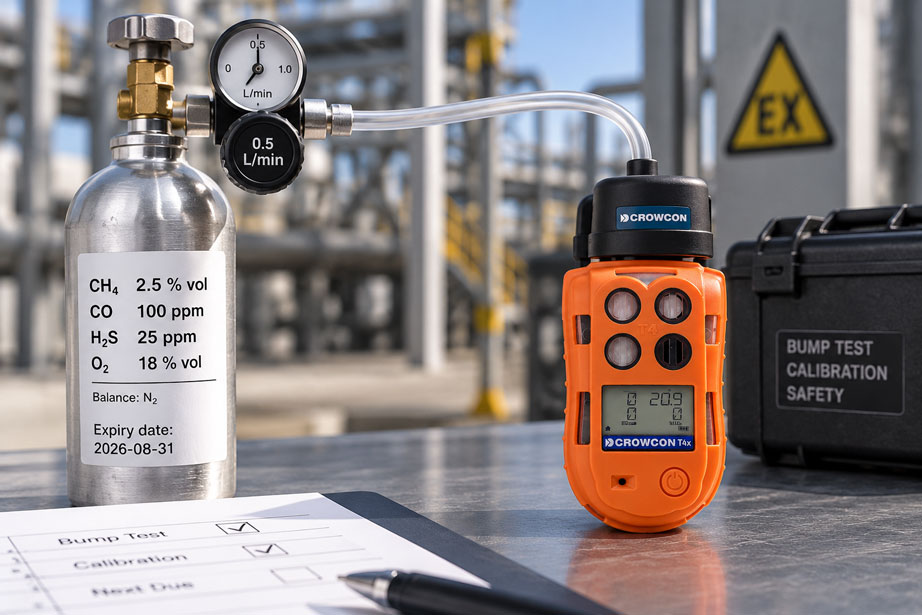
A gas detector is connected to a test gas cylinder, the regulator is opened and the sensor responds. At first glance, everything appears to be correct. However, for a reliable bump test or calibration, it is not sufficient for just any gas with the correct name to come out of the cylinder.
The decisive factor is whether the complete test gas system is suitable for the gas detector and the intended test procedure. This includes the target gas, concentration, unit, balance gas, certified concentration value, expiry date of the gas cylinder, regulator type, gas flow, hose and test adapter.
Typical errors already occur when selecting the concentration. A CO sensor with a measuring range of 0 … 1,000 ppm must not automatically be tested using any available CO cylinder. Likewise, for combustible gases, a distinction must be made between concentrations specified in vol.% and %LEL and between the calibration conventions configured in the gas detector.
With multi-gas detectors, several gases may also be contained in one test gas cylinder. The mixture must then match the actual sensor configuration and the test procedure specified by the manufacturer. The balance gas is also part of the gas mixture and must not be treated as an insignificant secondary specification.
For calibration, the actual certified concentration value is also relevant. A cylinder may, for example, have been ordered with a nominal target value while the corresponding certificate states a slightly different actual filling concentration. If the calibrator or gas detector is configured with a value that differs from the actual concentration in the cylinder, this difference is transferred directly into the calibration.
The expiry date must also not be confused with the remaining cylinder pressure. A cylinder may still be clearly pressurized even though the certified stability period of the gas mixture has already expired. The remaining pressure only indicates that gas is still present – not that its composition is still within the certified concentration limits.
Finally, the correct flow regulator must be selected. A fixed-flow regulator delivers a predefined gas flow. A demand-flow regulator, by contrast, supplies gas according to the demand of the connected test system. Pumped instruments and automatic test stations may therefore require a different regulator from a diffusion instrument with a manual calibration plate.
The key point is: A test gas cylinder is part of a complete measurement and test setup. Target gas, concentration, balance gas, expiry date and regulator must all match the gas detector, sensor and test procedure. Only then is a passed bump test or calibration technically reliable.
Table of Contents
- What is a test gas cylinder?
- Correctly distinguish between bump testing and calibration
- How is the correct test gas concentration selected?
- Why the alarm threshold alone does not determine the test gas concentration
- Why the certified actual cylinder value is important
- Do not confuse %LEL, vol.% and ppm
- Select a multi-gas mixture that matches the sensor configuration
- Why the balance gas is also relevant
- What does the expiry date of a test gas cylinder mean?
- Why remaining pressure says nothing about the validity of the test gas
- Why reactive gases require special consideration
- Distinguishing fixed-flow and demand-flow regulators
- Selecting the correct flow rate
- Consider hose, adapter and gas path
- Correctly plan cylinder size and gas consumption
- Use and discharge test gas safely
- Systematically perform a manual bump test
- Correctly supply automatic test stations with test gas
- Systematically diagnose typical faults
- Suitable gas detection and test equipment from ICS Schneider
- Conclusion
- Frequently asked questions about test gas cylinders for gas detectors
1. What is a test gas cylinder?
A test gas cylinder contains a defined gas or gas mixture with a known concentration. This gas is used to expose a gas sensor to a known gas concentration under controlled conditions.
Depending on the test task, the terms test gas, bump test gas, calibration gas or zero gas are commonly used. However, these terms do not necessarily describe different physical cylinders. The decisive factor is the test step for which the respective gas is intended and specified.
During a bump test, the gas detector must demonstrate that its sensors respond to a defined gas exposure and that the intended alarm functions are activated.
During calibration, by contrast, the quantitative relationship between a known gas concentration and the measured value indicated by the sensor is checked or adjusted.
The test gas cylinder therefore acts as a reference standard during calibration. Its concentration must be known, suitable for the sensor and within the specified validity period.
2. Correctly distinguish between bump testing and calibration
Bump testing and calibration are often performed using the same test setup, but they answer different questions.
A bump test is primarily a functional test. The instrument is exposed to gas and it is checked whether the sensors respond and whether the intended alarm functions operate correctly.
A calibration, on the other hand, evaluates whether the quantitative measured value matches the known gas concentration. If it does not and the device procedure permits adjustment, the sensor sensitivity is corrected accordingly.
A device can therefore pass a bump test and still show an issue during a subsequent calibration check. A sensor may respond sufficiently to trigger the alarm while its stabilized measured value deviates significantly from the known test gas concentration.
| Test | Central question | Importance of the test gas concentration |
|---|---|---|
| Bump test | Do the sensor and alarm functions respond as intended? | Must match the intended bump-test procedure and device settings |
| Calibration check | Does the measured value correspond to the known gas concentration? | The actual certified gas value is decisive |
| Calibration / adjustment | Is the sensor response adjusted to the known reference value? | An incorrectly entered gas value directly causes a calibration error |
The selection of a test gas cylinder should therefore always begin by determining which test procedure is actually to be performed.
3. How is the correct test gas concentration selected?
The correct concentration is not determined solely by the measuring range of the sensor.
A sensor with a measuring range of up to 1,000 ppm CO, for example, does not necessarily have to be calibrated using 1,000 ppm. Likewise, an arbitrary concentration somewhere within the measuring range is not automatically suitable.
The manufacturer of the gas detector specifies suitable test gases and test gas concentrations for the particular sensor and device configuration.
This takes into account the range in which the sensor can be reliably tested or calibrated and the response expected by the device firmware during the bump test.
With modern gas detectors, the stored test concentrations may additionally be saved in the device configuration. The test gas cylinder must then match these values or the intended test program.
Especially with multi-gas instruments, the test gas cylinder should therefore not be selected based on a single sensor alone. The complete device configuration is decisive.
4. Why the alarm threshold alone does not determine the test gas concentration
A common assumption is that the test gas concentration only needs to be slightly above the configured alarm threshold.
For a simple functional consideration, this may initially sound logical. However, a bump test is a test procedure defined by the device manufacturer and not merely a question of whether an alarm eventually occurs.
The device firmware may evaluate a specific expected gas value, a minimum response or a defined response time.
A concentration only slightly above the alarm threshold can therefore be unsuitable even though it could theoretically trigger an alarm.
Conversely, using the highest possible concentration is not automatically better either. It may lie outside the intended test range, unnecessarily increase gas consumption or make sensor evaluation more difficult.
The correct sequence is therefore not “look at the alarm threshold and select any higher concentration,” but rather “determine the manufacturer’s test procedure and device configuration and select the specified test gas concentration accordingly.”
5. Why the certified actual cylinder value is important
During calibration, the nominal ordered concentration of the test gas is not the only relevant value.
The actual filled and certified concentration may differ slightly from the nominal target value. The value documented for the individual cylinder is therefore the better reference.
For a gas detector where the calibration value is entered manually, this actual concentration should be used if required by the manufacturer.
If, for example, a higher concentration value is entered in the instrument than is actually being supplied, the instrument interprets the sensor response as too low and may incorrectly adjust the sensitivity.
With an automatic test station, gas cylinder data may be assigned manually, through software or through an integrated cylinder-management system, depending on the system.
The cylinder, certificate and concentration stored in the test software must therefore clearly belong together.
6. Do not confuse %LEL, vol.% and ppm
Test gas concentrations can be specified in different units.
Toxic gases such as CO or H₂S are often specified in ppm. Oxygen and carbon dioxide are typically specified in vol.%. Combustible gases, by contrast, may be expressed either in vol.% or as a percentage of the lower explosive limit, %LEL.
These values must not simply be treated as equivalent.
For methane in particular, the LEL convention used by the instrument must be considered. Depending on the applicable standard and configuration, devices and documentation may use different relationships between vol.% methane and %LEL.
A cylinder with a specific vol.% concentration must therefore not be assigned to an arbitrary %LEL value based solely on a rough conversion.
For testing, the units used on the gas cylinder, certificate and gas detector, as well as the device configuration, must all clearly correspond to one another.
7. Select a multi-gas mixture that matches the sensor configuration
With a multi-gas detector, a single test gas cylinder may contain several target gases.
This reduces the test effort because several electrochemical and combustible-gas sensors can be exposed simultaneously.
However, a multi-gas mixture is only suitable if its composition is explicitly compatible with the installed sensor configuration and the intended test procedure.
An instrument with CO, H₂S, O₂ and combustible-gas sensors does not automatically require the same gas mixture as another instrument equipped with CO₂, NH₃ or other sensors.
New sensor technologies may also impose specific requirements on test gas composition.
For the Crowcon T4x with an MPS sensor, for example, the manufacturer requires the use of cylinder compositions listed in the device documentation. A seemingly similar standard mixture must therefore not be substituted without checking.
When ordering a multi-gas mixture, the device, sensor configuration and intended test procedure should therefore always be specified.
8. Why the balance gas is also relevant
A test gas cylinder does not contain only the target gases highlighted on the label. The remaining fraction consists of a so-called balance or carrier gas.
Typical balance gases include nitrogen, air or defined air mixtures.
This balance gas can influence the sensor response.
Oxygen sensors naturally respond directly to the oxygen content of the gas mixture. With certain combustible-gas sensor principles, the composition of the background gas can also be relevant.
This means that two cylinders with the same methane concentration are not necessarily interchangeable for a particular device configuration if the remainder of their gas composition differs.
The complete cylinder composition stated in the manufacturer’s documentation or calibration certificate is therefore more important than simply the largest number printed on the label.
9. What does the expiry date of a test gas cylinder mean?
Test gas mixtures are supplied for a specified period with a defined concentration or stability.
The use-by or expiry date stated on the cylinder or certificate indicates the period during which the defined gas composition should be used under the specified storage conditions.
After this period has expired, the cylinder should not simply continue to be used for quantitative calibration merely because sufficient pressure remains.
The certified concentration forms part of the calibration reference. If its validity can no longer be guaranteed, the traceability and reliability of the test are also impaired.
With a simple bump test, there is a particular temptation to continue using an expired cylinder because the sensor still visibly responds. However, this introduces an unknown influence into a safety-relevant test process.
Operational test gas management should therefore monitor not only remaining contents and cylinder number, but also the expiry date.
10. Why remaining pressure says nothing about the validity of the test gas
The pressure in a test gas cylinder essentially answers the question of whether a sufficient quantity of gas remains available.
It does not answer whether the composition of the mixture is still within the certified concentration limits.
A cylinder can therefore reach two different limits: It can be empty or too depleted for the regulator to operate correctly, or it can reach its expiry date while gas is still present.
Both conditions make the cylinder unsuitable for the intended test process.
An automatic test system can partly assist with this management. The Crowcon I-Test, for example, also checks whether an assigned gas cylinder is empty or expired.
With manual test setups, however, this control remains entirely the responsibility of the user.
11. Why reactive gases require special consideration
Not every test gas behaves in the same way on its path from the cylinder to the sensor.
Certain reactive or adsorptive gases can interact more strongly with regulators, hose materials, seals and surfaces.
As a result, the concentration actually reaching the sensor may be lower or delayed compared with the concentration in the cylinder.
Special regulator and material versions therefore exist for such applications. Crowcon, for example, offers a dedicated 0.5 l/min fixed-flow regulator for reactive gases.
Hose selection can also depend on the gas. Particularly reactive gases may require PTFE or metallic gas paths, while certain standard plastics may be unsuitable.
With such sensors, a slow rise in the measured value must therefore not immediately be interpreted as a sensor fault. First, the complete gas path must be checked for suitability for the target gas.
12. Distinguishing fixed-flow and demand-flow regulators
The pressure inside a test gas cylinder is significantly higher than the gas pressure required at the gas detector. The regulator therefore forms the interface between the gas cylinder and the test setup.
Different regulator concepts are used depending on the test procedure.
| Regulator type | Operating principle | Typical application |
|---|---|---|
| Fixed Flow | Delivers a defined gas flow when opened | Manual bump test with diffusion instrument and calibration plate |
| Demand Flow | Supplies gas according to the demand of the connected system | Pumped instruments and automatic test stations, where specified |
| Adjustable regulator | Gas flow adjustable within a defined range | Special test setups according to manufacturer specifications |
| Regulator for reactive gases | Gas path and materials designed for sensitive test gases | Reactive or adsorptive gases |
An arbitrary pressure regulator from the workshop is therefore not automatically a suitable test gas regulator.
It must match the cylinder, valve connection, gas, required flow rate and the gas detector or test station.
13. Selecting the correct flow rate
Even with the correct test gas, an incorrect flow rate can influence the test result.
With a diffusion instrument and calibration plate, sufficient gas must flow over the sensor openings so that the intended test gas concentration is established at the sensors.
An insufficient gas flow can delay the response and increase the influence of ambient air.
An unnecessarily high gas flow is not useful either. It increases gas consumption and may differ from the flow conditions intended for the test adapter.
For the Crowcon T4x, the manufacturer recommends a flow rate of 0.5 l/min for bump testing and calibration.
However, this value is device-specific and must not automatically be applied to every gas detector.
For other devices, fixed detectors or pumped sampling systems, the respective manufacturer specifications apply.
14. Consider hose, adapter and gas path
There is a complete pneumatic gas path between the test gas cylinder and the sensor.
It typically consists of the regulator, hose, connectors, test or calibration plate and the actual sensor openings.
Each of these components can influence the test result.
A kinked hose reduces the gas flow. A damaged seal on the test adapter can draw in ambient air. A very long hose increases the volume of gas that must first be displaced when the regulator is opened.
With reactive gases, unsuitable hose materials can additionally influence gas transmission.
The correct test gas cylinder therefore cannot compensate for an unsuitable gas path.
If sensor behavior is unusual, the gas path should always be assessed as a complete system.
15. Correctly plan cylinder size and gas consumption
The required cylinder size depends on the number of tests, gas flow and duration of each test.
A fixed-flow regulator delivering 0.5 l/min theoretically consumes approximately 0.5 liters of test gas during one minute of gas exposure.
In practice, flushing times, connection times and possible repeat tests must also be added.
A larger test gas cylinder therefore allows more test cycles, but is less mobile. Smaller cylinders are more convenient for field service and mobile maintenance, but need to be replaced more frequently.
With automatic stations, gas consumption can be reduced by standardized short test sequences.
The Crowcon IQhub, for example, specifies a gas consumption of 0.5 l/min and performs compatible bump tests in less than 10 seconds and complete calibrations in less than 30 seconds.
However, cylinder planning should not consider only the calculated gas volume. The expiry date and actual test demand also determine whether a very large cylinder is economically sensible.
16. Use and discharge test gas safely
Test gases are used to functionally test hazardous gas conditions and may themselves be harmful, combustible or oxygen-displacing.
Even small test gas cylinders are compressed-gas containers and must be handled and stored in accordance with the manufacturer’s instructions and applicable safety requirements.
During testing, escaping test gas should not unnecessarily enter the user’s breathing zone.
Particularly with toxic gases or repeated tests in enclosed spaces, adequate ventilation or suitable discharge of the exhaust gas is required.
Nitrogen is not automatically harmless either. A larger release can reduce the oxygen concentration in the surrounding air.
For combustible test gases, ignition sources and local explosion-protection conditions must also be considered.
The test procedure should therefore specify not only the gas detector and regulator, but also the safe discharge of the consumed test gas.
17. Systematically perform a manual bump test
Before connecting the equipment, first check whether the gas cylinder actually matches the sensor configuration and the intended test procedure.
Gas type, concentration, unit, balance gas and expiry date are compared with the device documentation or test plan.
The correct regulator is then checked. Regulator type and flow rate must match the gas detector and the test adapter being used.
The hose and calibration plate are inspected for damage, contamination and correct fit.
The gas detector is prepared according to its operating instructions or placed into the intended bump-test mode.
The test gas is then supplied for the specified duration and at the specified gas flow.
When evaluating the test, not only numerical values on the display are considered. Depending on the device procedure, the audible alarm, visual alarm, vibration alarm and, where applicable, status indicators also form part of the functional test.
After completion, the gas flow is stopped, the test adapter is removed and the device is operated in clean air until the sensor readings have returned to the intended normal range.
The test result is documented according to the operational test concept.
18. Correctly supply automatic test stations with test gas
Automatic test stations reduce many operator-related influences associated with manual bump testing.
Gas flow, test duration, evaluation and documentation can be controlled reproducibly by the system.
However, this does not mean that every test gas cylinder and every regulator is automatically suitable.
With the Crowcon I-Test, for example, a demand-flow regulator is required. The system controls the test procedure automatically and can also detect empty or expired gas cylinders.
The current Crowcon IQhub also operates with a standardized gas supply and supports different target gases through configurable gas inputs.
For automatic test systems, cylinder composition, regulator and software configuration must therefore be treated as one complete system.
An incorrectly stored cylinder value can result in an incorrect reference even during an otherwise fully automatic calibration.
19. Systematically diagnose typical faults
| Observation | Possible cause | Recommended check |
|---|---|---|
| Sensor barely responds despite the gas cylinder being open | Cylinder empty, wrong regulator, gas flow blocked or adapter leaking | Check cylinder pressure, regulator, hose and test adapter |
| Sensor responds but does not reach the expected value | Incorrect concentration, expired gas, unsuitable gas path or sensor drift | Check certificate, expiry date and test setup |
| Bump test fails with a new gas mixture | Gas composition does not match the device configuration | Check sensor configuration and approved cylinder composition |
| O₂ reading implausible during multi-gas test | Unsuitable balance gas or O₂ content of the test gas | Check the complete cylinder composition |
| Combustible-gas reading in %LEL does not match expectations | Vol.% and %LEL or calibration convention confused | Check units and device configuration |
| Reactive gas reaches the sensor only very slowly | Adsorption in regulator, hose or adapter | Use a regulator suitable for the gas and the specified hose material |
| Automatic station does not receive gas | Fixed-flow regulator used instead of the required demand-flow regulator | Check the regulator requirements of the test station |
| Cylinder still has pressure but the station reports it as expired | Certified validity period has expired | Check cylinder label or certificate and replace the cylinder |
20. Suitable gas detection and test equipment from ICS Schneider
ICS Schneider Messtechnik offers portable and fixed gas detectors as well as solutions for bump testing, calibration and fleet management. An overview can be found under Gas Detection / Gas Warning Equipment and Portable Gas Detectors.
20.1 Crowcon T4
The Crowcon T4 is a portable 4-gas personal safety monitor for carbon monoxide, hydrogen sulfide, combustible gases and oxygen.
A suitable bump-test/calibration plate is available for regular bump tests and calibrations. The device can also be used with automatic Crowcon test systems.
For a manual test setup, test gas composition, regulator, gas flow and calibration plate must match the device version.
20.2 Crowcon T4x
The Crowcon T4x simultaneously monitors up to four typical gas hazards and uses MPS sensor technology for combustible gases.
For bump testing and calibration, Crowcon requires the use of suitable gas cylinder compositions listed in the device documentation.
For manual testing, Crowcon recommends a flow rate of 0.5 l/min. For optimum calibration, the actual concentration value of the supplied calibration gas from the cylinder certificate should be used.
The T4x therefore clearly demonstrates why the description “methane test gas” alone is insufficient. The concentration and complete cylinder composition must match the MPS configuration.
20.3 Crowcon I-Test
The Crowcon I-Test automates bump testing and calibration of compatible Gas-Pro and T4 devices.
The system uses a demand-flow regulator and automatically controls the gas supply.
Bump-test and calibration data are also stored. The system can also detect whether an assigned test gas cylinder is empty or expired.
I-Test therefore particularly reduces errors caused by varying test durations, manual gas supply and missing test documentation.
20.4 Crowcon IQhub
The Crowcon IQhub is a current automatic bump-test, calibration and charging station for compatible portable Crowcon gas detectors.
The system performs automatic bump tests in less than 10 seconds and complete calibrations in less than 30 seconds.
It operates with a gas consumption of 0.5 l/min and has three configurable gas inputs for fresh air and target gases.
Crowcon Connect allows test and device data to be centrally managed and documented.
20.5 Which test setup is suitable for which task?
For individual manual bump tests, a suitable test gas cylinder with a device-specific fixed-flow regulator, hose and calibration plate may be sufficient.
For pumped devices or test systems, a demand-flow regulator may instead be required.
For larger instrument fleets, automatic stations offer advantages through standardized test procedures, documented results and centralized management of test intervals and device status.
In all cases, correct matching of the gas mixture, concentration, regulator and gas detector remains essential.
21. Conclusion
A test gas cylinder is not merely a container from which the correct gas emerges. It is an essential part of the reference and therefore of the quality of the entire bump-test or calibration process.
Correct selection begins with the gas detector to be tested and its actual sensor configuration.
The next step is to determine which gas composition and concentration the manufacturer specifies for bump testing or calibration.
For quantitative calibration, the actual certified concentration value of the cylinder used should be taken into account. The gas value configured in the test device must match the actual cylinder.
The balance gas is also part of the specification. Particularly with oxygen sensors and certain combustible-gas sensors, the background composition can influence the test.
The expiry date must not be replaced by a simple pressure check. A cylinder may still contain gas even though the certified stability period has already expired.
For regulators, a distinction must be made between fixed flow, demand flow, adjustable versions and, where applicable, special versions for reactive gases.
The gas flow is also device-specific. For the Crowcon T4x, for example, 0.5 l/min is recommended; this value is not a general requirement for every gas detector.
Hose, test adapter and seal are also part of the gas path. Correct test gas cannot compensate for a leaking adapter or unsuitable hose.
For a reliable test setup, the following sequence therefore applies:
Identify the gas detector and sensor configuration → define the test procedure → select an approved gas mixture → check concentration and unit → check balance gas → use the certified actual value → check expiry date → select the correct regulator → use the specified gas flow → inspect the gas path and adapter → safely discharge test gas → document the result.
Following this sequence avoids one particularly problematic error with gas detectors: a formally passed test using a test gas supply that does not actually match the sensor, device or test procedure.
22. Frequently asked questions about test gas cylinders for gas detectors
22.1 What test gas concentration do I need?
The concentration should be selected according to the operating instructions or defined test procedure of the gas detector. The measuring range and alarm threshold alone are not sufficient for selection.
22.2 Does the test gas concentration have to be above the alarm threshold?
During a bump test, the intended sensor and alarm response must be achieved. However, the decisive factor is the test concentration or device configuration specified by the manufacturer, not simply any value just above the alarm threshold.
22.3 Can I use a higher concentration so that the device responds faster?
Not without a corresponding manufacturer specification. A higher concentration is not automatically better and may be outside the intended test conditions.
22.4 What is the difference between nominal and certified gas concentration?
The nominal concentration is the target value of the gas mixture. The certified value documents the actual concentration determined or guaranteed for the specific cylinder. For precise calibration, the specific certified value is relevant.
22.5 Why do I need to know the balance gas?
Because the remainder of the gas mixture can influence the sensor response. Oxygen sensors and certain combustible-gas sensor technologies are particularly affected.
22.6 Can I use any methane test gas cylinder for any methane gas detector?
No. Concentration, unit, balance gas, sensor principle and device configuration must match the intended test procedure.
22.7 What does %LEL mean?
%LEL represents a percentage of the lower explosive limit of a combustible gas. This value is not the same as the concentration in vol.%.
22.8 Can I simply convert vol.% methane into %LEL?
Only if the LEL definition or calibration convention used for the device and application is known. The device configuration must be taken into account.
22.9 Can I still use an expired test gas cylinder for a bump test?
For a defined and documented test process, a cylinder outside its specified validity period should no longer be used as a known test gas reference.
22.10 Is a test gas cylinder automatically still valid as long as it has pressure?
No. Remaining pressure only indicates that gas is still present. It says nothing about whether the certified gas composition remains within its specified validity period.
22.11 What is a fixed-flow regulator?
A fixed-flow regulator delivers a defined volumetric flow when the gas is released, for example 0.5 l/min. It is commonly used for manual test setups with diffusion instruments.
22.12 What is a demand-flow regulator?
A demand-flow regulator supplies gas according to the demand of the connected system. It is required for certain pumped devices and automatic test systems.
22.13 Can I use a fixed-flow regulator instead of a demand-flow regulator?
Not generally. The required regulator type depends on the gas detector or test station. The Crowcon I-Test, for example, specifically requires a demand-flow regulator.
22.14 What flow rate does the Crowcon T4x require?
Crowcon recommends a flow rate of 0.5 l/min for bump testing and calibration of the T4x.
22.15 Does 0.5 l/min apply to every gas detector?
No. The flow rate is specific to the device and test setup. The manufacturer’s specification for the respective gas detector is decisive.
22.16 Why are there special regulators for reactive gases?
Reactive gases can interact more strongly with certain materials or adsorb onto surfaces. Special regulators and gas paths reduce these effects.
22.17 Can an unsuitable hose affect the gas concentration?
Yes. Particularly with reactive or strongly adsorptive gases, the material, length and condition of the hose can influence gas transmission to the sensor.
22.18 Why does a sensor respond later when a long test gas hose is used?
After the regulator is opened, the gas already present inside the hose must first be displaced. A larger hose volume therefore increases the transport time to the sensor.
22.19 What should be checked on the test gas cylinder?
At minimum, the gas type or mixture, concentrations, units, balance gas, unique cylinder or batch identification and expiry date should be checked against the test procedure.
22.20 Which is more important: the test gas cylinder or the calibration adapter?
Both are part of the same test setup. A correct cylinder does not provide a reliable test if the regulator, hose or adapter does not ensure the intended gas transfer to the sensor.
22.21 When is an automatic bump-test station worthwhile?
For recurring tests or larger device fleets, automatic systems can standardize the test procedure, gas flow, evaluation and documentation.
22.22 What information does ICS Schneider require to select the correct test gas?
Useful information includes the manufacturer and model of the gas detector, exact sensor configuration, measuring ranges, units used, whether bump testing or calibration is required, the existing test adapter or test station, and whether a manual fixed-flow setup, pumped instrument or automatic test station is being used.