


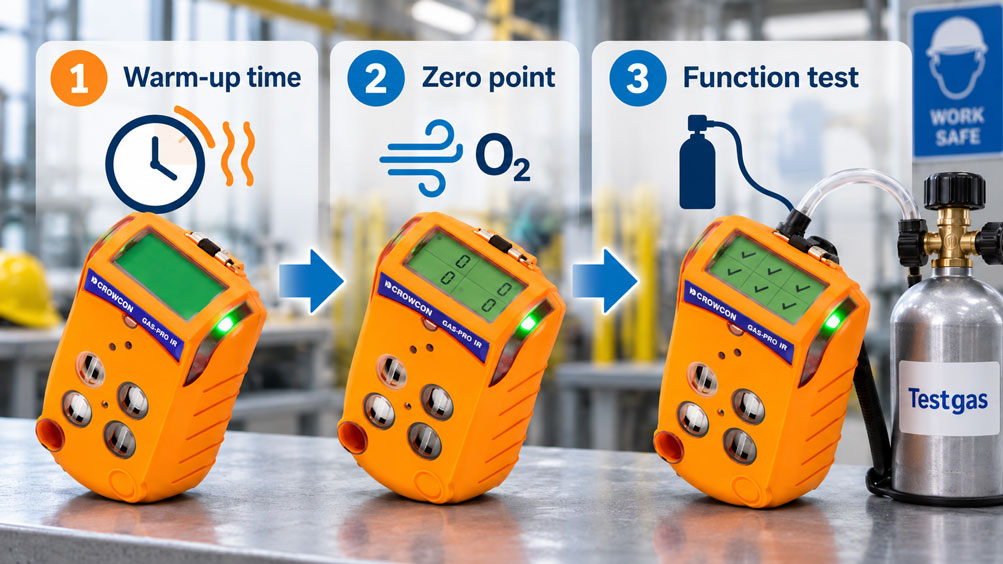
A portable multi-gas detector has been stored in a tool cabinet for several months following a plant shutdown. Before the next maintenance operation, it is switched on. The display works, the battery indicator appears normal and the sensors show seemingly normal readings.
But can the instrument immediately be used again for personal gas monitoring?
During extended storage, the characteristics of gas sensors may change. Electrochemical sensors can age, batteries may discharge, and unfavorable storage conditions can cause moisture damage or contamination.
A normal reading and a successful self-test are therefore not sufficient proof that a gas detector will provide reliable gas warnings.
Before reuse, the instrument-specific warm-up time, zero point or reference value, gas response and alarm functions must be checked. Depending on the condition and test results, additional calibration or sensor replacement may be necessary.
This article explains the differences between sensor technologies, bump testing and calibration, and presents a traceable procedure for recommissioning.
Table of Contents
- What Happens During Extended Storage?
- Preparing for Recommissioning
- Sensor Technologies and Storage Effects
- Storage Conditions and Sensor Ageing
- Checking the Battery and Instrument Condition
- Warm-Up Time and Stabilization
- Checking the Zero Point and Reference Atmosphere
- Practical Example: Testing a CO Detector After Storage
- Performing a Bump Test Correctly
- Distinguishing Bump Testing from Calibration
- Selecting Suitable Test Gas
- Test Gas Supply and Flow Rate
- Response Time and Sensor Behavior
- Testing Multi-Gas Detectors Completely
- Pump, Filters and Sampling Lines
- Audible, Visual and Vibration Alarms
- Calibration Due Dates and Sensor Service Life
- Safety Requirements and DGUV Guidelines
- Documenting Test Results
- Release Decision After Storage
- Typical Faults and Troubleshooting
- Suitable ICS Products
- Conclusion
- Frequently Asked Questions
1. What Happens During Extended Storage?
Even when a gas detector is switched off, certain components can continue to age.
In electrochemical sensors, for example, the electrolyte and electrode characteristics may change. Storage duration, temperature and humidity also influence subsequent performance.
Electronic components and batteries also have a limited storage life.
The potential changes depend on the specific sensor technology and storage conditions.
2. Preparing for Recommissioning
Before reusing the instrument, its model, serial number, storage duration and last documented test status should be established.
The operating instructions contain the relevant specifications for warm-up time, calibration, sensor service life and required functional checks.
An instrument that has been stored for an extended period should first be inspected and tested under suitable conditions outside any hazardous atmosphere.
It may only be used for its intended protective function once all required tests have been successfully completed.
3. Sensor Technologies and Storage Effects
Different gas detectors use different physical measuring principles.
| Sensor Technology | Typical Application | Important Checks |
|---|---|---|
| Electrochemical | CO, H₂S, O₂ and other suitable gases | Stabilization, sensitivity, sensor ageing and zero point |
| Pellistor (catalytic bead) | Flammable gases | Sensitivity, possible sensor poisoning, test gas response and required oxygen concentration |
| Infrared (IR) | Suitable hydrocarbons and CO₂ | Optics, contamination, zero point and gas response |
| Photoionization (PID) | Suitable volatile organic compounds | UV lamp, contamination, humidity effects and sensitivity |
| Other semiconductor and multi-gas technologies | Depending on sensor type and target gas | Instrument-specific stabilization, gas sensitivity and calibration |
The table describes potential effects. Not every sensor exhibits the same changes following extended storage.
4. Storage Conditions and Sensor Ageing
Gas detectors should be stored within the temperature and humidity limits specified by the manufacturer.
Extreme heat, freezing temperatures, condensation and chemical vapors can affect subsequent instrument performance.
Storage near solvents or silicone-containing substances can be particularly problematic for certain sensor technologies.
Even an unused sensor may have a limited service life due to its design and age.
5. Checking the Battery and Instrument Condition
Before switching on the instrument, the housing, display, gas inlets, filters and connections should be inspected for visible damage.
Rechargeable instruments should be charged according to the manufacturer’s instructions.
A battery icon indicating sufficient charge does not automatically confirm the actual available operating time. This may be reduced in ageing batteries.
The date, time, fault messages and stored maintenance notifications should also be checked.
6. Warm-Up Time and Stabilization
After switching on, certain gas sensors require a warm-up or stabilization period.
During this period, the sensor electronics are activated and internal test procedures may be performed.
After extended storage, the stabilization behavior of individual sensors may change.
The required warm-up time depends on the instrument and sensor. There is no universally applicable waiting period of five or ten minutes, for example.
The manufacturer’s instructions and the subsequent successful functional test are decisive.
7. Checking the Zero Point and Reference Atmosphere
For toxic gas sensors, the zero point is usually checked in a suitable atmosphere free from the respective target gas.
For detectors measuring flammable gases, the corresponding instrument-specific zero-point check applies.
An oxygen sensor, on the other hand, is typically evaluated against a known oxygen concentration. Clean ambient air contains approximately 20.9 vol.% oxygen.
Automatic fresh-air adjustment may only be performed if a suitable, uncontaminated atmosphere is actually present and the manufacturer specifies this procedure.
Incorrect zero adjustment can result in dangerous measurement errors.
8. Practical Example: Testing a CO Detector After Storage
A hypothetical CO gas detector has not been used for several months.
After inspection and stabilization, a bump test is performed using suitable carbon monoxide test gas.
All the following figures and acceptance criteria are freely selected example values. For a real instrument, only the specified test conditions and acceptance limits apply.
8.1 Initial Data
- Test gas concentration: 50 ppm CO.
- Example alarm threshold: 30 ppm CO.
- Measured value during test gas application: 45 ppm CO.
- Time to reach the specified test criterion: 18 seconds.
- Hypothetical minimum criterion: 80% of the test gas concentration.
- Hypothetical maximum permissible test time: 30 seconds.
8.2 Calculating the Test Gas Response
For a simplified evaluation, the ratio between the indicated concentration and the test gas concentration is calculated:
R = cIndicated / cTest gas · 100%
R = 45 / 50 · 100%
R = 90%
In this example, the instrument reaches 90% of the specified test gas concentration.
8.3 Evaluating the Minimum Criterion
The assumed minimum criterion is 80%:
50 ppm · 0.80 = 40 ppm
Since the indicated value is 45 ppm, this example criterion is fulfilled.
8.4 Evaluating Response Time
The measured test time is 18 seconds.
18 s < 30 s
Therefore, the hypothetical time criterion is also fulfilled.
The test time is not automatically equivalent to the standardized T90 response time of the sensor. Gas path, test procedure and evaluation threshold influence the measured time.
8.5 Checking the Alarm Function
During test gas application, it is also verified whether the configured alarm function is activated as intended.
In this example, the audible, visual and vibration alarms are successfully detected.
The alarm is reset after the test gas application has ended, according to the instrument’s functionality.
8.6 Summary of Results
| Test Parameter | Example Value | Evaluation |
|---|---|---|
| Test gas concentration | 50 ppm CO | Specified |
| Indicated concentration | 45 ppm CO | 90% of test gas concentration |
| Assumed minimum criterion | 40 ppm CO | Passed |
| Assumed maximum test time | 30 s | Specified |
| Achieved test time | 18 s | Passed |
| Visual alarm | Activated | Passed |
| Audible alarm | Activated | Passed |
| Vibration alarm | Activated | Passed |
8.7 Interpreting the Results Correctly
According to the hypothetical criteria, the described bump test would be considered successful.
However, the result does not confirm a complete calibration or comprehensive measurement accuracy over the entire measuring range.
Testing and calibration due dates, as well as other instrument requirements, must also be fulfilled before the gas detector can be used again.
9. Performing a Bump Test Correctly
During a bump test, suitable test gas is applied to the gas detector.
The test is intended to confirm that the relevant gas channel responds within the specified criteria and that the alarm functions operate correctly.
Test gas concentration, gas application method, test duration and acceptance criteria are determined by the manufacturer’s instructions and the company’s testing procedure.
A passed bump test does not automatically replace a calibration that is due.
10. Distinguishing Bump Testing from Calibration
A bump test is a targeted functional check. It verifies sufficient sensor response and alarm activation under specified conditions.
Calibration determines the metrological behavior using suitable reference gas concentrations.
If the instrument exhibits unacceptable deviations, adjustment or sensor replacement may be necessary.
After adjustment, the relevant functions must be checked again.
11. Selecting Suitable Test Gas
Test gas must be suitable for the sensor technology, target gas and intended testing procedure.
Important factors include the correct gas concentration, balance gas, expiry date and a suitable pressure regulator.
Suitable test gas mixtures may be used for multi-gas detectors, provided the manufacturer approves the combination for the respective instrument.
Expired test gas or an unsuitable gas composition can lead to incorrect test results.
12. Test Gas Supply and Flow Rate
The test gas flow rate must be suitable for the gas detector and the test adapter or docking station used.
Insufficient or unsuitable flow can affect gas application.
For manually performed tests, the specified regulators, adapters and hose lengths must be used.
Automatic testing stations can simplify gas application and documentation, provided they are compatible with the respective instrument and correctly configured.
13. Response Time and Sensor Behavior
Response time describes how quickly a sensor reacts to a change in gas concentration.
The T90 parameter is frequently used and describes the time required to reach 90% of a defined signal change.
A delayed response after extended storage may indicate sensor ageing, contaminated gas inlets or problems with the sampling system.
For a reliable assessment, the testing conditions specified by the manufacturer must be followed.
14. Testing Multi-Gas Detectors Completely
A multi-gas detector contains several sensors that may exhibit different ageing characteristics.
For example, a successful test of the CO channel does not automatically confirm the functionality of the H₂S, oxygen or combustible gas channel.
During recommissioning, all gas channels required for the intended application must therefore be considered.
The individually configured alarm thresholds must also be checked.
15. Pump, Filters and Sampling Lines
For gas detectors with active sampling, the sampling system must also be inspected.
This includes pump operation, inlet filters, hose connections and, where applicable, the specified flow monitoring function.
A blocked filter or damaged sampling line can prevent the gas being monitored from reaching the sensor in time.
For longer sampling lines, gas transport time and possible losses of certain gases must also be considered.
16. Audible, Visual and Vibration Alarms
A gas detector can only fulfill its protective function if a dangerous gas concentration is detected and signaled according to the intended alarm concept.
Depending on the instrument, audible signals, LEDs, display messages or vibration are used.
These functions must be verified during the specified functional check.
For stationary or networked instruments, alarm transmission and connected safety equipment may also be relevant.
17. Calibration Due Dates and Sensor Service Life
Extended storage does not automatically reset sensor ageing or the specified calibration interval.
Before reuse, it must therefore be checked whether calibration, maintenance or sensor replacement is due.
For instruments with a limited sensor or overall service life, the manufacturing date, activation date and any instrument-based lifetime counter may also be relevant.
An instrument that has exceeded its permissible service life must not continue to be used solely because it passes its power-on check.
18. Safety Requirements and DGUV Guidelines
In Germany, DGUV Information 213-056 and DGUV Information 213-057 are particularly relevant to gas detection systems.
DGUV Information 213-056 covers gas detection systems for toxic gases, vapors and oxygen. DGUV Information 213-057 addresses gas detection systems for explosion protection.
These publications cover selection, use, functional checks and maintenance, among other topics.
The type and frequency of required tests must be appropriate for the application and specified requirements.
A gas detector that has failed a required functional test must not be used for safety-related monitoring.
19. Documenting Test Results
The tests performed should be documented to ensure traceable recommissioning.
Important information includes instrument identification, date, test gas, testing procedure, results, calibration status and responsible person.
Automatic testing stations can store corresponding test records and assign them to the relevant instrument.
For larger instrument fleets, centralized management makes it easier to monitor testing due dates and instrument status.
20. Release Decision After Storage
The instrument should only be returned to service once all specified checks have been successfully completed.
A suitable procedure includes:
- Identification and assessment of storage conditions.
- Visual inspection and verification of the power supply.
- Switching on and instrument-specific stabilization.
- Checking the zero point or reference value.
- Bump testing with suitable test gas.
- Checking all required alarm functions.
- Verifying calibration due dates and sensor status.
- Documented release or withdrawal of the instrument from service.
If any abnormalities are detected, the cause must be investigated and the necessary additional tests performed.
21. Typical Faults and Troubleshooting
Sensor responds slowly after switching on: Check warm-up time, sensor condition and manufacturer instructions.
Zero point is unstable: Investigate the suitability of the reference atmosphere, possible interfering gases and sensor ageing.
Bump test failed: Check test gas, gas application, adapter and sensor sensitivity. Withdraw the instrument from service until the issue has been successfully resolved.
Display responds, but no alarm is activated: Check alarm thresholds, alarm outputs and instrument status.
Pump fault: Inspect filters, hoses, pump and sampling system according to manufacturer instructions.
Calibration overdue: Arrange the required calibration before the intended use.
22. Suitable ICS Products
ICS Schneider Messtechnik offers various portable gas detectors and automatic testing stations for industrial safety applications.
| Product | Important Functions | Typical Application |
|---|---|---|
| Crowcon UnoIQ | Single-gas detector, replaceable sensor modules, bump testing and calibration | Personal monitoring of a single gas hazard |
| Crowcon DuoIQ | Dual-gas detector, various sensor technologies, visual, audible and vibration alarms | Personal protection against two gas hazards |
| Crowcon DetectiveIQ | Area monitor with up to seven gas channels, optional sampling and networking | Temporary safety zones |
| Crowcon IQhub | Automatic bump testing, calibration, charging and test documentation | Recurring testing of compatible instruments |
| Crowcon Gas-Pro IR | Multi-gas detector, IR and other sensor technologies, optional pump | Industrial multi-gas monitoring and sampling |
22.1 Crowcon UnoIQ
The Crowcon UnoIQ is a compact personal single-gas detector with modular, replaceable sensor cartridges.
Depending on the configuration, electrochemical, IR, pellistor and other suitable sensors are available.
Integration with Crowcon IQhub enables automatic bump testing and calibration of compatible instruments.
Crowcon UnoIQ – Product Information
22.2 Crowcon DuoIQ
The Crowcon DuoIQ monitors up to two gas hazards simultaneously.
It features visual, audible and vibration alarms as well as different sensor technologies.
In combination with IQhub, the specified testing and calibration procedures can be automated.
Crowcon DuoIQ – Product Information
22.3 Crowcon DetectiveIQ
The DetectiveIQ is a portable multi-gas area monitor for monitoring temporary work areas and safety zones.
Depending on the configuration, up to seven gases can be monitored simultaneously.
For recommissioning after extended storage, the condition of the sensors, power supply and optional sampling system is particularly relevant.
Crowcon DetectiveIQ – Product Information
22.4 Crowcon IQhub
The Crowcon IQhub is an automatic testing, calibration and charging station for compatible portable Crowcon gas detectors.
According to manufacturer specifications, automatic bump tests can be completed in less than 10 seconds and calibrations in less than 30 seconds.
Actual testing time depends on the gas, sensor and configuration.
The station also supports the documentation and management of instrument tests.
Crowcon IQhub – Product Information
22.5 Crowcon Gas-Pro IR
The Crowcon Gas-Pro IR is a portable multi-gas detector with different sensor options, including infrared technology.
Suitable configurations are available with an integrated pump.
Before use following extended storage, the sampling pump, filters and sampling lines may also need to be checked in addition to the gas channels.
Crowcon Gas-Pro IR – Product Information
Additional Gas Measuring Instruments and Gas Detectors at ICS Schneider Messtechnik
23. Conclusion
After extended storage, a gas detector must not be returned to safety-related service based solely on a normal display reading.
Decisive factors include instrument condition, the specified warm-up time, a suitable zero-point check and verification of reliable sensor and alarm functionality.
A bump test verifies the intended gas response. Additional calibration may be necessary if calibration is overdue or measurement performance shows abnormalities.
For multi-gas detectors, all required gas channels must be considered.
The most important rule is: A gas detector may only be released for its intended protective function once all required functional checks have been successfully completed and documented.
24. Frequently Asked Questions
24.1 Can a Gas Detector Be Used Immediately After Extended Storage?
Only if the required instrument status and all prescribed checks have been successfully verified. A normal display reading alone is not sufficient.
24.2 Why Can Gas Detectors Age During Storage?
Sensors and batteries are subject to material- and technology-dependent ageing processes. Temperature and humidity can also influence their performance.
24.3 How Long Must a Gas Sensor Warm Up After Switching On?
The required warm-up time depends on the sensor and instrument configuration. Manufacturer instructions are decisive.
24.4 Is a Bump Test Required After Extended Storage?
The gas response test required for the intended application must have been successfully completed. Extended storage is an additional reason to check the testing status particularly carefully.
24.5 What Is a Bump Test?
A functional check in which suitable test gas is applied to verify the intended sensor response and alarm function.
24.6 Is a Bump Test the Same as Calibration?
No. A bump test checks functionality against specified criteria. Calibration determines metrological performance under defined conditions.
24.7 When Is Calibration Required?
When required by the established testing schedule, manufacturer instructions, special events or abnormal test results.
24.8 Can a Gas Sensor Be Defective Despite Showing Zero?
Yes. A sensor can display an apparently normal zero reading while responding inadequately to the target gas.
24.9 What Should an Oxygen Sensor Indicate in Clean Air?
Normal ambient air contains approximately 20.9 vol.% oxygen. The actual assessment must follow manufacturer specifications.
24.10 Can a Gas Detector Be Zeroed Automatically?
Suitable instruments offer corresponding functions. These may only be used under the reference conditions specified by the manufacturer.
24.11 What Should Be Done if the Bump Test Fails?
The instrument must not be used for its intended protective function. Test gas, test setup and instrument condition must be checked, and the necessary corrective actions performed.
24.12 Can an Old Sensor Still Work?
Yes, this is possible. However, permissible service life, calibration status and successfully verified functionality are decisive.
24.13 Can Batteries Discharge During Storage?
Yes. Rechargeable batteries in particular can discharge and age during prolonged periods of non-use.
24.14 Must All Sensors in a Multi-Gas Detector Be Tested?
All gas channels required for the intended application must meet the applicable testing requirements.
24.15 Why Is the Sampling Pump Important?
An inadequately functioning pump or blocked sampling line can prevent the target gas from reaching the sensor in time.
24.16 Which DGUV Publications Are Relevant?
DGUV Information 213-056 and 213-057 cover the use and operation of gas detection systems for toxic gases, oxygen and explosion protection.
24.17 Can Automatic Testing Stations Simplify Recommissioning?
Yes. Suitable systems such as the Crowcon IQhub enable automated bump tests, calibrations and documented testing procedures for compatible instruments.
24.18 What Information Does ICS Need for a Service or Calibration Inquiry?
The required information includes manufacturer, instrument model, serial number, sensor configuration, storage duration, last calibration status, fault messages and the requested testing or maintenance service.