


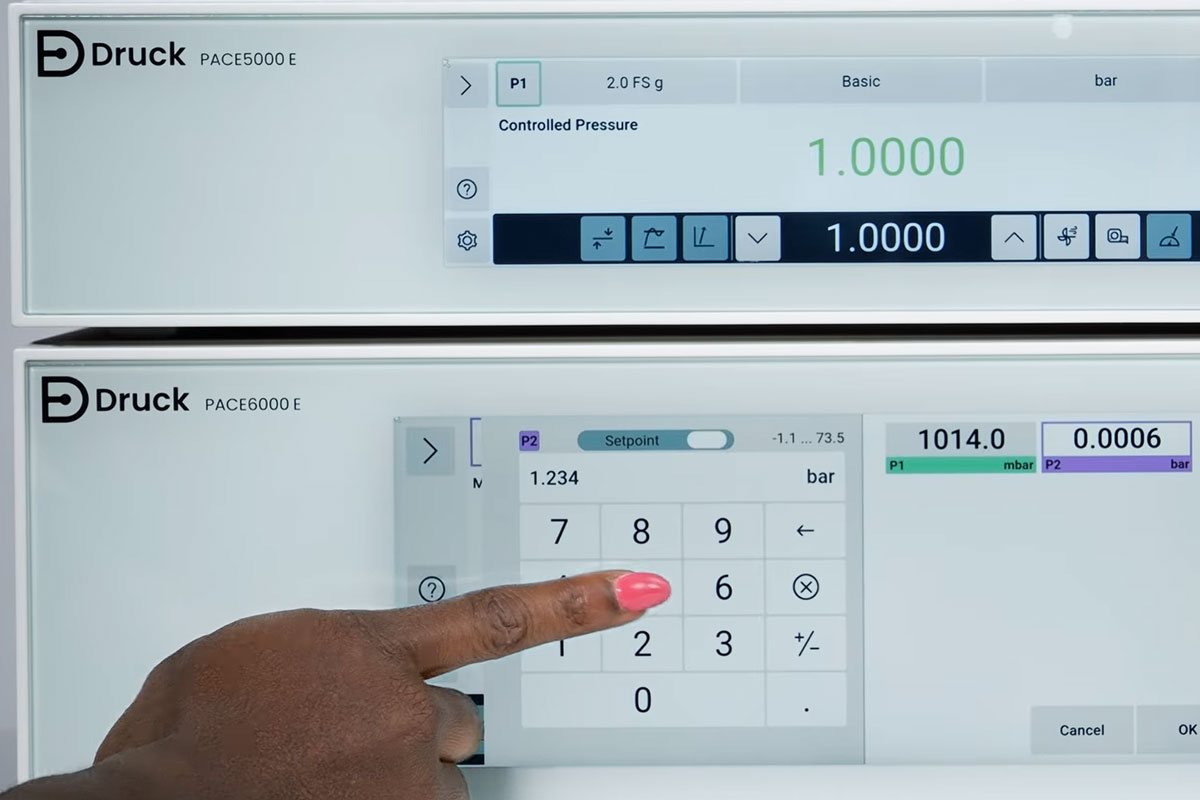
Source: Druck PACE5000 E & 6000 E Product Overview Video (English)
→ PRODUCT → DatasheetAutomated Pressure Calibration with the PACE6000E
The requirements for modern calibration processes continue to increase. In virtually every industrial sector, pressure sensors, pressure transmitters, pressure switches, and digital pressure gauges must be regularly tested, calibrated, and documented. At the same time, companies face increasing cost pressures and must make their testing processes more efficient. Traditional manual calibration methods often reach their limits under these conditions.
Each calibration point must be manually generated, stabilized, read, and documented. This consumes valuable time while simultaneously increasing the risk of operator errors. Especially when dealing with larger quantities of instruments or recurring calibration tasks, the workload can become substantial.
This is where automated pressure calibration comes into play. Modern pressure controllers automatically handle pressure generation, pressure control, and communication with calibration software. The operator simply defines the test sequence. The system then automatically moves through all pressure points and documents the results.
One of the most powerful solutions for these tasks is the PACE6000E High-Precision Pressure Controller from Druck. Thanks to its fast pressure control performance, modular architecture, and extensive automation capabilities, it is ideally suited for both industrial test benches and demanding calibration laboratories.
The PACE6000E becomes particularly valuable wherever large numbers of pressure measuring instruments are tested regularly or where strict requirements for traceability, documentation, and measurement uncertainty exist. The ability to use two pressure ranges simultaneously and switch automatically between them significantly reduces setup times and increases productivity.
In this article, you will learn how automated pressure calibrations work, the advantages they offer compared to manual methods, and why the PACE6000E is considered one of today’s most capable pressure controllers for automated calibration applications.
Why Automated Pressure Calibration Is Becoming Increasingly Important
Only a few years ago, many calibrations were still performed entirely manually. The operator generated the required pressure, waited for stabilization, recorded the reference instrument readings, and compared them with the readings of the device under test. This process had to be repeated for every individual calibration point.
For a small number of calibrations per day, this approach was perfectly practical. However, modern production facilities and calibration environments often operate with significantly higher volumes. In many companies, dozens or even hundreds of pressure instruments must be verified every day.
At the same time, documentation requirements continue to grow. Quality management systems according to ISO 9001 and accredited calibrations according to ISO/IEC 17025 require complete traceability of all measurement results. Manual record-keeping increases the risk of transcription errors and makes long-term archiving more difficult.
Automated calibration systems solve these challenges. The pressure controller independently manages pressure control and communicates directly with calibration software. Measurement data is automatically stored, evaluated, and documented. This significantly reduces workload while simultaneously improving the quality of the results.
Companies benefit from several advantages:
- Significantly shorter calibration times
- Higher utilization of test benches
- Reduction of operator errors
- Improved measurement quality
- Automatic data acquisition
- Complete traceability
- Lower operating costs per calibration
- Standardized testing procedures
Calibration laboratories, testing service providers, and manufacturing facilities in particular can achieve substantial economic benefits through automation.
What Is Automated Pressure Calibration?
Automated pressure calibration refers to the automatic generation, control, measurement, and documentation of pressure values within a calibration process.
The user first defines the required calibration points. These may be, for example, 0%, 25%, 50%, 75%, and 100% of the measuring range of a pressure transmitter. The pressure controller then takes over the entire pressure regulation process.
The system automatically moves to each calibration point, monitors pressure stability, and transfers the measurement values to the calibration software. There, the measured values are automatically compared with the target values and documented.
The operator no longer needs to manually operate valves or adjust individual pressure values. As a result, calibrations become not only faster but also significantly more reproducible.
Another advantage is that calibration procedures can be repeated as often as required. Every device under test follows exactly the same test sequence. This improves the comparability of results and simplifies compliance with internal quality standards.
Modern systems such as the PACE6000E can be fully integrated into calibration and testing systems. This creates seamless digital processes, from pressure generation to the automatic creation of calibration certificates.
The PACE6000E as a Central Pressure Control Platform
The PACE6000E has been specifically developed for high-precision pressure control and calibration applications. It combines the functionality of a highly accurate reference pressure standard with the capabilities of modern automation technology.
The system is based on a modular architecture and can be equipped with various CM and CM3 control modules. This allows the pressure controller to be precisely configured for the specific application.
Particularly noteworthy is the ability to operate two independent control modules simultaneously. This allows different pressure ranges to be used without reconfiguration. The result is reduced downtime and significantly increased productivity, especially in calibration laboratories.
When equipped with high-precision CM3 control modules, the PACE6000E utilizes TERPS technology (Trench Etched Resonant Pressure Sensor). These sensors provide exceptional accuracy, low hysteresis, outstanding repeatability, and extremely low long-term drift.
Key features of the PACE6000E include:
- Two independent pressure control channels
- Modular CM and CM3 control modules
- TERPS reference sensors for the highest levels of accuracy
- Fast pressure generation and venting rates
- Auto-Ranging functionality
- Ethernet, USB, and RS232 interfaces
- Optional IEEE-488/GPIB support
- SCPI support for automation applications
- Excellent long-term stability
- Easy integration into test benches and calibration systems
These capabilities make the PACE6000E suitable for both industrial testing applications and accredited calibration laboratories with the highest requirements for accuracy and traceability.
Advantages of Automation Compared to Manual Calibration
The biggest difference between manual and automated pressure calibration lies in the degree of process automation. While manual procedures require many tasks to be performed by the operator, an automated calibration system allows the pressure controller to carry out most of these tasks independently.
In a traditional manual calibration process, the operator must set each individual pressure point, monitor pressure stability, read the reference values, and then document the measurement results. Depending on the number of calibration points, this procedure can be very time-consuming.
Additional sources of error arise from manual data entry, reading errors, or insufficiently stabilized pressure points. These factors can negatively affect measurement quality and often lead to longer calibration times.
An automated calibration system using the PACE6000E, on the other hand, operates according to a predefined test sequence. Each pressure point is automatically generated, controlled, and documented. As a result, calibrations become highly reproducible and independent of the individual operator.
| Manual Calibration | Automated Calibration with PACE6000E |
|---|---|
| Manual pressure point adjustment | Automatic pressure generation |
| Operator-dependent results | Standardized test procedures |
| Manual data entry | Automatic data acquisition |
| Higher risk of errors | Reduced operator errors |
| Longer calibration times | Shorter test cycles |
| Difficult result comparison | High reproducibility |
Especially in applications involving large quantities of instruments or recurring calibration tasks, the resulting time savings can quickly add up to several hours per week. At the same time, result consistency improves because every calibration follows exactly the same procedure.
Dual-Channel Technology: Two Pressure Ranges in One System
One of the key features of the PACE6000E is its dual-channel architecture. While single-channel pressure controllers can only provide one installed pressure range at a time, the PACE6000E can accommodate two independent control modules simultaneously.
This allows, for example, a low-pressure range and a high-pressure range to be available at the same time. Users can switch directly between the ranges without replacing pressure modules or using additional instruments.
Many calibration laboratories process devices with widely varying pressure ranges every day. A pressure transmitter with a range of 250 mbar requires very different calibration conditions than a sensor rated for 70 bar or 100 bar. With a conventional single-channel system, multiple reference systems are often required.
The PACE6000E significantly simplifies this process. Two different pressure ranges remain permanently available and can be used whenever needed.
The benefits are clear:
- No setup time when changing pressure ranges
- Higher laboratory productivity
- Fewer operator errors
- Reduced equipment inventory
- Greater flexibility for changing test requirements
For calibration service providers and large in-house calibration laboratories in particular, this can result in a significant increase in operational efficiency.
Auto-Ranging for Maximum Accuracy
A unique feature of the PACE6000E is its Auto-Ranging capability. This function intelligently combines two installed control modules.
In practice, this means that the system automatically selects the pressure range that provides the lowest measurement uncertainty for the current calibration point.
For example, assume the following modules are installed:
- CM3 Module A: 0 to 1 bar
- CM3 Module B: 0 to 70 bar
For calibration points within the lower pressure range, the system automatically uses the 1-bar module. Once the test pressure exceeds this range, the system switches automatically to the 70-bar module.
This ensures that the user always benefits from the highest possible resolution and accuracy. At the same time, manual range selection becomes unnecessary.
In automated calibration sequences involving many different devices under test, this represents a major advantage. Test procedures can run completely automatically while the system independently selects the most appropriate measurement range.
Integration into Test Benches and Calibration Systems
Modern calibration processes consist of much more than a pressure controller alone. In many cases, calibration software, PLC systems, test bench controllers, and database systems are also involved.
The PACE6000E has been specifically designed to meet these requirements. Thanks to its open communication architecture, it can be integrated easily into existing systems.
Many companies use the pressure controller as the central pressure source within automated test benches. In these applications, the PACE6000E provides highly accurate pressure control while higher-level software manages the overall test procedure.
Typical integration scenarios include:
- Automated calibration laboratories
- Production test benches
- End-of-line testing systems
- Research and development test facilities
- Pressure transmitter test systems
- Quality assurance systems
This allows the PACE6000E to be used both as a standalone pressure controller and as a key component within complex automation solutions.
Interfaces and Communication
The success of any automation project largely depends on how easily a device can be integrated into existing systems. The PACE6000E has been specifically designed for this purpose and offers a wide range of standardized communication interfaces.
This allows the pressure controller to be integrated into both modern Industry 4.0 environments and existing calibration systems. Companies do not need to replace their entire infrastructure but can gradually integrate the PACE6000E into their current processes.
The following communication interfaces are available:
- Ethernet / LAN
- USB
- RS232
- Optional IEEE-488 / GPIB
- SCPI command set
Support for SCPI commands (Standard Commands for Programmable Instruments) is particularly important for automated test benches. Standardized commands can be used to set pressure values, retrieve measurement data, or automate complete testing procedures.
This enables the PACE6000E to communicate seamlessly with calibration software, laboratory management systems, or custom automation solutions.
For many users, this represents a major advantage because existing test programs can often continue to be used with only minimal modifications.
Typical Automated Pressure Calibration Procedure
The calibration process in automated systems always follows a similar principle. The key difference compared to manual calibration is that nearly all process steps are executed automatically.
A typical calibration procedure using the PACE6000E is as follows:
- Connect the device under test
- Select the calibration program
- Define the pressure range
- Specify the calibration points
- Start the calibration sequence
- Automatically generate and control pressure points
- Allow pressure stabilization
- Acquire measurement data
- Calculate deviations
- Generate a calibration report
- Store and archive the results
Throughout the entire calibration process, the operator only needs to supervise the procedure. Pressure control, data acquisition, and calculations are performed automatically.
This allows even less experienced personnel to perform standardized calibrations without compromising the quality of the results.
Practical Example: Calibration Laboratory with High Throughput
An industrial calibration laboratory calibrates several hundred pressure transmitters each day for a wide range of customers. Measurement ranges extend from a few millibars up to several dozen bar.
Before implementing an automated system, different reference instruments had to be used and pressure ranges had to be changed frequently. In addition, documentation was partly performed manually.
After introducing the PACE6000E, two different pressure ranges became available simultaneously. The calibration software took over automatic control of the calibration procedures.
The results were clearly measurable:
- Reduced setup times
- Higher daily throughput of devices under test
- Fewer operator errors
- Improved documentation
- Higher utilization of calibration workstations
- More consistent measurement results
Particularly at high calibration volumes, the calibration cost per device could be significantly reduced.
Traceability, Documentation, and Quality Assurance
A calibration is only valuable if its results can be documented and traced reliably. This is one of the main reasons why automatic data acquisition is becoming increasingly important in modern calibration laboratories.
The PACE6000E supports automatic storage of all relevant calibration data, including:
- Pressure values
- Timestamps
- Measurement deviations
- Device-under-test information
- Calibration programs
- User information
This creates complete documentation of the entire calibration process. As a result, compliance with regulatory and quality requirements becomes significantly easier.
This is particularly important for organizations operating according to standards such as:
- ISO 9001
- ISO/IEC 17025
- DAkkS requirements
- FDA regulations
- Internal quality standards
In addition, calibration reports can be generated and archived automatically. This significantly reduces administrative effort while improving the traceability of all calibration activities.
When Does Automation Make Sense?
Not every calibration process necessarily requires automation. For occasional calibrations performed only a few times per week, a manual procedure may still be sufficient.
The situation changes when larger numbers of pressure instruments must be calibrated regularly or when extensive documentation requirements exist.
Automation is particularly beneficial when:
- Calibrations are performed on a regular basis
- Multiple employees are involved in testing processes
- High repeatability is required
- Calibration times need to be reduced
- Documentation effort should be minimized
- Regulatory requirements must be met
- Large numbers of devices under test are processed
In many cases, the investment pays for itself within a relatively short period through labor savings and increased productivity.
Conclusion: More Efficient Calibration Processes with the PACE6000E
Automating pressure calibration is one of the most effective ways to make testing processes more efficient, reliable, and cost-effective. Modern organizations benefit not only from shorter calibration times but also from significantly improved documentation and greater process security.
With the PACE6000E, users have access to a powerful pressure controller specifically developed for these requirements. The combination of dual-channel technology, Auto-Ranging functionality, TERPS precision sensors, and extensive communication capabilities makes it an ideal solution for automated calibration and testing applications.
Calibration laboratories, manufacturing facilities, and testing service providers in particular can increase productivity, improve measurement quality, and reduce long-term operating costs through the use of automated pressure calibration systems.
Frequently Asked Questions About Automated Pressure Calibration
What Is Automated Pressure Calibration?
Automated pressure calibration is a process in which predefined pressure points are generated, controlled, measured, and documented automatically. The operator only defines the test parameters, while the calibration system manages pressure generation, pressure control, data acquisition, and documentation. This significantly reduces manual effort while improving the repeatability of measurement results.
What Advantages Does the PACE6000E Offer Compared to Manual Calibration?
The PACE6000E provides automatic pressure control with high speed and precision. Calibration points are automatically generated and stabilized, reducing test times, minimizing operator errors, and enabling fully automated documentation of calibration results.
Which Applications Is the PACE6000E Best Suited For?
The PACE6000E is ideally suited for calibration laboratories, industrial test benches, production environments, research and development departments, and calibration service providers. Its benefits become particularly evident when handling large numbers of devices under test or applications involving frequently changing pressure ranges.
Can the PACE6000E Be Integrated into Existing Test Systems?
Yes. The PACE6000E has been specifically designed for integration into automated calibration and testing systems. Ethernet, USB, RS232, and optional IEEE-488/GPIB interfaces allow seamless communication with calibration software, PLCs, and custom testing applications.
What Does Auto-Ranging Mean?
Auto-Ranging automatically selects the most suitable pressure range from two installed control modules. The PACE6000E always uses the range that provides the best resolution and lowest measurement uncertainty, ensuring maximum accuracy across a wide pressure range.
What Are the Benefits of Dual-Channel Technology?
The ability to install two different control modules simultaneously allows multiple pressure ranges to be available without reconfiguration. This reduces setup times, minimizes operator intervention, and significantly increases productivity, especially in calibration laboratories.
Can the PACE6000E Operate Two Pressure Channels Simultaneously?
Yes. The PACE6000E features two independent pressure control channels. This allows two pressure ranges to be available at the same time and supports advanced testing applications, comparison measurements, and automated test benches.
What Is the Role of CM3 Control Modules?
The optional CM3 control modules largely determine the overall measurement performance of the system. Utilizing TERPS technology, they provide extremely low measurement uncertainty, exceptional long-term stability, excellent repeatability, and minimal hysteresis.
What Is TERPS Technology?
TERPS stands for Trench Etched Resonant Pressure Sensor. Unlike conventional pressure sensors that rely on resistance changes, TERPS technology measures pressure through highly stable resonant frequency changes. This results in exceptional accuracy, outstanding repeatability, excellent temperature stability, and extremely low long-term drift.
Which Pressure Media Can Be Used?
The PACE6000E is designed for clean, dry, non-corrosive, and non-flammable gases. Typical pressure media include compressed air and nitrogen. The use of alternative media should always be verified against the manufacturer’s specifications.
Does the PACE6000E Support SCPI Commands?
Yes. The pressure controller supports industry-standard SCPI commands, making it ideal for integration into automated calibration systems, test benches, and laboratory automation software.
Can Calibration Documentation Be Generated Automatically?
Yes. When connected to appropriate calibration software, all measurement values can be automatically recorded, evaluated, and documented. Calibration certificates and test reports can be generated quickly and consistently without manual data entry.
Is the PACE6000E Suitable for ISO and Accredited Calibration Applications?
Yes. The high accuracy, complete traceability, and extensive documentation capabilities make the PACE6000E well suited for applications requiring compliance with ISO 9001, ISO/IEC 17025, and similar quality standards.
Which Pressure Ranges Can Be Covered?
The available pressure range depends on the installed CM or CM3 control modules. Thanks to its modular architecture, the PACE6000E can be configured for applications ranging from very low pressures to high-pressure calibration requirements.
Can Existing PACE Control Modules Continue to Be Used?
Yes. Existing compatible PACE control modules can typically be reused, helping protect previous investments and simplifying upgrades to newer calibration systems.
When Does It Make Sense to Automate Pressure Calibration?
Automation is particularly beneficial when calibrations are performed regularly, when large numbers of instruments are tested, when extensive documentation is required, or when calibration times need to be reduced. In many cases, the investment is recovered quickly through labor savings and increased productivity.
Is the PACE6000E Suitable for Production Test Benches?
Absolutely. Its fast pressure control performance and straightforward integration capabilities make the PACE6000E an excellent choice for production and end-of-line testing applications. Testing procedures can be standardized and fully automated.
How Does Automation Improve Measurement Quality?
Automated calibration eliminates many common sources of human error. Pressure points are always generated, stabilized, and documented in exactly the same way, resulting in highly reproducible and comparable measurement results.
What Benefits Does Automation Provide for Calibration Laboratories?
Calibration laboratories benefit from shorter turnaround times, higher throughput, reduced operator errors, improved documentation quality, and more efficient utilization of laboratory resources. This increases both profitability and operational efficiency.
Why Is the PACE6000E Considered a Reference Pressure Controller?
The combination of high-accuracy TERPS sensors, modular CM3 control modules, Auto-Ranging functionality, dual-channel architecture, and outstanding long-term stability enables the PACE6000E to meet the demanding requirements of modern calibration laboratories and reference measurement applications.