


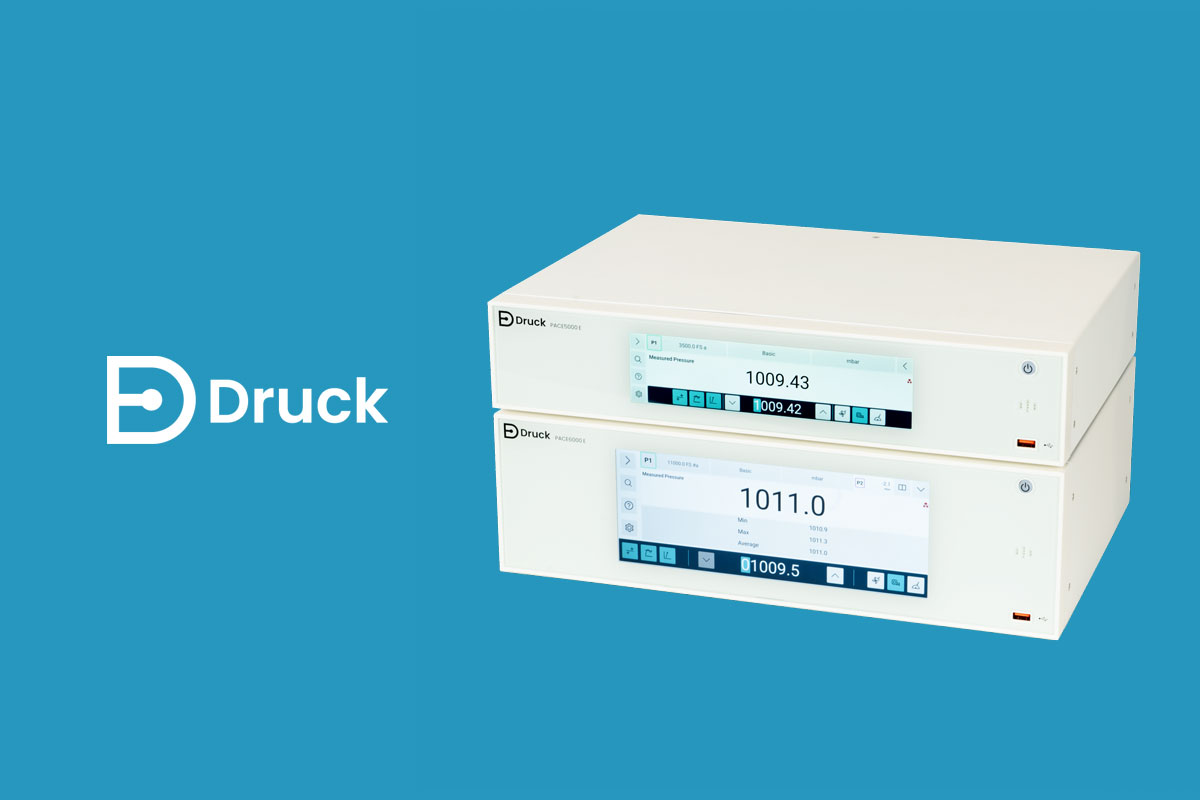
With the introduction of the new PACE5000E and PACE6000E pressure controller generation, Druck offers two state-of-the-art pressure control systems for calibration, testing, and automation applications. Both instruments are based on the same platform, use the same interchangeable CM and CM3 control modules, and provide high control speed, stability, and precision.
Nevertheless, there are significant differences. The key question is: Is a single-channel pressure controller sufficient, or does a dual-channel system offer decisive advantages? In this article, we compare both systems and show which applications are best suited for the PACE5000E and which benefit most from the PACE6000E.
The Shared Technology Platform
Both the PACE5000E and the PACE6000E are based on Druck’s latest generation of electronic precision pressure controllers. Both systems offer:
- Fully digital pressure control
- Interchangeable CM and CM3 control modules
- TERPS sensor technology for the highest levels of accuracy
- Fast pressure generation and venting rates
- Excellent long-term stability
- Ethernet, USB, and RS232 interfaces
- Optional IEEE-488/GPIB communication
- Automation capability via SCPI commands
- Leak test and pressure switch test functions
- Compatibility with existing PACE control modules
The actual measurement accuracy is not determined by the base unit itself but by the installed control module. A PACE5000E equipped with a CM3 module achieves the same accuracy as a PACE6000E equipped with the identical CM3 module.
Technical Comparison
| Feature | PACE5000E | PACE6000E |
|---|---|---|
| Number of Control Channels | 1 | 2 |
| Maximum Number of Control Modules | 1 | 2 |
| Simultaneous Pressure Control | No | Yes |
| Auto-Ranging | No | Yes |
| Rack Height | 2U | 3U |
| CM3 Compatibility | Yes | Yes |
| Ethernet, USB, RS232 | Yes | Yes |
| Typical Application | Calibration, Service, Production | Calibration Laboratory, Automation, Research |
When Is the PACE5000E the Better Choice?
The PACE5000E is a single-channel precision pressure controller and is particularly suitable for applications where a single pressure range must be controlled reliably, quickly, and with high accuracy. For many calibration, testing, and production applications, one channel is entirely sufficient. At the same time, the PACE5000E is the more economical solution, as only one base unit and one control module are required.
Typical applications include the calibration of pressure sensors, pressure transmitters, and digital pressure gauges, as well as the testing of pressure switches. The PACE5000E is also an excellent choice for production and end-of-line test benches where devices under test are processed sequentially and no parallel dual-channel operation is required.
Another advantage is its compact design. The PACE5000E can be easily integrated into workshop environments, test stations, or existing calibration systems. Service and maintenance departments particularly benefit from its ease of use, high control speed, and precise pressure regulation.
The PACE5000E is also often sufficient for factory calibration laboratories where similar pressure ranges are routinely tested. Thanks to its interchangeable CM and CM3 control modules, the system can be adapted flexibly to different requirements. The actual measurement performance is determined by the installed control module.
The PACE5000E is particularly recommended when:
- Only one pressure range needs to be controlled
- Only one device under test is processed at a time
- An economical solution with high accuracy is required
- Available rack or test bench space is limited
- Service, workshop, or production applications are the primary focus
- No automatic switching between multiple pressure ranges is required
Since only one control module is required, investment costs are lower. At the same time, users benefit from the same pressure control quality available in larger systems. Therefore, the key factor is not the base unit itself but selecting the most suitable control module for the required pressure range.
Practical Example
A pressure transmitter manufacturer calibrates several hundred sensors per day in the range of 0 to 16 bar. Since only one device under test is processed at a time and the pressure range remains constant, the PACE5000E provides an ideal combination of precision, speed, and cost-effectiveness. Investment costs remain manageable while delivering the same high level of pressure control performance available in larger systems.
When Is the PACE6000E Worth Considering?
The PACE6000E is a dual-channel precision pressure controller and offers significantly more flexibility than a single-channel system. It can be equipped with two independent CM or CM3 control modules, making it particularly suitable for demanding calibration, testing, and automation applications.
The biggest difference compared to the PACE5000E is that two different pressure ranges can be installed in the instrument simultaneously. This eliminates the time-consuming process of changing modules when switching between pressure ranges. Users can switch directly between installed modules or take advantage of the Auto-Ranging function.
Calibration laboratories, in particular, benefit from this flexibility. Pressure sensors, transmitters, and gauges with vastly different measurement ranges often need to be calibrated throughout the day. With the PACE6000E, multiple pressure ranges are immediately available within a single instrument.
Another advantage is the ability to use two independent pressure channels simultaneously. This enables comparison measurements, parallel testing procedures, and complex automated test sequences. As a result, testing times can be reduced while improving overall process efficiency.
The Auto-Ranging function is especially valuable. The PACE6000E automatically selects the most suitable pressure range for the current application, ensuring the best possible accuracy over a wide operating range without requiring any manual intervention.
The PACE6000E is particularly recommended for:
- Calibration laboratories with frequently changing pressure ranges
- Automated test benches
- Research and development departments
- Multi-range calibration applications
- Comparison and reference measurements
- Aerospace, industrial, and metrology applications
- Highly automated production testing
- Applications requiring maximum flexibility and efficiency
The higher initial investment can often be recovered quickly when frequent switching between pressure ranges is required or when multiple testing processes are running in parallel.
Practical Example
A calibration laboratory tests pressure instruments ranging from 100 mbar to 70 bar every day. With a single-channel system, control modules would need to be exchanged regularly, or additional instruments would have to be maintained. The PACE6000E, however, can accommodate two different control modules simultaneously and automatically select the most appropriate pressure range. This significantly reduces setup times and increases laboratory productivity.
The Major Advantage: Auto-Ranging
One of the greatest advantages of the PACE6000E is its Auto-Ranging functionality. For example, two different control modules can be installed:
- Module 1: 0 to 1 bar
- Module 2: 0 to 70 bar
The system automatically uses the most suitable measurement range for the current pressure. This ensures the highest possible accuracy across a wide pressure range without requiring the user to manually switch modules.
Using Two Pressure Channels Simultaneously
The PACE6000E allows two independent pressure channels to be used simultaneously. This provides significant advantages for comparison measurements, test benches with multiple devices under test, research applications, automated calibration procedures, and applications involving frequently changing pressure ranges.
Cost-Effectiveness Considerations
The PACE5000E Is Often the Better Choice When:
- Only one pressure range is required
- Only one device under test is processed at a time
- Auto-Ranging functionality is not required
- Rack space is limited
- The investment budget needs to be optimized
The PACE6000E Is Particularly Beneficial When:
- Multiple pressure ranges are used regularly
- Testing procedures need to be automated
- Testing times must be reduced
- Maximum flexibility is required
- Future expansion is planned
What Role Do CM3 Control Modules Play?
The actual measurement performance of both instruments is primarily determined by the installed control modules. Particularly powerful are the optional CM3 control modules featuring TERPS technology.
- Extremely high accuracy
- Outstanding long-term stability
- Very low hysteresis
- Excellent temperature stability
- Outstanding repeatability
For high-precision calibration applications, selecting the correct CM3 module is often more important than choosing between the PACE5000E and PACE6000E.
Selection Guide
| Requirement | Recommendation |
|---|---|
| Individual calibration tasks | PACE5000E |
| Production test benches | PACE5000E |
| Service and maintenance | PACE5000E |
| Calibration laboratory | PACE6000E |
| Multiple pressure ranges without module changes | PACE6000E |
| Automated testing systems | PACE6000E |
| Maximum flexibility | PACE6000E |
| Lowest investment cost | PACE5000E |
Conclusion
The PACE5000E is the ideal solution for users who need to control a single pressure range with high precision, speed, and cost efficiency. It provides virtually everything required for production testing, service applications, and routine calibration tasks.
The PACE6000E, on the other hand, is designed for users requiring maximum flexibility. With two independent control modules, Auto-Ranging functionality, and the ability to use multiple pressure ranges simultaneously, it is particularly well suited for calibration laboratories, research facilities, and complex test systems.
The most important takeaway is that accuracy is not determined by the base instrument itself but by the installed CM or CM3 control module. Users requiring the highest levels of precision should therefore pay particular attention to selecting the most appropriate control module for their application.
Frequently Asked Questions (FAQ)
Is the PACE6000E more accurate than the PACE5000E?
No. Measurement accuracy is determined by the installed CM or CM3 control module. When equipped with identical modules, both the PACE5000E and PACE6000E provide the same measurement accuracy.
Can I use the same control modules in both instruments?
Yes. CM and CM3 control modules are fully compatible with both the PACE5000E and the PACE6000E. This protects existing investments and allows users to migrate between systems if required.
What does Auto-Ranging mean?
Auto-Ranging allows the PACE6000E to automatically select the most appropriate pressure range from two installed control modules. This ensures optimum accuracy across a wide pressure range without requiring manual intervention.
When is a PACE5000E completely sufficient?
If only one pressure range is required and only one device under test is processed at a time, the PACE5000E is usually the most economical and practical solution.
Who benefits most from a PACE6000E?
The PACE6000E is particularly beneficial for calibration laboratories, research departments, automated test systems, and users who regularly work with multiple pressure ranges.
Can the PACE6000E provide two pressure ranges simultaneously?
Yes. Two different control modules can be installed at the same time and are immediately available without requiring any mechanical changes.
Can the PACE6000E control two pressure channels simultaneously?
Yes. The PACE6000E features two independent pressure control channels, making it suitable for complex testing applications, comparison measurements, and advanced automation tasks.
What is the advantage of TERPS technology?
TERPS (Trench Etched Resonant Pressure Sensor) technology used in CM3 control modules provides exceptional accuracy, low hysteresis, excellent temperature stability, outstanding repeatability, and superior long-term stability.
Are both systems suitable for automated calibration systems?
Yes. Both the PACE5000E and PACE6000E support Ethernet, USB, RS232, and SCPI commands, allowing seamless integration into automated calibration and testing systems.
Can I upgrade from a PACE5000E to a PACE6000E later?
Yes. Existing CM and CM3 control modules can continue to be used in a PACE6000E, helping to protect previous investments.
Which instrument is better suited for production test benches?
For standard production testing applications, the PACE5000E is often sufficient. However, if multiple pressure ranges or more complex testing procedures are required, the PACE6000E offers additional advantages.
Which instrument is better suited for calibration laboratories?
For demanding calibration laboratory environments, the PACE6000E is often the preferred choice due to its flexibility, Auto-Ranging functionality, and dual-channel architecture.
Do both systems support the same communication interfaces?
Yes. Both instruments support Ethernet, USB, and RS232 as standard. Optional IEEE-488/GPIB interfaces are also available for integration into existing automated test systems.
Can pressure ranges be changed later?
Yes. Thanks to the modular architecture of the PACE platform, CM and CM3 control modules can be exchanged as application requirements change.
What pressure media can be used with PACE pressure controllers?
The PACE5000E and PACE6000E are designed for use with clean, dry, non-corrosive, and non-flammable gases. Typical media include dry air and nitrogen.