


In hygienic processes, it is not enough to measure flow only approximately. In the food, beverage and pharmaceutical industries, quantities must be dosed precisely, recipes must be reproduced reliably, product changes must be controlled safely and cleaning processes must be traceable. At the same time, measuring instruments must not create hygienic weak points. Dead spaces, unsuitable materials, surfaces that are difficult to clean or incorrect process connections can impair product quality, process safety and plant availability.
Coriolis flowmeters are particularly interesting for such applications because they measure mass flow directly and can also provide important process variables such as density and temperature. This is especially valuable when media have different densities, viscosities or temperatures, when recipes must be followed precisely or when product changes and quality control play an important role.
This article explains when Coriolis flow measurement is useful in hygiene applications and what should be considered in food, beverage and pharmaceutical processes. The focus is on hygienic process connections, stainless steel, surfaces, cleanability, CIP/SIP, density and temperature measurement, viscosity, product changes, recipe processes, quality control, certificates, documentation and suitable solutions such as the SITRANS FCS500 Coriolis flow sensor for standard and hygiene applications.
Table of contents
- Basics: why Coriolis is interesting in hygiene processes
- Hygiene requirements: more than just stainless steel
- SITRANS FCS500: Coriolis sensor for standard and hygiene applications
- Mass flow, density and temperature in one measuring system
- Hygienic process connections and integration into the plant
- CIP and SIP: considering cleaning and sterilization correctly
- Viscosity, product changes and difficult media
- Recipes, dosing and quality control
- Installation, pressure loss and plant planning
- Output signals, PLC connection and checking the measuring chain
- Certificates, materials and documentation
- Typical errors with Coriolis measurements in hygiene applications
- Practical example: recipe dosing in food production
- Which measuring instruments / products are suitable?
- Conclusion: Coriolis is strong when hygiene and accuracy come together
- FAQ: frequently asked questions about Coriolis flowmeters in hygiene processes
Basics: why Coriolis is interesting in hygiene processes
A Coriolis flowmeter measures mass flow directly. This distinguishes it from many other flow measurement principles, which first measure velocity or volume flow and then use additional assumptions or compensation to derive mass, quantity or process value. In hygienic processes, this direct mass flow measurement is particularly valuable because many recipes, dosing quantities and quality parameters are evaluated on a mass basis.
In food, beverage and pharmaceutical applications, media often change. For example, a plant may process syrup, water, fruit preparation, alcohol, dairy products, oils, creams, active ingredient solutions, buffer solutions or cleaning media. These media can have different densities, viscosities, temperatures and flow properties. A measuring instrument that works independently of conductivity and largely independently of changing medium properties can offer clear advantages here.
In addition, Coriolis systems often provide additional process variables besides mass flow. Density, temperature and derived values can be used for plausibility checks, product identification, concentration monitoring or quality control. This turns the flowmeter not only into a quantity measuring instrument, but also into an important process sensor.
Nevertheless, not every Coriolis device is automatically suitable for hygiene applications. Wetted materials, surfaces, process connections, cleanability, installation position, temperature resistance, seals, approvals and the specific process control are decisive. Selection must therefore always be application-specific.
| Advantage | Meaning in hygiene processes | Typical application |
|---|---|---|
| Direct mass flow | Quantity is recorded without conversion via density | Recipes, dosing, filling, batch processes |
| Density measurement | Additional indication of product, concentration or medium change | Syrup, concentrates, active ingredient solutions, cleaning media |
| Temperature measurement | Helps with process evaluation and plausibility checking | CIP, hot filling, pharmaceutical preparations, product changes |
| No moving parts | Reduces mechanical wear in the measuring device | Continuous operation, dosing lines, process plants |
| Hygienic versions possible | Process connection and surface can match the application | Food, beverages, pharmaceuticals, cosmetics |
Hygiene requirements: more than just stainless steel
Hygienic measuring technology is often equated with stainless steel. Stainless steel is indeed a central material, but hygiene means much more. It is decisive that all wetted parts match the application, that surfaces are easy to clean, that no critical dead spaces are created and that process connections are designed hygienically correctly.
In food and beverage processes, the main focus is usually on avoiding contamination, residues, microbiological growth and product carryover. In pharmaceutical applications, additional requirements for reproducibility, documentation, validation, material certificates and often very narrow process windows are added. The flowmeter must therefore not only measure, but also fit into the hygienic plant concept.
Cleanability is particularly important. A measuring instrument may be made of suitable stainless steel, but still be hygienically problematic due to an unfavorable installation position, incorrect seal, unsuitable connection geometry or insufficient drainability. Especially with product changes or sensitive media, residues must be reliably removed.
The selection of a Coriolis flowmeter should therefore always be considered together with plant planning, quality assurance, production, cleaning concept and maintenance. Only when measuring device, process connection, installation position and cleaning strategy fit together does a hygienically meaningful measuring point result.
| Hygienic point | Why relevant? | Practical question |
|---|---|---|
| Wetted material | Contact with product and cleaning media | Is the material suitable for product, CIP and SIP? |
| Surface | Influences cleanability and residue formation | Is a polished version required? |
| Process connection | Determines sealing point and hygienic integration | Does the connection match the plant standard? |
| Drainability | Prevents product residues and cleaning residues | Is the installation position suitable for the medium? |
| Documentation | Important for audits, validation and quality assurance | Which certificates and material certificates are required? |
SITRANS FCS500: Coriolis sensor for standard and hygiene applications
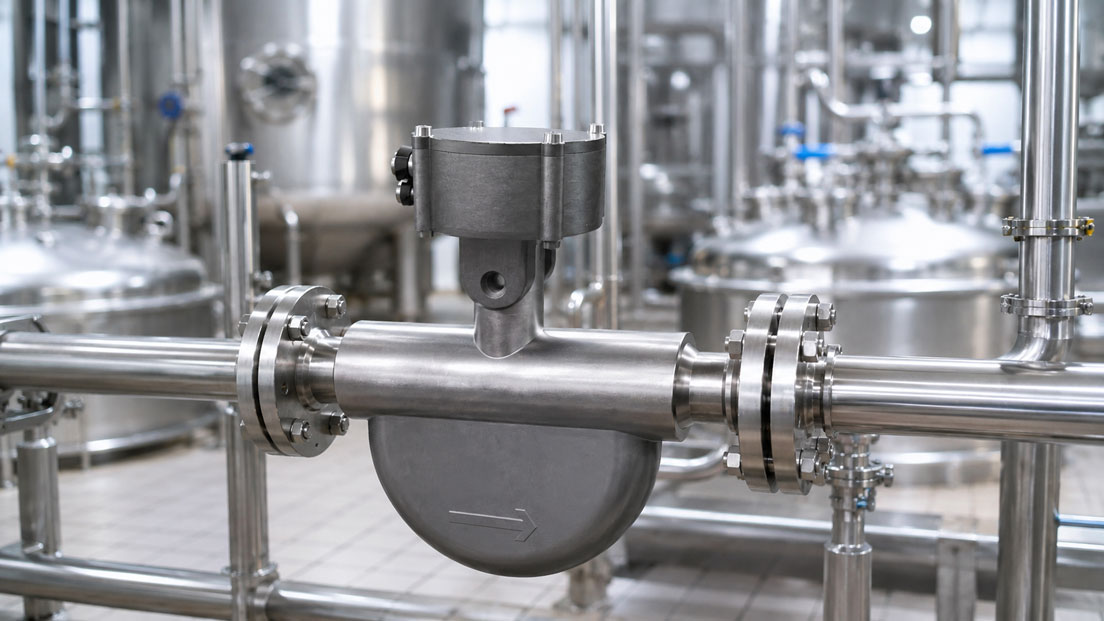
The SITRANS FCS500 is a Coriolis flow sensor for standard and hygiene applications. It is particularly suitable for processes that require robust, universal and hygienically integrable flow measurement. Typical areas of use are in the food, beverage, pharmaceutical, chemical and process industries.
For hygiene applications, it is relevant that the sensor is designed with wetted tubes made of stainless steel and, depending on the version, can be combined with suitable process connections for hygienic plants. This allows the sensor to be integrated into lines where cleaning, product changes and process safety play a central role.
The SITRANS FCS500 is particularly interesting when a measuring point is intended to provide not only volume flow, but also mass flow and additional process information. In recipe, dosing and quality processes, this multiparameter approach can offer a major advantage because quantity, density and temperature can be evaluated together.
Correct sizing is still important. Nominal size, process connection, measuring range, medium, viscosity, pressure loss, temperature, cleaning conditions and desired output signals must match the plant. Especially in hygiene applications, selection should not be based solely on pipe size, but on the process task and cleaning requirement.
Mass flow, density and temperature in one measuring system
A key advantage of Coriolis technology is the direct measurement of mass flow. In many hygienic processes, mass is the more relevant variable than volume. One liter of a product can have a different mass depending on temperature, density or composition. When recipes are based on kilograms, concentration or mass fractions, mass flow is particularly meaningful.
The additional density measurement can provide greater process reliability in many applications. It can indicate whether the correct medium is in the line, whether a product change has been completed or whether a concentration is plausible. In beverage applications, syrup dosing, mixing processes or pharmaceutical preparations, this can help run processes more stably.
Temperature measurement is also not just a secondary value. Temperature influences viscosity, density, cleaning effect, product quality and process behavior. If flow, density and temperature are available from one measuring point, process states can be evaluated better than with pure flow measurement.
This combination is particularly valuable for quality assurance. Deviations in flow can be compared directly with density or temperature changes. This makes it possible to detect product changes, air entrainment, cleaning phases or implausible process states more quickly.
| Measured variable | Benefit in hygiene applications | Example |
|---|---|---|
| Mass flow | Direct quantity determination independent of volume changes | Dosing of syrup, oil, active ingredient solution or concentrate |
| Volume flow | Helpful for plant operation and pump monitoring | Monitoring of process or cleaning lines |
| Density | Indication of product, concentration or medium change | Differentiating between product, water and cleaning medium |
| Temperature | Evaluation of process and cleaning conditions | CIP phase, hot filling, tempered preparations |
| Totalizer | Recording of batch or consumption quantities | Batching, filling, raw material consumption |
Hygienic process connections and integration into the plant
The process connection determines how the Coriolis flowmeter is integrated into the plant. In hygienic plants, connections such as clamp connections, sterile screw connections or other hygienic connection types are common. It is decisive that connection, seal and installation geometry match the plant standard and the cleaning process.
A hygienic connection must not only fit mechanically, but also be cleanable. Seals must not protrude unfavorably into the product flow or create dead spaces. Installation must also be carried out correctly, because an incorrectly inserted seal or unsuitable sealing surface can impair the hygienic quality of the measuring point.
When selecting the device, it should also be considered whether the sensor remains permanently in the line or is regularly removed. In many plants, fixed installation with reliable CIP cleaning is desired. In other cases, good accessibility for inspection or maintenance may be more important.
The process connections should be clarified early in the planning stage. If the Coriolis sensor is selected too late, nominal size, overall length, connection standard or sealing requirement may not fit the pipeline optimally. This can lead to unnecessary adapters, additional sealing points or unfavorable installation situations.
CIP and SIP: considering cleaning and sterilization correctly
CIP and SIP are central planning points in hygiene processes. CIP stands for Cleaning in Place, meaning cleaning without dismantling. SIP stands for Sterilization in Place, meaning sterilization in the installed state. Both processes place requirements on materials, seals, temperature resistance, surfaces and drainability.
A Coriolis flowmeter in a CIP-capable plant must not only measure the product, but also safely withstand cleaning media, rinsing water and, where applicable, steam or hot water phases. Cleaning media can be chemically more aggressive than the actual product. Media compatibility must therefore always consider product and cleaning together.
The installation position is also important. If cleaning liquid or product residues remain in the sensor, this can be hygienically problematic. With viscous products or media containing solids, particular attention must be paid to ensuring that flow and cleaning sufficiently flush the measuring tubes.
SIP applications bring additional thermal requirements. High temperatures and rapid temperature changes stress materials, seals and measuring system. Therefore, maximum medium temperatures, cleaning times and temperature cycles must already be known when selecting the device.
| Cleaning aspect | Influence on the Coriolis sensor | Planning note |
|---|---|---|
| CIP medium | Chemical stress on wetted parts | Check product and cleaning chemistry together. |
| SIP temperature | Thermal stress on sensor and seals | Consider maximum temperature and exposure time. |
| Drainability | Residues can be hygienically critical | Select suitable installation position and pipe routing. |
| Product change | Residues can influence subsequent batches | Validate cleaning effect and rinsing phases. |
| Seal | Contact with product and cleaning media | Check sealing material not only for product, but also for CIP/SIP. |
Viscosity, product changes and difficult media
Many hygienic media are not water-like. Syrups, sauces, concentrates, oils, creams, lotions, fruit preparations or pharmaceutical intermediates can have significantly higher viscosities. Viscosity influences pressure loss, pump behavior, drainability, cleanability and the response time of the plant.
Coriolis flowmeters can be very suitable for many viscous media, but they must be sized correctly. A sensor that is too small can create unnecessarily high pressure loss or stress the process. A sensor that is too large can be unfavorable at low flow rates. Sizing should therefore not be based only on pipe size, but on the actual flow range, viscosity and pressure conditions.
Product changes create additional requirements. In one line, product, rinsing water, cleaning medium and then product again may flow one after another. The Coriolis measured value can help to distinguish these phases more effectively, especially when density and temperature are also considered. This supports quality assurance and process optimization.
For media containing solids, air bubbles or strongly changing composition, the application must be checked more precisely. Air entrainment can influence measured values, and solids can make flow and cleaning more difficult depending on type and concentration. The measuring point should therefore always be designed for the specific medium.
Recipes, dosing and quality control
In recipe processes, repeatability matters. If a batch is always to have the same composition, raw materials, intermediates and additives must be dosed reliably. Coriolis flowmeters are strong here because they directly record mass-based quantities and therefore fit very well with many recipe and batch processes.
In beverage applications, this can include dosing concentrates, syrups, alcohol, flavors or water. In food processes, oils, ingredients, dairy products, fruit preparations or sauces may be relevant. In pharmaceutical applications, active ingredient solutions, buffers, solvents, cleaning media or process liquids are often involved.
Density measurement can additionally contribute to quality control. If a medium has an expected density, a significant deviation can indicate the wrong product, incomplete mixing, temperature deviation, air entrainment or a product change. The Coriolis flowmeter therefore provides additional process information beyond pure quantity measurement.
In practice, it is important that measured values and batch counters are cleanly integrated into the controller, control system or recipe management. Only if scaling, unit, totalizer, signal processing and batch logic are correct can the sensor’s high measurement performance be used in the process.
Installation, pressure loss and plant planning
The installation of a Coriolis flowmeter must match the plant mechanically, hygienically and metrologically. Unlike many other measuring principles, Coriolis devices generally do not require long straight inlet and outlet runs. Nevertheless, installation position, mounting, pipe stress, vibrations, drainability and accessibility are important.
Pipe stress and mechanical loads can influence the measuring point. The sensor should not serve as mechanical compensation for poorly aligned pipelines. Especially in hygienic piping systems with frequent temperature changes and cleaning cycles, installation must be stable and free of stress.
Pressure loss is also an important point. In many food and pharmaceutical plants, pump performance, product protection and cleaning flow are decisive. Excessive pressure loss can influence dosing behavior, throughput or CIP effectiveness. The nominal size should therefore be selected to match the process.
Accessibility must also not be forgotten. Display, terminal compartment, cables, grounding, nameplate and possible service points must remain accessible. In hygienic plants, care must also be taken that the installation does not create external areas that are difficult to clean or unnecessary dirt traps.
| Installation point | Why important? | Practical note |
|---|---|---|
| Nominal size | Influences measuring range and pressure loss | Size according to flow range and viscosity, not only according to pipe size. |
| Installation position | Influences drainability and air inclusions | Select according to medium, cleaning and plant geometry. |
| Pipe stress | Can mechanically stress the sensor | Provide stress-free installation and suitable support. |
| Vibration | Can influence measurement and mounting | Consider pumps, pipe supports and plant environment. |
| Accessibility | Important for service, inspection and documentation | Keep transmitter, cables and nameplate accessible. |
Output signals, PLC connection and checking the measuring chain
A Coriolis flowmeter only provides benefit if its measured values are processed correctly in the controller, control system, batch system or quality data acquisition. In addition to flow, density, temperature, totalizer, status information or diagnostic values may also be relevant.
In many plants, analog 4–20 mA signals are still used, for example for flow, density or temperature. Digital interfaces or fieldbuses can also be used when several measured values and diagnostics need to be transmitted. It is decisive that measuring range, unit, scaling, limit values and error behavior are clearly defined.
A common error occurs when the measuring instrument works correctly, but the PLC or control system is scaled incorrectly. In this case, recipe quantity, batch counter or process value are incorrect even though the sensor itself measures correctly. Especially in hygienic production processes, this can lead to scrap, rework or quality deviations.
The UPS4E loop calibrator is suitable for checking 4–20 mA signals. It can be used to measure or simulate current loops and detect scaling errors between Coriolis flowmeter, display, PLC and control system. This is particularly helpful during commissioning, recipe checking and troubleshooting.
Certificates, materials and documentation
In hygiene applications, documentation plays a greater role than in many standard applications. Operators often require material certificates, surface specifications, calibration certificates, declarations of conformity, hygienic approvals or other project-related documents. Which documents are required depends on the industry, operator standard and application.
For food and beverage plants, material, surface, seals and cleanability can be decisive. In pharmaceutical plants, additional requirements for traceability, validation, calibration and change control are often added. The flowmeter must therefore not only be technically suitable, but also fit the operator’s quality system from a documentation perspective.
Clear assignment of the measuring point is particularly important. Serial number, measuring range, process connection, materials, certificates, calibration and parameterization should be documented traceably. This saves a lot of effort during later audits, maintenance or spare parts orders.
Changes must also be documented. If a sensor is replaced, a measuring range is changed, an output signal is scaled differently or a process connection is adapted, this must be traceable in the plant and quality system. In validated or quality-critical processes, this is a central part of operational safety.
| Document / certificate | Typical purpose | Relevance in hygiene processes |
|---|---|---|
| Material certificate | Confirmation of wetted materials | Important for product contact and audit capability. |
| Surface specification | Assessment of cleanability | Relevant for hygienic and pharmaceutical requirements. |
| Calibration certificate | Proof of measurement accuracy | Important for quality assurance, recipes and batch processes. |
| Hygienic approval | Proof of suitability for hygienic applications | Relevant for food, beverages and pharmaceuticals. |
| Parameterization data | Traceability of measuring range and signal assignment | Important for PLC, control system and recipe management. |
Typical errors with Coriolis measurements in hygiene applications
A common error is selecting the measuring device only according to pipe size. With Coriolis flowmeters, however, the actual flow range, viscosity, pressure loss, desired accuracy and medium properties are decisive. A sensor that mechanically fits into the pipeline is not automatically optimal for the process.
Another error is neglecting cleaning. If only the product is considered, but CIP media, temperatures, cleaning times and seals are not checked, the measuring point can cause problems during operation. Cleaning media can stress materials and seals more than the product itself.
Product changes are also often underestimated. If density, viscosity or temperature change significantly, it must be checked whether measuring range, signal processing and recipe logic fit all operating states. A measuring instrument in a hygienic line often sees product, water, cleaning medium, air and then product again in sequence.
Unclear signal assignment is also problematic. If mass flow, volume flow, density, temperature or totalizer are scaled incorrectly or named incorrectly in the PLC, process errors occur despite correct measurement. Electrical and digital integration is therefore just as important as hygienic installation.
| Error pattern | Possible cause | Test approach |
|---|---|---|
| Dosing quantity is incorrect | Incorrect scaling, incorrect unit or unsuitable measuring range | Check measuring range, totalizer and PLC parameterization. |
| High pressure loss | Sensor too small or medium too viscous | Reassess nominal size based on flow, viscosity and pressure conditions. |
| Cleaning is insufficient | Unfavorable installation position, dead spaces or incorrect connection geometry | Check CIP concept, drainability and process connection. |
| Density value is unstable | Air entrainment, product change or process instability | Check medium condition, pump operation and measuring point. |
| Audit documentation is missing | Certificates and material certificates were not ordered | Clarify documentation requirements before ordering. |
Practical example: recipe dosing in food production
In a food production plant, syrup is to be dosed into a mixing line. The quantity must be recorded precisely for each batch because even small deviations can influence taste, color and product quality. At the same time, the line is regularly rinsed with water and cleaning medium. The operator therefore needs a measuring point that works reliably both during product operation and during cleaning and product change.
A Coriolis flowmeter is installed in the dosing line. The mass flow is used for precise dosing of the syrup. In addition, density and temperature are monitored in order to better distinguish product state and cleaning phases. During product change, the measured values help trace the transition from product to rinsing water and back to product.
During sizing, flow range, viscosity, medium temperature, CIP conditions, hygienic connection and desired documentation are considered. The sensor is not selected only according to pipe size, but according to the actual measuring task. This reduces pressure loss, improves dosing accuracy and facilitates integration into the recipe control system.
During commissioning, mass flow, totalizer, 4–20 mA signal, PLC scaling and batch logic are checked. This ensures that the measured value is interpreted identically in the device, in the controller and in the recipe documentation.
Which measuring instruments / products are suitable?
The SITRANS FCS500 Coriolis flow sensor for standard and hygiene applications is the suitable central solution for many hygienic flow measurements in food, beverage and pharmaceutical applications. It is particularly interesting when mass flow, density, temperature, hygienic process connections and reliable integration into industrial plants are required together.
The page Coriolis flow measurement provides an overview of Coriolis technology and the SITRANS FC system world. It is the right starting point when distinguishing between sensor, transmitter, compact or remote version and different Coriolis series.
For smaller flow rates, special dosing tasks or laboratory and pilot plants, other Coriolis systems from the SITRANS FC range may also be relevant. For particularly high flow rates, extreme temperatures or corrosive media, another sensor series may be more suitable. Selection should therefore always be based on medium, flow range, process connection, temperature, pressure loss and documentation requirements.
If Coriolis flowmeters are integrated into PLCs, displays or control systems with 4–20 mA signals, the UPS4E loop calibrator is a helpful test tool. It can be used to check whether measuring device, controller and control system use the same scaling and whether the measuring chain works correctly.
| Product / area | Typical use | Particularly relevant for |
|---|---|---|
| SITRANS FCS500 | Coriolis flow sensor for standard and hygiene applications | Food, beverages, pharmaceuticals, recipes, product changes and hygienic process connections |
| Coriolis flow measurement | Overview of SITRANS FC Coriolis systems | Selection of sensor, transmitter, size and system architecture |
| Hygienic process connections | Integration into cleanable piping systems | CIP/SIP, food contact, pharmaceutical applications and product changes |
| Coriolis systems for small flow rates | Precise dosing of small quantities | Active ingredients, flavors, additives, laboratory and pilot plants |
| UPS4E loop calibrator | Testing and simulation of 4–20 mA signals | Commissioning, scaling check, recipe checking and troubleshooting |
Conclusion: Coriolis is strong when hygiene and accuracy come together
Coriolis flowmeters are particularly useful in hygiene applications when quantities need to be recorded precisely, recipes need to be run reproducibly and additional process information such as density and temperature is to be used. In food, beverage and pharmaceutical plants, this multiparameter measurement can offer clear added value compared with pure volume flow measurement.
The SITRANS FCS500 is particularly interesting for such tasks when a universal Coriolis solution for standard and hygiene applications is required. However, correct sizing is decisive: medium, flow range, viscosity, pressure loss, hygienic connection, CIP/SIP conditions, materials, documentation and signal processing must fit together.
The most important recommendation is: always consider Coriolis measuring points in hygiene processes as part of the entire plant and cleaning concept. Only when measuring device, process connection, installation position, cleaning, documentation and controller integration are planned cleanly does a measuring point result that not only measures accurately, but also works hygienically and reliably.
FAQ: frequently asked questions about Coriolis flowmeters in hygiene processes
Why are Coriolis flowmeters interesting for hygiene applications?
They measure mass flow directly and can also provide density and temperature. This is particularly helpful for recipes, dosing, product changes and quality control.
What is the advantage compared with pure volume flow measurement?
Mass flow is independent of volume-related changes caused by density or temperature. For many recipes and batch processes, mass is the more important variable.
Can a Coriolis flowmeter be used in the food industry?
Yes, provided that materials, surface, process connection, seal and cleanability match the application. The specific version must always be selected to match the plant and the product.
Is Coriolis also suitable for pharmaceutical applications?
Coriolis can be very useful in pharmaceutical applications if hygienic design, documentation, calibration, material certificates and process requirements are fulfilled.
What does hygienic process connection mean?
A hygienic process connection is designed so that it is easy to clean, does not create critical dead spaces and matches the standards of the plant.
Why is CIP important when selecting the device?
With CIP, the plant is cleaned without dismantling. The flowmeter must safely withstand cleaning media, temperatures, flows and chemical stresses.
What must be considered with SIP?
SIP means sterilization in the installed state. Temperature resistance, seals, materials and exposure times are particularly important here.
Can a Coriolis measuring device detect product changes?
It can support product changes because, in addition to flow, density and temperature are often available. Changes in these values can indicate medium changes or rinsing phases.
What role does density measurement play?
Density measurement can be used for plausibility checking, product identification, concentration evaluation or quality control.
What role does temperature measurement play?
Temperature influences product behavior, density, viscosity and cleaning. A temperature value from the measuring point helps with process evaluation and control.
Is Coriolis suitable for viscous media?
Yes, Coriolis can be suitable for many viscous media. However, correct sizing, pressure loss, flow range and cleanability are important.
What happens if air enters the medium?
Air entrainment can influence Coriolis measurements. Pump operation, pipe routing and process state should therefore be assessed so that gas fractions are avoided or detected as far as possible.
Does Coriolis require inlet and outlet runs?
Coriolis flowmeters generally do not require long straight inlet and outlet runs. Nevertheless, installation position, pipe stress, vibrations and drainability must be considered.
Why should the sensor not be selected only according to pipe size?
Because flow range, viscosity, pressure loss, desired accuracy and cleaning requirements can be more important than the pipe size alone.
Which documents are important in hygiene applications?
Depending on the application, material certificates, surface specifications, calibration certificates, hygienic approvals, declarations of conformity and parameterization data may be relevant.
How is a Coriolis flowmeter integrated into the PLC?
Typical options are analog signals such as 4–20 mA or digital interfaces. Measuring range, unit, scaling, fault behavior and totalizer must be parameterized cleanly.
How do you check a 4–20 mA signal from a Coriolis flowmeter?
A loop calibrator can be used to measure or simulate the signal. This makes it possible to check whether measuring device, display, PLC and control system use the same scaling.
When is the SITRANS FCS500 particularly useful?
The SITRANS FCS500 is particularly useful when Coriolis flow measurement for standard and hygiene applications is required with mass flow, density, temperature and hygienic integration.