


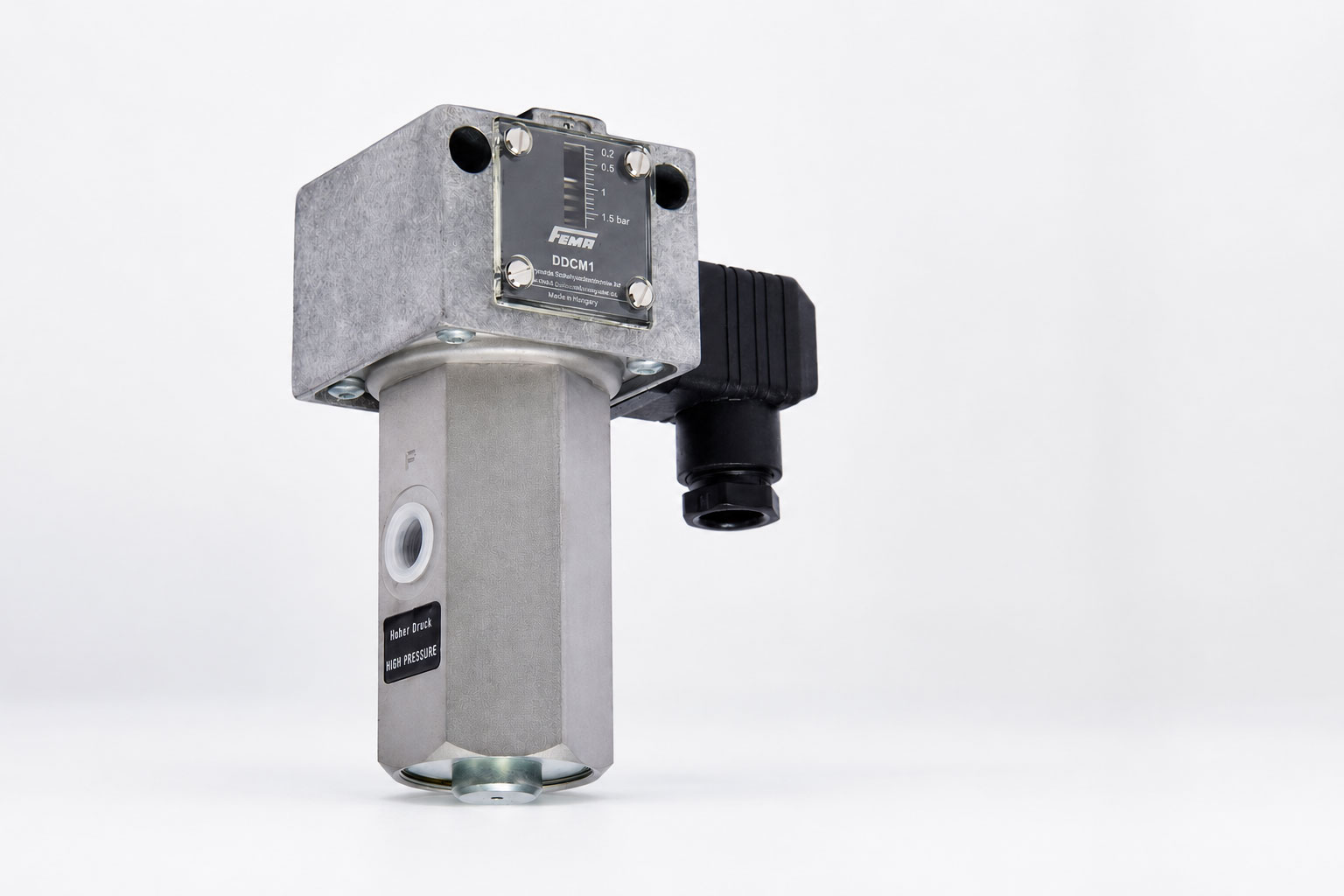
When it is not the absolute pressure but the pressure difference between two points that is decisive, a differential pressure switch is the right solution. Typical examples include filter monitoring, fan monitoring, airflow monitoring or monitoring flow conditions in liquid lines.
In many applications, a normal pressure switch is not sufficient because the pressure at a single point is not what needs to be assessed. What matters instead is how strongly the pressure differs before and after a component. This exact difference can indicate whether a filter is clogged, a fan is running, a pump is delivering or a heat exchanger is becoming blocked.
This article explains what a differential pressure switch measures, when differential pressure is more suitable than absolute pressure, which errors frequently occur in practice and which devices are useful for filters, ventilation, air conditioning and liquids.
You can find an overview of suitable devices in our category
Pressure switches for liquids / gases.
For ventilation and air conditioning technology, the
DPS differential pressure switch for ventilation and air conditioning
is particularly relevant. For liquids and non-combustible gases, the
DPSL differential pressure switch for gas and liquid
can be a suitable solution.
Table of contents
- What does a differential pressure switch measure?
- Pressure switch or differential pressure switch: What is the difference?
- When is differential pressure better than absolute pressure?
- Filter monitoring: rising differential pressure as a warning signal
- Ventilation and air conditioning technology: monitoring airflow and fans
- Liquids: monitoring pumps, heat exchangers and lines
- P1 and P2: assigning connections correctly
- Selecting the measuring range and switching point correctly
- Typical errors in practice
- Setting and checking the switching point
- Which differential pressure switches are suitable?
- Practical examples from filters, ventilation and liquid systems
- Checklist for selection and commissioning
- Conclusion
- FAQ: Frequently asked questions about differential pressure switches
What does a differential pressure switch measure?
A differential pressure switch compares two pressure points with each other. It does not simply measure the pressure at one single point, but the difference between a higher and a lower pressure. When a set differential pressure is reached, the switching contact opens or closes.
This measurement is particularly helpful when a component generates a pressure loss. This can be a filter, a heat exchanger, a pipe, an orifice plate, a fan, a pump or another flow-related component.
| Measured variable | Meaning | Typical application |
|---|---|---|
| Absolute pressure | Pressure referenced to absolute vacuum | Barometry, vacuum technology, special process measurements |
| Gauge pressure | Pressure referenced to ambient pressure | Pumps, vessels, hydraulics, pneumatics |
| Differential pressure | Pressure difference between two measuring points | Filter monitoring, airflow, flow, heat exchangers |
| Vacuum | Pressure below ambient pressure | Suction side, ventilation, extraction, vacuum monitoring |
A differential pressure switch is therefore useful whenever the statement “pressure at point A” alone is not sufficient. The decisive question is: How large is the difference between point A and point B?
Pressure switch or differential pressure switch: What is the difference?
A pressure switch monitors the pressure at one single measuring point. If a set limit value is exceeded or undershot, the contact switches. A differential pressure switch, on the other hand, monitors the difference between two pressure points.
In practice, this distinction is often underestimated. If a normal pressure switch is used although a pressure difference is actually relevant, the application can be assessed incorrectly. For example, a filter can be clogged even though the absolute pressure before the filter is still within the normal range.
| Device | What is monitored? | Typical application |
|---|---|---|
| Pressure switch | One pressure point | Pump pressure, compressor pressure, vessel pressure, minimum or maximum pressure |
| Vacuum switch | Vacuum at one measuring point | Extraction, vacuum supply, suction lines |
| Differential pressure switch | Pressure difference between two measuring points | Filters, fans, airflow, heat exchangers, flow monitoring |
| Pressure limiter | Safety-relevant limit value | Systems with increased safety requirements |
Simple example
With a filter, the pressure before the filter is higher than after the filter. The more the filter becomes clogged, the greater the pressure loss across the filter becomes. A differential pressure switch detects this rising pressure difference and can trigger a signal when the switching point is reached.
When is differential pressure better than absolute pressure?
Differential pressure is always better suited when the condition of a component or a flow is to be assessed based on a pressure loss. The absolute pressure at a single point can then be misleading because it depends on operating condition, delivery pressure, system height or load case.
| Application | Why absolute or gauge pressure is not sufficient | Why differential pressure is better |
|---|---|---|
| Filter monitoring | The pressure before the filter can fluctuate depending on the system. | The pressure loss across the filter indicates contamination better. |
| Airflow monitoring | A single pressure point does not reliably show whether air is flowing. | Differential pressure can better represent flow conditions. |
| Fan monitoring | The static pressure alone can vary depending on the duct system. | Pressure difference can indicate operation or failure. |
| Heat exchanger | A single line pressure says little about flow through the component. | Rising differential pressure can indicate contamination or restriction. |
| Pump protection | Pump pressure alone does not always show the actual flow condition. | Differential pressure can compare conditions before and after a component. |
The correct measured variable therefore depends on the question that needs to be answered. If the issue is a pressure limit at one point, a pressure switch is suitable. If the issue is a pressure loss between two points, a differential pressure switch is the better choice.
Filter monitoring: rising differential pressure as a warning signal
One of the most common applications for differential pressure switches is filter monitoring. A clean filter causes only a small pressure loss. As contamination increases, the filter resistance rises. This increases the differential pressure between the filter inlet and filter outlet.
When a defined limit value is reached, the differential pressure switch can trigger a signal. This signal can, for example, trigger a maintenance message, a filter replacement indication, a fault message or a system shutdown.
| Filter condition | Differential pressure | Assessment |
|---|---|---|
| New or clean filter | Low | Filter resistance is low. |
| Filter in normal operation | Medium | Pressure loss is within the expected range. |
| Filter increasingly clogged | Rising | Maintenance or filter replacement is approaching. |
| Filter heavily clogged | High | Warning signal or shutdown may be required. |
| Filter damaged or missing | Unusually low | A differential pressure that is too low can also be noticeable. |
For filter, fan and airflow monitoring in air conditioning and ventilation systems, the
DPS differential pressure switch for ventilation and air conditioning
is a typical solution.
Ventilation and air conditioning technology: monitoring airflow and fans
In ventilation and air conditioning systems, differential pressure switches are often used to monitor filter condition, airflow or fan function. The pressure before and after a filter, at an orifice, in the air duct or across a fan is compared.
A differential pressure signal can indicate whether a fan is running, whether airflow is present or whether a filter is clogged. This monitoring is especially important in building services, cleanroom technology, ventilation systems, air conditioning units and industrial air technology.
| Application | What is monitored? | Typical signal |
|---|---|---|
| Filter monitoring | Pressure loss across the filter | Rising differential pressure with contamination |
| Fan monitoring | Pressure build-up by the fan | Undershooting can indicate failure |
| Airflow monitoring | Pressure difference in the air duct | Signal when airflow is present or missing |
| Air conditioning and ventilation units | Filter, fan and air routing | Maintenance or fault message |
| Room air technology | Pressure conditions and air movement | Monitoring of system conditions |
For air applications, the measuring range must be selected particularly carefully because differential pressures in ventilation technology are often very low. A measuring range that is too coarse makes the switching point inaccurate or difficult to set.
Liquids: monitoring pumps, heat exchangers and lines
Differential pressure switches are not only used in ventilation and air conditioning technology. With liquids, too, the pressure difference between two points can provide important process information. Typical applications include pump monitoring, heat exchangers, filter systems, pipelines, cooling circuits and flow monitoring via restrictions or orifice plates.
With liquids, however, different requirements must be considered than with air. Medium, pressure range, materials, sealing, contamination, viscosity, temperature and pressure surges can influence the selection of the differential pressure switch.
| Application | What does the differential pressure indicate? | Possible reaction |
|---|---|---|
| Liquid filter | Contamination or blockage | Filter replacement, maintenance message, shutdown |
| Heat exchanger | Increasing pressure loss due to deposits | Cleaning or process check |
| Pump monitoring | Pressure build-up between suction and discharge side | Dry-running, delivery or fault monitoring |
| Pipeline | Restriction, flow condition or pressure loss | Alarm, control or diagnosis |
| Orifice plates / restrictions | Flow-dependent differential pressure | Switching signal at minimum flow or limit value |
For neutral as well as slightly aggressive liquids and non-combustible gases, the
DPSL differential pressure switch for gas and liquid
may be suitable. For general differential pressure monitoring, flow monitoring and automatic control of filter systems, the
DDCM differential pressure switch for liquids and gases
is also relevant.
P1 and P2: assigning connections correctly
With differential pressure switches, correct assignment of the connections is decisive. Typically, one connection is used for the higher pressure and one connection for the lower pressure. If these connections are reversed, the switch may not respond as expected.
In practice, confusing the plus and minus connection often leads to malfunctions, incorrect switching points or missing signals. Especially for filter and fan monitoring, it should therefore be clearly checked before commissioning which measuring point is before and which is after the component.
| Connection | Meaning | Typical assignment |
|---|---|---|
| P1 / plus side | Higher pressure | Before filter, discharge side, higher duct or line pressure |
| P2 / minus side | Lower pressure | After filter, suction side, lower duct or line pressure |
| Measuring hose | Transmits the pressure to the switch | For air applications, route cleanly, without kinks and leak-tight |
| Process connection | Connects medium and measuring chamber | For liquids, design suitable for the medium and ventable |
Typical consequences of reversed connections
- The switch does not trip even though the filter is clogged.
- The switch is already switched in the normal condition.
- The switching point appears implausible or not reproducible.
- The system reports airflow although there is no sufficient airflow.
- The differential pressure monitoring reacts opposite to expectations.
Selecting the measuring range and switching point correctly
The measuring range of the differential pressure switch must match the application. If the range is too small, the switch can be overloaded or respond too early. If the range is too large, the desired switching point may not be adjustable accurately enough.
Before selection, normal operation, start-up behavior, maximum differential pressure, permissible pressure loss and desired switching point should therefore be known. With filter monitoring, it is also important to know at which differential pressure a maintenance message or shutdown should occur.
| Selection point | Why important? | Practical question |
|---|---|---|
| Normal differential pressure | Basis for the expected operating condition | What differential pressure is present with a clean filter or normal flow? |
| Switching point | Limit value for warning or shutdown | From which differential pressure should the signal be triggered? |
| Maximum differential pressure | Protection against device overload | What difference can occur during fault, blockage or start-up? |
| Maximum static pressure | Both measuring chambers can be under system pressure | How high is the maximum system or line pressure? |
| Switching differential | Determines the distance between switch-on and reset point | Is a stable switching state without chatter possible? |
| Medium | Materials and seals must match | Is it air, gas, water, oil or a slightly aggressive liquid? |
Especially with very small differential pressures in ventilation systems, a device with a suitable low-pressure range should be selected. For liquids, system pressure, materials and possible pressure peaks must also be considered.
Typical errors in practice
Many problems with differential pressure switches are not caused by the device itself, but by incorrect selection, incorrect connection or unfavorable installation conditions. Incorrect measuring ranges, reversed connections, contaminated measuring lines, condensate or missing venting are particularly common.
| Fault pattern | Possible cause | Practical solution |
|---|---|---|
| Switch does not trip | Measuring range too large, connections reversed or pressure difference too low | Check measuring range, P1/P2 assignment and actual differential pressure. |
| Switch trips too early | Switching point too low or measuring range unsuitable | Set and check switching point according to system values. |
| Switching point is unstable | Pulsation, fluctuating airflow or switching differential too small | Assess damping, mounting position, measuring point and switching point. |
| No response to filter contamination | Measuring hose blocked, incorrectly connected or leaking | Check, clean and correctly connect measuring lines. |
| Incorrect indication after maintenance | P1 and P2 reversed or hose connected incorrectly | Check connection diagram and clearly mark measuring points. |
| Switch reacts slowly | Condensate, dirt or viscous medium influences measuring line | Check measuring line, venting, condensate routing and medium. |
| Contact chatters | Switching point is too close to normal operating value | Select switching point with sufficient distance from normal operation. |
Consider condensate and dirt
In air applications, condensate in measuring hoses can distort pressure transmission. With liquids, dirt, deposits, air inclusions or blockages in measuring lines can influence function. Measuring lines and connections must therefore be designed so that the differential pressure reliably reaches the switch.
Setting and checking the switching point
The switching point determines at which differential pressure the contact changes state. It should not be selected arbitrarily, but derived from the process. Especially with filter monitoring, it is useful to know the differential pressure with a clean filter, in normal operation and at maximum permissible contamination.
When setting the switch, the switching differential must also be considered. The reset point is not always at the same value as the switch-on point. This difference can be important so that the switch does not constantly switch on and off.
| Step | Description | Note |
|---|---|---|
| 1. Determine normal value | Record differential pressure in normal operation. | Measure with clean filter or normal flow. |
| 2. Define limit value | Define switching point for maintenance, alarm or shutdown. | Observe manufacturer information for filter, system or process. |
| 3. Check measuring range | Device must match the desired switching point. | If possible, do not choose the switching point at the very edge of the range. |
| 4. Check connections | Assign P1 and P2 correctly. | Higher pressure to plus side, lower pressure to minus side. |
| 5. Test function | Check switching behavior with actual or simulated differential pressure. | Document switch-on and reset point. |
| 6. Observe operation | Check switching behavior in real operation. | Avoid chatter or delayed switching. |
Which differential pressure switches are suitable?
The suitable device selection depends strongly on the medium and the application. Different versions are required for ventilation and air conditioning technology than for liquids, process systems or applications with higher static pressure.
| Product | Especially relevant for | Note |
|---|---|---|
| DPS differential pressure switch for ventilation and air conditioning | Filter, fan and airflow monitoring in air conditioning and ventilation systems | Suitable for air as well as non-combustible and non-aggressive gases in ventilation and air conditioning technology. |
| DPSL differential pressure switch for gas and liquid | Monitoring of differential pressure, vacuum and overpressure with liquids and non-combustible gases | Relevant for neutral as well as slightly aggressive liquids and applications where differential pressure in lines needs to be monitored. |
| DDCM differential pressure switch for liquids and gases | Differential pressure monitoring, flow monitoring and automatic control of filter systems | Useful for process engineering, mechanical engineering and plant engineering when differential pressures in liquids or gases need to be monitored. |
You can find a complete overview in the category
Pressure switches for liquids / gases.
Practical examples from filters, ventilation and liquid systems
Example 1: Filter in a ventilation system becomes increasingly clogged
In a ventilation system, the pressure loss across the filter slowly increases. The differential pressure switch is connected before and after the filter. When the set switching point is reached, a maintenance message is issued. This allows the filter to be replaced in time before the airflow decreases too much.
Example 2: Fan does not start
After a ventilation system is started, no sufficient differential pressure is built up. The differential pressure switch does not indicate airflow. Possible causes include a defective fan, incorrect direction of rotation, closed dampers, contaminated ducts or incorrectly connected measuring hoses.
Example 3: Heat exchanger in a cooling circuit becomes blocked
In a liquid circuit, the differential pressure across a heat exchanger slowly increases over several weeks. This can indicate deposits or increasing restriction. A liquid differential pressure switch can trigger a signal before the flow is reduced too much.
Example 4: Filter monitoring in a liquid line
A liquid filter is connected to the differential pressure switch before and after the filter. With a clean filter, the pressure loss is low. As contamination increases, the differential pressure rises. The switching point is selected so that a maintenance message is issued before the process is affected.
Example 5: Incorrectly connected measuring lines after maintenance
After filter maintenance, the system continuously reports a fault although the filter is new. During inspection, it turns out that P1 and P2 were reversed. After correct connection, the differential pressure switch responds as expected again.
Checklist for selection and commissioning
This checklist can be used to check whether a differential pressure switch matches the application and has been integrated correctly.
| Check question | Why important? | Practical recommendation |
|---|---|---|
| Is differential pressure really the right measured variable? | For filters, airflow and flow, the pressure difference is often more important than a single pressure value. | Check whether two measuring points need to be compared. |
| Which medium is being monitored? | Air, gas and liquids place different requirements on the device. | Select device to match medium, material and seal. |
| Is the measuring range suitable? | Ranges that are too large or too small lead to inaccurate or incorrect switching. | Compare normal value, switching point and maximum value. |
| Are P1 and P2 connected correctly? | Reversed connections lead to malfunctions. | Clearly assign higher and lower pressure. |
| Are measuring lines clear and leak-tight? | Blockage, leakage or condensate distorts pressure transmission. | Check hoses, lines and connections. |
| Is the switching point selected sensibly? | Too close to the normal value can cause contact chatter. | Set switching point with distance from normal operation. |
| Was the function checked after installation? | Only a practical test shows whether the switch responds as expected. | Check and document switch-on and reset point. |
| Have condensate, dirt or air bubbles been considered? | These influences can block measuring lines or distort measured values. | Check mounting position, venting and measuring line routing. |
Conclusion: differential pressure switches monitor conditions that a normal pressure switch cannot detect
Differential pressure switches are useful whenever the pressure difference between two points is decisive. With filters, rising differential pressure indicates increasing contamination. In ventilation systems, differential pressure can be used for fan and airflow monitoring. In liquid lines, it can provide indications of flow conditions, blockage, filter loading or heat exchanger problems.
Decisive for reliable function are a suitable measuring range, correct media selection, correctly connected P1 and P2 lines, a sensibly set switching point and clean measuring lines. Many errors are not caused by the differential pressure switch itself, but by incorrect connection assignment, condensate, dirt, unsuitable measuring range or unclear switching point definition.
For ventilation and air conditioning technology, the
DPS differential pressure switch
is a suitable solution. For liquids and non-combustible gases, the
DPSL differential pressure switch
may be relevant. For general differential pressure and flow monitoring as well as filter systems, the
DDCM differential pressure switch
is also suitable.
You can find a suitable preselection in the category
Pressure switches for liquids / gases.
FAQ: Frequently asked questions about differential pressure switches
What is a differential pressure switch?
A differential pressure switch monitors the pressure difference between two measuring points. When a set differential pressure is reached, an electrical contact switches.
What is the difference between a pressure switch and a differential pressure switch?
A pressure switch monitors the pressure at one single measuring point. A differential pressure switch compares two measuring points with each other and reacts to the pressure difference between both points.
Why is differential pressure suitable for filter monitoring?
A filter creates a pressure loss. The more the filter becomes clogged, the greater the differential pressure between filter inlet and filter outlet becomes. This makes the filter condition easy to monitor.
How is a differential pressure switch used in ventilation systems?
In ventilation systems, a differential pressure switch can be used for filter monitoring, fan monitoring or airflow control. For this purpose, two pressure points in the air duct, at the filter or at the fan are compared.
Can a differential pressure switch also be used for liquids?
Yes, but the differential pressure switch must be suitable for liquids. Medium, material, seal, pressure range, temperature and contamination must match the application.
What do P1 and P2 mean on a differential pressure switch?
P1 is usually the connection for the higher pressure, P2 for the lower pressure. If the connections are reversed, the switch can react incorrectly or not at all.
How do I choose the correct measuring range?
The measuring range should match the normal differential pressure, the desired switching point and the maximum possible differential pressure. A range that is too large makes accurate setting more difficult; a range that is too small can cause malfunctions or overload.
How is the switching point set?
The switching point is set to the differential pressure at which a message, warning or shutdown should occur. The normal operating value, the permissible limit value and the switching differential of the device should be used as the basis.
Which errors frequently occur with differential pressure switches?
Frequent errors include reversed connections, incorrect measuring range, blocked measuring lines, condensate, dirt, incorrect switching point or unsuitable materials for the medium.
Which differential pressure switches are suitable?
For ventilation and air conditioning technology, the
DPS differential pressure switch
is suitable.
For liquids and non-combustible gases, the
DPSL differential pressure switch
can be used. For general differential pressure monitoring, flow monitoring and filter systems, the
DDCM differential pressure switch
is relevant.