


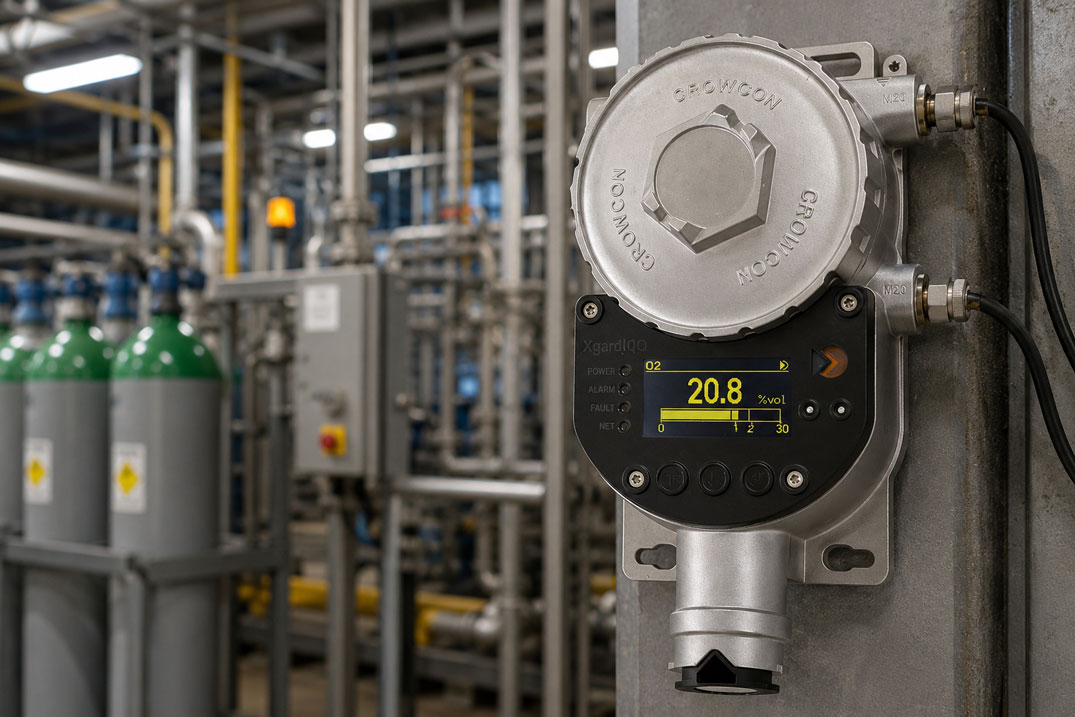
Stationary gas detectors continuously monitor areas where flammable, toxic or oxygen-altering gases may occur. They are an important part of gas detection systems in industry, laboratories, energy plants, refrigeration systems, storage rooms, technical rooms and potentially explosive areas.
A gas detector can be technically suitable and still fail to provide reliable protection if it is installed in the wrong location. If a sensor is mounted too high, too low, too far away from the possible leak source or in an unfavorable airflow, a dangerous gas concentration may be detected too late or, in the worst case, not at all.
This article explains why the installation location is decisive for stationary gas detectors, what role gas type, density, airflow, leak source, environment and maintenance access play and which typical mistakes should be avoided when placing gas detectors.
You can find an overview of suitable devices in our category
Gas measuring devices / gas detectors.
Suitable stationary gas detectors can be found in the category
Stationary gas detectors.
For complete monitoring systems, the category
Gas detection system is also relevant.
Table of contents
- Why is the installation location so important for gas detectors?
- Gas type and density: does the gas rise or collect near the floor?
- Correctly assessing possible leak sources
- Taking airflow, ventilation and room geometry into account
- Installation height: typical examples for methane, hydrogen, CO2 and heavy gases
- Temperature, dust, humidity and contamination
- Observe Ex zone and device approval
- Plan maintenance, calibration and accessibility
- Connection to gas detection controller, 4–20 mA, relays, Modbus and HART
- Planning alarms, warning signals and shutdown functions correctly
- Typical errors when installing stationary gas detectors
- Which stationary gas detectors and controllers are suitable?
- Practical examples from industry, technical rooms and energy plants
- Checklist for correct placement
- Conclusion
- FAQ: Frequently asked questions about placing stationary gas detectors
Why is the installation location so important for gas detectors?
A stationary gas detector can only detect the gas that actually reaches the sensor. The technical performance of the detector is therefore only one part of the solution. It is just as important that the device is installed in a location where a dangerous gas concentration can realistically occur in the event of a fault.
In practice, gas distribution in a room depends on many factors. These include the gas type, the density of the gas, the possible release point, temperature, pressure, ventilation, room height, airflow, obstacles, machines, shafts, ceiling areas, floor depressions and normal plant operation.
| Influencing factor | Why important? | Typical risk if assessed incorrectly |
|---|---|---|
| Gas type | Different gases behave differently in air. | Sensor is mounted at the wrong height. |
| Density | Light gases tend to rise, heavy gases tend to collect near the floor. | Gas cloud reaches the sensor too late or not at all. |
| Leak source | Gas usually escapes at specific fittings, flanges, valves or pipes. | Sensor is installed too far away from the hazard point. |
| Airflow | Ventilation can dilute, distribute or carry gas away from the sensor. | Sensor is outside the relevant flow path. |
| Environment | Dust, humidity, temperature or aggressive atmosphere can affect sensor and housing. | False alarms, delayed response or reduced sensor lifetime. |
| Maintenance | Sensors must be checked, calibrated and replaced if necessary. | Device is difficult to access and is not maintained regularly. |
The correct placement should therefore always be based on the specific application, a risk assessment, the gas type, the plant geometry and the manufacturer’s instructions.
Gas type and density: does the gas rise or collect near the floor?
An important first step when placing stationary gas detectors is to determine how the gas to be monitored behaves in relation to air. Some gases are lighter than air and tend to rise. Other gases are heavier than air and can collect near the floor, in pits, shafts or depressions.
Density alone is not always sufficient to determine the installation location. Temperature, release pressure, flow, ventilation, turbulence and room geometry can significantly influence the behavior. Nevertheless, density is an important starting point.
| Gas / gas group | Tendency compared to air | Typical placement consideration |
|---|---|---|
| Methane / natural gas | Lighter than air | Often place sensor in the upper room area or near possible release points. |
| Hydrogen | Significantly lighter than air | Check sensor placement at ceilings or high points, especially in battery rooms or hydrogen systems. |
| Propane / LPG | Heavier than air | Place sensor more likely near the floor, in depressions or lower areas. |
| Carbon dioxide CO2 | Heavier than air | Place sensor more likely in lower areas or where CO2 can escape and accumulate. |
| Carbon monoxide CO | Similar density to air | Placement depends strongly on airflow, source and room geometry. |
| Oxygen O2 | Monitoring oxygen deficiency or oxygen enrichment | Place sensor where oxygen changes may occur due to displacement or leakage. |
| Hydrogen sulfide H2S | Heavier than air | Check lower areas and locations near possible release points. |
Important: The actual installation height must not be derived solely from gas density in a generalized way. The specific leak source, room volume, ventilation and operating conditions are always decisive.
Correctly assessing possible leak sources
Stationary gas detectors should not be distributed randomly throughout a room. They must be installed where a dangerous gas concentration is most likely to occur first or quickly enough in the event of a fault.
Typical leak sources include flanges, valves, fittings, compressors, pumps, gas cylinders, pipe connections, sensor connections, tanks, batteries, refrigeration systems, vessels, hoses or process connections.
| Leak source | Typical risk | Placement question |
|---|---|---|
| Flange / pipe connection | Gas escapes locally at a connection. | Is the sensor close enough to the possible release point? |
| Valve / fitting | Leakage due to seal, actuation or wear. | Is the gas cloud carried toward the sensor by airflow or away from it? |
| Gas cylinder / storage area | Leak at cylinder valve or pressure regulator. | Is the sensor mounted at the correct height and close to the storage area? |
| Battery room | Hydrogen formation possible with certain battery technologies. | Are ceiling areas, ventilation and possible accumulation points considered? |
| Refrigeration system | Refrigerant can escape and displace oxygen. | Is the sensor mounted where the gas can accumulate in the event of a leak? |
| CO2 system | CO2 can accumulate in lower areas. | Are floor-level areas, depressions and poor ventilation considered? |
In larger plants, a single gas detector cannot cover every possible leak point. In such cases, structured placement of several detectors or a gas detection system with multiple measuring points is required.
Taking airflow, ventilation and room geometry into account
Airflow is one of the most important factors for the correct placement of stationary gas detectors. Ventilation can dilute a gas cloud, transport it or carry it away from the sensor. At the same time, it can move gas into areas that would not initially be affected without ventilation.
Rooms with fans, exhaust air, supply air, open doors, shafts, ducts, ceiling voids, floor pits, machine heat or strong temperature differences are particularly critical. Obstacles such as machines, shelves, vessels or partition walls can also influence gas distribution.
| Influence | Effect | Practical assessment |
|---|---|---|
| Supply air | Can dilute gas or push it in a certain direction. | Do not automatically place the sensor directly in the fresh air stream. |
| Exhaust air | Can transport gas toward the exhaust opening. | Assess sensor position in the flow path. |
| Fan | Can quickly distribute gas or locally blow it away. | Consider fan operation and failure condition. |
| Room height | Light gases can accumulate near the ceiling. | Check high points and dead zones. |
| Floor depressions / shafts | Heavy gases can collect there. | Assess depressions, pits and poorly ventilated areas. |
| Obstacles | Can shield or redirect gas clouds. | Do not mount sensor behind barriers or in dead corners. |
A common mistake is mounting a gas detector at a conveniently accessible wall position without checking whether the gas cloud would actually reach this point. Convenient installation must not be more important than effective gas detection.
Installation height: typical examples for methane, hydrogen, CO2 and heavy gases
The installation height depends strongly on the gas to be monitored. Light gases such as hydrogen or methane are often monitored more in the upper area. Heavy gases such as propane, LPG or CO2, on the other hand, can collect more in lower areas. For gases with a density similar to air, airflow is often particularly important.
| Application | Gas | Typical installation consideration |
|---|---|---|
| Natural gas line / methane | Methane CH4 | Check upper room area, ceiling areas or proximity to possible release point. |
| Battery room / hydrogen system | Hydrogen H2 | Pay particular attention to very high points, ceiling areas and ventilation concept. |
| CO2 storage / beverage industry | Carbon dioxide CO2 | Check lower areas, floor-level areas, depressions and poorly ventilated zones. |
| LPG storage | Propane / butane / LPG | Assess floor-level areas, pits, shafts and low areas particularly carefully. |
| Combustion processes / parking area | Carbon monoxide CO | Define placement according to source, airflow and occupied area. |
| Inerting / nitrogen | Oxygen deficiency due to displacement | Monitor areas where oxygen-displacing gases can spread. |
These examples do not replace plant planning. They only show why the installation location must not be defined in a generalized way. For each application, gas type, source, ventilation, room geometry and safety concept must be assessed together.
Temperature, dust, humidity and contamination
Stationary gas detectors often operate in harsh industrial environments. Temperature, humidity, dust, splash water, aggressive atmosphere, cleaning agents, vibration or mechanical stress can affect measurement and service life.
A sensor must not only be mounted theoretically in the right place. It must also function reliably there and remain serviceable. Therefore, housing, protection rating, sensor principle, temperature range and accessories must match the environment.
| Environmental influence | Possible problem | Practical measure |
|---|---|---|
| Dust | Sensor opening or filter can become contaminated. | Plan suitable protective caps, regular visual inspection and maintenance. |
| Humidity / condensation | Measurement can be affected or electronics stressed. | Observe protection rating, mounting position and weather protection. |
| Temperature | Sensor may operate outside the permitted range. | Compare operating temperature of the device with the installation location. |
| Draft | Gas can be diluted or guided past the sensor. | Check position in the real airflow pattern. |
| Cleaning agents / chemicals | Sensor poisoning or cross-sensitivities possible. | Consider sensor principle and ambient substances. |
| Mechanical stress | Damage from forklifts, tools or installation work. | Provide mechanical protection and sensible installation position. |
Observe Ex zone and device approval
If a gas detector is used in a potentially explosive area, device approval, type of explosion protection, zone, gas group, temperature class and installation requirements must match the application. A stationary gas detector must not be selected based on its measuring function alone.
The Ex zone classification and the selection of the suitable device must be carried out by qualified persons. In addition, manufacturer specifications, connection instructions, cable glands, grounding, housing design and maintenance requirements must be taken into account.
| Check point | Why important? | Practical question |
|---|---|---|
| Ex zone | Device must be suitable for the respective zone. | Is the installation location in Zone 0, 1, 2 or outside an Ex zone? |
| Gas group | Explosive gases have different requirements. | Does the device approval match the gas group? |
| Temperature class | Surface temperature must not become an ignition source. | Does the temperature class match the atmosphere? |
| Cable connection | Incorrect cable entry can impair protection rating or explosion protection. | Are suitable glands and connection types used? |
| Maintenance in Ex areas | Opening, calibrating or replacing may be subject to special rules. | Is maintenance possible safely and in accordance with standards? |
For potentially explosive industrial applications, robust stationary gas detectors such as the
Xgard detector,
the
XgardIQ gas detector
or the
IRmax infrared gas detector
may be relevant. The specific suitability must always be checked based on the application and the technical specification.
Plan maintenance, calibration and accessibility
Stationary gas detectors must be checked, maintained and, depending on the sensor principle, calibrated or adjusted regularly. An installation location is therefore only useful if the sensor is not only correctly positioned for detection, but can also be accessed safely.
A common problem is installation at difficult-to-access ceiling points, behind machines, in narrow shafts or in locations that can only be reached with great effort. This can lead to maintenance intervals not being observed or tests being carried out only incompletely.
| Maintenance aspect | Why important? | Practical recommendation |
|---|---|---|
| Accessibility | Sensor must be able to be checked, calibrated or replaced. | Plan installation location with maintenance route, ladder, platform or access. |
| Test gas supply | Test gas is often required for functional testing or calibration. | Consider calibration adapter, hose routing or remote calibration. |
| Local display | Status and measured value should be visible during maintenance. | Check devices with display or remote indication. |
| Sensor replacement | Sensors have a limited service life. | Consider replaceability and spare parts concept. |
| Maintenance in hazardous areas | Work may require special permits. | Plan maintenance concept and operating permits in advance. |
The installation location should therefore always be considered together with the maintenance concept. An optimally placed sensor is of little use if it cannot be safely tested during operation.
Connection to gas detection controller, 4–20 mA, relays, Modbus and HART
Stationary gas detectors are often integrated into a gas detection system or a higher-level safety system. Depending on the device and system, analog signals, relay contacts or digital interfaces can be used.
Typical connections include 4–20 mA, relay outputs, RS-485 Modbus or HART. These interfaces can transmit measured values, alarm states, faults or diagnostic data to a gas detection controller, PLC, control room or building management system.
| Interface / signal | Typical task | Practical benefit |
|---|---|---|
| 4–20 mA | Analog transmission of measured value | Standardized integration into gas detection controllers, PLCs or process control systems. |
| Relays | Switching on alarm, pre-alarm or fault | Direct actuation of warning lights, horns, shutdowns or ventilation. |
| RS-485 Modbus | Digital communication of several devices | Reduced wiring effort and structured data transmission. |
| HART | Diagnostics and communication via the analog signal | Parameterization, maintenance and diagnostics during plant operation. |
| Gas detection controller | Monitoring several detectors | Central alarm handling, relay logic, event logging and system overview. |
For central gas detection systems, for example, the
Gasmaster gas detection controller
or the
GM addressable controllers
may be relevant. For detectors with modern communication, the
XgardIQ gas detector,
the
Xgard Bright addressable gas detector
or the
IRmax infrared gas detector
may be of interest.
Planning alarms, warning signals and shutdown functions correctly
A stationary gas detector is not just a sensor. It is part of a safety concept. The decisive question is therefore what should happen when an increased gas concentration occurs. Possible actions include pre-alarm, main alarm, visual and audible warning, ventilation control, plant shutdown, closing valves or reporting to a control room.
The alarm strategy must match the hazard. With flammable gases, the focus is often on preventing explosive atmospheres. With toxic gases, personal protection is the priority. With oxygen deficiency or oxygen enrichment, safe occupancy conditions and fire or asphyxiation risks are the focus.
| Alarm function | Typical task | Important note |
|---|---|---|
| Pre-alarm | Early warning when gas concentration begins to rise | Can trigger maintenance, ventilation or cause investigation. |
| Main alarm | Alarm at dangerous concentration | Must be clear, visible and audible. |
| Ventilation control | Dilution or removal of the gas | Ventilation must not unintentionally prevent detection. |
| Plant shutdown | Limit hazard or prevent further release | Shutdown logic must be safely planned and tested. |
| Valve control | Interrupt gas supply | Observe fail-safe behavior and power supply. |
| Forwarding to control room | Central monitoring and event response | Signals must be clearly named and documented. |
Typical errors when installing stationary gas detectors
Many errors in stationary gas detection systems are not caused by the measuring device itself, but by unfavorable installation, incorrect planning or insufficient consideration of the environment. Incorrect installation height, too great a distance from the leak source, installation in the fresh air stream or poor accessibility are particularly critical.
| Error | Possible consequence | Better approach |
|---|---|---|
| Sensor mounted at the wrong height | Gas cloud reaches sensor too late or not at all. | Consider gas density, temperature, airflow and source. |
| Sensor too far away from leak source | Alarm is delayed. | Analyze possible release points and flow paths. |
| Installation directly in fresh air stream | Gas is diluted, measured value remains too low. | Check sensor position in the real airflow pattern. |
| Installation in dead corner | Gas does not reliably reach sensor. | Observe air movement, obstacles and room geometry. |
| No maintenance accessibility | Calibration and testing become more difficult. | Plan maintenance route and test gas supply. |
| Wrong sensor for the gas | Gas is not detected correctly. | Select gas type, measuring range and sensor principle appropriately. |
| Environment not considered | False alarms, sensor wear or failure possible. | Check temperature, humidity, dust, chemicals and protection rating. |
| Alarm chain not tested | Sensor measures, but warning or shutdown does not work. | Test complete chain of sensor, controller, relay, signal device and shutdown. |
Which stationary gas detectors and controllers are suitable?
The suitable device selection depends on gas type, measuring range, Ex requirements, environment, interface, maintenance concept and system structure. For simple measuring points, a classic stationary gas detector may be sufficient. For larger plants, gas detection controllers or addressable systems are useful.
| Product | Especially relevant for | Note |
|---|---|---|
| Xgard detector | Robust stationary gas detection in industry and potentially explosive areas | Suitable when different sensor variants and a 4–20 mA output are required for gas detection systems. |
| XgardIQ gas detector | Intelligent stationary gas detection with display and flexible sensor modules | Relevant when 4–20 mA, RS-485 Modbus, optional relays or HART communication are desired. |
| Xgard Bright addressable stationary gas detector | Addressable stationary gas detection with display | Useful when reduced wiring, Modbus/HART options and simple local operation are relevant. |
| IRmax infrared gas detector | Infrared detection of hydrocarbon gases and vapors | Suitable for applications where flammable hydrocarbons need to be detected reliably and quickly. |
| Gasmaster gas detection controller | Central monitoring of several gas detectors | Interesting when measured values, alarms, faults, relay outputs and Modbus connection are to be processed centrally. |
| GM addressable controllers | Addressable gas detection systems with several channels and zones | Relevant for larger plants when several detectors, zones, alarms and digital communication must be managed. |
You can find a complete overview in the categories
Stationary gas detectors
and
Gas detection system.
Practical examples from industry, technical rooms and energy plants
Example 1: Methane monitoring in a technical room
Natural gas or methane is monitored in a technical room. Since methane is lighter than air, the upper room area is considered particularly carefully. In addition, possible leak sources such as valves, flanges and gas lines are assessed. The sensor is positioned so that escaping gas is very likely to be detected before a dangerous concentration spreads.
Example 2: CO2 monitoring in a storage area
In an area with CO2 cylinders or CO2 lines, carbon dioxide can escape and collect in lower areas. Installation only at head height or near the ceiling would often not be sufficient here. Floor-level areas, depressions, ventilation and possible occupied areas are decisive.
Example 3: Hydrogen in a battery room
With certain battery systems, hydrogen can be generated. Since hydrogen is very light, ceiling areas, high points and ventilation must be given special attention. A sensor at a low wall position could detect a hydrogen accumulation in the upper area too late.
Example 4: Refrigerant in a machine room
In refrigeration systems, refrigerants can escape and, depending on the gas type and room conditions, displace oxygen or collect in certain areas. Sensor position, ventilation, machine layout, floor-level areas and possible release points must be assessed together.
Example 5: Several detectors in a larger industrial plant
In a larger plant, a single gas detector is often not sufficient. Different leak sources, room sections, airflows and hazardous areas must be monitored separately. A gas detection controller such as the
Gasmaster gas detection controller
or an addressable system with
GM addressable controllers
can help to monitor several measuring points in a structured way.
Checklist for correct placement
This checklist can be used to better prepare and check the placement of stationary gas detectors.
| Check question | Why important? | Practical recommendation |
|---|---|---|
| Which gas is to be detected? | Gas type and sensor principle must match. | Check gas type, measuring range and cross-sensitivities. |
| Is the gas lighter or heavier than air? | Density influences possible installation height. | Do not assess installation height in isolation, but together with airflow. |
| Where are possible leak sources located? | Gas does not escape randomly, but usually at specific points. | Check valves, flanges, tanks, lines, batteries, refrigeration systems and fittings. |
| How is the ventilation designed? | Airflow can carry gas toward the sensor or away from it. | Consider supply air, exhaust air, fans, doors and shafts. |
| Are there depressions, shafts or ceiling areas? | Gas can accumulate in certain areas. | Assess room geometry and possible accumulation points. |
| Is the sensor suitable for the environment? | Dust, humidity, temperature and chemicals can affect function. | Check protection rating, housing, sensor principle and accessories. |
| Is the installation location in an Ex zone? | Device and installation must match explosion protection requirements. | Check Ex zone, gas group, temperature class and approval. |
| Is the sensor accessible for maintenance? | Testing, calibration and sensor replacement must be possible. | Plan access, test gas supply and maintenance procedure. |
| Is the alarm chain defined? | Detection alone is not sufficient. | Plan pre-alarm, main alarm, relays, controller, ventilation and shutdown. |
| Was function checked after installation? | Only a function test shows whether the system reacts correctly. | Test sensor, signal transmission, controller, alarm and shutdown. |
Conclusion: The correct installation location determines the effectiveness of gas detection
Stationary gas detectors can only provide reliable warnings if they are installed in the correct location. The installation location must match the gas type, density, possible leak source, ventilation, room geometry and environment. A technically suitable sensor can be ineffective if the gas cloud does not reach it in the event of a fault.
The correct installation height, proximity to the possible release point, consideration of airflow, Ex zones, environmental conditions and maintenance access are particularly important. In addition, the gas detector must be integrated into a meaningful alarm and safety concept.
Depending on the application, different solutions are available for stationary gas detection, for example
Xgard detector,
XgardIQ gas detector,
Xgard Bright,
IRmax infrared gas detector,
Gasmaster gas detection controller
or
GM addressable controllers.
You can find a suitable preselection in the categories
Stationary gas detectors
and
Gas detection system.
FAQ: Frequently asked questions about placing stationary gas detectors
Where should a stationary gas detector be installed?
The installation location depends on gas type, density, possible leak source, airflow, room geometry and environment. A sensor should be installed where a dangerous gas concentration can realistically occur in the event of a fault and reach the sensor.
Where should a methane gas detector be installed?
Methane is lighter than air. For methane, upper room areas, ceiling areas or areas near possible release points are therefore often considered. The exact position, however, depends on ventilation, room geometry and plant layout.
Where should a hydrogen gas detector be installed?
Hydrogen is significantly lighter than air and can accumulate at high points or under the ceiling. In hydrogen applications, ceiling areas, ventilation, possible release points and room geometry must be considered particularly carefully.
Where should a CO2 gas detector be installed?
CO2 is heavier than air and can collect in lower areas, depressions or poorly ventilated zones. Installation should therefore often be checked more in lower areas, depending on source, room and ventilation.
Why is airflow important for gas detectors?
Airflow can transport gas to the sensor, dilute it or carry it away from the sensor. A gas detector must therefore not be placed only according to wall space or installation convenience, but must be assessed in the real airflow pattern.
Does a stationary gas detector have to be approved for Ex zones?
If the detector is installed in a potentially explosive area, the device approval must match the zone, gas group, temperature class and application. Selection and installation must be carried out professionally.
Why must the sensor be easily accessible?
Stationary gas detectors must be checked, calibrated and, if necessary, maintained or fitted with sensor modules regularly. A poorly accessible installation location makes this work more difficult and can impair operational safety.
Why is 4–20 mA important for gas detectors?
4–20 mA is a common analog standard signal for transmitting measured values to gas detection controllers, PLCs or process control systems. It enables continuous monitoring of the gas value.
When are Modbus or HART useful?
Modbus or HART are useful when diagnostics, parameterization, status information or digital integration into a higher-level system are required in addition to the measured value.
When do you need a gas detection controller?
A gas detection controller is useful when several gas detectors are monitored, alarms are processed centrally, relays are switched, events are logged or warning and shutdown functions are coordinated.
Which products are suitable for stationary gas detection technology?
Depending on the application, suitable products include, for example, the
Xgard detector,
the
XgardIQ gas detector,
Xgard Bright,
the
IRmax infrared gas detector,
the
Gasmaster gas detection controller
or
GM addressable controllers.