


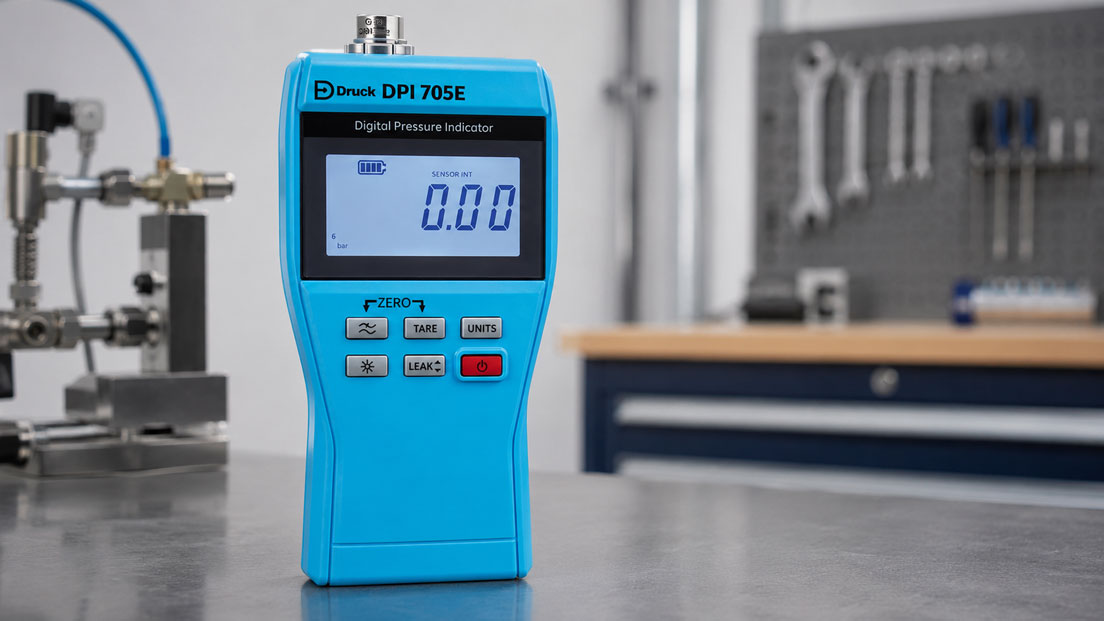
Digital pressure gauges are frequently used as reference or control instruments in industry, maintenance, service, test benches, hydraulics, pneumatics and plant engineering. They display pressure values quickly and accurately, are used on site at machines and often serve as the basis for decisions: Is a system leak-tight? Is a pressure switch working correctly? Is the system pressure within the specified range? This is exactly why the question regularly arises: Is a simple check sufficient, or does the digital pressure gauge need to be calibrated?
Many users use the terms checking, calibrating and adjusting in a similar way in everyday language. Technically, however, they do not mean the same thing. A simple functional check only shows whether a device generally responds. A comparison measurement shows whether the display is plausible compared with a reference. A calibration documents the deviation of the device at defined measuring points under specified conditions. This difference is crucial for test equipment monitoring, quality management, audits or customer inspections.
Suitable solutions can be found, among others, in the areas of calibration services, pressure calibration technology, pressure gauges / digital pressure gauges as well as devices such as the DPI705E precision pressure / temperature measuring instrument, the WIKA CPG1500 precision digital pressure gauge or suitable calibration kits and test kits.
Table of contents
- Checking, calibrating, adjusting: What is the difference?
- When is a simple functional check sufficient?
- Comparison measurement: A useful interim check in everyday use
- What happens during calibration of a digital pressure gauge?
- Factory calibration or DAkkS calibration?
- Why measurement uncertainty is more important than deviation alone
- Which calibration points are common for digital pressure gauges?
- Calibration interval: How often should a digital pressure gauge be calibrated?
- Operating conditions: Why use and stress are decisive
- When should a digital pressure gauge no longer be used?
- Documentation and test equipment monitoring
- Typical mistakes when handling digital pressure gauges
- Suitable products and services
- Practical example: Digital pressure gauge in service use
- Conclusion: Checking is helpful, calibration provides traceable evidence
- FAQ: Frequently asked questions about calibrating digital pressure gauges
Checking, calibrating, adjusting: What is the difference?
The most important step is to clearly distinguish between the terms. Checking initially only means that a digital pressure gauge is inspected for a specific property. This may be a visual inspection, a functional check or a simple plausibility check. For example, it is checked whether the display works, whether the zero point is plausible, whether the device indicates pressure changes and whether the connections, housing and seal are in good condition.
Calibrating, on the other hand, means that the digital pressure gauge is compared with a suitable reference. At defined pressure points, it is determined how large the deviation is between the value displayed by the digital pressure gauge and the reference value. Calibration does not initially change the device. It documents the condition of the measuring instrument.
Adjusting means that a measuring instrument is set or corrected so that its display better matches the reference value. Adjustment can be performed before or after calibration, but it should not be confused with calibration itself. After adjustment, a new calibration is often useful because only then is it documented how the device measures after adjustment.
| Term | Meaning | Typical result |
|---|---|---|
| Visual inspection | External inspection of device, connection, display and condition | Detects visible damage or abnormalities |
| Functional check | Checks whether the device generally responds and displays plausibly | Rough statement about usability |
| Comparison measurement | Comparison with a reference at one or more points | Indication of deviation or drift |
| Calibration | Documented comparison with a suitable reference | Calibration certificate with measured values and deviations |
| Adjustment | Setting the device to correct the display | Device is changed and should then be checked again |
This distinction is very important in practice. Anyone who simply applies pressure to a digital pressure gauge for a short time has not automatically calibrated it. And anyone who adjusts a device has not yet created documented evidence of the actual measurement deviation.
When is a simple functional check sufficient?
A simple functional check may be sufficient if the only aim is to rule out major faults before use. This includes checking whether the display is readable, whether the battery is sufficiently charged, whether the device responds to pressure changes and whether the zero point appears plausible when the connection is depressurized.
Such checks are particularly useful before a service job or before quick troubleshooting on a system. A digital pressure gauge that does not switch on, is badly damaged, leaks at the connection or already displays an obviously incorrect value in a depressurized state should not simply continue to be used.
However, a functional check does not replace calibration. It does not show with sufficient certainty how large the measurement deviation is across the entire measuring range. A device may look plausible at 0 bar and still deviate significantly at 50 bar. Likewise, a device may be inconspicuous at a single check point but outside tolerance at other pressure points.
For simple internal checks without high accuracy requirements, a functional check can be useful as a daily or weekly preliminary check. As soon as measured values are documented, passed on to customers, used for approvals or used in quality management, a purely functional check is usually no longer sufficient.
Comparison measurement: A useful interim check in everyday use
A comparison measurement is more than a pure functional check, but it is not automatically a complete calibration. The digital pressure gauge is compared with a reference device. The device under test and the reference are subjected to the same pressure, and the displays are compared with each other.
Such interim checks are very useful in everyday use. They can show whether a digital pressure gauge has drifted noticeably since the last calibration or whether it still measures plausibly after a fall, overload or demanding field use. Especially with frequently used test equipment, an internal comparison measurement can help detect problems at an early stage.
However, it is important that the comparison measurement is also carried out properly. The reference must be suitable and itself validly calibrated. The pressure must be stable. Both devices must work in the appropriate measuring range. Temperature, pressure medium, mounting position and stabilization can influence the result.
A comparison measurement therefore provides good orientation, but it only replaces calibration if it is performed according to a defined procedure, with a suitable reference, defined calibration points, evaluation criteria and documentation. Without these conditions, it remains an internal plausibility check.
What happens during calibration of a digital pressure gauge?
During calibration of a digital pressure gauge, the device is compared with a reference at several defined pressure points. For this purpose, a stable test pressure is generated, for example with a hand test pump, a pressure controller, a hydraulic pressure source or a pneumatic pressure source. The digital pressure gauge displays the pressure, while the reference specifies the actual value or measures it with higher accuracy.
Typically, several points across the measuring range are approached. Depending on the procedure, the measurement is performed in increasing and decreasing direction in order to detect hysteresis and repeatability behavior. With a digital pressure gauge, in addition to the display, resolution, zero point behavior, stability, unit switching, temperature behavior and, where applicable, data logger or output functions may also be relevant.
The result of calibration is a calibration certificate. It documents the calibration points, nominal values, actual values, deviations, ambient conditions, references and, where applicable, measurement uncertainties. This makes it traceable how the device measured at the time of calibration.
A calibration is therefore not merely a “good-or-bad” label. It provides measurement data. Whether the device may continue to be used depends on whether the user’s specified tolerances are met. These tolerances result from the application, the required accuracy, internal quality requirements or customer specifications.
Factory calibration or DAkkS calibration?
With digital pressure gauges, the question often arises as to whether a factory calibration certificate is sufficient or whether DAkkS calibration is required. A factory calibration is sufficient for many technical applications if the main focus is documented checking and internal traceability. It is often used for operating equipment, service devices, maintenance and simple test equipment monitoring.
A DAkkS calibration is particularly useful or required when accredited, traceable calibration is demanded. This may be the case for audits, quality management systems, testing bodies, demanding customer requirements, regulated areas or reference measuring instruments. Here, not only the measured value is important, but also proven traceability and stated measurement uncertainty.
The decision therefore depends not only on the digital pressure gauge, but also on how the device is used. A digital pressure gauge that is used only for rough system checks may not require DAkkS calibration. A digital pressure gauge used as a reference for customer inspections or for calibrating other devices has significantly higher requirements.
| Application | Factory calibration often sufficient? | DAkkS calibration useful? |
|---|---|---|
| Internal system check | Often yes | For high accuracy or audit requirements |
| Service use at customer site | Depending on customer requirements | Often useful if measured values are documented |
| Reference device for internal checks | Possible if accepted internally | Often recommended |
| Calibration of other test equipment | Only to a limited extent | Usually useful or required |
| Audit- or quality-relevant measurement | Depends on the QM system | Often the better choice |
It is important to clarify the requirements before calibration. If a DAkkS certificate is needed later, a simple factory calibration certificate may not be sufficient. Conversely, DAkkS calibration is not economically necessary for every simple operational check.
Why measurement uncertainty is more important than deviation alone
Many users first look at the deviation during calibration: Does the digital pressure gauge display too much or too little? This is understandable, but not complete. For professional evaluation, measurement uncertainty is also decisive. It describes the uncertainty associated with the calibration result.
A simple example: If a digital pressure gauge has a permissible tolerance of ±0.1 bar and the measured deviation is 0.08 bar, this initially appears uncritical. However, if the measurement uncertainty of the calibration is also taken into account, the assessment can become much closer. The closer a measured value is to the tolerance limit, the more important measurement uncertainty becomes.
Measurement uncertainty is particularly important for test equipment used as a reference. A reference device should be significantly more accurate than the device under test. If the reference and the device under test have similar accuracy, the significance of the comparison measurement is limited. A deviation can then be observed, but reliable evaluation becomes more difficult.
Therefore, when selecting a digital pressure gauge, reference device and calibration procedure, the measurement uncertainty acceptable for the application should always be considered. It is not just about displaying some pressure value, but about making a reliable statement about the measured value.
Which calibration points are common for digital pressure gauges?
The calibration points depend on the measuring range, accuracy, application and desired calibration. Frequently, several points are distributed across the measuring range, for example at 0 %, 25 %, 50 %, 75 % and 100 % of the measuring range. Depending on the procedure, these points may be approached in increasing and decreasing direction.
For digital pressure gauges, the zero point is particularly important. A zero point error affects many measurements and is often the first thing noticed in everyday use. Nevertheless, a zero point check alone is not sufficient. Especially at higher pressures, linearity deviations, hysteresis or range errors can occur that are not visible at the zero point.
For applications in which only a narrow pressure range is used, calibration in the actually used working range can be useful. If a digital pressure gauge has a measuring range up to 700 bar but is regularly used only between 80 and 120 bar, calibration points in this range are particularly relevant for the application. The full measuring range remains important if the device is used flexibly.
| Calibration point | Why useful? | Typical statement |
|---|---|---|
| 0 % | Check of zero point and return after pressure load | Detects offset and zero point drift |
| 25 % | Check in the lower measuring range | Shows deviations at lower pressures |
| 50 % | Check in the middle range | Helps evaluate linearity |
| 75 % | Check in the upper working range | Detects range deviations |
| 100 % | Check near the end of the measuring range | Shows behavior under high load |
| Decreasing measurement series | Comparison after pressure relief | Detects hysteresis and return behavior |
The suitable calibration points should not only be selected according to a standard approach, but also according to actual use. A digital pressure gauge used as test equipment for pressure switches at 6 bar should also be checked meaningfully in this range.
Calibration interval: How often should a digital pressure gauge be calibrated?
There is no fixed calibration interval for all digital pressure gauges. An annual interval is often used, but this is not automatically correct for every application. The appropriate interval depends on use, accuracy requirement, stress, environment, device history and quality management requirements.
A digital pressure gauge that is used daily in field service, transported, mechanically stressed and frequently remounted should be assessed more critically than a device used stationary in a clean workshop. High pressure cycles, vibration, overpressure events, temperature fluctuations or aggressive media can also influence long-term stability.
The calibration history is particularly helpful. If a device remains stable over several calibrations, the interval may possibly be maintained or, in some cases, adjusted. If a device regularly drifts or is close to being outside tolerance, the interval should be shortened or the device replaced.
The calibration interval should therefore not be viewed merely as a calendar entry. It is part of test equipment monitoring. The goal is not to calibrate as rarely as possible, but to ensure that measured values are reliable enough throughout the entire period of use.
Operating conditions: Why use and stress are decisive
Digital pressure gauges are often used under harsh conditions. They are transported in tool cases, connected to hydraulic power units, used on construction sites, placed in workshops or stored in service vehicles. Each of these conditions can affect measurement stability.
Mechanical shocks can stress the sensor system, connection thread, housing or electronics. Overpressure can permanently change the sensor. Contaminated or unsuitable pressure media can clog connections or damage sealing surfaces. Temperature changes can influence display and sensor behavior. A weak battery can also lead to misinterpretations if the device does not operate reliably.
Therefore, after exceptional events, a digital pressure gauge should not wait until the next regular calibration date before being checked. If the device has been dropped, overloaded, come into contact with an unsuitable medium or suddenly displays implausible values, an interim check or calibration is useful.
For important test tasks, it can also be useful to keep a second device or a reference available for plausibility checks. This makes it easier to detect major deviations in everyday use.
When should a digital pressure gauge no longer be used?
A digital pressure gauge should no longer be used for quality-relevant measurements if the calibration status has expired and valid calibration is required. This does not automatically mean that the device measures incorrectly. However, it means that proof is missing that it is within the required tolerance.
Caution is also required in the case of visible damage. Damaged pressure connections, leaks, cracks in the housing, poorly readable displays, damaged keys or signs of liquid ingress are clear warning signals. Such a device should not continue to be used as reliable test equipment until it has been checked or repaired.
Implausible measured values are particularly critical. If a digital pressure gauge deviates significantly compared with other measuring instruments, does not return to zero, shows jumping values or fluctuates strongly under stable pressure conditions, it should be taken out of service. A calibration or technical inspection then clarifies whether the device can still be used.
| Abnormality | Possible meaning | Recommended action |
|---|---|---|
| Calibration period expired | Proof of measurement quality is missing | Have it calibrated before quality-relevant use |
| Zero point drifts | Offset, overload or sensor drift possible | Perform comparison measurement or calibration |
| Display jumps strongly | Unstable pressure, sensor problem or electronics fault possible | Check measuring setup and inspect device |
| Device was overloaded | Pressure sensor may be permanently damaged | Take out of service and have it checked |
| Mechanical damage | Tightness and measurement reliability questionable | Do not continue to use as test equipment |
For simple, non-critical indications, an older device may possibly still serve as an auxiliary display. As test equipment for documented measurements, however, it should only be used with valid and suitable calibration evidence.
Documentation and test equipment monitoring
Calibration of a digital pressure gauge is only truly helpful if it is properly documented and integrated into test equipment monitoring. This includes a clear device ID, serial number, measuring range, accuracy specification, calibration date, next calibration date and the associated calibration certificate.
In many companies, test equipment is marked with inspection labels, inventory numbers or QR codes. This makes it immediately visible whether the device is approved for use. This is particularly important in service applications because technicians on site need to quickly check whether the digital pressure gauge being used is still validly calibrated.
The documentation should also record for which application the device is approved. A digital pressure gauge with a large measuring range and moderate accuracy may be suitable for a rough system check, but not for calibrating a high-accuracy pressure transmitter. The calibration certificate alone therefore does not replace the assessment of whether the device is suitable for the measuring task.
If deviations outside tolerance occur, it must also be decided what happens to earlier measurements. If a digital pressure gauge is found to be outside tolerance during calibration, it should be checked which measurements have been carried out with it since the last valid calibration and whether these results are still acceptable.
Typical mistakes when handling digital pressure gauges
A common mistake is assuming that a digital device is automatically permanently accurate. The digital display appears clear and precise, but a digital pressure gauge can also drift, be overloaded or be operated outside its specification. Many decimal places on the display do not automatically mean high measurement accuracy.
Another mistake is using an unsuitable measuring range. If a digital pressure gauge with a very large measuring range is used for very low pressures, the resolution or accuracy may be insufficient for the application. Conversely, a device must not be operated close to or above its load limit just because the connection fits mechanically.
Confusing checking, calibration and adjustment also leads to misunderstandings. Anyone who compares a device with another pressure gauge using a hand pump has not automatically performed a complete calibration. Anyone who zeroes a device has not yet proven that it measures correctly across the measuring range.
| Mistake | Why problematic | Better approach |
|---|---|---|
| Confusing digital display with accuracy | Many digits do not automatically mean low measurement deviation | Consider specification and calibration result |
| Only zero point checked | Deviations in the measuring range remain undetected | Use several calibration points in the working range |
| Ignoring calibration period | Traceability is missing during audits or customer inspections | Maintain test equipment monitoring consistently |
| Wrong measuring range used | Measurement uncertainty may be too large for the task | Select measuring range to match the application |
| Overload not documented | Sensor may be damaged without it being immediately obvious | Perform interim check after overload |
The best solution is a clear internal test equipment process. It defines which devices may be used for which tasks, how often they are calibrated, when interim checks are required and how abnormal devices are handled.
Suitable products and services
For users who regularly use digital pressure gauges, calibration services are particularly important. Depending on requirements, these include factory calibrations, DAkkS calibrations, calibration certificates, inspection labels and support with test equipment monitoring. This ensures that the pressure measuring instruments used are regularly checked and documented.
For in-house test and comparison measurements, solutions from the area of pressure calibration technology are available. Depending on the application, hand test pumps, pressure calibrators, pressure test kits or complete calibration kits can be used. It is important that reference device, pressure generation, measuring range and desired accuracy match.
Among pressure gauges and digital pressure gauges, different devices may be suitable depending on the measuring task. The DPI705E is suitable for mobile pressure and temperature measurements in maintenance and service. The CPG1500 precision digital pressure gauge is interesting when a high-accuracy digital pressure measuring instrument is required. For robust on-site applications, devices such as the CPG500 digital pressure gauge or the HySense® digital pressure gauge may also be suitable, depending on the requirements.
If tests are to be carried out directly on site, calibration kits and test kits can be a useful solution. They combine pressure generation, reference display and accessories in a mobile set. This allows digital pressure gauges, pressure switches, pressure sensors or system measuring points to be checked in a practical way.
Practical example: Digital pressure gauge in service use
A service technician regularly uses a digital pressure gauge to perform pressure tests on customer systems. The device is used for maintenance, leak tests and adjustment work on pressure switches. The measured values are documented in service reports and serve as proof for the customer that the system is operating within the required pressure limits.
Initially, the device is only checked internally. Before each use, the technician checks the zero point, external condition and battery. This check is useful, but it is not sufficient for documented customer measurements. The customer wants to be able to trace whether the test equipment used is itself validly calibrated.
The digital pressure gauge is therefore included in test equipment monitoring. It receives a clear test equipment number, a calibration interval and a calibration certificate. During calibration, several points in the used pressure range are checked. The results show that the device is within the specified tolerance and may continue to be used.
One year later, the next calibration shows a significant deviation in the upper measuring range. The cause could be overload or long-term drift. The device is no longer used for customer measurements until it is clarified whether adjustment, repair or replacement is necessary. At the same time, it is checked whether previous measurements could be affected.
The example shows: The daily check helps detect obvious problems. However, documented calibration is what provides reliable evidence that the digital pressure gauge was suitable for the measuring task.
Conclusion: Checking is helpful, calibration provides traceable evidence
A simple check of a digital pressure gauge is useful for detecting obvious damage, empty batteries, leaking connections or major malfunctions. It should be standard practice before important use. However, it does not replace calibration when measured values are documented, passed on or used for quality-relevant decisions.
Calibration shows how much the digital pressure gauge deviates from a reference at defined pressure points. Only this makes it traceable whether the device is within the specified tolerance. Measurement uncertainty, calibration points, traceability, calibration interval and the question of whether a factory calibration is sufficient or DAkkS calibration is useful are particularly important.
For users, this means: Checking and calibration belong together, but they fulfill different tasks. Checking is the quick everyday control. Calibration is the documented proof of measurement quality. Suitable support is provided by calibration services, pressure calibration technology and suitable digital pressure gauges for service, maintenance and test equipment monitoring.
FAQ: Frequently asked questions about calibrating digital pressure gauges
What is the difference between checking and calibrating?
Checking means inspecting a device for function, condition or plausibility. Calibrating means comparing the device with a reference at defined measuring points and documenting the deviation.
Is a functional check of a digital pressure gauge sufficient?
For simple preliminary checks, a functional check may be sufficient. For documented measurements, customer inspections, quality management or test equipment monitoring, it is usually not sufficient.
What is calibrated on a digital pressure gauge?
During calibration, the pressure display of the digital pressure gauge is compared with a reference at defined pressure points. Nominal value, actual value, deviation and, depending on the calibration, measurement uncertainty are documented.
What is the difference between calibration and adjustment?
Calibration documents the deviation of a measuring instrument without necessarily changing it. Adjustment means setting or correcting the device. After adjustment, the device should be calibrated again.
When is a factory calibration certificate sufficient?
A factory calibration certificate is often sufficient for internal test equipment monitoring, service devices or less critical applications. The requirements of the user, customer or quality management are decisive.
When is DAkkS calibration useful?
DAkkS calibration is useful when accredited, traceable calibration with stated measurement uncertainty is required, for example for reference devices, audits, testing bodies or demanding customer requirements.
How often should a digital pressure gauge be calibrated?
The calibration interval depends on use, accuracy requirements, environment, stress and calibration history. Annual calibration is common; for high stress or critical applications, shorter intervals may be useful.
Which calibration points are common during calibration?
Several points are often distributed across the measuring range, for example 0 %, 25 %, 50 %, 75 % and 100 %. Depending on the application, additional points in the actually used working range may be useful.
Why is measurement uncertainty important during calibration?
Measurement uncertainty describes how reliable the calibration result is. It is particularly important when measured values are close to tolerance limits or when the digital pressure gauge is used as a reference device.
When may a digital pressure gauge no longer be used?
A digital pressure gauge should no longer be used for quality-relevant measurements if the calibration period has expired, the device is damaged, displays implausible values, has been overloaded or is outside the specified tolerance.
Which products and services are suitable for calibrating digital pressure gauges?
Suitable options include calibration services, solutions from pressure calibration technology, calibration kits and suitable digital pressure gauges such as the DPI705E or the CPG1500 precision digital pressure gauge.