


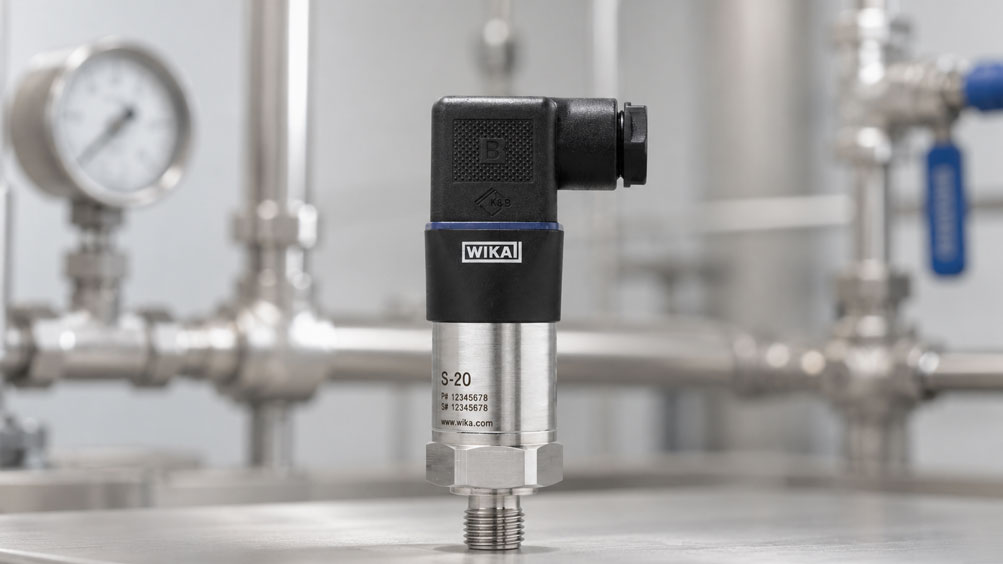
A pressure sensor is not just a pressure sensor. Even if two devices look similar from the outside and have the same measuring range, they can contain completely different sensor technologies inside. Ceramic measuring cells, piezoresistive silicon sensors and thin-film pressure sensors each have their own strengths, limits and typical areas of application. Anyone who only looks at measuring range, output signal and process connection overlooks an important part of the selection process.
The sensor technology influences, among other things, media compatibility, temperature behavior, long-term stability, overload resistance, accuracy, cost and suitability for dynamic pressure profiles. A pressure sensor for a simple water application must meet different requirements than a sensor in hydraulics, in the process industry, in a mobile machine, in a test bench or in an application with hydrogen, oxygen or aggressive media.
This article explains the most important differences between ceramic, piezoresistive and thin-film pressure sensors. The aim is not to present one technology as generally better, but to find the right technology for the application. Suitable products can be found, among others, in the areas of WIKA pressure sensors and pressure transmitters, pressure sensors / differential pressure sensors as well as devices such as the WIKA S-20 pressure transmitter, the UNIK 5000 pressure sensor or the UNIK 5900 SIL high-precision pressure sensor.
Table of contents
- Why sensor technology is important in pressure sensors
- Basic principle: How is pressure measured electronically?
- Ceramic pressure sensors: Resistant to many media, but not ideal for everything
- Piezoresistive pressure sensors: High sensitivity and good accuracy
- Thin-film pressure sensors: Metallic measuring cell for robust industrial applications
- Ceramic, piezoresistive and thin-film in comparison
- Media compatibility: Why materials and seals are decisive
- Temperature behavior and compensation
- Long-term stability, drift and service life
- Overload, burst pressure and fast pressure spikes
- Accuracy, measuring range and resolution
- Cost differences and economic selection
- Typical applications by sensor technology
- Typical selection mistakes
- Suitable pressure sensors and product areas
- Practical example: Selecting pressure sensors differently for hydraulics, water and test benches
- Conclusion: The right sensor technology depends on the application
- FAQ: Frequently asked questions about pressure sensor technologies
Why sensor technology is important in pressure sensors
In many inquiries, the measuring range is the first focus. For example, the customer is looking for a pressure sensor 0…10 bar, 0…100 bar or 0…400 bar with 4…20 mA, 0…10 V or IO-Link. This is an important start, but it is not enough. Two pressure sensors with the same measuring range can behave very differently if they are based on different sensor technologies.
The technology determines how the pressure is mechanically absorbed and converted into an electrical signal. It influences whether the sensor comes into direct contact with the medium, whether a transmission fluid is used, whether elastomer seals are required, how well the sensor withstands fast pressure peaks and how stable the measured values remain over a longer period of time.
This selection becomes particularly important with difficult media, high temperatures, strong vibrations, fast pressure changes or high accuracy requirements. A sensor that works perfectly in a simple water line can reach its limits much faster in a hydraulic system with strong pressure peaks. Conversely, a simple OEM application does not always require the most technically complex solution.
The right selection therefore does not begin with the question “Which technology is the best?”, but with the question “Which technology fits the medium, measuring range, installation situation, accuracy requirement and load?”
Basic principle: How is pressure measured electronically?
An electronic pressure sensor converts mechanical pressure into an electrical signal. The pressure acts on a diaphragm or measuring cell. This deforms minimally. The deformation is electrically detected and then converted into an output signal such as 4…20 mA, 0…10 V, mV/V, IO-Link, CAN, I²C or a digital protocol.
The decisive difference lies in how this deformation is detected and which materials are involved. Ceramic sensors often use a ceramic measuring cell. Piezoresistive sensors use highly sensitive semiconductor structures, usually based on silicon. In thin-film sensors, strain gauge structures are applied directly to a metallic diaphragm.
The mechanical separation from the medium also plays a major role. Some sensors have a dry measuring cell and do not require transmission fluid. Others use a metallic separating diaphragm and a filling fluid to transfer the pressure to the actual measuring cell. This design can be very accurate, but it must fit the application and the medium.
For the user, the important point is: The measuring principle is not just a technical detail in the data sheet. It determines whether the sensor is suitable for water, oil, gas, hydraulics, aggressive media, high temperatures, fast pressure changes or hygienic requirements.
Ceramic pressure sensors: Resistant to many media, but not ideal for everything
Ceramic pressure sensors use a measuring cell made of ceramic. Ceramic is chemically resistant, low-corrosion and well suited for many liquids and gases. This technology is often used in applications where a dry measuring cell without a metallic separating diaphragm and without filling fluid is desired.
One advantage of ceramic measuring cells is their good media resistance against many substances. Ceramic itself is insensitive to numerous media. However, it is not enough to look only at the ceramic. The seal, housing material and process connection must also be compatible with the medium. If a ceramic measuring cell is combined with an unsuitable elastomer seal, the seal can become the weak point.
Ceramic sensors are often a good choice for water, wastewater, simple process media, air, neutral gases and many general industrial applications. They can also be interesting in applications where no filling fluid is desired inside the sensor. Depending on the design, they are also comparatively economical and well suited for standard applications.
There are limits in the case of very dynamic pressure peaks, strong mechanical shocks or applications in which the measuring cell must withstand very high pressure changes and vibrations. Ceramic is hard and chemically resistant, but it is not the most robust solution against mechanical shock loads in every situation. The sealing situation must also be checked carefully.
Piezoresistive pressure sensors: High sensitivity and good accuracy
Piezoresistive pressure sensors use the piezoresistive effect. A semiconductor material, often silicon, changes its electrical resistance when it is mechanically deformed. This change can be evaluated very sensitively. Piezoresistive sensors are therefore particularly suitable for low pressure ranges, high sensitivity and precise measuring tasks.
In many industrial pressure sensors, the piezoresistive measuring cell is not in direct contact with the medium, but is protected by a metallic separating diaphragm and a transmission fluid. The pressure acts on the separating diaphragm, is transmitted via the filling fluid and deforms the silicon measuring cell. This design enables very good measuring properties, but must be correctly assessed with regard to medium, temperature and application.
Piezoresistive sensors are widely used in precision pressure measurement, test applications, calibration technology, low pressure ranges, barometers, differential pressure measurement and applications where high signal sensitivity is required. Many high-quality pressure sensor platforms are also based on micromachined silicon technology.
The design with filling fluid must be considered if it is used. In certain media or applications, filling fluid may be undesirable. Temperature changes, diaphragm geometry and mechanical overload can also influence behavior. For critical media or extreme conditions, the specific version must therefore be checked carefully.
Thin-film pressure sensors: Metallic measuring cell for robust industrial applications
Thin-film pressure sensors use a metallic measuring diaphragm onto which very thin resistive structures are applied. The measuring structure is firmly bonded to the metallic diaphragm. When pressure acts on the diaphragm, it deforms minimally, and the change in electrical resistance is evaluated.
The major advantage lies in the robust metallic design. Stainless steel measuring cells are often used, making them well suited for harsh industrial applications, hydraulics, mechanical engineering and higher pressure ranges. Since the measuring cell is metallic, many versions can be designed without internal transmission fluid. This can be an important advantage in certain applications.
Thin-film sensors are often very well suited when high pressure ranges, pressure peaks, vibration, robust process connections and long service life are required. They are frequently used especially in hydraulic systems, mobile machines, test benches and industrial series applications.
However, the technology is not automatically ideal for every medium. The decisive question is whether the medium is compatible with the wetted stainless steel and the seals used. For highly aggressive media, high temperatures or special process requirements, other materials, flush-mounted versions, diaphragm seals or special sensor designs may be required.
Ceramic, piezoresistive and thin-film in comparison
The following overview shows typical properties of the three technologies. It does not replace a specific design assessment, but it helps with initial orientation. In practice, the properties always depend on the specific design, manufacturer, measuring range, electronics and process version.
| Technology | Typical strengths | Typical limits | Common applications |
|---|---|---|---|
| Ceramic measuring cell | Good chemical resistance of the ceramic, often dry measuring cell, economical for many standard applications | Seals must be compatible with the medium, not always ideal for strong mechanical pressure peaks | Water, wastewater, air, neutral media, general industry |
| Piezoresistive | High sensitivity, good accuracy, very well ceramic, often dry measuring cell, economical for many standard applications | Seals must be compatible with the medium, not always ideal for strong mechanical pressure peaks | Water, wastewater, air, neutral media, general industry |
| Piezoresistive | High sensitivity, good accuracy, very well suited for low pressure ranges and precision measurement | Depending on design, filling fluid and separating diaphragm; media and temperature requirements must be checked | Test benches, calibration technology, low pressures, precision applications |
| Thin-film on metal | Robust stainless steel measuring cell, well suited for high pressures, vibration and industrial use | Media compatibility of stainless steel and seals must be considered | Hydraulics, mechanical engineering, mobile machines, high-pressure applications |
It is important not to understand the table as a rigid rule. There are ceramic sensors with high overload resistance, piezoresistive sensors for demanding industrial applications and thin-film sensors in very precise versions. The technology gives a direction, but the specific product selection is always based on the technical data and operating conditions.
Media compatibility: Why materials and seals are decisive
Media compatibility is one of the most important points when selecting a pressure sensor. It is not enough to look only at the sensor material. All wetted parts are decisive: diaphragm, process connection, seals, filling fluid, welds and, if applicable, protective coatings.
In ceramic sensors, the ceramic itself is resistant to many media. However, there is often a seal between the measuring cell and the process connection. Depending on the medium, this seal may be made of FKM, EPDM, NBR, FFKM or other materials. If this seal is not compatible with the medium, the sensor can leak or measure incorrectly.
In piezoresistive sensors with a metallic separating diaphragm, the diaphragm material and filling fluid must match the application. For many standard media, this is unproblematic. However, with oxygen, hydrogen, aggressive chemicals, food, pharmaceutical applications or high temperatures, the design must be checked very carefully.
Thin-film sensors often have a metallic wetted measuring cell. This is advantageous for many hydraulic oils, technical gases, water-glycol mixtures and industrial applications. With corrosive media, it must be checked whether stainless steel is sufficient or whether special materials, coatings or a diaphragm seal system are required.
| Selection question | Why is it important? |
|---|---|
| Which medium is being measured? | Determines materials, seals and possible filling fluids |
| Is the medium aggressive, sticky, crystallizing or contaminated? | May require flush diaphragms, flushing connections or diaphragm seals |
| Are oxygen, hydrogen or special safety requirements involved? | Materials, cleaning and sensor design must be checked especially carefully |
| What is the medium temperature? | Influences measuring cell, seal, electronics and long-term behavior |
| Are there pressure peaks or pulsations? | Influences overload resistance, damping and technology selection |
The best sensor technology is of little use if a sealing material is not compatible with the medium or if a filling fluid is not permitted in the application. Media compatibility is therefore always a system consideration.
Temperature behavior and compensation
Temperature influences every pressure sensor. It affects the measuring cell, electronics, seals, housing and pressure medium. Depending on technology and design, temperature can affect zero point, span, linearity and long-term behavior to different degrees.
Piezoresistive silicon sensors are very sensitive and require good temperature compensation. Modern sensors compensate for temperature influences electronically, but the compensated temperature range should still be observed. Outside this range, measurement deviations can become larger.
Ceramic measuring cells are temperature-stable in many applications, but seals and housing expansion can play a role. With fast temperature changes, local effects can occur that are not fully visible in the normal data sheet value.
Thin-film sensors on metal diaphragms are well suited for many industrial temperature ranges. Since the measuring structure sits directly on the metallic diaphragm, the design is mechanically robust. Nevertheless, temperature influences must also be compensated here and the operating limits must be observed.
For selection, the maximum medium temperature is not the only important factor. Ambient temperature, temperature changes, installation location, heat conduction via the process connection and possible measures such as cooling sections, siphons, diaphragm seals or mounting distance from the hot process line are also decisive.
Long-term stability, drift and service life
Long-term stability describes how much the display or output signal of a pressure sensor changes over time. A sensor can be very accurate when delivered, but drift during operation due to pressure changes, temperature, mechanical stress or ageing. For many applications, not only the initial accuracy is decisive, but also the behavior over months or years.
Thin-film sensors are often used in industrial and hydraulic applications because of their robust metallic design and good long-term stability. Piezoresistive sensors can be very precise, but they require good compensation and a suitable mechanical design. Ceramic sensors provide stable measured values in many standard applications, provided that medium, seal and load match the design.
However, long-term stability does not depend only on the technology. Overloads, pressure peaks, vibrations, temperature cycles, incorrect installation, unsuitable media and electrical interference can also stress a sensor. A sensor that is regularly operated outside its specification can age faster regardless of the measuring principle.
For quality-relevant applications, the data sheet alone should therefore not be relied upon. Regular comparison measurements, calibrations or plausibility checks show whether a sensor remains stable over time.
Overload, burst pressure and fast pressure spikes
Overload resistance and burst pressure are among the most important safety and selection criteria. The measuring range only describes the range in which the sensor measures according to specification. Beyond that, there is a permissible overload range and a burst pressure. These values must not be confused with the normal operating limit.
In hydraulic systems, pump systems, compressors, test benches and mobile machines, fast pressure peaks often occur. These are often significantly higher than the normal operating pressure and are not always detected by simple displays. A sensor may therefore appear to be used in a 250-bar system, while in reality it regularly sees pressure peaks of 400 bar or more.
Thin-film sensors and other robust metallic measuring cells are often well suited for such applications if the measuring range, overload resistance and mechanical design fit. Ceramic sensors can also be designed with high overload resistance, but must be selected carefully with regard to dynamic loads. Piezoresistive sensors can be very precise, but depending on the design may be more sensitive to strong overload.
For pulsating pressures, damping elements, snubbers, capillary lines or a different installation position can be useful. However, it must be noted that damping changes the dynamics of the measurement. Anyone who wants to detect fast pressure peaks must not accidentally filter them out through the installation.
Accuracy, measuring range and resolution
The accuracy of a pressure sensor is often specified as a percentage of full scale. This means that with a large measuring range, the absolute deviation can be greater than with a smaller measuring range. The measuring range should therefore match the application as closely as possible. A 0…600 bar sensor is not automatically a good choice if only 0…6 bar is measured regularly.
Piezoresistive sensors are often particularly strong in small pressure ranges and high accuracy requirements. Thin-film sensors are very well suited for many industrial and higher pressure ranges. Ceramic sensors are often an economical and robust solution for general pressure measurements. However, the actual accuracy always depends on sensor, electronics, temperature compensation and calibration.
Resolution must also not be confused with accuracy. A sensor or display device can show many decimal places and still have a larger measurement uncertainty. For selection, it is not how finely a value is displayed that matters, but how reliably this value is measured under real conditions.
In practice, it is also important whether the sensor is used as a control variable, monitoring variable or reference measurement. Rough pressure monitoring requires a different accuracy than a test bench, calibration application or process with tight tolerance.
Cost differences and economic selection
Sensor technology also influences cost. Simple ceramic or OEM pressure sensors can be economically sensible for many standard applications. High-accuracy piezoresistive sensors, robust thin-film sensors, special materials, high overload resistance, Ex approvals, SIL versions or digital interfaces increase the price.
The economically correct solution is not always the cheapest sensor. If a sensor in a hydraulic system regularly fails due to pressure peaks, an inexpensive standard sensor ultimately becomes more expensive than a robust version. Conversely, a high-precision special pressure sensor is unnecessary if only simple level or pump monitoring with moderate requirements is needed.
The selection should therefore consider total costs: purchase price, failure risk, installation effort, downtime, calibration effort, spare parts availability and possible consequential damage caused by incorrect measured values. Especially in OEM applications with high quantities, even a small price or quality difference can have a major long-term impact.
A good selection criterion is the question: Which properties are mandatory, and which are only desirable? This usually quickly shows whether a standard technology is sufficient or whether a higher-quality sensor platform is necessary.
Typical applications by sensor technology
In many cases, the suitable technology can be derived from the application. For simple water or air applications with moderate pressures, a ceramic measuring cell can be a very good fit. For precise measurements, low pressure ranges or test tasks, piezoresistive technology can be useful. For hydraulics, mobile machines and high mechanical loads, thin-film or other robust metallic measuring cells are often the better choice.
| Application | Often suitable technology | Important selection criteria |
|---|---|---|
| Water, wastewater, neutral liquids | Ceramic or stainless steel, depending on medium | Seal, corrosion protection, condensation, overload |
| Hydraulics and mobile machines | Thin-film or robust metallic measuring cell | Pressure peaks, vibration, M12 connection, IP protection rating |
| Low pressures and precision measurement | Piezoresistive | Sensitivity, temperature compensation, measurement uncertainty |
| Test bench and laboratory | Piezoresistive or high-quality thin-film / silicon platform | Accuracy, dynamics, calibratability, stability |
| OEM mechanical engineering | Ceramic, thin-film or OEM sensor depending on load profile | Cost, availability, electrical connections, service life |
| Process industry | Process transmitter, piezoresistive, capacitive or diaphragm seal solution | Medium, temperature, HART, Ex approval, materials |
| Hydrogen or special gases | Special version required | Materials, tightness, embrittlement, approvals, filling media |
This classification is intentionally general. It shows typical directions, but does not replace specific product selection. Especially in critical applications, the data sheet, medium, installation situation and safety requirements should be checked together.
Typical selection mistakes
A common mistake is selecting only by measuring range and output signal. A 0…250 bar pressure sensor with 4…20 mA can be built very differently from a technical point of view. If medium, pressure peaks, temperature and mechanical load are not considered, a sensor that formally fits may be unsuitable in practice.
Another mistake is neglecting the seals. Especially with ceramic sensors or process connections with elastomer seals, the seal is often the decisive point. The medium must be compatible not only with the measuring cell, but also with the seal.
Pressure peaks are also often underestimated. In hydraulic systems, the normal operating pressure can be significantly below the peaks that actually occur. If only the operating pressure is considered, the sensor is designed too tightly. This can lead to drift, zero point shift or failure.
It is also problematic to assume that an expensive or highly accurate sensor is automatically the right choice. If the medium does not match or the mechanical design is unsuitable, high accuracy does not help. Conversely, a simple sensor can be completely sufficient if the application is moderate and has no special requirements.
| Mistake | Possible consequence | Better approach |
|---|---|---|
| Only measuring range and output signal considered | Sensor fits electrically, but not the application | Also evaluate medium, temperature, pressure peaks and technology |
| Sealing material ignored | Leakage or chemical attack | Check all wetted materials |
| Pressure peaks underestimated | Sensor drifts or fails prematurely | Check overload resistance and damping |
| Measuring range selected too large | Poorer absolute accuracy in the working range | Select measuring range as close as possible to the operating pressure |
| Filling fluid not considered | Problems with critical media or safety requirements | Evaluate sensor design and medium together |
Suitable pressure sensors and product areas
For general industrial applications, WIKA pressure sensors and pressure transmitters are a suitable product group. Depending on the application, different measuring cells and versions may be considered. Devices such as the WIKA S-20 pressure transmitter are suitable for demanding industrial measuring tasks, while the WIKA A-10 pressure transmitter or the WIKA O-10 OEM pressure sensor may be interesting for many standard and OEM applications.
For highly accurate, configurable or demanding measuring tasks, pressure sensor platforms such as the UNIK 5000 are interesting. Such sensor platforms are often used where accuracy, stability, flexibility and different output signals are important. For demanding safety or Ex applications, the UNIK 5900 SIL can also be a suitable solution.
If hydrogen or special gas applications are involved, sensor selection should be carried out particularly carefully. Specialized devices such as the UNIK 5000H pressure sensor for hydrogen applications can be relevant here. In such applications, materials, tightness, media compatibility and approvals are especially important.
For modern automation tasks with digital communication, sensors with IO-Link such as the WIKA A-1200 pressure sensor with IO-Link can be interesting. Here, the focus is not only on sensor technology, but also on parameterization, diagnostics, switching outputs and integration into the machine control system.
Practical example: Selecting pressure sensors differently for hydraulics, water and test benches
A machine builder is looking for a pressure sensor with 4…20 mA output. At first, the task seems simple: The measuring range should be 0…250 bar, the process connection G1/4 and the electrical connection M12. On closer inspection, however, it turns out that three different applications are planned: a hydraulic system, a water line and a test bench.
In the hydraulic system, fast pressure peaks and vibrations occur. The normal operating pressure is around 180 bar, but short-term peaks can be significantly higher. Here, a robust metallic measuring cell with sufficient overload resistance, good vibration resistance and suitable protection rating would be appropriate. A sensor designed only just for the operating pressure would be risky.
In the water line, the medium is much less dynamic, but media compatibility and possible condensation are important. Depending on water quality, temperature and installation situation, a ceramic measuring cell or a stainless steel measuring cell may be suitable. Seals, process connection, overload and protection against moisture in the electrical connection are decisive.
In the test bench, however, the focus is on precise and stable measurement. The pressure values are documented and compared with other measurements. Here, a high-quality piezoresistive or micromachined silicon technology with good accuracy and calibratability may be the better choice. Measurement uncertainty, long-term stability and calibration certificate are also important.
The example shows: The same measuring range and the same output signal do not automatically lead to the same sensor technology. The application determines the right selection.
Conclusion: The right sensor technology depends on the application
Ceramic, piezoresistive and thin-film pressure sensors each have clear strengths. Ceramic measuring cells are robust for many media and economically interesting. Piezoresistive sensors offer high sensitivity and are particularly suitable for precise measurements and smaller pressure ranges. Thin-film pressure sensors with a metallic measuring cell are often a very good choice for robust industrial, hydraulic and high-pressure applications.
However, the technology alone is never decisive. Medium, temperature, pressure peaks, overload resistance, seals, materials, accuracy, long-term stability, output signal, installation situation and costs must be considered together. A sensor is only suitable if the entire measuring point fits the application.
Depending on the task, different product areas are available for selection: WIKA pressure sensors and pressure transmitters for industrial applications, UNIK 5000 for configurable precision measurements, UNIK 5000H for hydrogen applications and IO-Link pressure sensors for modern automation tasks. The best solution always results from the combination of measuring task and suitable sensor technology.
FAQ: Frequently asked questions about pressure sensor technologies
Which pressure sensor technologies are available?
Common technologies include ceramic measuring cells, piezoresistive silicon sensors, thin-film sensors on metal diaphragms as well as capacitive or special micromechanical measuring principles. The suitable technology depends on medium, pressure range, accuracy and application.
What is a ceramic pressure sensor?
A ceramic pressure sensor uses a measuring cell made of ceramic. Ceramic is resistant to many media and is often used in general industrial, water, wastewater and air applications. However, seals and process connection must also match the medium.
What does piezoresistive pressure sensor mean?
A piezoresistive pressure sensor uses a change in resistance in a semiconductor material, often silicon. When pressure deforms the measuring cell, the electrical resistance changes. This technology is very sensitive and well suited for precise measurements and smaller pressure ranges.
What is a thin-film pressure sensor?
In a thin-film pressure sensor, very thin measuring structures are applied to a metallic diaphragm. This technology is robust and is often used for industrial, hydraulic and high-pressure applications.
Which technology is best?
There is no generally best technology. Ceramic, piezoresistive sensors and thin-film sensors have different advantages. The decisive factor is which technology fits the medium, temperature, pressure peaks, accuracy, cost and installation location.
Is ceramic better than stainless steel?
Not generally. Ceramic is very resistant to many media, but may require seals and is not ideal for every mechanical load. Stainless steel measuring cells are often very robust and well suited for hydraulics or high pressures. The application determines the choice.
When is a piezoresistive sensor useful?
Piezoresistive sensors are especially useful for low pressure ranges, high sensitivity, precision measurements, test benches and applications where good accuracy and fine signal resolution are required.
When is a thin-film sensor useful?
Thin-film sensors are often useful at high pressures, in hydraulics, mobile machines, vibration, pressure peaks and robust industrial applications. They provide a metallic measuring cell and a resistant design.
Why is media compatibility so important?
The medium does not only touch the measuring cell, but also seals, process connection, diaphragm and possibly filling fluid. If one of these materials does not match the medium, the sensor can leak, measure incorrectly or fail.
What role do pressure peaks play?
Pressure peaks can be significantly higher than the normal operating pressure. If they are not considered during selection, the sensor can be overloaded, drift or fail. This is particularly important in hydraulics and pump systems.
Which pressure sensor fits hydraulics?
For hydraulics, robust metallic measuring cells, thin-film technology or sensors specifically designed for pressure peaks are often useful. Overload resistance, vibration resistance, protection rating, electrical connection and suitable pressure connections are important.
Which products fit different pressure sensor technologies?
Depending on the application, WIKA pressure sensors, the WIKA S-20, the WIKA A-10, the WIKA O-10, the UNIK 5000, the UNIK 5000H or the UNIK 5900 SIL may be suitable.