


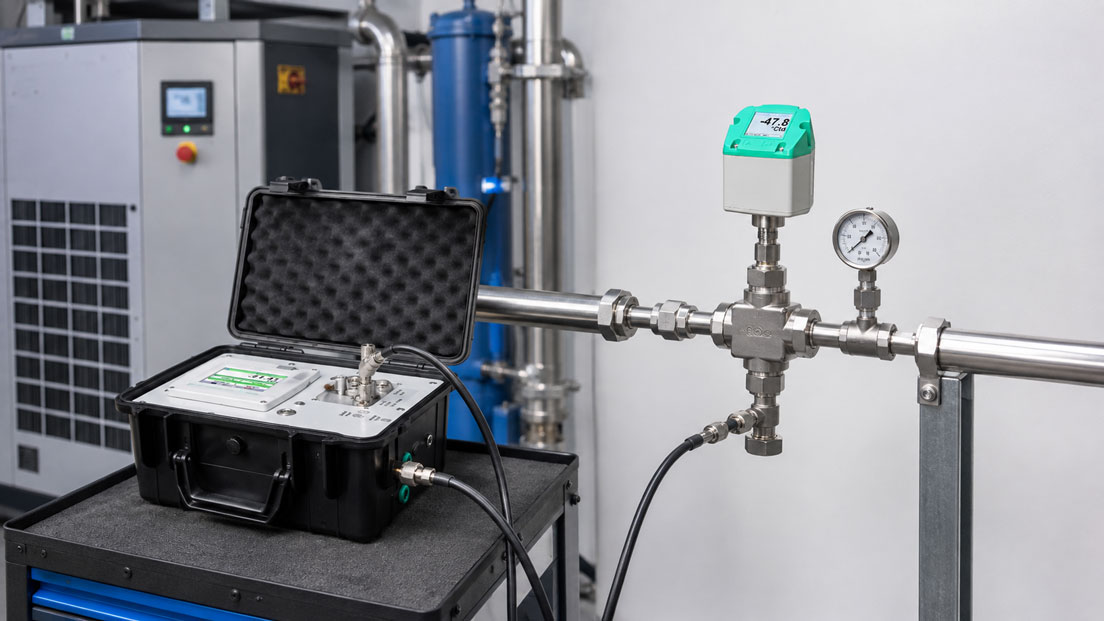
When assessing compressed-air systems, dew point values are often compared even though they were measured at different pressures. For example, a measuring instrument may indicate a dew point of −20 °C after the air has been expanded to atmospheric pressure, while the dryer is specified with a pressure dew point of +3 °C. At first glance, these values may appear inconsistent. In fact, however, they can describe almost the same water content.
The reason is that the dew point depends on pressure. When moist air is compressed, the water vapour partial pressure increases, and so does the dew point. When the same air is expanded, the water vapour partial pressure and dew point decrease. The pressure dew point at 7 bar gauge pressure is therefore considerably higher than the atmospheric dew point of the same air after expansion.
For a reliable assessment, the dew point, absolute pressure, measuring point and reference conditions must therefore always be stated together. Otherwise, a correctly operating compressed-air dryer may be wrongly rejected, unsuitable alarm limits may be configured or readings from different instruments may be compared incorrectly.
Suitable instruments can be found in the ICS category Humidity Measuring Instruments and Dew Point Measurement. Solutions for monitoring moisture, particles, oil and other quality parameters are summarised under Compressed-Air Quality.
Table of Contents
- What does the dew point describe?
- Distinguishing pressure dew point from atmospheric dew point
- Which water content remains unchanged during expansion?
- Do not confuse gauge pressure with absolute pressure
- How is the dew point converted?
- Example: Pressure dew point at 7 bar
- Correctly assessing refrigeration and adsorption dryers
- Measurement under pressure or after expansion?
- Assessing the risk of condensation in the pipe network
- Systematic verification and conversion procedure
- Typical errors when assessing dew point values
- Practical example: Different readings at a refrigeration dryer
- Which products and solutions are suitable?
- Conclusion
- Frequently asked questions
What does the dew point describe?
The dew point is the temperature to which a gas must be cooled at constant pressure for the water vapour it contains to reach saturation. If the gas is cooled further, the water vapour can no longer remain completely gaseous and begins to condense.
A dew point of +3 °C therefore does not mean that the compressed air currently has a temperature of 3 °C. It means that, at the specified pressure, condensation can begin at approximately +3 °C. If the actual compressed-air temperature is 25 °C, for example, the air temperature is considerably above the dew point and the water vapour initially remains gaseous.
The lower the dew point, the less water vapour is present. For dry compressed air, the dew point is therefore more informative than relative humidity. Relative humidity can be very low in warm compressed air but still increase sharply as soon as the air cools in a cold pipeline.
At very low temperatures, a physical distinction can be made between the dew point above liquid water and the frost point above ice. Industrial instruments and specifications nevertheless often use the general term dew point or °Ctd. For accurate comparisons, the definition used by the respective instrument or calculation method must therefore be considered.
Distinguishing pressure dew point from atmospheric dew point
Pressure dew point
The pressure dew point describes the dew point at the pressure prevailing at the compressed-air measuring point. If a sensor is installed directly in a 7-bar compressed-air line or in a measuring chamber at the same pressure as the line, it measures the pressure dew point.
The pressure dew point is decisive when determining whether condensation will occur inside the pressurised pipeline. If the pipe temperature falls below the pressure dew point, water vapour begins to condense.
Atmospheric dew point
The atmospheric dew point describes the dew point after the compressed air has been expanded to approximately atmospheric pressure. It is measured, for example, when a sample is routed through a pressure regulator into an unpressurised measuring chamber or discharged freely into the surrounding atmosphere.
With an unchanged moisture content, the atmospheric dew point is lower than the pressure dew point. Expansion reduces the water vapour partial pressure. The air would therefore have to be cooled further before saturation and condensation are reached again.
| Measured parameter | Pressure at the measuring point | Typical application |
|---|---|---|
| Pressure dew point | Operating pressure of the compressed-air line | Dryer monitoring and condensation assessment in the compressed-air network |
| Atmospheric dew point | Approximately 1 bar absolute | Assessment of expanded air or requirements referenced to atmospheric pressure |
| Calculated atmospheric dew point | Calculated from pressure dew point and both absolute pressures | Comparison with specifications at atmospheric pressure |
| Calculated pressure dew point | Calculated from atmospheric dew point and operating pressure | Conversion of an unpressurised measured value to the compressed-air line |
Which water content remains unchanged during expansion?
The frequently used statement that the “absolute water content” remains unchanged during expansion requires more precise consideration. In the idealised case, the amount of water in relation to a defined quantity of dry gas remains unchanged. This can be expressed, for example, as a molar fraction in ppmV/V or as a moisture ratio in grams of water per kilogram of dry air.
A value in mg/m³, however, is only unambiguous if the pressure, temperature and reference conditions are also specified. One cubic metre of compressed air at 8 bar absolute contains considerably more gas molecules than one cubic metre of expanded air at 1 bar absolute. The mass of water vapour per actual cubic metre therefore changes during expansion.
| Humidity parameter | Behaviour during an ideal pressure change | Points to consider |
|---|---|---|
| ppmV/V | Remains approximately constant | Applies without condensation, leakage or moisture exchange |
| g/kg of dry air | Remains approximately constant | Relates the amount of water to the mass of dry air |
| mg/m³ under standard conditions | Remains comparable with a clearly defined standard reference | Standard temperature and standard pressure must be stated |
| mg/m³ under current operating conditions | Changes with pressure and temperature | Do not compare without reference conditions |
| Dew point | Changes with total pressure | State the pressure at the measuring or reference point |
The conversion assumes that no water condenses, evaporates, is adsorbed or enters through leaks between the two pressure states. A wet pressure regulator, an unsuitable hose or a leaking sample line can invalidate this assumption.
Do not confuse gauge pressure with absolute pressure
Absolute pressures must be used when converting dew point values. In compressed-air systems, however, the operating pressure is usually indicated as gauge pressure.
Absolute pressure = Gauge pressure + Atmospheric pressure
With a line pressure of 7 bar gauge and an atmospheric pressure of approximately 1.013 bar, the result is:
pabs = 7 bar + 1.013 bar = 8.013 bar absolute
Using 7 bar absolute instead produces a systematic conversion error. The deviation is already relevant in typical compressed-air networks and becomes even greater as a percentage at lower gauge pressures.
The atmospheric reference pressure does not always have to be exactly 1.01325 bar either. Weather conditions and altitude affect the local atmospheric pressure. The standard value is sufficient for many operational estimates. For precise calculations, however, the actual or clearly agreed reference pressure should be used.
How is the dew point converted?
A direct linear conversion such as “subtract a fixed temperature value per bar” is not possible. The relationship is based on the saturation vapour pressure of water, which does not change linearly with temperature.
In simplified terms, the calculation is performed in four steps:
- The corresponding saturation vapour pressure of water is determined from the known dew point.
- At the dew point, this corresponds to the existing water vapour partial pressure.
- The water vapour partial pressure is converted according to the ratio of the absolute pressures.
- The corresponding new dew point is calculated from the new water vapour partial pressure.
The approximate conversion from pressure state 1 to pressure state 2 is:
pv,2 = psat(Tdp,1) × pabs,2 / pabs,1
Where:
- pv,2: water vapour partial pressure after the pressure change,
- psat(Tdp,1): saturation vapour pressure at the known dew point,
- pabs,1: original absolute pressure,
- pabs,2: new absolute pressure.
The new dew point is then the temperature at which the saturation vapour pressure equals the calculated water vapour partial pressure:
psat(Tdp,2) = pv,2
For practical applications, this calculation should be performed using a suitable measuring instrument, verified humidity software or a reliable thermophysical property calculation. Approximate tables are useful but do not replace a calculation using the actual pressures.
Example: Pressure dew point at 7 bar
The following table shows approximately which atmospheric dew point results when compressed air is expanded from 7 bar gauge pressure—corresponding to approximately 8.013 bar absolute—to 1.013 bar absolute.
| Pressure dew point at 7 bar gauge | Atmospheric dew point after expansion | Typical classification |
|---|---|---|
| +5 °Ctd | approx. −19 °Ctd atm | Moisture level of a typical refrigeration-dryer operating condition |
| +3 °Ctd | approx. −21 °Ctd atm | Frequently used design point for a refrigeration dryer |
| 0 °Ctd | approx. −23 °Ctd atm | Drier than a typical positive pressure dew point |
| −20 °Ctd | approx. −40 °Ctd atm | Dried compressed air with a low residual moisture content |
| −40 °Ctd | approx. −57 °Ctd atm | Typical target range for dry adsorption systems |
| −60 °Ctd | approx. −74 °Ctd atm | Very dry compressed air or process gases |
The values are approximate. They assume that no condensation occurs during expansion, no moisture enters from the environment and no moisture is released from or absorbed by the pipework or measuring chamber.
The example also illustrates the reverse calculation: an atmospheric dew point of approximately −21 °C can correspond to a pressure dew point of approximately +3 °C when the air is compressed to 7 bar gauge. A value of −21 °C after expansion therefore does not mean that the dryer achieves a pressure dew point of −21 °C.
Correctly assessing refrigeration and adsorption dryers
Refrigeration dryers
Refrigeration dryers cool the compressed air so that some of the water vapour condenses and can be separated. Depending on the model and operating conditions, the achievable pressure dew point is often within the positive single-digit temperature range.
A specified pressure dew point of +3 °C normally refers to defined inlet temperatures, volume flow rates, ambient temperatures and operating pressures. If the inlet temperature increases, the dryer is overloaded or the condensate discharge does not function correctly, the actual pressure dew point can be considerably higher.
Adsorption dryers
Adsorption dryers are used when significantly lower pressure dew points are required. Depending on the design and operating mode, target pressure dew points may be −20, −40 or −70 °C, for example.
Here too, it must be clearly established whether the stated requirement describes a pressure dew point at operating pressure or an atmospheric dew point. At 7 bar gauge, an atmospheric value of −40 °C does not correspond to a pressure dew point of −40 °C, but approximately to a pressure dew point of −20 °C.
| Question | Required information |
|---|---|
| Does the dryer meet its specification? | Dew point type, reference pressure and defined operating conditions |
| Is there a risk of condensation in the compressed-air network? | Pressure dew point and lowest pipe temperature |
| Does expanded process air meet a requirement? | Atmospheric dew point under the conditions of use |
| Are two measuring instruments comparable? | Same pressure, same dew point definition and comparable measuring point |
Measurement under pressure or after expansion?
Inline measurement at operating pressure
The sensor is installed directly in the compressed-air line. This solution measures the pressure dew point at the actual line pressure. It provides a direct process measurement but requires suitable pressure resistance, the correct installation position and adequate protection against dirt, oil and condensate.
Pressurised bypass measuring chamber
A small partial flow is routed from the main line through a measuring chamber. If the measuring chamber is at the same pressure as the main line, the pressure dew point is also measured.
The bypass facilitates sensor replacement and calibration. A defined sampling flow can also prevent dead volumes and improve response time. Pressure losses between the main line and measuring chamber must, however, be considered.
Measurement downstream of a pressure regulator
If the sample is expanded to atmospheric pressure before entering the measuring chamber, the sensor measures the atmospheric dew point. This value may only be assessed as a pressure dew point after it has been converted using the actual operating pressure.
The sample line downstream of the pressure regulator must be sealed against ambient air. Particularly with very dry compressed air, even very small leaks, unsuitable plastics or long hoses can significantly impair the measured value.
Pressure reduction inside or downstream of the measuring chamber
The position of the pressure restriction is decisive. If the throttle is downstream of the measuring chamber, the chamber can remain at line pressure and measure the pressure dew point. If the pressure regulator is upstream of the measuring chamber, the chamber is at a lower pressure and therefore measures a different dew point.
Assessing the risk of condensation in the pipe network
To assess condensation, the pressure dew point must be compared with the lowest expected temperature of the pressurised pipeline:
Pipe temperature > Pressure dew point: Water vapour generally remains gaseous
Pipe temperature ≤ Pressure dew point: Condensation can begin
A safety margin between the lowest pipe temperature and the pressure dew point is advisable because measurement uncertainty, load changes, local cold spots and temporary dew point peaks must be considered. The required margin must be defined for the specific application and must not be assumed to be a universal value.
If the pressure decreases along the network, the corresponding pressure dew point generally decreases as well. At the same time, the compressed air can cool during expansion. Pressure and temperature changes must therefore be considered together when assessing the actual risk of condensation.
Existing liquid condensate does not automatically disappear when the pressure is reduced. If water is carried over from a vessel, filter or low point in the pipework, faults can occur even when the calculated atmospheric dew point is low. Dew point measurement assesses gaseous water vapour and does not replace the inspection of condensate drains and water separators.
Systematic verification and conversion procedure
- Clearly identify the measured value: Document whether it is a pressure dew point or atmospheric dew point.
- Record the measuring pressure: Determine the pressure directly at the measuring chamber or sensor.
- Check the pressure type: Clearly distinguish between gauge pressure and absolute pressure.
- Define the reference pressure: Use the standard atmospheric pressure or the actual ambient pressure.
- Check the measuring setup: Identify the positions of the pressure regulator, throttle, measuring chamber and outlet.
- Exclude moisture exchange: Check the sample line for leaks, diffusion, condensate and unsuitable materials.
- Convert the value: Use suitable software, an instrument function or a validated thermophysical property calculation.
- Check the comparison value: Ensure that the requirement and measured value use the same pressure reference.
- Assess the temperature: Compare the pressure dew point with the coldest point in the compressed-air network.
- Evaluate the trend: Record dryer cycles, load peaks and temporary increases in dew point.
Typical errors when assessing dew point values
| Error | Possible consequence | Suitable measure |
|---|---|---|
| Direct comparison of pressure dew point and atmospheric dew point | Dryer is assessed incorrectly | Convert both values to the same pressure |
| Using 7 bar gauge as 7 bar absolute | Systematic conversion error | Add atmospheric pressure to the gauge pressure |
| Using the main-line pressure instead of the pressure in the measuring chamber | Incorrect reference pressure | Measure the pressure directly at the measuring point |
| Overlooking a pressure regulator upstream of the measuring chamber | Atmospheric value is interpreted as pressure dew point | Document the measuring setup and pressure profile |
| Comparing mg/m³ without reference conditions | Different gas states are mixed | State pressure, temperature and standard reference conditions |
| Leak in the sample line | Dew point is too high due to moist ambient air | Use leak-tight metal tubing and suitable connections |
| Condensate upstream of the sensor | Long recovery time or implausibly high moisture reading | Dry the measuring line and eliminate the cause of condensation |
| Spot measurement during a favourable dryer cycle | Temporary dew point peaks remain undetected | Record the measured-value trend over several load and dryer cycles |
| Confusing dew point with the current gas temperature | Condensation limit is interpreted incorrectly | Document gas temperature and dew point separately |
Practical example: Different readings at a refrigeration dryer
A refrigeration dryer is designed for a pressure dew point of +3 °C. The compressed-air network operates at 7 bar gauge. A service technician connects a portable dew point measuring instrument through a pressure regulator and measures a dew point of approximately −20 °C at atmospheric pressure.
Initially, the measurement is suspected to be incorrect because the displayed value differs considerably from the dryer specification of +3 °C. In fact, however, two different reference conditions were compared:
- Manufacturer specification: +3 °C pressure dew point at approximately 8 bar absolute,
- Service measurement: approximately −20 °C atmospheric dew point at around 1 bar absolute.
After pressure-dependent conversion, it becomes clear that both values describe approximately the same moisture content. The dryer is therefore generally operating within the expected range.
During a subsequent trend measurement, however, the atmospheric dew point temporarily rises to −12 °C under high system load. Converted to the line pressure, this corresponds to a significantly higher pressure dew point. At the same time, the lowest temperature of an outdoor pipeline in winter is only +2 °C.
There is therefore a temporary risk of condensation. The cause is ultimately found to be an overload of the refrigeration dryer caused by a high inlet temperature. The decisive finding does not come from the single −20 °C reading, but from the correct pressure conversion and the recording over the complete operating cycle.
Which products and solutions are suitable?
IFA500 Dew Point Sensor
The IFA500 is designed for stationary dew point monitoring on refrigeration, membrane and adsorption dryers. It features an integrated display, a freely scalable 4–20 mA output, Modbus RTU and an adjustable alarm relay.
After entering the system pressure and atmospheric reference pressure, the sensor can also calculate the atmospheric dew point from the measured pressure dew point. This allows both dew point values to be compared unambiguously, provided that the pressure values used are configured correctly.
IDP400 Portable
The IDP400 Portable combines dew point measurement down to −80 °Ctd with integrated pressure measurement up to 16 bar. In addition to pressure dew point, gas temperature and line pressure, the instrument can calculate further pressure-dependent humidity parameters and the atmospheric dew point.
Because the dew point and measuring pressure are recorded together, the system is particularly suitable for service work, dryer inspections and comparisons between different compressed-air measuring points.
IDP500 Portable Dew Point Measuring Instrument
The IDP500 is a portable dew point measuring instrument with a graphical display and data logger. It is designed for dew point measurements on compressed-air dryers down to −80 °Ctd and calculates parameters including mg/m³, ppmV/V, g/kg and atmospheric dew point.
The graphical recording function is particularly helpful for visualising switching cycles, load changes and temporary dew point peaks over an extended period.
IFA550 for Stationary Measuring Points
The IFA550 is designed for stationary dew point measurements under harsh industrial conditions. In addition to pressure dew point, temperature and other humidity parameters, the atmospheric dew point can also be output via the digital interface.
For all sensors, the measuring chamber must correspond to the required dew point type. A pressurised measuring chamber provides the pressure dew point. A sample expanded upstream of the measuring chamber provides a dew point at the lower pressure actually prevailing inside the chamber.
Conclusion
Pressure dew point and atmospheric dew point can only be meaningfully compared when both values are referenced to the same pressure. The same moisture content produces a higher dew point at high pressure and a lower dew point after expansion.
Absolute pressures must be used for the conversion. An operating pressure of 7 bar gauge corresponds to approximately 8 bar absolute. A simple linear temperature correction is not possible because the calculation is based on the temperature-dependent saturation vapour pressure.
The pressure dew point is decisive when assessing condensation in a pressurised pipe network. For expanded process air or a requirement at atmospheric pressure, the atmospheric dew point is required instead. The measuring point, pressure regulator, measuring chamber and reference pressure must therefore always be documented.
Measurement is particularly reliable when dew point and pressure are recorded simultaneously, converted automatically and logged over several dryer and load cycles. This prevents both incorrect comparisons and temporary moisture problems from being overlooked.
Frequently asked questions about pressure dew point and atmospheric dew point
What is the difference between pressure dew point and atmospheric dew point?
The pressure dew point applies at the operating pressure of the compressed-air line. The atmospheric dew point applies after expansion to approximately 1 bar absolute. At the same moisture content, the atmospheric dew point is lower.
What is the atmospheric dew point at a pressure dew point of +3 °C and 7 bar?
At 7 bar gauge, corresponding to approximately 8 bar absolute, expansion to 1.013 bar absolute results in an approximate atmospheric dew point of −21 °C.
Can I subtract a fixed temperature value per bar?
No. The relationship between pressure and dew point is not linear. For correct conversion, the saturation vapour pressure and both absolute pressures must be taken into account.
Do I calculate using gauge pressure or absolute pressure?
Absolute pressures are required for the conversion. The atmospheric pressure must therefore be added to the indicated gauge pressure.
Does a measuring chamber always measure the pressure dew point?
No. It measures the dew point at the pressure actually prevailing in the measuring chamber. At line pressure, this is the pressure dew point. If the sample is expanded to atmospheric pressure upstream of the chamber, the atmospheric dew point is measured.
Does pressure reduction change the water content?
During ideal expansion without condensation, leakage or moisture exchange, the amount of water relative to the quantity of dry air remains unchanged. The dew point and the water mass per actual cubic metre, however, change with pressure.
Which dew point is relevant to condensation in the compressed-air network?
For a pressurised pipeline, the pressure dew point at the local line pressure is decisive. It must be compared with the lowest expected pipe temperature.
Why does an instrument indicate a much lower dew point downstream of the pressure regulator?
Pressure reduction lowers the water vapour partial pressure. The expanded air must therefore be cooled to a lower temperature before condensation begins.
Can a low dew point rule out the presence of liquid water?
No. A dew point value describes gaseous water vapour. Liquid condensate from defective drains, filters or low points in the pipework may still be present and carried downstream.