


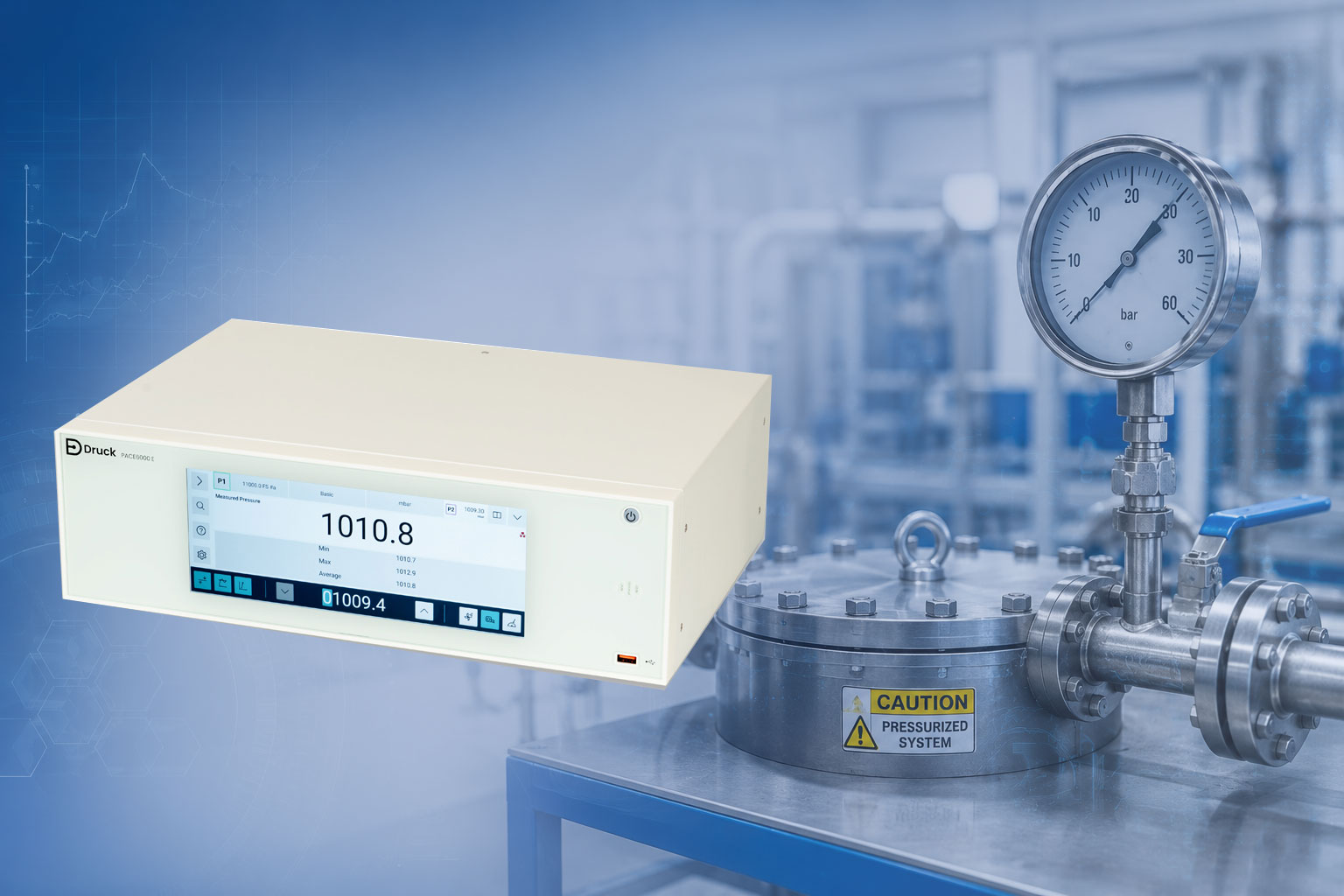
Pressure vessels, fittings, valves, sensors, pipelines, and complete assemblies must be tested regularly in many industrial sectors. The challenge is to apply a defined test pressure safely, reproducibly, and in a controlled manner. If the pressure is increased too quickly, test objects may be damaged. If pressure control is too imprecise, the test results may not be meaningful. And when test procedures are performed manually, the risk of operator errors also increases.
This becomes particularly critical with safety-relevant components or high-value products. In such cases, it is not sufficient to set the pressure only “approximately”. Instead, precisely defined pressure profiles must be generated, pressure levels must be held accurately, and pressure changes must be documented reliably.
The modular pressure controllers of the PACE5000E and PACE6000E series were developed precisely for these tasks. In combination with the highly precise CM3 control modules, they enable fast, stable, and reproducible pressure control across a wide pressure range. Thanks to fully digital control technology, pressure values can be approached, maintained, and automatically documented with high stability.
Why Manual Pressure Testing Is Often Problematic
Many tests are still carried out using hand pumps, pressure regulators, or simple pressure sources. This often leads to the following challenges:
| Manual Pressure Testing | PACE Controller with CM3 Module |
|---|---|
| Pressure is adjusted manually | Pressure is controlled automatically |
| Fluctuating test pressures | High control stability |
| Operator influence on results | Reproducible test procedures |
| Time-consuming documentation | Can be automated |
| Higher risk of errors | Defined pressure profiles |
| Long testing times | Fast pressure control |
Manual methods quickly reach their limits, especially for repetitive testing tasks or high production volumes.
Practical Example 1: Pressure Testing a Safety Valve
A manufacturer of safety valves must test every unit before delivery. During this process, the test pressure has to be increased step by step until the valve’s set pressure is reached.
Challenge
Manual pressure generation often causes pressure overshoot. As a result, the actual opening pressure can be difficult to determine accurately.
Solution with PACE6000E and CM3
The PACE controller automatically approaches the required pressure in predefined steps:
| Test Step | Pressure |
|---|---|
| Pre-test | 5 bar |
| Step 1 | 10 bar |
| Step 2 | 15 bar |
| Step 3 | 20 bar |
| Opening Test | 21.5 bar |
The pressure is maintained with exceptional stability and controlled with high precision.
Result
- Reproducible test results
- No pressure overshoot
- Faster testing procedures
- Improved product safety
Practical Example 2: Leak Testing a Pressure Vessel
A plant manufacturer produces pressure vessels for the chemical industry. Before delivery, every vessel must undergo a leak test.
Challenge
The test pressure must first be generated and then maintained at a constant level for a defined period. Even the smallest pressure changes can indicate a leak.
Solution with PACE6000E
The controller automatically generates the required test pressure and maintains it throughout the entire testing period.
Test Procedure
| Phase | Pressure | Duration |
|---|---|---|
| Pressure Build-Up | 0 → 40 bar | 30 s |
| Stabilization Phase | 40 bar | 5 min |
| Leak Test | 40 bar | 30 min |
Thanks to the outstanding control stability, even the smallest pressure losses can be detected. The integrated leak test function supports automatic evaluation of the results.
Result
- Higher testing reliability
- Automated documentation
- Early leak detection
- Shorter testing times
Practical Example 3: Testing Pressure Transmitters in Production
A manufacturer of pressure transmitters wants to automatically test every instrument before shipment.
Challenge
Each sensor must pass through several pressure points. The pressure values must be reached precisely and maintained with high stability.
Solution with PACE5000E and CM3
The PACE controller automatically generates the required pressure points.
| Test Point | Setpoint |
|---|---|
| Zero Point | 0 bar |
| Point 1 | 25% FS |
| Point 2 | 50% FS |
| Point 3 | 75% FS |
| Full Scale | 100% FS |
Thanks to the high control speed, the required setpoints are reached within seconds. Pressure profiles and test programs can be stored directly in the controller and executed automatically.
Result
- Higher production throughput
- Fully automated testing procedures
- Reduced operator errors
- Reproducible quality assurance
Why the CM3 Control Module Is Particularly Suitable
The CM3 control module is based on Druck’s TERPS technology and combines outstanding measurement accuracy with exceptional long-term stability. At the same time, the PACE platform is among the fastest pressure control systems available and can reach and stabilize test pressures within just a few seconds.
| Advantage | Benefit |
|---|---|
| High control speed | Shorter testing times |
| High control stability | Reliable test results |
| Modular concept | Flexible adaptation to different applications |
| Automated test programs | Higher productivity |
| Integrated leak test function | Simplified leak testing |
| Digital communication interfaces | Easy integration into test benches |
Safe Testing Instead of Improvisation
Pressure testing is not only about accuracy—it is primarily about safety, repeatability, and process reliability. The PACE5000E and PACE6000E, combined with the CM3 control module, enable precisely defined pressure profiles, highly stable pressure control, and fully automated testing procedures. As a result, pressure vessels, valves, sensors, and other pressurized components can be tested more safely, faster, and more reliably than with conventional manual methods.