


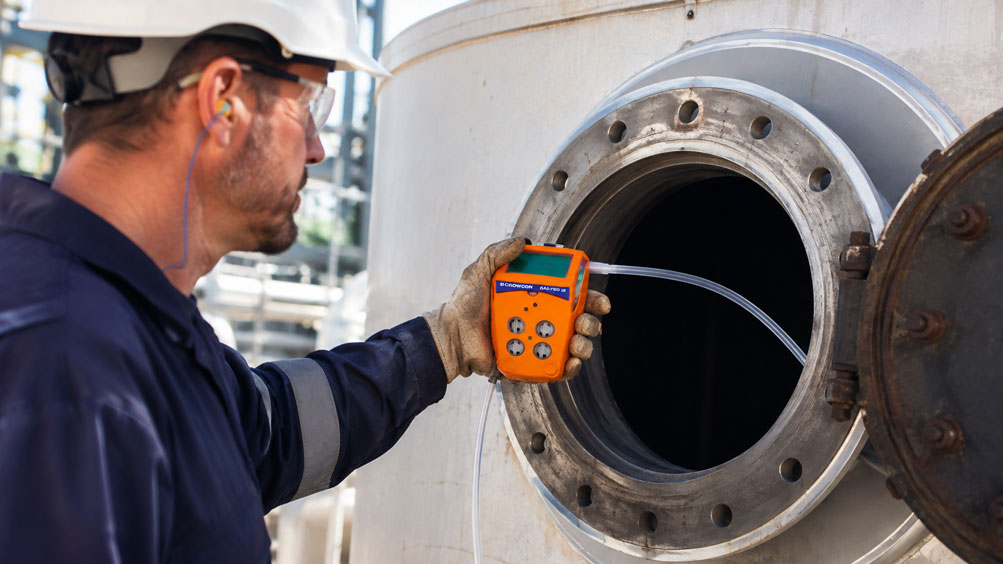
A portable gas detector indicates:
5 % LEL
for a combustible gas.
At the same time, however, the measured oxygen concentration is only:
10 vol.-% O₂
.
Can it therefore be concluded that only a low concentration of combustible gas is present?
Not necessarily.
The decisive factor is which measuring principle is used to detect the combustible gas.
A conventional catalytic sensor – often referred to as a:
pellistor
or:
catalytic bead sensor
– does not measure combustible gases simply because the gas is present inside the sensor.
The measuring principle requires catalytic oxidation of the combustible gas.
This requires:
oxygen
.
If the oxygen concentration drops significantly, the catalytic reaction can become weaker.
The result may be:
actual gas concentration high
but:
indicated %LEL value too low
A low pellistor reading in an oxygen-deficient or inerted atmosphere must therefore not automatically be interpreted as evidence of a low combustible-gas concentration.
This relationship is particularly relevant for:
- inerted tanks,
- vessels purged with nitrogen,
- tank cleaning,
- gas clearance measurements,
- process vessels,
- pipelines during inerting or degassing,
- confined spaces with oxygen displacement.
For such applications, the following must already be clarified when selecting the instrument:
Which gas is to be measured?
Can oxygen deficiency occur?
Can the atmosphere become completely inerted?
Which sensor principle is suitable under these conditions?
Gas measuring and gas warning instruments can be found at ICS Schneider under Gas Measuring Instruments / Gas Detectors.
Table of Contents
- How a catalytic LEL sensor works
- What does % LEL mean?
- Why a pellistor requires oxygen
- What happens to the measured value under oxygen deficiency
- Why inerted vessels are particularly critical
- Oxygen deficiency does not automatically mean there is no permanent explosion risk
- High combustible-gas concentrations as an additional limitation
- Sensor poisoning in pellistors
- Why a bump test is important
- Consider calibration gas and target gas
- Correction factors and cross-sensitivity
- Infrared sensor as an alternative
- IR sensors also have application limits
- MPS technology as another sensor option
- Why parallel O₂ measurement is important
- Sampling from tanks and confined spaces
- Distinguishing clearance measurement from personal monitoring
- Typical fault patterns
- Systematic selection of the measuring principle
- Practical example: inerted fuel tank
- Suitable ICS products
- Conclusion
- FAQ
How a catalytic LEL sensor works
Catalytic sensors have been used for many years to measure combustible gases.
The measuring principle is based on a controlled reaction of the combustible gas at a heated catalytic element.
Active and reference sensor element
In simplified form, a pellistor has two heated elements:
- a catalytically active measuring element,
- a reference element.
If a combustible gas reaches the active element and sufficient oxygen is available, the gas is oxidized on its surface.
The reaction generates heat
The catalytic reaction increases the temperature of the active sensor element.
This changes its electrical resistance.
An electrical signal is generated from the difference between the measuring and reference elements.
In simplified form
combustible gas + oxygen → catalytic reaction → heat → resistance change → measuring signal
Important consequence
The measuring signal does not depend solely on how much combustible gas is present.
It also depends on whether the conditions required for the catalytic reaction are present.
This particularly includes:
sufficient oxygen
What does % LEL mean?
LEL stands for:
Lower Explosive Limit
The German abbreviation is:
UEG = Untere Explosionsgrenze
.
100 % LEL does not mean 100 vol.-% gas
The indication:
100 % LEL
means that the concentration of the combustible gas in question corresponds to its lower explosive limit.
Example principle
If the lower explosive limit of a gas is, for example, a few percent by volume, then:
100 % LEL
corresponds to these few percent by volume of gas in an atmosphere under the underlying conditions.
50 % LEL
correspondingly means:
50 % of the concentration of the lower explosive limit
and not:
50 vol.-% gas
LEL relates to flammability in air
The concept of explosive limits is fundamentally associated with an oxidizing atmosphere.
In a strongly inerted atmosphere, a gas mixture may currently not be ignitable despite a high combustible-gas concentration.
However, this does not mean that the actual combustible-gas concentration is irrelevant.
Why a pellistor requires oxygen
Catalytic measurement is based on an oxidation reaction.
This requires:
combustible gas + oxygen
Normal ambient air
Under normal atmospheric conditions, sufficient oxygen is available for the sensor to operate according to its intended principle.
Oxygen is displaced
This can occur, for example, due to:
- nitrogen,
- carbon dioxide,
- process gases,
- combustible gases,
- inert-gas purging.
The catalytic reaction is affected
If the available oxygen concentration drops significantly, less combustible gas can be oxidized at the sensor element.
As a result, less heat is generated.
The electrical sensor signal can therefore become smaller.
Dangerous misinterpretation
The display may show a low:
%LEL value
even though a considerable amount of combustible gas is still present.
The sensor may therefore indicate a low value not because little gas is necessarily present, but because its measuring principle can no longer operate correctly in the oxygen-deficient atmosphere.
What happens to the measured value under oxygen deficiency
There is no universal oxygen value below which every catalytic sensor suddenly fails completely.
The behavior depends, among other things, on:
- sensor type,
- gas type,
- gas concentration,
- oxygen content,
- temperature,
- sensor condition.
As oxygen decreases, the measurement becomes increasingly critical
The sensor can:
- indicate too low,
- respond more poorly,
- show altered sensitivity,
- under extreme conditions provide practically no usable combustible-gas signal.
A low reading is therefore not automatically an all-clear signal
A particularly dangerous conclusion would be:
O₂ low + pellistor shows 0 % LEL → vessel is gas-free
This conclusion is not permissible.
Why inerted vessels are particularly critical
Tanks and process vessels are often deliberately inerted.
A typical inert gas is, for example:
nitrogen
Purpose of inerting
The oxygen content is reduced to such an extent that, under the intended conditions, no ignitable gas-air mixture can form.
The combustible gas does not automatically disappear
A fuel tank may simultaneously contain:
- very little oxygen,
- a large amount of nitrogen,
- a high concentration of combustible hydrocarbon vapors.
Problem for catalytic sensors
In precisely this type of atmosphere, a pellistor cannot be used reliably to determine the combustible-gas concentration.
A suitable measuring principle is required
For certain hydrocarbons, infrared sensors can be used because their measuring principle does not require catalytic combustion of the target gas.
Oxygen deficiency does not automatically mean there is no permanent explosion risk
An inerted atmosphere may currently be outside the ignitable range.
However, the situation can change.
Example: tank ventilation
A tank contains:
- nitrogen,
- fuel vapor,
- little oxygen.
Air is now introduced.
The oxygen content rises
while fuel vapor is still present.
During this transition, the mixture can pass through an:
ignitable concentration range
.
Therefore determine the combustible-gas concentration
During inerting, purging and gas freeing, the atmosphere must be monitored throughout the entire process using measuring technology suitable for the task.
A temporarily low oxygen concentration is not a substitute for reliably determining the combustible-gas concentration present.
High combustible-gas concentrations as an additional limitation
Catalytic LEL sensors are typically designed for the range up to the lower explosive limit.
Very high combustible-gas concentrations are a different measuring range
In tank applications, for example, concentrations can occur that are significantly above:
100 % LEL
.
Distinguish between % LEL and vol.-%
For monitoring a complete inerting or gas-freeing process, it can therefore be useful to use an instrument that can measure both:
% LEL
and:
vol.-%
.
Gas-Pro TK
The Crowcon Gas-Pro TK listed by ICS, for example, is intended precisely for this special application.
For combustible-gas measurement, it can automatically switch between:
% LEL
and:
vol.-%
.
Sensor poisoning in pellistors
Oxygen deficiency is not the only possible cause of a reading that is too low.
Catalytic sensors can also be affected or permanently damaged by certain substances.
Sensor poisoning
Certain substances can impair the catalytically active surface.
Depending on the sensor design and environment, these can include compounds containing:
- silicone,
- lead,
- sulfur
.
Consequence
The catalytic reaction becomes weaker.
The sensor responds less sensitively to combustible gas.
Particularly critical
A poisoned sensor may still:
- be switched on,
- show no obvious fault indication,
- display an apparently plausible zero value.
Nevertheless, its sensitivity to the target gas may be significantly reduced.
Why a bump test is important
A bump test or functional test with test gas verifies whether the gas detector responds to a known gas exposure.
The test does not only check the sensor
A complete functional test can check, among other things:
- sensor response,
- display,
- audible alarm,
- visual alarm,
- vibration alarm.
Why is this particularly important for catalytic sensors?
A pellistor can lose sensitivity due to:
- sensor poisoning,
- aging,
- mechanical or thermal stress,
- contamination
.
A zero reading does not prove functionality
A display showing:
0 % LEL
only proves that no corresponding signal is currently being displayed.
It does not automatically prove that the sensor would respond correctly to combustible gas.
Consider calibration gas and target gas
A catalytic sensor does not respond exactly the same to every combustible gas.
Calibration
The instrument is calibrated using a defined test gas at a known concentration.
Different target gas
If another combustible gas is subsequently measured, the sensor sensitivity may differ.
Examples of different combustible gases
- methane,
- propane,
- butane,
- pentane,
- hydrogen,
- various solvent vapors.
Therefore select the instrument according to the actual gas task
Before selection, at least the following should be known:
- target gas or gas mixture,
- expected concentration range,
- calibration gas,
- measuring principle.
Correction factors and cross-sensitivity
For certain sensors, correction factors can be used when the sensor is calibrated with one gas and another gas is measured.
However
A correction factor does not fundamentally correct:
- oxygen deficiency,
- sensor poisoning,
- an unsuitable sensor technology,
- a measuring range outside the specification.
Important distinction
different gas sensitivity
is a different problem from:
sensor cannot operate correctly because oxygen is missing
Infrared sensor as an alternative
With an infrared sensor, the combustible gas is not catalytically burned.
Instead, the absorption of infrared radiation by the target gas is evaluated.
Simplified principle
IR light → gas sample → absorption of specific wavelengths → concentration signal
No oxygen required for the measurement reaction
Because no catalytic oxidation of the combustible gas is required, suitable IR sensors can also operate in oxygen-deficient or oxygen-free atmospheres.
Advantage during inerting
This is particularly relevant for:
- fuel tanks,
- tank farms,
- inerted vessels,
- nitrogen purging,
- gas-freeing processes.
Another advantage
IR sensors are also not susceptible to catalytic sensor poisoning in the same way as pellistors.
IR sensors also have application limits
The statement:
IR is always better
would also be incorrect.
IR must match the target gas
Not every combustible gas absorbs infrared radiation in a way that can be detected by a typical hydrocarbon IR sensor.
Hydrogen as an important example
A conventional IR sensor for hydrocarbons is not automatically suitable for:
H₂
.
Therefore
Before selecting an IR instrument, it must be checked:
- which gas is to be detected,
- which measuring range is required,
- whether the specific sensor module is specified for this gas.
MPS technology as another sensor option
In addition to pellistor and IR sensors, further measuring principles for combustible gases are available today.
MPS
MPS stands for:
Molecular Property Spectrometer
Example: Crowcon T4x
The Crowcon T4x listed by ICS uses an MPS sensor option for measuring combustible gases.
ICS specifies:
- detection of more than 15 combustible gases,
- measuring range 0 … 100 % LEL,
- reduced or eliminated risk of conventional sensor poisoning,
- simultaneous monitoring of oxygen, H₂S and CO in the corresponding configuration.
The sensor principle must still be matched to the application
Even with modern sensor technology, the specific instrument must be suitable for:
- target gas,
- atmosphere,
- measuring range,
- Ex requirements,
- sampling method
.
Why parallel O₂ measurement is important
For applications in which inerting may occur, combustible gas should not be considered in isolation.
At least two different hazards
The following can exist simultaneously:
combustible gas
and:
oxygen deficiency
Oxygen measurement provides important contextual information
The O₂ value indicates, for example:
- whether an atmosphere is oxygen-deficient,
- whether inerting is still maintained,
- whether the atmosphere is changing during ventilation.
However
O₂ measurement does not replace combustible-gas measurement.
And combustible-gas measurement does not replace O₂ measurement.
Both answer different questions.
Sampling from tanks and confined spaces
Even a suitable sensor principle only provides a meaningful value if the gas sample actually reaches the sensor.
Atmospheres can be stratified
Depending on:
- gas density,
- temperature,
- air movement,
- vessel geometry,
- inlet and outlet points
different concentrations can occur at different locations.
A single measuring point may be insufficient
For a clearance measurement, it may be necessary to test, for example:
- at the top,
- in the middle,
- at the bottom
.
Pumped measurement
For measurement before entry, a gas detector with a suitable pump and sampling hose can be used.
Allow for purge time
The hose has its own internal volume.
After changing the measuring point, the new gas sample therefore requires time until it reaches:
hose + pump + sensor
.
Distinguishing clearance measurement from personal monitoring
A measurement before entering a confined space answers the question:
What is the atmosphere like at the time of the clearance measurement?
The atmosphere can change afterwards
For example due to:
- incoming gas,
- residual products,
- cleaning work,
- welding or cutting work,
- changes in ventilation.
Therefore
Depending on the risk assessment, continuous personal gas monitoring may additionally be required.
Typical faults in LEL measurements
| Observation | Possible cause | Recommended check |
|---|---|---|
| Pellistor shows nearly 0 % LEL in an inerted tank | Too little oxygen for catalytic measurement | Check O₂ value and use a suitable oxygen-independent measuring principle |
| LEL reading suddenly increases after air is introduced | Pellistor once again receives sufficient oxygen | Assess inerting condition and actual combustible-gas concentration |
| Sensor barely responds during bump test | Sensor poisoning, aging or defect | Remove instrument from service and test or calibrate according to manufacturer instructions |
| Sensor continuously shows zero although combustible gas is expected | Unsuitable measuring principle, damaged sensor or sample does not reach the sensor | Check bump test, sampling and sensor technology |
| Measured value differs greatly from expected value | Calibration gas and target gas are different | Check gas type, calibration and correction factors where applicable |
| Only the measurement at the tank opening is normal | Gas stratification inside the vessel | Measure at several heights and locations |
| Gas reading responds only after a significant delay | Long sampling hose or insufficient volume exchange | Consider hose length, pump performance and purge time |
| IR instrument does not show an expected combustible gas | Target gas cannot be detected with the IR sensor used | Check sensor specification for the specific gas |
| O₂ is low, but combustible-gas reading is also low | Possible oxygen dependency with a pellistor | Do not use the measuring principle for clearance without further verification |
| Pellistor responds less strongly after silicone work | Possible sensor poisoning | Perform a functional test using suitable test gas |
Systematic selection of the measuring principle
- Determine the target gas: Clearly define methane, propane, butane, hydrogen, solvent vapor or gas mixture.
- Determine the concentration range: Distinguish between ppm, % LEL and vol.-%.
- Determine oxygen conditions: Check whether oxygen deficiency or complete inerting can occur.
- Consider process conditions: Evaluate normal operation, inerting, purging, gas freeing and maintenance separately.
- Select the sensor principle: Choose pellistor, IR, MPS or another suitable technology according to the gas task.
- Use pellistors only within their operating conditions: Explicitly consider oxygen dependency.
- Check IR suitability for the target gas: Not every combustible gas can be measured with every IR sensor.
- Distinguish between LEL and vol.-%: Provide a suitable measuring range for high concentrations.
- Monitor O₂ in parallel: Treat oxygen deficiency as an independent hazard in tanks and confined spaces.
- Determine additional toxic gases: Consider H₂S or CO, for example, depending on the process.
- Define sampling: Select diffusion or pumped measurement according to the application.
- Consider hose length: Take response delay and possible adsorption into account.
- Define measuring points: Consider possible gas stratification and vessel geometry.
- Determine calibration gas: Match calibration to the actual gas task.
- Check correction factors: Apply only in accordance with manufacturer information.
- Assess sensor poisoning: Consider possible silicones, sulfur-, lead- or other interfering compounds.
- Plan functional testing: Perform bump tests in accordance with operating and manufacturer requirements.
- Check Ex approval: Match instrument marking to zone and gas group.
- Separate clearance measurement and personal monitoring: Depending on the risk assessment, plan both tasks separately.
- Document the measurement strategy: Record instrument, sensor principle, target gas, measuring points and operating condition.
Practical example: inerted fuel tank
A fuel tank is to be prepared for maintenance work.
The tank still contains:
- hydrocarbon vapors,
- an inerted atmosphere created using nitrogen.
Step 1: Measure oxygen
The measurement shows, for example:
O₂ significantly below normal ambient air
The tank therefore remains oxygen-deficient.
Step 2: Measure combustible gas using a pellistor
A catalytic sensor shows only a low:
%LEL value
Incorrect conclusion
Low %LEL value → hardly any fuel vapor present
This assessment would not be safe.
Why?
The pellistor requires oxygen for its catalytic reaction.
The low indication may therefore be caused by the oxygen-deficient atmosphere.
Step 3: Use a suitable IR measuring principle
An infrared sensor suitable for the specific hydrocarbons present is used.
Step 4: Consider the concentration range
At the beginning of the process, the combustible-gas concentration may be significantly above the conventional LEL measuring range.
For this tank application, it is therefore useful to use a solution capable of measuring both:
vol.-%
and:
% LEL
.
Step 5: Monitor the gas-freeing process
During further purging or ventilation, the following are continuously monitored:
- combustible-gas concentration,
- oxygen concentration,
- toxic gases where applicable.
Important transition
When air is introduced, the oxygen concentration rises.
At the same time, fuel vapors may still be present.
The transition process must therefore be monitored in a controlled manner.
Result
For an inerted tank, not just any “LEL meter” is sufficient. Sensor principle, measuring range and oxygen conditions must be suitable for the entire tank procedure.
Suitable ICS products for combustible-gas measurement under oxygen deficiency
Crowcon Gas-Pro IR
A particularly suitable solution for this topic is the following instrument listed by ICS:
Crowcon Gas-Pro IR
Combustible-gas detection is performed using infrared technology.
Why the Gas-Pro IR is suitable for this topic
The IR measuring principle is particularly useful for applications in which:
- little oxygen may be present,
- an atmosphere is inerted,
- catalytic pellistor sensors may reach their operating limits.
ICS lists the following for the Gas-Pro IR, among other things
- combustible gases in the range 0 … 100 % LEL,
- oxygen measurement,
- additional gas options depending on configuration,
- optional internal pump,
- portable multi-gas measurement.
Always match the measuring principle to the gas
For the Gas-Pro IR as well, it must be checked whether the specific IR sensor is suitable for the expected combustible gas.
Further information can be found under Crowcon Gas-Pro IR at ICS Schneider.
Crowcon Gas-Pro TK for inerted tanks
For a particularly typical application involving inert gas, ICS offers the:
Crowcon Gas-Pro TK
ICS explicitly specifies the application
as tank inspection in:
tanks and vessels containing inert gases
Important features
- measurement of combustible gases from high vol.-% concentrations down to low %LEL values,
- automatic range switching between % LEL and vol.-%,
- parallel oxygen monitoring,
- suitable for specialized tank-monitoring tasks,
- remote sampling with the corresponding equipment.
Why two measuring ranges are important
During tank purging, the combustible-gas concentration can range from:
high vol.-% values
down to:
low %LEL values
.
A pure 0 … 100 % LEL instrument does not represent this complete process in the same way.
Further information can be found under Crowcon Gas-Pro TK at ICS Schneider.
Crowcon T4x with MPS sensor
For personal multi-gas monitoring, ICS also offers the:
Crowcon T4x
with MPS sensor option for combustible gases.
ICS lists, among other things
- 0 … 100 % LEL for combustible gases,
- detection of more than 15 combustible gases using MPS technology,
- oxygen measurement 0 … 30 vol.-%,
- CO and H₂S monitoring in the corresponding configuration,
- ATEX Zone 0 version.
Different application from the Gas-Pro TK
The T4x is primarily a personal multi-gas detector.
For specialized tank inerting processes involving high combustible-gas concentrations and required vol.-% measurement, the specific measuring range or a dedicated tank solution such as the Gas-Pro TK should instead be considered.
Further information can be found under Crowcon T4x at ICS Schneider.
Which ICS solution is suitable?
| Application | Suitable ICS solution |
|---|---|
| Combustible hydrocarbons with possible oxygen deficiency | Consider Crowcon Gas-Pro IR |
| Inerted fuel tanks and vessels | Crowcon Gas-Pro TK |
| Measurement from high vol.-% concentrations down into the %LEL range | Crowcon Gas-Pro TK |
| Personal multi-gas monitoring with modern combustible-gas sensor technology | Crowcon T4x with MPS sensor option |
| Combustible gas + oxygen + other typical gas hazards | Gas-Pro IR, Gas-Pro TK or T4x depending on application and configuration |
An overview of further instruments can be found under Gas Measuring Instruments and Gas Detectors at ICS Schneider.
Conclusion
A catalytic LEL sensor or pellistor is a proven measuring principle for detecting combustible gases.
However, its function is based on catalytic oxidation.
The decisive relationship is therefore:
combustible gas + oxygen → catalytic reaction → measuring signal
If insufficient oxygen is available, the measuring signal can be too low.
Therefore:
A low %LEL indication from a catalytic sensor in an oxygen-deficient atmosphere does not automatically prove that only a small amount of combustible gas is present.
This is particularly relevant for:
- inerted tanks,
- nitrogen purging,
- tank cleaning,
- gas-freeing processes,
- confined spaces with oxygen displacement.
In addition, pellistors can be affected by:
- sensor poisoning,
- aging,
- unsuitable gas calibration,
- high combustible-gas concentrations
.
Regular functional tests using test gas are therefore an essential part of safe operation.
For oxygen-deficient or oxygen-free hydrocarbon atmospheres, a suitable:
infrared measuring principle
may provide a better solution.
IR sensors do not require catalytic combustion of the target gas for the actual concentration measurement.
However, they are not universally suitable for every combustible gas either.
The specific target gas must therefore always be checked against the sensor specification.
For corresponding applications, ICS offers the Crowcon Gas-Pro IR, among others.
For the specialized monitoring of inerted tanks with a concentration range extending from high vol.-% values down to the low %LEL range, the Crowcon Gas-Pro TK is particularly suitable.
For personal multi-gas monitoring, the Crowcon T4x also provides an MPS-based solution for combustible gases.
For practical applications:
Determine target gas → define concentration range → assess possible oxygen depletion → consider inerting → select measuring principle → confirm sensor suitability for the specific gas → distinguish between %LEL and vol.-% → measure oxygen in parallel → consider possible sensor poisoning → match calibration gas and target gas → perform bump test → plan sampling and hose length → consider several measuring points in the vessel → distinguish clearance measurement from personal monitoring → document results and measurement conditions.
FAQ: Catalytic LEL Sensors Under Oxygen Deficiency
What is a catalytic LEL sensor?
A catalytic LEL sensor or pellistor detects combustible gases through a catalytic reaction at a heated sensor element.
What does LEL mean?
LEL stands for Lower Explosive Limit and corresponds to the German term UEG, Untere Explosionsgrenze.
What does 100 % LEL mean?
100 % LEL means that the concentration of the gas in question corresponds to the lower explosive limit. It does not mean 100 vol.-% gas.
Why does a pellistor require oxygen?
Because the measuring signal is generated by catalytic oxidation of the combustible gas. Oxygen is required for this reaction.
What happens to a pellistor under oxygen deficiency?
The catalytic reaction can become weaker. As a result, the sensor may indicate a combustible-gas concentration that is too low.
Can a pellistor reliably measure combustible gas at 0 % oxygen?
The catalytic measuring principle is fundamentally unsuitable for a completely oxygen-free atmosphere because the oxygen required for the measurement reaction is absent.
Does 0 % LEL at low oxygen mean that no combustible gas is present?
No. With a catalytic sensor, a low or absent reading may be caused by oxygen deficiency.
Why is this dangerous in inerted tanks?
An inerted tank can contain very little oxygen and at the same time a high concentration of combustible gas. Due to its measuring principle, a pellistor may assess this situation incorrectly or indicate too low.
What does inerting mean?
During inerting, the oxygen content is reduced using an inert gas such as nitrogen in order to prevent the formation or ignitability of an explosive mixture.
Can an inerted tank still contain a large amount of combustible gas?
Yes. Inerting primarily reduces the available oxygen and does not necessarily remove the combustible gas present.
Why can an explosion hazard arise again when ventilating an inerted tank?
When air is introduced, the oxygen concentration rises while combustible gas may still be present. During this transition, an ignitable mixture can form.
Which sensor also works without oxygen?
For suitable target gases, an infrared sensor can be used because it does not require catalytic combustion for the measurement.
Is an IR sensor always better than a pellistor?
No. The suitable measuring principle depends on the target gas and the application.
Can an IR sensor measure hydrogen?
A typical IR sensor for hydrocarbons is not automatically suitable for hydrogen. The specific sensor specification must be checked.
What is sensor poisoning?
Sensor poisoning refers to a reduction in the catalytic activity of a pellistor caused by certain substances, which can permanently reduce its sensitivity.
Which substances can affect a pellistor?
Depending on the sensor design, certain silicone-, lead- or sulfur-containing compounds can be problematic.
Can a poisoned pellistor still display 0 % LEL?
Yes. A zero indication does not prove that the sensor is still sufficiently sensitive to combustible gas.
How can you check whether a gas detector still responds to combustible gas?
By performing a suitable functional test or bump test using a defined test gas in accordance with the manufacturer’s instructions.
What does a bump test check?
Among other things, it checks whether the sensor responds to test gas and whether the display and alarm functions of the gas detector respond correctly.
Is a bump test the same as calibration?
No. A bump test checks the function and response of the instrument. During calibration, the measurement response is adjusted or verified using a defined gas concentration.
Why is the calibration gas important?
Because different combustible gases can produce different sensitivities with many sensor technologies.
Can a sensor calibrated with methane measure propane?
Depending on the instrument and sensor, this may be possible, but the indication may have a different sensitivity. Manufacturer information and any specified correction factors must be considered.
What is a correction factor?
A correction factor takes into account the different sensitivity of a sensor to different gases.
Can a correction factor compensate for oxygen deficiency?
No. A correction factor does not replace the oxygen required by a catalytic sensor.
Why is oxygen measured together with combustible gases?
Because oxygen deficiency is a separate hazard and at the same time provides important information about the condition of an inerted or ventilated atmosphere.
Is a low oxygen concentration automatically explosion-safe?
The ignitability of a gas mixture depends on several factors. In particular, process changes or the introduction of air can change the situation. O₂ measurement alone therefore does not replace combustible-gas measurement.
Why must measurements be taken at several locations inside a tank?
Gases can be distributed differently depending on density, temperature, air movement and vessel geometry.
Why does a long sampling hose affect the measurement?
The gas sample must first flow through the internal volume of the hose. This creates a delay before the new sample reaches the sensor.
What is the difference between diffusion and pumped measurement?
With diffusion measurement, the gas reaches the sensor through natural molecular movement and ambient air flow. With pumped measurement, the sample is actively transported to the instrument by a pump.
What is a clearance measurement?
A clearance measurement assesses the atmosphere before or in connection with entering a hazardous area based on the gas concentrations required for the task.
Is a single clearance measurement sufficient for the entire period of work?
Not necessarily. The atmosphere can change during the work. Whether continuous monitoring is required depends on the risk assessment and applicable operating procedures.
What is the Crowcon Gas-Pro IR?
The Gas-Pro IR is a portable multi-gas detector listed by ICS with infrared technology for combustible-gas measurement in corresponding configurations.
Why is the Gas-Pro IR suitable for oxygen-deficient atmospheres?
Infrared measurement does not require catalytic oxidation of the combustible gas and can therefore be used for suitable target gases even with little or no oxygen.
Which combustible-gas range does the Gas-Pro IR measure?
ICS lists a range of 0 … 100 % LEL for combustible-gas measurement.
Can the Gas-Pro IR also measure oxygen?
Yes. Depending on the instrument configuration, additional oxygen measurement is available.
What is the Crowcon Gas-Pro TK?
The Gas-Pro TK is a specialized gas detector for tank inspection in tanks and vessels containing inert gases.
What is the particular advantage of the Gas-Pro TK?
It can monitor combustible gases over a wide concentration range and automatically switch between % LEL and vol.-%.
Why is vol.-% measurement also required during tank inerting?
At the beginning of a tank purging process, the combustible-gas concentration can be significantly above the lower explosive limit. A pure 0 … 100 % LEL range is not sufficient to represent such high concentrations.
Does the Gas-Pro TK also measure oxygen?
Yes. ICS explicitly lists oxygen monitoring as part of the tank application.
What is the Crowcon T4x?
The T4x is a portable multi-gas detector for simultaneous monitoring of typical gas hazards including combustible gases and oxygen.
Which sensor does the T4x use for combustible gases?
ICS lists an MPS sensor option for combustible gases with a measuring range of 0 … 100 % LEL.
What does MPS mean?
MPS stands for Molecular Property Spectrometer and describes a modern sensor technology for detecting various combustible gases.
Which instrument is particularly suitable for an inerted fuel tank?
For this specific task, the Crowcon Gas-Pro TK listed by ICS is particularly suitable because it is explicitly intended for tanks and vessels containing inert gas and covers both %LEL and vol.-% ranges.
Where can I find the Gas-Pro IR at ICS Schneider?
Further information can be found under Crowcon Gas-Pro IR at ICS Schneider.
Where can I find the Gas-Pro TK at ICS Schneider?
Further information can be found under Crowcon Gas-Pro TK at ICS Schneider.
Where can I find the T4x at ICS Schneider?
Further information can be found under Crowcon T4x at ICS Schneider.
Where can I find additional gas detectors at ICS Schneider?
An overview can be found under Gas Measuring Instruments and Gas Detectors at ICS Schneider.