


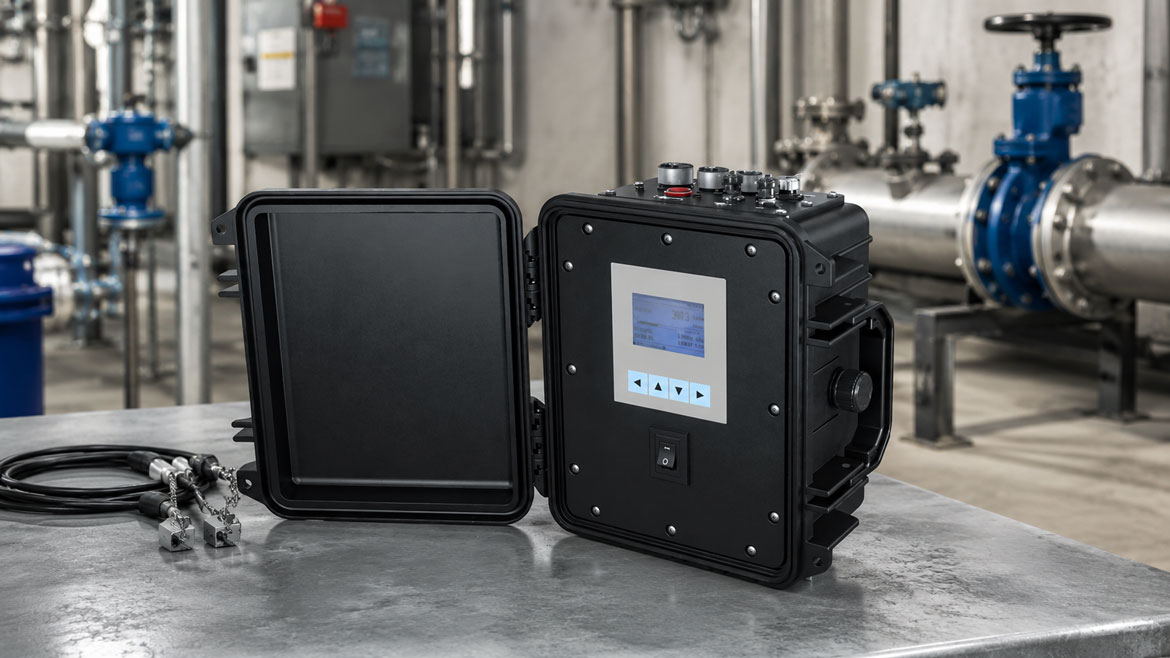
A mobile ultrasonic flow meter is ideal when flow only needs to be checked temporarily. In many plants, there is no fixed measuring point, installing an inline flow meter would be too complex, or the measurement is only required for service, acceptance testing, troubleshooting, pump control, energy analysis or check metering.
This is exactly where portable clamp-on ultrasonic flow meters offer a major advantage: the sensors are mounted externally on the pipeline. The pipe does not need to be opened, the process often does not need to be interrupted and the medium does not come into contact with the measuring device. This allows flow values to be checked, compared and documented directly on existing pipelines.
This article explains when mobile flow measurement is useful, which typical applications exist, what needs to be considered for temporary measurements on existing pipelines and what the limitations of mobile clamp-on measurements are. We also show when devices such as the SITRANS FS290 ultrasonic flow measurement system or the Portaflow-C portable ultrasonic flow meter can be suitable solutions.
You can find suitable devices in our category
ultrasonic flow meters.
For temporary measurements, check metering and test measurements, the
SITRANS FS290 ultrasonic flow measurement system
is particularly relevant. For mobile clamp-on measurements on filled pipelines, the
Portaflow-C portable ultrasonic flow meter
can also be a suitable solution.
Table of contents
- What is a mobile ultrasonic flow meter?
- When is mobile flow measurement useful?
- Clamp-on principle: measuring flow without opening the pipe
- Typical applications: service, testing and check metering
- Measuring point assessment: checking pipe, medium and installation situation
- Pipe data: why diameter, wall thickness and material are important
- Sensor position, inlet run and coupling
- Data logger, battery and mobile documentation
- Limitations of mobile clamp-on measurement
- SITRANS FS290: mobile ultrasonic flow measurement system for test measurements
- Portaflow-C: portable ultrasonic flow measurement instrument
- Product comparison: which mobile flow meter is suitable?
- Practical examples from industry, water, HVAC and service
- Checklist: preparing mobile ultrasonic flow measurement
- Conclusion
- FAQ: frequently asked questions about mobile ultrasonic flow meters
What is a mobile ultrasonic flow meter?
A mobile ultrasonic flow meter is a portable measuring system for temporary flow measurement on existing pipelines. In most cases, it is a clamp-on system. The ultrasonic sensors are attached externally to the pipeline and connected to a portable transmitter.
The device determines the flow velocity of the medium using ultrasonic signals. The volume flow is then calculated from the flow velocity and the pipe cross-section. Since the sensors are not installed inside the pipe, the pipeline remains closed and the process is not influenced by an additional inline component.
Mobile devices are mainly used where a fixed flow measuring point is not economical or where measured values are only needed for a limited period of time. Typical tasks include comparative measurements, plant checks, pump testing, troubleshooting, acceptance testing, energy analysis or temporary consumption measurement.
When is mobile flow measurement useful?
Mobile flow measurement is particularly useful when a flow value needs to be checked quickly and without modification. This can be the case in existing plants, unknown operating conditions, unclear pump performance or where fixed measuring points are missing.
A temporary measurement is also helpful during commissioning or acceptance testing. The technician can check whether the actual flow rate matches the design. In the event of later faults, the same measurement method can be used to detect changes or to check a fixed measuring point.
| Application | Why mobile measurement is useful | Typical benefit |
|---|---|---|
| Service work | Measurement directly on an existing pipeline. | Fast check without plant modification. |
| Check metering | Comparison with an existing measuring point. | Plausibility check and fault detection. |
| Pump control | Flow rate can be checked during operation. | Detection of wear, incorrect setting or operating problems. |
| Acceptance testing / commissioning | Temporary proof of flow. | Comparison of setpoint and actual value. |
| Energy analysis | Flow data can be recorded temporarily. | Evaluation of cooling, heating or process circuits. |
Clamp-on principle: measuring flow without opening the pipe
The clamp-on principle is the most important advantage of mobile ultrasonic flow meters. The sensors are mounted externally on the pipeline using straps, rails or brackets. The medium remains inside the pipe, there is no pressure loss and the measurement can often be carried out during ongoing operation.
This is particularly valuable for service and troubleshooting. Opening a pipeline, installing a measuring section or draining the process is often expensive and time-consuming. With a mobile clamp-on device, it can first be checked whether flow measurement at this point is useful at all and whether the measured values are plausible.
However, the measuring point must be suitable. The pipe should be completely filled, the pipe wall must transmit the ultrasound sufficiently and the medium should not disturb the measurement through too many air bubbles, high solids content or unfavorable flow conditions.
Typical applications: service, testing and check metering
Mobile ultrasonic flow meters are often used as testing and diagnostic tools. They do not provide a permanent plant installation, but rather a flexible measurement option for changing measuring points. This makes them particularly suitable for service departments, maintenance teams, energy consultants, plant manufacturers and operators of larger technical installations.
For a comparative measurement, a mobile device can be used alongside an existing stationary measurement. If the values do not match, it can be checked whether the deviation is caused by the stationary measuring point, the mobile measurement, incorrect pipe data or unfavorable process conditions.
For troubleshooting, a temporary measurement helps narrow down causes. If a pump delivers too little performance, a heat exchanger does not receive enough flow or a circuit is not hydraulically balanced correctly, a mobile ultrasonic flow meter can provide important indications.
Measuring point assessment: checking pipe, medium and installation situation
Before starting a mobile measurement, the measuring point should be assessed. The decisive factors are pipe material, pipe diameter, wall thickness, lining, medium, temperature, fill level, flow profile and accessibility. Without this information, even a good measuring device can deliver incorrect or unstable values.
Especially in older plants, pipe data is not always fully known. In such cases, wall thickness, outer diameter or material must be determined on site or plausibly estimated. The more accurate the input data, the better the volume flow can be calculated.
Accessibility is also important. The sensors must be mounted cleanly and securely on the pipe. Insulation, corrosion, paint, uneven surfaces or tight installation situations can make the measurement more difficult.
Pipe data: why diameter, wall thickness and material are important
A mobile ultrasonic flow meter calculates the volume flow from the measured flow velocity and the pipe cross-section. Incorrect pipe data therefore has a direct effect on the result. Even small deviations in the inner diameter can lead to noticeable measurement errors.
For parameterization, outer diameter, wall thickness, pipe material, possible lining and medium are typically required. With clamp-on systems, it is also important how the ultrasound travels through the pipe wall and the medium. The material data influences sensor spacing and signal quality.
In practice, it is worth preparing the pipe data before the measurement. For recurring measuring points, this data can be documented so that later test measurements can be carried out more quickly and more reproducibly.
Sensor position, inlet run and coupling
The sensor position strongly determines the quality of the measurement. The ideal measuring point is located on a straight pipe section with the most uniform flow profile possible. Directly downstream of bends, valves, pumps, reducers or branches, turbulence can occur and influence the measurement.
The coupling of the sensors is also crucial. The ultrasound must be transmitted well between sensor and pipe. Coupling gel or suitable contact media are used for this purpose. The pipe surface should be clean, smooth and free of loose paint layers, rust or heavy deposits.
In mobile applications, setup is often carried out under time pressure. Nevertheless, mounting should be performed carefully. A poorly seated sensor holder or insufficient coupling medium can lead to weak signal, fluctuating measured values or no measurement at all.
Data logger, battery and mobile documentation
For many applications, an instantaneous measurement is not sufficient. If the flow is to be observed over several minutes, hours or days, data logger, memory function and battery operation are important. This allows load changes, pump cycles, consumption profiles or time-dependent disturbances to be documented.
A mobile flow meter should therefore not only display a current value, but also record measurement series. Especially for energy analyses, pump checks or recurring disturbances, a trend is often more meaningful than a single measuring point.
Documentation of the measuring point is also important. Pipe data, sensor position, medium, operating condition, date, time and measurement duration should be recorded as well. Only then can later measurements be meaningfully compared.
Limitations of mobile clamp-on measurement
Mobile clamp-on measurement is very flexible, but not ideal for every application. The measurement requires that the ultrasound can sufficiently penetrate the pipe and the medium. Heavily loaded media, many air bubbles, partially filled pipelines, heavily corroded pipes or unfavorable flow profiles can make the measurement more difficult.
Accuracy also depends strongly on the measuring point. A mobile device can deliver very good results if pipe data, sensor position and medium are suitable. However, it cannot fully compensate for an unfavorable measuring point. Mobile measurement should therefore always be considered as a combination of measuring device, measuring point and correct parameterization.
If a flow value is to be monitored permanently, used for billing or used for control, a stationary solution may be more appropriate. Mobile devices are particularly strong for temporary testing, diagnostics, comparative measurement and measuring point assessment.
SITRANS FS290: mobile ultrasonic flow measurement system for test measurements
The SITRANS FS290 ultrasonic flow measurement system is particularly interesting for users who want to perform temporary measurements, check metering and test measurements. It is suitable for situations where flow values need to be recorded flexibly at different measuring points.
In practice, the FS290 is useful when a plant needs to be checked, a stationary measurement needs to be verified for plausibility or a measuring point needs to be evaluated before a fixed installation. In service applications, a mobile ultrasonic flow measurement system can also help quickly obtain an overview of real flow conditions.
Easy handling, battery operation, mobile mounting, data recording and the ability to record measured values on existing pipelines are particularly relevant. This makes the device a versatile tool for maintenance, plant testing and temporary process analysis.
| FS290 application | Benefit | Typical objective |
|---|---|---|
| Temporary measurement | Flow is recorded temporarily. | Testing without a fixed measuring point. |
| Check metering | Comparison with existing measurement. | Assess plausibility and deviations. |
| Test measurement | Measuring point or plant condition is checked. | Narrow down faults and document operating condition. |
| Service work | Mobile device can be used at changing locations. | Fast diagnosis in the field. |
Portaflow-C: portable ultrasonic flow measurement instrument
The Portaflow-C is a portable clamp-on flow meter for liquids in filled pipelines. It operates according to the ultrasonic transit-time method and is designed for mobile measurements on existing pipelines.
The Portaflow-C is particularly interesting for applications where a complete mobile measurement package is required. The data sheet describes it as a portable measuring device in a transport case with transmitter, ultrasonic transducers, mounting material, signal cables, coupling gel, software, memory card and power supply.
Typical applications are found in facility management, water and wastewater, chemical and petrochemical industries as well as energy optimization. Pump control, leak detection, distribution and consumption measurements or verification of an existing flow meter can also be usefully supported with a portable system.
| Portaflow-C application | Benefit | Typical application |
|---|---|---|
| Mobile clamp-on measurement | No pipe opening required. | Checking existing liquid pipelines. |
| Pump control | Pump performance becomes visible. | Pump testing and plant optimization. |
| Energy optimization | Flow data supports consumption analysis. | Heating, cooling and supply systems. |
| Verification measurement | Comparison with an existing measuring point. | Check metering and plausibility check. |
Product comparison: which mobile flow meter is suitable?
The suitable solution depends on whether a temporary test measurement, comparative measurement, pump control or longer data recording is required. The decisive factors are pipe dimensions, medium, measurement duration, desired accuracy, documentation and operating environment.
| Product / category | Suitable for | Typical application |
|---|---|---|
| Ultrasonic flow meters | Overview of clamp-on and ultrasonic flow meters. | Selection according to stationary or mobile measuring task. |
| SITRANS FS290 ultrasonic flow measurement system | Temporary measurements, check metering and test measurements. | Service, plant testing, comparative measurement and mobile diagnostics. |
| Portaflow-C portable ultrasonic flow meter | Mobile clamp-on measurement on filled liquid pipelines. | Pump control, energy optimization, leak detection and verification measurements. |
| Stationary clamp-on flow meter | Permanent non-invasive flow measurement. | Continuous monitoring without intervention in the pipe. |
Practical examples from industry, water, HVAC and service
Example 1: Pump control in a cooling water line
A cooling water pump apparently does not deliver the expected performance. Instead of modifying the pipeline, a mobile ultrasonic flow meter is mounted externally on the pipe. The measurement shows whether the actual flow rate matches the pump curve and the operating condition.
Example 2: Comparative measurement on an existing flow meter
A stationary flow meter shows implausible values. An independent comparative measurement is carried out with a mobile clamp-on device. If the two values do not match, pipe data, sensor position, medium and operating condition are checked more closely.
Example 3: Temporary measurement for energy analysis
Energy consumption in a heating or cooling circuit is to be evaluated. For this purpose, the flow is recorded temporarily and combined with temperature data. The mobile measurement helps make load profiles and optimization potential visible.
Example 4: Acceptance testing of a newly installed system
During commissioning, it must be checked whether the planned flow rate is achieved. A mobile ultrasonic measuring device enables a test measurement without immediately installing a fixed measuring point.
Example 5: Troubleshooting fluctuating process flow
A plant shows fluctuating process values. A mobile flow meter records the flow trend over a defined period of time. This makes it possible to identify whether the fluctuation is caused hydraulically or occurs at another measuring point.
Checklist: preparing mobile ultrasonic flow measurement
Good preparation determines the quality of the mobile measurement. This checklist helps avoid typical errors before use.
| Check question | Why important? | Practical recommendation |
|---|---|---|
| Is the pipe completely filled? | Clamp-on ultrasound requires a suitable sound path through the medium. | Select measuring point only on filled pipeline. |
| Are pipe data known? | Outer diameter, wall thickness and material influence calculation and sensor spacing. | Record pipe data in advance or measure on site. |
| Is the medium suitable? | Air bubbles, solids or very difficult media can disturb the signal. | Check medium and operating condition. |
| Is there enough straight pipe run? | A disturbed flow profile can influence measured values. | Choose measuring point as far away as possible from pumps, valves and bends. |
| Is the surface suitable? | Sensors need good acoustic coupling. | Clean pipe, use coupling gel and fasten sensors securely. |
| How long should the measurement run? | Instantaneous value or measurement series require different preparation. | Plan battery life, memory and data logger. |
| Is a comparison value required? | Check metering depends on reproducible conditions. | Document operating condition and measuring point. |
Conclusion: mobile ultrasonic flow meters are powerful tools for temporary flow testing
A mobile ultrasonic flow meter is the right solution when flow values need to be checked temporarily without installing a fixed measuring device. Especially for service, plant testing, pump control, check metering, acceptance testing, troubleshooting and energy analysis, clamp-on technology offers major advantages.
The sensors are mounted externally on the pipe, the pipeline remains closed and the process often does not need to be interrupted. At the same time, measurement quality depends strongly on pipe data, sensor position, medium, coupling and flow conditions. Good preparation and clean documentation are therefore essential.
For temporary measurements, check metering and test measurements, the SITRANS FS290 ultrasonic flow measurement system is particularly relevant. For portable clamp-on measurements on filled liquid pipelines, the Portaflow-C can be a suitable solution. You can find an overview of suitable devices in the category
ultrasonic flow meters.
FAQ: frequently asked questions about mobile ultrasonic flow meters
What is a mobile ultrasonic flow meter?
A mobile ultrasonic flow meter is a portable measuring device for temporary flow measurement on existing pipelines. The sensors are usually mounted externally on the pipe without opening the line.
When do you use a mobile ultrasonic flow meter?
It is used when flow only needs to be measured temporarily, for example for service, testing, check metering, pump control, acceptance testing, troubleshooting or energy analysis.
Does the pipeline need to be opened for measurement?
With clamp-on ultrasonic measurement, the pipeline is not opened. The sensors are mounted externally and measure through the pipe wall.
What does check metering mean?
Check metering means that an existing measurement is compared with an independent measuring device. This allows plausibility, deviations or possible errors of a stationary measuring point to be assessed.
Can pumps be checked with a mobile ultrasonic flow meter?
Yes. A mobile measurement can show whether a pump reaches the expected flow rate and whether actual operation matches the pump curve or plant requirement.
What are the limitations of mobile clamp-on measurement?
Limitations exist with unsuitable pipe data, partially filled lines, high gas content, many solids, poor pipe surface, unfavorable sensor position or disturbed flow profile.
Which pipe data is required?
Typically, outer diameter, wall thickness, pipe material, possible lining and medium are required. This data influences sensor spacing, signal quality and flow calculation.
Why is a data logger useful?
A data logger enables the recording of flow trends over time. This is particularly helpful for energy analyses, pump checks, load profiles or sporadic disturbances.
What is the SITRANS FS290 suitable for?
The SITRANS FS290 is particularly suitable for temporary measurements, check metering, test measurements and mobile diagnostics on existing pipelines.
What is the Portaflow-C suitable for?
The Portaflow-C is suitable as a portable clamp-on flow meter for liquids in filled pipelines, for example for pump control, energy optimization, leak detection and verification measurements.
Which products are suitable for mobile ultrasonic flow measurement?
For temporary measurements, check metering and test measurements, the SITRANS FS290 ultrasonic flow measurement system is particularly relevant. For mobile clamp-on measurements on filled liquid pipelines, the Portaflow-C portable ultrasonic flow meter can be suitable. You can find an overview in the category
ultrasonic flow meters.