


A single measurement of dielectric constant or conductivity is not enough to reliably determine whether hydraulic or lubricating oil needs to be changed. Two different fresh oils can already have significantly different initial values. Temperature, additives, water content and contaminants also influence the electrical properties of the oil.
The real advantage of continuous oil condition monitoring therefore lies in the trend. If a defined reference oil is recorded under comparable conditions and the development of relative permittivity, conductivity, moisture and temperature is subsequently monitored over weeks or months, gradual changes can become visible much earlier than with visual inspection alone.
A distinction must be made between slow oil aging and sudden events. A continuous drift can, for example, indicate oxidation and changes in the additive system. A sudden change in measured values, on the other hand, can be caused by foreign oil, water, top-up oil, process fluid or a change in operating conditions.
Dielectric constant and conductivity should therefore never be evaluated as isolated absolute limit values. The decisive factors are the reference condition, temperature, trend over time and the combined evaluation of several oil condition parameters.
Suitable sensors can be found at ICS Schneider under Oil Condition Sensors as well as in the general category Flow Measurement Technology.
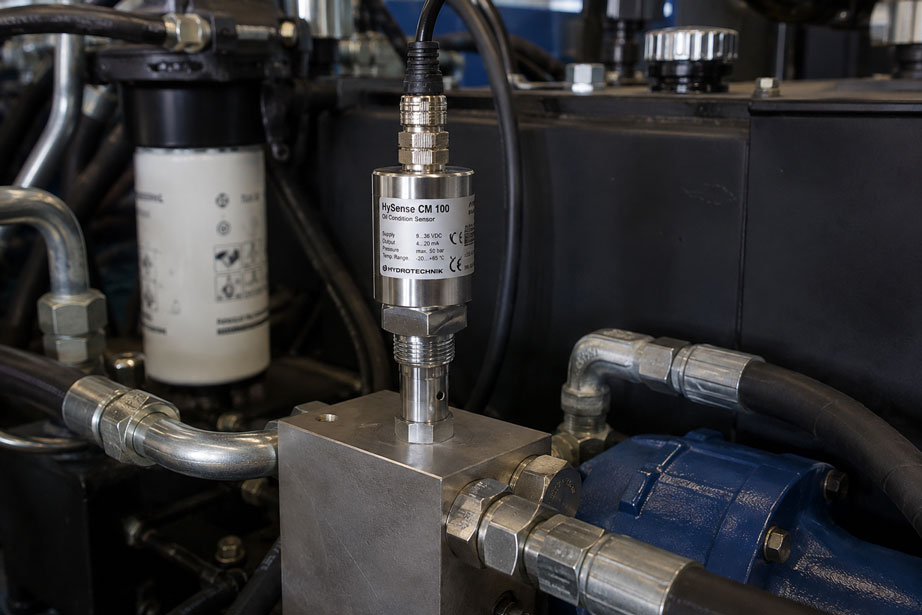
For continuous monitoring, for example, the HySense CM100 can be used. It measures relative humidity, relative permittivity, conductivity and temperature, enabling a combined evaluation of oil condition. For more comprehensive mobile analysis, the HySense CX197 Service Measurement Set is also available.
Table of Contents
- Why oil condition should not be evaluated using a single measured value
- What happens as oil ages
- What relative permittivity reveals about the oil
- Why electrical conductivity is important
- Why temperature must always be evaluated as well
- Moisture as an additional condition parameter
- Why a reference value for fresh oil is required
- Evaluate the aging trend instead of a single value
- Use the rate of change for early detection
- Slow drift or sudden change in measured value?
- Interpret permittivity, conductivity, moisture and temperature together
- Why there are no universal limit values
- Do not decide on oil changes based on operating hours alone
- Correctly install an oil condition sensor
- Why air bubbles and dead zones are problematic
- Correctly evaluate 4–20 mA and digital interfaces
- Store and display trend data effectively
- Correctly combine online sensors and laboratory analysis
- Typical faults in oil condition monitoring
- Practical example: detecting gradual oil aging
- Systematically commission oil condition monitoring
- Suitable oil condition sensors from ICS Schneider
- Conclusion
- FAQ
Why oil condition should not be evaluated using a single measured value
Technical oils are complex mixtures of:
- base oil,
- anti-wear additives,
- oxidation inhibitors,
- corrosion protection additives,
- detergents and dispersants,
- viscosity improvers,
- other product-specific additives.
This composition already determines the electrical properties of the oil when new.
A measured value of, for example:
εr = 2,3
may be completely normal for one particular oil, while for another oil it may already deviate significantly from its original condition.
The initial condition is therefore decisive
An oil condition sensor becomes particularly informative when its measured values are compared with a known reference condition.
The key question is not:
Is this absolute value good or bad?
but rather:
How much has this value changed compared with the defined initial condition?
This is precisely where the benefit of continuous trend monitoring lies.
What happens as oil ages
Oil changes chemically and physically during operation.
One major aging mechanism is oxidation. Oxygen reacts with components of the oil. This process can be accelerated by high temperatures, metallic wear particles and other influencing factors.
Over time, the following may form, among other things:
- polar oxidation products,
- acids,
- varnish- and resin-forming substances,
- sludge,
- additive degradation products.
As a result, properties such as the following may change:
- viscosity,
- permittivity,
- electrical conductivity,
- water absorption capacity,
- acid number,
- color and odor.
Online sensors do not measure all of these parameters directly
An oil condition sensor measures specific physical parameters and detects changes in them.
These changes can be used to draw conclusions about changes in the oil condition.
An oil condition sensor therefore does not directly measure “oxidation” or the “remaining service life” of the oil. It measures physical parameters whose development is used to evaluate the condition.
What relative permittivity reveals about the oil
Relative permittivity is also commonly referred to as:
dielectric constant εr
.
It describes how strongly a material influences an electric field compared with a vacuum.
For a simplified capacitor:
C = ε0 × εr × A / d
Where:
C= capacitance,ε0= vacuum permittivity,εr= relative permittivity of the medium,A= electrode area,d= distance between electrodes.
If the composition of the oil changes, its relative permittivity often changes as well.
Possible causes of a change include
- oxidation,
- aging of the additive system,
- water ingress,
- mixing with another oil,
- fuel or process fluid ingress,
- other polar contaminants.
The direction of the change is not universal
It would therefore be incorrect to make a general statement such as:
Permittivity increases = oil is bad
The change must always be assessed relative to the oil being used and its initial condition.
Particularly informative is therefore:
Δεr = εr,current - εr,reference
or, for temperature-compensated values:
Δεr40 = εr40,current - εr40,reference
Why electrical conductivity is important
Even an oil that behaves as an electrical insulator still has finite electrical conductivity.
Conductivity:
σ
is often specified for oil condition sensors in very small units such as:
pS/m
.
It depends, among other things, on:
- base oil,
- additive package,
- polar aging products,
- moisture,
- contaminants,
- temperature.
Conductivity is also specific to the type of oil
Two fresh hydraulic oils with the same viscosity grade can already have significantly different conductivities due to different additive formulations.
An absolute conductivity value should therefore not be evaluated without knowing the oil being used.
Once again, the change is particularly interesting
For example, the following can be evaluated:
Δσ40 = σ40,current - σ40,reference
A relative change can additionally be displayed:
Δσrel = (σcurrent - σreference) / σreference × 100 %
Whether a positive or negative trend is critical must be assessed on the basis of the specific oil and application.
Why temperature must always be evaluated as well
The electrical properties of oils are temperature-dependent.
If, for example, conductivity is compared in the morning when the machine is cold and after several operating hours at a significantly higher oil temperature, the difference in measured value may be caused by temperature alone.
The same applies to varying degrees to other oil condition parameters.
Uncompensated values should therefore only be compared under comparable conditions
Suitable conditions include, for example:
- the same operating temperature,
- the same machine condition,
- comparable load,
- comparable sampling point.
Temperature-compensated values simplify trend evaluation
The HySense CM100 provides, among other things, temperature-compensated values for permittivity and conductivity referenced to:
40 °C
.
This makes it easier to compare measurements taken at changing oil temperatures.
Temperature compensation does not, however, eliminate every process dependency. It improves comparability but does not replace evaluation of the actual operating condition.
Moisture as an additional condition parameter
Water can influence oil condition both directly and indirectly.
Possible consequences include:
- corrosion,
- accelerated oxidation,
- additive degradation,
- impairment of the lubricating film,
- sludge formation,
- filter problems.
At the same time, water also influences the electrical properties of the oil.
A change in permittivity or conductivity is therefore not automatically caused exclusively by oil aging.
Combining several measured variables improves interpretation
If, for example, relative humidity increases significantly at the same time, it must be checked whether the change in electrical parameters is at least partly caused by water ingress.
If moisture remains stable while permittivity and conductivity change continuously over a long period, an aging process may be more likely.
The relationship between water activity, temperature and ppm values in technical oils is explained in more detail in the technical article Measuring Water Activity in Oil: Correctly Evaluate Moisture in Hydraulic, Lubricating and Transformer Oils.
Why a reference value for fresh oil is required
A reliable trend analysis requires a defined initial condition.
The optimum approach is to establish a baseline using the oil actually being used
This should involve:
- the correct oil product,
- with the correct additive package,
- in the actual system,
- under stable operating conditions.
After a complete oil change, the very first measured value should not necessarily be used as the reference value.
First, it must be ensured that:
- the oil is sufficiently mixed,
- the sensor is completely wetted,
- there are no air bubbles at the measuring point,
- the temperature has reached a representative operating condition,
- residual oil from previous fillings has been taken into account.
Several initial values are better than a single value
A stable reference range can be formed from several measurement points.
For example:
εr40,reference = average of stable initial values
and:
σ40,reference = average of stable initial values
This prevents a random instantaneous value from shifting the entire subsequent evaluation.
Evaluate the aging trend instead of a single value
The greatest advantage of online measurement is that it does not provide only individual samples.
Instead, a time series is created:
measured value = f(t)
This makes it possible to detect slow changes that might remain unnoticed in individual laboratory samples.
Typical trend display
For example, it is useful to record the following in parallel:
- relative permittivity at 40 °C,
- conductivity at 40 °C,
- relative humidity,
- oil temperature.
Additional condition parameters can optionally be included, for example:
- viscosity,
- particle count,
- ferromagnetic wear,
- operating hours,
- machine load.
Normalization to the initial value
For visualization, the initial value can be set to:
100 %
.
For example, the following can then be displayed:
Indexε = εcurrent / εreference × 100
A value of:
105 %
then simply means that the current measured value is 5 % above the reference value.
Whether this change is acceptable or critical must be defined separately.
Use the rate of change for early detection
Not only the absolute deviation from the reference value can be relevant.
The speed at which a value changes also provides additional information.
In simplified form, a rate of change can be calculated as:
rate of change = (measured value2 - measured value1) / (t2 - t1)
A slow drift
over many operating hours may, for example, be associated with normal aging.
A suddenly accelerating trend
may, on the other hand, indicate a change in operating conditions or a fault.
Examples include:
- overtemperature,
- water ingress,
- mixing with foreign oil,
- process medium in the oil,
- unusual machine load.
A condition monitoring system can therefore react not only to a limit value but also detect an unusual development at an early stage.
Slow drift or sudden change in measured value?
The temporal pattern of a measured value change is often just as important as its magnitude.
| Measured value behavior | Possible interpretation | Recommended check |
|---|---|---|
| Slow continuous drift | Aging or gradual change possible | Compare trend with laboratory values and operating hours |
| Sudden change after topping up | Different properties of the top-up oil | Check oil product and batch |
| Permittivity and moisture increase simultaneously | Water ingress possible | Check moisture source and cooler |
| Values change together with temperature | Temperature influence possible | Evaluate values compensated to 40 °C |
| Sudden change in several parameters | Foreign medium or oil mixing possible | Check oil sample and system condition |
| Highly unstable signal | Air, insufficient wetting or unstable measuring point possible | Check installation position and oil flow |
| Value changes permanently after oil change | New oil type or different additive package | Create a new baseline |
A sudden change in measured value is therefore not automatically a sign of accelerated oil aging.
Interpret permittivity, conductivity, moisture and temperature together
The informative value increases when several measured variables are considered simultaneously.
| Observation | Possible explanation |
|---|---|
| Permittivity drifts, conductivity drifts, moisture remains stable | Chemical oil change or aging possible |
| Permittivity increases and moisture increases significantly | Check water ingress as a possible cause |
| Conductivity jumps after an oil change | Different oil formulation or additive package possible |
| All raw values change with temperature | Compensate for temperature influence before condition evaluation |
| Temperature remains elevated and aging trend accelerates | Check thermal load on the oil |
| Electrical parameters remain stable while wear particles increase | A mechanical problem may be present despite still stable oil condition |
Condition monitoring requires context
Additional process information can significantly improve the evaluation.
This includes:
- operating hours,
- oil temperature,
- machine load,
- pressure,
- filter changes,
- top-up quantities,
- oil changes,
- maintenance work.
If, for example, a sudden change in conductivity occurs immediately after oil has been topped up, this information is decisive for interpretation.
Why there are no universal limit values
A common mistake when introducing oil condition monitoring is to immediately look for a universally applicable alarm threshold.
A universal limit value for:
εr
or:
σ
is generally not meaningful for different oils.
Limit values should be based on the application
Suitable bases include, for example:
- measured values of fresh oil,
- historical measurement data from the machine,
- laboratory analyses,
- lubricant manufacturer recommendations,
- machine manufacturer limits,
- experience from previous oil changes.
Multi-stage warnings are often useful
For example, the following can be distinguished:
- normal range,
- pre-warning range,
- critical range.
In addition, an unusually high rate of change can trigger an alarm even though the actual absolute limit value has not yet been reached.
Do not decide on oil changes based on operating hours alone
Traditionally, oils are often changed at fixed intervals:
e.g. after x operating hours
This approach is simple but takes the actual load on the oil into account only to a limited extent.
Two identical systems can have completely different oil conditions despite having the same operating hours.
Influencing factors include, for example
- average oil temperature,
- temperature peaks,
- water ingress,
- dirt ingress,
- machine load,
- tank volume,
- top-up quantities,
- filtration,
- ambient conditions.
Condition Based Maintenance therefore aims to base the maintenance time more closely on the actual condition.
However, online measurement does not replace a professional oil-change decision
The sensor provides additional condition information.
If critical changes occur, the cause should be investigated and, if necessary, a laboratory analysis should be performed before an oil change is derived from a single sensor value alone.
Correctly install an oil condition sensor
An oil condition sensor can only evaluate the oil that actually flows past its measuring point.
The installation position is therefore an essential part of the measurement task.
A suitable measuring point should
- measure representative oil,
- have sufficient flow,
- ensure complete wetting of the sensor,
- contain no permanent air bubbles,
- remain within the permissible pressure and temperature range,
- be accessible for maintenance.
A return line or bypass can be useful
Depending on the system, a measuring point in a well-mixed return line or in a defined-flow bypass can provide a representative measurement.
The decisive factor is not merely its position in the hydraulic diagram, but whether oil from the relevant circuit is actually continuously guided past the sensor.
Observe the pressure range
For the HySense CM100, ICS Schneider specifies a maximum operating pressure of:
50 bar
Direct installation in a high-pressure line above this range is therefore not permitted.
In such systems, a suitable low-pressure section or an appropriately designed measuring or bypass circuit may be required.
Why air bubbles and dead zones are problematic
Sensors for permittivity and conductivity require defined contact with the oil.
If air bubbles are present around the measuring electrodes, the sensor is no longer measuring only the oil.
This can result in implausible or highly fluctuating measured values.
Problematic installation situations include, for example
- high points where air can collect,
- pipes that are not completely filled,
- suction lines with cavitation or air ingress,
- dead zones with hardly any oil exchange,
- areas immediately downstream of heavily aerated return lines.
An apparent oil condition trend may therefore actually be caused only by a change in the conditions at the measuring point.
Correctly evaluate 4–20 mA and digital interfaces
In addition to RS232 and CANopen, the HySense CM100 also provides analog:
4 … 20 mA
signals.
Depending on the parameterization, the analog outputs can be assigned to different oil condition variables.
These include, among others:
- temperature,
- relative humidity,
- relative permittivity,
- temperature-compensated permittivity at 40 °C,
- conductivity,
- temperature-compensated conductivity at 40 °C.
For PLC integration, the scaling must be clearly documented
An input value of:
12 mA
has no unambiguous physical meaning without knowing the configured measured variable and scaling.
At minimum, the following should therefore be documented:
- measured variable,
- 4 mA value,
- 20 mA value,
- unit,
- temperature compensation,
- alarm function.
Store and display trend data effectively
A condition monitoring system should not display only the current value.
The history is more important.
A suitable trend view contains, for example
- permittivity or P40,
- conductivity or C40,
- relative humidity,
- temperature,
- time or operating hours.
Events should also be marked
Examples:
- oil change,
- top-up,
- filter change,
- machine shutdown,
- overtemperature,
- heat exchanger repair.
This makes it possible to determine later whether a change in measured value is related to a specific event.
Not every short-term fluctuation is relevant
For long-term aging trends, suitable averaging can help distinguish short-term process noise from a sustained change.
At the same time, the raw data resolution should remain high enough to ensure that sudden events are not completely filtered out.
Correctly combine online sensors and laboratory analysis
Online oil condition sensors and laboratory analyses perform different tasks.
The online sensor offers its greatest advantage in
- continuous monitoring,
- detection of changes over time,
- detection of sudden events,
- automatic alarming.
Laboratory analysis can determine additional parameters
Depending on the scope of analysis, these may include:
- kinematic viscosity,
- acid number,
- additive elements,
- wear metals,
- water content,
- oxidation indicators,
- particle contamination.
The combination is particularly powerful:
Online trend detects change → laboratory analysis helps determine the cause
This means that oil samples do not necessarily have to be taken at short fixed intervals. Instead, unusual trends can be investigated specifically.
Typical faults in oil condition monitoring
| Observation | Possible cause | Recommended check |
|---|---|---|
| Permittivity changes daily when the machine starts | Temperature influence | Compare temperature or P40 |
| Conductivity jumps immediately after oil change | Different oil formulation | Create a new baseline for the new oil |
| Permittivity and moisture increase simultaneously | Water ingress possible | Check moisture source and oil sample |
| Measured values fluctuate strongly | Air bubbles or uneven wetting | Check measuring point and oil flow |
| Trend responds very slowly | Sensor is located in a poorly flushed dead zone | Check measuring point or use a bypass |
| Measured values suddenly differ after topping up | Top-up oil has different properties | Compare product and batch |
| Sensor indicates a change, laboratory sample appears normal | Different measurement times or measured variables | Take the sample at the same time from a representative point |
| Oil condition index deteriorates unusually quickly | Overtemperature or contamination possible | Check temperature history and process condition |
| Measured value changes after sensor cleaning | Deposits at the measuring point | Check installation conditions and oil cleanliness |
| Fixed limit value does not work for another oil | Different base oil or additive properties | Use oil-specific reference values |
Practical example: detecting gradual oil aging
A hydraulic system operates across several shifts with strongly fluctuating loads.
After an oil change, the new oil is initially recorded under stable operating conditions.
The following are stored as reference values, among others:
εr40,reference
and:
σ40,reference
Relative humidity and oil temperature are also recorded.
Phase 1: stable operation
Over several weeks, the temperature-compensated values remain within a narrow range.
Temperature and moisture fluctuate with machine operation, but the long-term electrical parameters remain largely stable.
Phase 2: slow drift
During further operation, permittivity and conductivity under comparable conditions begin to deviate continuously from the reference condition.
Relative humidity, however, does not show a comparable jump.
The change does not occur suddenly but develops over many operating hours.
Phase 3: accelerated change
After a period of elevated oil temperatures, the rate of change of the electrical parameters increases significantly.
The condition monitoring system therefore detects not only the absolute deviation but also the accelerated change.
Further investigation
A targeted oil sample is taken and analyzed in the laboratory.
The results are then compared with:
- online trend,
- operating hours,
- temperature history,
- maintenance history.
On this basis, a decision can be made as to whether the oil should remain in service, be monitored more closely or be changed.
Result
The advantage of continuous measurement is not that it generates a universal “oil good / oil bad” value. It shows when and how the oil changes compared with its original condition.
Systematically commission oil condition monitoring
- Clearly identify the oil: Document manufacturer, product type, viscosity grade and the most precise designation possible.
- Define the measurement task: Monitor aging, moisture, contamination, wear or several conditions.
- Select the sensor: Define the required measured variables and interfaces.
- Check process data: Compare temperature, pressure and media compatibility with the sensor specifications.
- Select the measuring point: Choose a representative installation location with sufficient flow.
- Avoid air and dead zones: Ensure complete wetting of the sensor.
- Parameterize electrical signals: Clearly assign 4–20 mA channels or digital communication.
- Use temperature compensation: For long-term comparisons, use P40 and C40 or comparable compensated variables whenever possible.
- Record the reference condition: After stable commissioning, store several initial values of the known oil.
- Start trend recording: Store permittivity, conductivity, moisture and temperature together.
- Document operating events: Mark oil changes, topping up, filter changes and faults.
- Define pre-warnings: Initially based on the system’s own reference condition and available experience.
- Monitor the rate of change: Evaluate unusually rapid changes in addition to absolute values.
- Verify abnormalities: Perform oil sampling and laboratory analysis if required.
- Optimize limit values: Compare online data, laboratory values and actual machine conditions over a longer period.
Suitable oil condition sensors from ICS Schneider
HySense CM100 for continuous oil condition monitoring
The HySense CM100 measures several oil condition parameters simultaneously.
ICS Schneider and Hydrotechnik specify, among other things:
- relative permittivity,
- relative humidity,
- electrical conductivity,
- temperature,
- relative permittivity measuring range
1 … 7, - relative humidity measuring range
0 … 100 % RH, - conductivity measuring range
100 … 800.000 pS/m, - operating temperature
-20 … +85 °C, - maximum operating pressure
50 bar, - RS232, CANopen and
4 … 20 mA, - M12, 8-pin electrical connection,
- degree of protection
IP67.
Temperature-compensated condition variables
For evaluation, the sensor provides, among other things:
- permittivity at the current temperature,
- permittivity referenced to 40 °C,
- conductivity at the current temperature,
- conductivity referenced to 40 °C.
For long-term trend analysis in particular, values referenced to a defined temperature are useful because changing operating temperatures can make direct comparison of raw values difficult.
Learning phase and condition evaluation
The HySense CM100 is designed for condition-based monitoring. After a learning phase, the measured oil condition parameters can be evaluated using implemented condition algorithms.
In combination with suitable measuring instruments from the MultiSystem series, it is possible, among other things, to:
- define limit values,
- store measured values,
- display historical data,
- visualize conditions,
- export measurement data.
HySense CX197 for more comprehensive mobile oil condition analysis
The HySense CX197 combines several sensors in one service measurement set.
Measured parameters include:
- particle count,
- viscosity,
- relative humidity,
- relative permittivity,
- conductivity,
- temperature.
This makes the set particularly suitable for mobile diagnostic and service applications in which viscosity and particle contamination are to be considered in addition to electrical oil condition parameters.
ICS specifies a maximum operating pressure of:
45 bar
and an operating temperature range of:
-20 … +85 °C
HySense CW100 for wear monitoring
An oil may still appear comparatively stable in terms of its electrical properties while a mechanical fault is developing at the same time.
The HySense CW100 therefore complements oil condition monitoring by detecting ferromagnetic wear particles.
The sensor distinguishes between:
- fine ferromagnetic particles in the µm range,
- larger particles in the mm range.
This makes it possible to monitor the development of mechanical wear in addition to the condition of the lubricant.
Further solutions can be found under Oil Condition Sensors at ICS Schneider.
Conclusion
Online oil condition monitoring enables a much more detailed assessment than a single oil condition value or a maintenance interval based exclusively on operating hours.
Permittivity indicates changes in oil composition
Aging, water, foreign oil and other contaminants can influence relative permittivity. The decisive factor is therefore the deviation from the known initial condition.
Conductivity provides additional independent information
It also responds to oil formulation, additives, aging products, moisture and contamination. A universal absolute limit value is therefore generally not meaningful.
Temperature must always be taken into account
For long-term comparisons, temperature-compensated variables such as permittivity and conductivity referenced to 40 °C are particularly useful.
Several measured variables increase the informative value
Evaluating permittivity, conductivity, moisture and temperature together enables significantly better interpretation than relying on a single sensor value.
The trend is more important than a snapshot
Slow drifts, sudden changes and the rate of change provide different information about the condition of the oil and the system.
Online and laboratory analyses complement each other
The online sensor detects when something changes. A targeted laboratory analysis can then help determine the cause more precisely.
For practical applications
Document the oil type → select the measured variables → define a representative measuring point → check temperature, pressure and media compatibility → ensure complete sensor wetting → record the reference condition with known oil → use temperature-compensated values → record permittivity, conductivity, moisture and temperature together → evaluate slow drift and rapid changes separately → document maintenance events → derive warning values from real trends and laboratory analyses → verify unusual changes → base the oil-change decision on the actual condition rather than exclusively on operating hours.
FAQ: Monitor oil condition online and correctly evaluate aging trends
What does an oil condition sensor measure?
Depending on the sensor type, parameters such as relative permittivity, electrical conductivity, moisture, temperature, viscosity and particles can be measured.
What does dielectric constant mean for oil?
The dielectric constant or relative permittivity describes the electrical dielectric properties of the oil. Changes can indicate a change in oil composition.
Does increasing permittivity always indicate oil aging?
No. Water, foreign oil and other contaminants can also change the permittivity. The development must be evaluated together with other condition parameters.
Why is a reference value required?
Different fresh oils have different initial values. Only comparison with the known initial condition of the actual oil being used makes the long-term trend meaningful.
What does relative permittivity mean?
It describes the ratio of the permittivity of the medium to the permittivity of a vacuum and is a dimensionless quantity.
Why does permittivity change as oil ages?
Chemical changes and the formation of polar aging products can change the electrical properties of the oil and therefore also influence its permittivity.
What does the conductivity of hydraulic oil indicate?
Electrical conductivity depends, among other things, on the base oil, additive system, aging products, moisture, contaminants and temperature.
Is high conductivity always bad?
No. The absolute value depends strongly on the oil being used. For condition monitoring, the change compared with the reference condition is therefore often more important.
Why is conductivity specified in pS/m?
Technical oils often have very low electrical conductivity. Correspondingly small units such as picosiemens per meter are therefore used.
Why must the oil temperature also be measured?
Permittivity, conductivity and other oil parameters are temperature-dependent. Without temperature information, normal operating changes can be incorrectly interpreted as changes in oil condition.
What does P40 mean?
In HySense evaluation, P40 refers to relative permittivity referenced to or temperature-compensated to 40 °C.
What does C40 mean?
C40 refers to electrical conductivity referenced to or temperature-compensated to 40 °C.
Why are P40 and C40 useful for trends?
They reduce the direct influence of changing oil temperatures and therefore improve the comparability of measurements taken at different times.
Can water change the permittivity?
Yes. Water ingress can influence the electrical properties of the oil. Moisture should therefore preferably be evaluated together with permittivity and conductivity.
Can an oil condition sensor detect water?
In addition to permittivity and conductivity, the HySense CM100 also measures the relative humidity of the oil.
What does relative humidity in oil mean?
In simplified terms, it describes how close the oil is to its water saturation condition at the respective temperature. The exact interpretation depends on the measurement principle.
Why is trend measurement better than a single measured value?
A trend shows whether a parameter changes slowly, quickly or suddenly. This makes it easier to distinguish aging from sudden faults.
What can a sudden jump in measured values indicate?
Possible causes include top-up oil, foreign oil, water, process media, air bubbles or a sudden change in operating temperature.
What does a slow drift mean?
A slow drift may indicate a continuous change in the oil. Whether actual aging is present should be checked using additional measured variables and, if necessary, laboratory analysis.
How can the change in permittivity be calculated?
For example, using Δεr = εr,current - εr,reference or as a relative percentage change compared with the reference value.
Should the oil be changed immediately when permittivity changes?
Not based on this measured value alone. Cause, trend, other condition variables, manufacturer requirements and, if necessary, laboratory analysis should be evaluated together.
Can an online sensor completely replace laboratory analysis?
No. Online sensors are particularly effective for continuous trend and event detection. Laboratory analyses can determine additional chemical and physical oil parameters.
Where should an oil condition sensor be installed?
A representative measuring point with sufficient flow where the sensor remains continuously and completely wetted with oil is suitable.
Can an oil condition sensor be installed in a dead zone?
This is unfavorable. Old or poorly mixed oil may remain there, meaning the measured value does not represent the actual condition of the circulating oil.
Why are air bubbles problematic?
The electrical properties of air differ greatly from those of oil. Air at the measuring point can therefore lead to unstable or incorrect measured values.
Can an oil condition sensor be installed in the return line?
A well-mixed return line can be a suitable measuring point provided that pressure, temperature, flow and wetting remain within the permissible conditions.
Can a bypass be used?
Yes. A defined-flow bypass can be particularly useful if no suitable measuring point is available in the main line.
What does the HySense CM100 measure?
The HySense CM100 measures relative humidity, relative permittivity, electrical conductivity and temperature.
What permittivity range does the HySense CM100 have?
Hydrotechnik specifies a relative permittivity measuring range of 1 … 7.
What conductivity range does the HySense CM100 have?
Hydrotechnik specifies a range of 100 … 800.000 pS/m.
What temperature range does the HySense CM100 have?
ICS Schneider specifies an operating temperature range of -20 … +85 °C.
What is the maximum operating pressure of the HySense CM100?
According to ICS Schneider, the maximum operating pressure is 50 bar.
Which interfaces does the HySense CM100 provide?
The sensor supports, among other things, RS232, CANopen and 4 … 20 mA.
Can the HySense CM100 output temperature-compensated values?
Yes. Hydrotechnik documentation lists, among other things, permittivity and conductivity referenced to 40 °C as available variables.
What is the HySense CX197?
The HySense CX197 is a mobile service measurement set for more comprehensive oil condition analysis.
Which parameters does the HySense CX197 measure?
It measures, among other things, particle count, viscosity, relative humidity, relative permittivity, conductivity and temperature.
What does the HySense CW100 measure?
The HySense CW100 detects ferromagnetic wear particles and can distinguish between fine particles in the µm range and larger particles in the mm range.
Why should wear be monitored in addition to oil condition?
A mechanical fault can generate wear particles even though the permittivity or conductivity of the oil has not yet changed significantly.
Where can I find the HySense CM100 at ICS Schneider?
Further information can be found under HySense CM100 at ICS Schneider.
Where can I find the HySense CX197 at ICS Schneider?
Further information can be found under HySense CX197 at ICS Schneider.
Where can I find the HySense CW100 at ICS Schneider?
Further information can be found under HySense CW100 at ICS Schneider.
Where can I find further oil condition sensors?
An overview can be found under Oil Condition Sensors at ICS Schneider.