


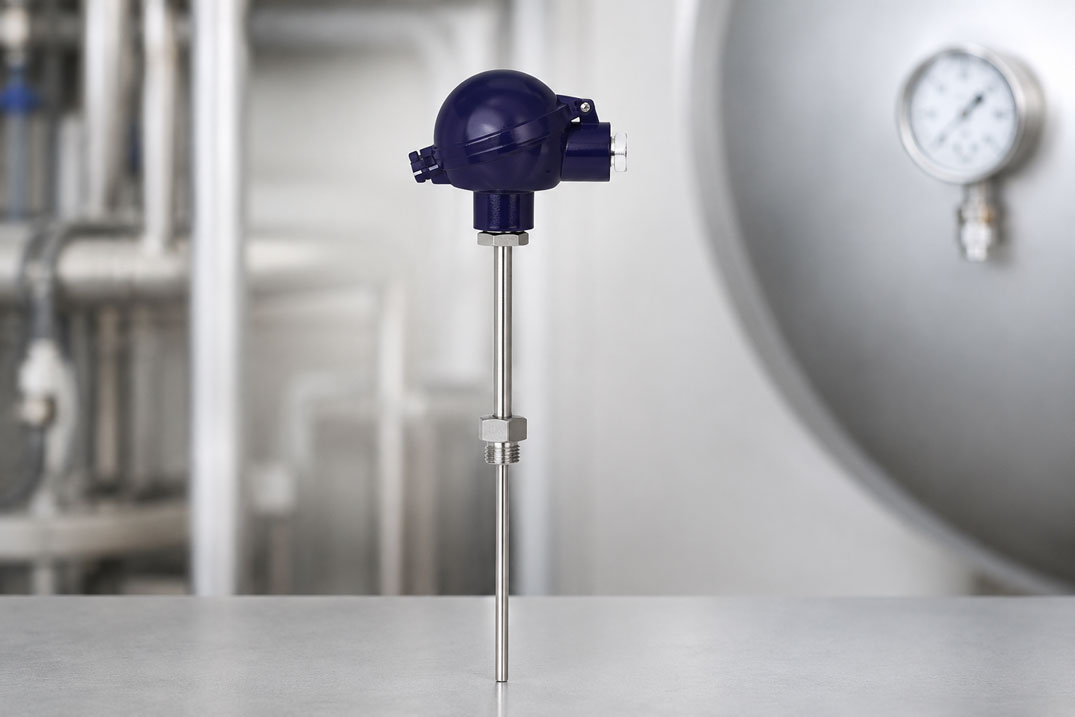
Pt100 temperature sensors are used in industrial systems when temperatures need to be recorded precisely, stably and reliably. Nevertheless, in practice it repeatedly happens that a Pt100 displays incorrect or implausible temperature values.
The cause is not always the temperature sensor itself. Measurement errors are often caused by incorrect wiring, unsuitable connection cables, incorrect 2-, 3- or 4-wire connection, poor terminal points, unfavorable installation or incorrect parameterization of the transmitter.
This article explains the most common causes of incorrect Pt100 measured values and shows how users can systematically narrow down the errors.
You can find an overview of suitable temperature sensors in our category
Resistance thermometers / Pt100 sensors.
Suitable transmitters and accessories can also be found in the category
Temperature transmitters and accessories for temperature sensors.
Table of contents
- Why does a Pt100 measure incorrectly?
- Basic principle: How does a Pt100 work?
- Cable errors: understanding 2-wire, 3-wire and 4-wire connections correctly
- Incorrect wiring and poor terminal points
- Setting the transmitter and evaluation unit correctly
- Installation location, insertion length and heat dissipation
- Defective sensor or wrong sensor type?
- EMC, long cables and interference
- Which temperature sensors and transmitters are suitable?
- Practical examples from industrial systems
- Troubleshooting checklist
- Conclusion
- FAQ: Frequently asked questions about incorrect Pt100 measured values
Why does a Pt100 measure incorrectly?
When a Pt100 delivers incorrect values, a defective sensor is often suspected first. In many cases, however, the sensor is working properly. The error is caused by the combination of sensor, cable, evaluation unit, transmitter, installation situation and process conditions.
Measurement deviations are particularly often caused by cable resistance, incorrect connection type, loose terminals, unsuitable extension cables, incorrect device settings or an unfavorable installation location.
- Cable resistance: Especially with 2-wire connections, the cable can falsify the measured value.
- Incorrect wiring: Swapped wires or incorrect terminal assignment lead to implausible values.
- Wrong sensor type: Pt100, Pt1000, thermocouple or NTC must not be confused.
- Incorrect parameterization: Transmitter or display must match the sensor and measuring range.
- Unfavorable installation: The sensor does not measure the actual process temperature.
- Interference: Long cables, EMC or poor shielding can influence measured values.
Structured troubleshooting is therefore important. Only after connection, cable, evaluation and installation have been checked should a sensor defect be assumed as the main cause.
Basic principle: How does a Pt100 work?
A Pt100 is a resistance thermometer. The electrical resistance of the sensor element changes with temperature. At 0 °C, a Pt100 has a nominal resistance of 100 ohms. The evaluation unit measures the resistance and converts it into a temperature.
For the temperature to be displayed correctly, the complete measuring system must match. Sensor, connection type, cable, evaluation unit and measuring range must be coordinated with each other.
| Component | Task | Typical error |
|---|---|---|
| Pt100 sensor | Changes its resistance depending on temperature. | Wrong sensor type or damaged sensor element. |
| Connection cable | Connects sensor and evaluation unit. | Cable resistance is not compensated. |
| Terminals and connection | Establish the electrical contact. | Loose terminals, corrosion or contact resistance. |
| Transmitter | Converts the sensor signal, for example into 4 … 20 mA. | Wrong sensor type or measuring range parameterized. |
| Display / PLC / controller | Displays the measured value or processes it further. | Input set incorrectly or scaling incorrect. |
Cable errors: understanding 2-wire, 3-wire and 4-wire connections correctly
One of the most common reasons for incorrect Pt100 measured values is the influence of the connection cable. Since a Pt100 is evaluated via its electrical resistance, the resistance of the cable is added to the sensor resistance. Depending on the connection type, this error can be compensated more or less effectively.
| Connection type | Description | Typical assessment |
|---|---|---|
| 2-wire connection | Sensor and evaluation unit are connected via two wires. | Simple, but sensitive to cable resistance. |
| 3-wire connection | An additional wire enables cable resistance compensation. | Common industrial standard solution. |
| 4-wire connection | Measuring current and voltage measurement are routed separately. | Particularly accurate, suitable for precise measurements and longer cables. |
Why the 2-wire connection can lead to errors
With a 2-wire connection, the cable resistance is measured by the evaluation unit as well. With short cables and low accuracy requirements, this may be acceptable. With longer cables or precise measuring tasks, however, the deviation can become clearly visible.
- The display is permanently too high or too low.
- The deviation remains relatively constant over the measuring range.
- The error increases with longer cables.
- A simple readjustment does not reliably eliminate the cause.
- Changing to 3- or 4-wire technology can improve the measurement.
Resistance thermometers such as the
WIKA Type TR10-B
are available with Pt100 or Pt1000 sensors depending on the version and can be used for industrial measuring tasks with a thermowell.
Incorrect wiring and poor terminal points
Even if the correct sensor type is used, incorrect wiring can lead to significant measurement errors. Especially with 3- and 4-wire connections, the wires must be assigned correctly. Even a swapped wire can lead to implausible or strongly deviating temperature values.
| Error pattern | Possible cause | Check |
|---|---|---|
| Display jumps or fluctuates | Loose terminal, cable break, loose contact | Tighten terminals, move cable, check continuity |
| Display is significantly too high | Cable resistance, incorrect connection type or contact resistance | Check 2-/3-/4-wire connection and terminal points |
| Display is completely implausible | Wrong sensor type or incorrect terminal assignment | Compare sensor type, device parameterization and wiring |
| Display shows error or sensor break | Interruption in the sensor or cable | Check resistance directly at the sensor and at the evaluation unit |
| Measured value slowly drifts | Moisture, corrosion, mechanical stress or process heat | Check connection head, cable, thermowell and installation situation |
Typical wiring errors
- Device set to 2-wire, but 3-wire connected: Compensation does not work correctly.
- 3-wire connection wired incorrectly: Cable resistance is not compensated correctly.
- Pt100 and Pt1000 confused: The display deviates strongly.
- Sensor connected to thermocouple input: The measuring principle does not match.
- Contact resistances at terminals: Oxidation, moisture or loose terminals influence the measured value.
Setting the transmitter and evaluation unit correctly
A Pt100 is often not connected directly to a display or PLC, but is evaluated via a temperature transmitter. The transmitter converts the resistance signal, for example into a 4 … 20 mA signal. This makes it easier to implement longer cable runs to the control system.
For the measurement to be correct, sensor type, connection type, measuring range, output signal and fault behavior must be parameterized correctly.
| Setting | Why important? | Typical error |
|---|---|---|
| Sensor type | The transmitter must know whether Pt100, Pt1000 or another sensor is connected. | Pt100 connected, but Pt1000 set in the transmitter. |
| Connection type | 2-, 3- or 4-wire connection must match the wiring. | 3-wire sensor is evaluated as a 2-wire sensor. |
| Measuring range | Determines the scaling of the output signal. | 4 … 20 mA does not correspond to the desired temperature range. |
| Output signal | PLC or display must interpret the signal correctly. | Scaling in the PLC does not match the transmitter. |
| Fault signaling | Sensor break or short circuit should be clearly detected. | Error is interpreted as an apparently valid temperature value. |
For resistance sensors such as Pt100 and Pt1000, for example, the
WIKA Type T15
can be used as a digital temperature transmitter in head-mounted or rail-mounted version.
For more demanding applications with HART protocol, diagnostic functions and safety-related requirements, the
WIKA Type T32.xS
can be a suitable solution.
Installation location, insertion length and heat dissipation
Not every incorrect temperature display is an electrical problem. Often the Pt100 measures correctly, but not at the right point. An unfavorable installation location, too short an insertion length or strong heat dissipation via the thermowell can result in the displayed value not corresponding to the actual process temperature.
Typical installation problems
- Insertion length too short: The sensor is not sufficiently deep in the medium.
- Measurement in edge zones: The sensor does not measure the main flow or the relevant process area.
- Heat dissipation via process connection: The environment influences the measured value.
- Thermowell too massive: The sensor reacts slowly or measures with a delay.
- Unfavorable flow: The medium does not sufficiently flow around the sensor.
- Incorrect contact: In surface measurements, the sensor does not have sufficient contact.
| Installation problem | Effect | Possible solution |
|---|---|---|
| Sensor installed too short | Temperature is influenced by pipe wall or environment | Check insertion length and measuring point |
| Thermowell too massive | Measurement reacts too slowly | Evaluate thermowell dimensions and response time |
| Sensor outside the main flow | Measured value does not correspond to process temperature | Optimize installation position |
| Strong heat dissipation | Display is permanently too low or too high | Check insertion length, insulation and process connection |
| Incorrect installation for surface measurement | Measured value fluctuates or reacts slowly | Improve contact surface and fastening |
For direct screw-in applications with integrated multi-part thermowell, for example, the
WIKA Type TR10-C
can be a suitable design.
Defective sensor or wrong sensor type?
A defective Pt100 is possible, but not the only explanation for incorrect measured values. Before replacing the sensor, it should be checked whether the correct sensor type is connected and whether the sensor reacts plausibly to temperature changes.
| Check | What is checked? | Note |
|---|---|---|
| Measure resistance directly at the sensor | Basic value of the Pt100 at a known temperature | At approx. 0 °C about 100 ohms, correspondingly higher at room temperature. |
| Measure resistance at the evaluation unit | Sensor including cable | Deviation from the sensor value indicates cable or terminal issues. |
| Heat the sensor | Reaction of the resistance value | Resistance must increase with rising temperature. |
| Compare sensor type | Pt100, Pt1000, thermocouple or other sensor | Check nameplate, data sheet or order code. |
| Check insulation condition | Moisture or ground fault | Especially relevant in harsh environments and at high temperatures. |
Compact resistance thermometers such as the
WIKA Type TR33
can be used with direct sensor output or integrated transmitter, depending on the version.
EMC, long cables and interference
In industrial systems, temperature cables often run close to motor cables, frequency converters, contactors or power cables. This can cause electrical interference. Especially with long cables or weak sensor signals, cable routing should be carefully considered.
Typical sources of interference
- Cable routed parallel to power cables or motor cables
- Missing or incorrectly connected shielding
- Frequency converter close to the measuring cable
- Long cable runs without suitable signal conditioning
- Missing galvanic isolation under difficult system conditions
- Common ground or earthing problems
| Problem | Possible effect | Practical measure |
|---|---|---|
| EMC interference from frequency converters | Measured value fluctuates or jumps | Check cable routing, shielding and earthing |
| Very long sensor cable | Cable resistance or interference increases | Use 3-/4-wire technology or transmitter close to the sensor |
| Shield connected incorrectly | Interference is not sufficiently discharged | Check shielding concept of the system |
| Direct Pt100 connection to distant PLC | Measured value becomes more sensitive to cable influences | Use 4 … 20 mA transmitter close to the sensor |
Which temperature sensors and transmitters are suitable?
The suitable solution depends on whether the error is caused by the sensor design, the connection type, the installation situation or signal processing. In many cases, not only a different sensor helps, but also better evaluation or more robust signal transmission.
| Product | Especially relevant for | Note |
|---|---|---|
| WIKA Type TR10-B | Resistance thermometer for installation in a thermowell | Suitable for industrial measuring points where a thermowell and replaceable measuring insert are required. |
| WIKA Type TR10-C | Screw-in resistance thermometer with multi-part thermowell | Relevant for direct process connections on pipelines, vessels or system components. |
| WIKA Type TR33 | Compact screw-in applications with fast response time | Depending on the version, it can be used with direct Pt100/Pt1000 output or integrated 4 … 20 mA transmitter. |
| WIKA Type T15 | Conversion of Pt100/Pt1000 signals into a standard signal | Useful when the sensor is to be connected to a PLC or display over longer distances. |
| WIKA Type T32.xS | Demanding measuring tasks with HART, diagnostics or safety requirements | Interesting for process plants where diagnostics, parameterization and fault monitoring are particularly important. |
You can find a complete overview in the categories
Resistance thermometers / Pt100 sensors
and
Temperature transmitters and accessories for temperature sensors.
Practical examples from industrial systems
Example 1: Pt100 permanently displays too high a temperature
A Pt100 is connected to a display via a long 2-wire cable. The cable resistance is not compensated and is added to the sensor resistance. As a result, the display shows a higher temperature than actually present. A 3- or 4-wire connection or a transmitter close to the sensor can improve the measurement.
Example 2: Temperature value fluctuates on a machine
The measured value jumps as soon as a motor or frequency converter is running. The cause may be unfavorable cable routing or missing shielding. The sensor cable should be routed separately from power cables and the shielding should be checked according to the system concept.
Example 3: After sensor replacement, the measured value is completely wrong
A defective Pt100 was replaced, but the display remains implausible. During the check, it turns out that a Pt1000 was accidentally installed or that the evaluation unit is still set to another sensor type. Sensor, order code and parameterization must match.
Example 4: Temperature reacts very slowly
The sensor is mounted in a massive thermowell and is not positioned optimally in the flow. The sensor itself is not defective, but reacts with a delay to temperature changes. A different thermowell, better installation position or more compact design can improve the response time.
Troubleshooting checklist
This checklist can be used to systematically narrow down the cause of incorrect Pt100 measured values.
| Check question | Why important? | Assessment |
|---|---|---|
| Is a Pt100 really installed? | Pt100, Pt1000 and thermocouples have different characteristic curves. | Check nameplate, data sheet or order code. |
| Does the connection type match? | 2-, 3- or 4-wire connection affects the cable error. | Compare wiring and device setting. |
| Is the transmitter parameterized correctly? | Sensor type, measuring range and output signal must be correct. | Compare parameterization with documentation. |
| Are there loose terminals or contact resistances? | Poor contacts falsify the resistance value. | Check terminals, plugs and connection head. |
| Is the cable too long or unsuitable? | Cable resistance and interference can increase. | Check cable length, cross-section and shielding. |
| Is the installation location suitable? | The sensor must detect the relevant process temperature. | Evaluate insertion length, flow and heat dissipation. |
| Does the sensor react to temperature changes? | The resistance must increase when heated. | Carry out comparison measurement or simple functional test. |
| Is the scaling in PLC or display correct? | A correct 4 … 20 mA signal can be interpreted incorrectly. | Compare measuring range and input scaling. |
Conclusion: Incorrect Pt100 measured values often originate in the measuring system
If a Pt100 displays incorrect values, the sensor is not automatically defective. The cause is often found in the entire measuring system: connection cable, wiring, 2-/3-/4-wire connection, transmitter, scaling, installation location or interference must be considered together.
Structured troubleshooting helps avoid unnecessary sensor replacement and find the actual cause more quickly. Especially with long cables, high accuracy requirements or interference-prone environments, a suitable transmitter close to the sensor can significantly improve measurement reliability.
You can find a suitable preselection in the categories
Resistance thermometers / Pt100 sensors
and
Temperature transmitters and accessories for temperature sensors.
FAQ: Frequently asked questions about incorrect Pt100 measured values
Why does my Pt100 measure incorrectly?
Common causes include cable resistance, incorrect connection type, swapped wires, poor terminal points, incorrect parameterization of the transmitter, unsuitable installation location or the wrong sensor type. A defective sensor is possible, but not always the most likely cause.
Why is the 2-wire connection critical for Pt100?
With a 2-wire connection, the cable resistance is measured as well. This can falsify the temperature display, especially with longer cables or higher accuracy requirements.
When should a 3-wire connection be used?
The 3-wire connection is a common industrial standard solution because it can compensate the influence of cable resistance better than a 2-wire connection. The prerequisite is that wiring and evaluation unit are correctly implemented.
When is a 4-wire connection useful?
A 4-wire connection is particularly useful for precise measurements, longer cables or high requirements for measuring accuracy. It reduces the influence of cable resistance particularly reliably.
What happens if Pt100 and Pt1000 are confused?
Pt100 and Pt1000 have different nominal resistances. If a Pt1000 is evaluated on a Pt100 input or vice versa, strongly incorrect and implausible temperature values occur.
When do I need a temperature transmitter?
A transmitter is useful if the sensor signal needs to be transmitted over longer distances, converted into a standard signal such as 4 … 20 mA or better protected against interference. Examples are the
WIKA Type T15
or the
WIKA Type T32.xS.
Why is the value in the PLC wrong even though the transmitter measures correctly?
In this case, the scaling in the PLC may be incorrect. The temperature range of the transmitter must match the scaling of the PLC input. A 4 … 20 mA signal is only correct if both sides use the same measuring range.
Can the installation location cause incorrect temperatures?
Yes. If the sensor is installed too short, is located outside the main flow or is strongly influenced by the environment, it does not measure the actual process temperature. The sensor can be electrically flawless and still provide an unsuitable process value.
How do I recognize whether a Pt100 is defective?
A Pt100 can be checked by resistance measurement. When the temperature rises, the resistance must increase. An interruption, short circuit, strongly deviating values or unstable behavior can indicate a defect or a cable problem.
Where can I find suitable Pt100 sensors and transmitters?
You can find an overview in the categories
Resistance thermometers / Pt100 sensors
and
Temperature transmitters and accessories for temperature sensors.