


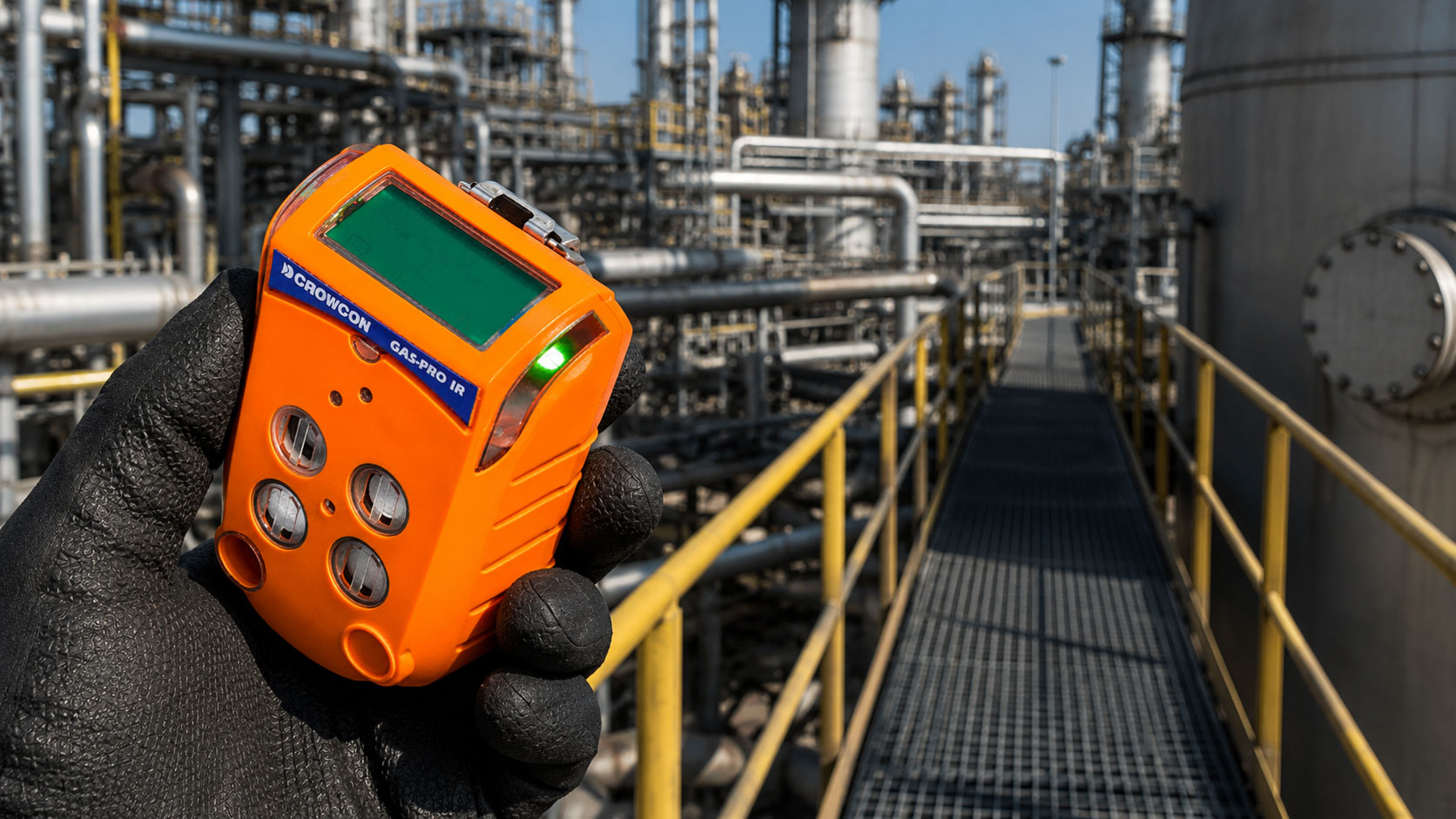
When a gas detector triggers an alarm, the situation must always be taken seriously. An alarm can indicate a hazardous gas concentration, oxygen deficiency, oxygen enrichment, toxic gases or flammable gases. At the same time, there are also cases in practice where an alarm is triggered by sensor faults, incorrect use, missing calibration or unfavorable environmental conditions.
Therefore, it is important that a gas alarm is not prematurely dismissed as a false alarm. First, the company safety instructions must be followed and the hazardous area must be secured. Only then can it be checked whether it is a real alarm, a maintenance notice, a device fault or a misinterpretation.
This article explains typical alarm causes for portable gas detectors and stationary gas detection systems, shows important immediate measures and provides practical guidance for troubleshooting.
You can find an overview of suitable devices in our categories
gas measuring instruments / gas detectors,
portable gas detectors,
stationary gas detectors
and
gas detection systems.
Table of contents
- Why must a gas alarm always be taken seriously?
- Alarm types: pre-alarm, main alarm, device fault and maintenance notice
- CO, H₂S, O₂ and flammable gases: What does each alarm mean?
- Immediate measures in the event of a gas alarm
- False alarm or real alarm?
- Sensors, cross-sensitivities and environmental conditions
- Bump test, calibration and function test
- Differences between portable and stationary gas detectors
- Which gas detectors and test systems are suitable?
- Practical examples from industrial applications
- Checklist after a gas alarm
- Conclusion
- FAQ: Frequently asked questions about gas alarms and gas detectors
Why must a gas alarm always be taken seriously?
A gas detector is not simply a measuring instrument, but a safety-relevant warning system. It is designed to warn people and systems at an early stage of hazardous atmospheres. These include toxic gases, oxygen deficiency, oxygen enrichment and explosive gas-air mixtures.
An alarm therefore initially means that a hazard may exist. Whether the cause is later identified as an actual gas concentration, a device problem or incorrect operation may only be checked after the situation has been secured.
- Personal protection: Portable gas detectors warn the employee directly.
- Area monitoring: Stationary gas detectors permanently monitor fixed measuring points.
- Explosion protection: Flammable gases can be detected before dangerous concentrations are reached.
- Health protection: Toxic gases such as CO or H₂S can be dangerous even at low concentrations.
- Process safety: Stationary gas detection systems can trigger alarms, ventilation or shutdowns.
The specific response to a gas alarm must always follow the company risk assessment, safety instructions and alarm plan.
Alarm types: pre-alarm, main alarm, device fault and maintenance notice
Not every signal tone from a gas detector automatically means the same condition. Depending on the version, modern gas detectors distinguish between pre-alarm, main alarm, sensor fault, battery warning, maintenance notice, bump test due date or calibration requirement.
| Alarm type | Meaning | Typical response |
|---|---|---|
| Pre-alarm | A first alarm threshold has been reached. | Leave the area attentively or respond according to operating instructions. |
| Main alarm | A higher or critical alarm threshold has been reached. | Leave the hazardous area immediately and follow the alarm plan. |
| STEL or TWA alarm | Short-term or shift average value has been exceeded. | Assess exposure and initiate safety measures. |
| Oxygen alarm | Oxygen deficiency or oxygen enrichment has been detected. | Do not enter or leave the area; have the cause clarified. |
| Sensor fault | Sensor does not provide a plausible measured value or is disturbed. | Do not use the device as safety-relevant monitoring equipment. |
| Battery alarm | Device no longer has sufficient energy for use. | Charge or replace the device before continuing to use it. |
| Maintenance or calibration notice | Bump test or calibration is due. | Check, test or calibrate the device. |
Devices such as the
T4
use audible, visual and vibrating alarms so that the user is warned even in loud or confusing working areas.
CO, H₂S, O₂ and flammable gases: What does each alarm mean?
The meaning of an alarm strongly depends on which gas is being monitored. An oxygen alarm must be assessed differently from a CO alarm, H₂S alarm or alarm for flammable gases. It must therefore always be known which sensors are installed in the device and which alarm thresholds have been set.
| Gas / measured variable | Typical hazard | Important to know |
|---|---|---|
| Carbon monoxide CO | Toxic gas, often odorless and not perceptible. | Take the alarm seriously, leave the area and have the cause checked. |
| Hydrogen sulfide H₂S | Highly toxic gas, particularly critical in wastewater, shafts, oil and gas environments. | Odor is not a safe warning method; the gas detector is decisive. |
| Oxygen O₂ | Oxygen deficiency or oxygen enrichment. | Particularly relevant in confined spaces, vessels, inerting or leaks. |
| Flammable gases | Explosive atmosphere possible. | Measurement is often carried out in % LEL. |
| CO₂ | Risk of suffocation and increased concentrations in poorly ventilated areas. | Depending on the application, an IR sensor or stationary monitoring may be useful. |
| VOC | Volatile organic compounds, often in solvent or process environments. | Depending on the substance, PID technology may be required. |
For typical four-gas applications with CO, H₂S, flammable gases and oxygen deficiency, the
T4
can be a suitable portable solution. For extended multi-gas monitoring of up to five gases, the
Gas-Pro
may be relevant.
Immediate measures in the event of a gas alarm
In the event of a gas alarm, personal protection comes first. The exact procedure must be defined in the company safety instructions. In general: an alarm is first treated as a potential hazard, not as a measurement error.
Basic procedure
- Stop work immediately: Do not carry out any further activities in the possible hazardous area.
- Leave the hazardous area: Move away calmly using the designated escape route.
- Warn other people: Inform colleagues, supervisors or the control room.
- Follow the alarm plan: Observe company requirements, evacuation and clearance processes.
- Do not create ignition sources: In the case of flammable gases, do not unnecessarily operate switches, devices or tools.
- Do not re-enter the area: Only after clearance by responsible specialists or safety personnel.
- Do not ignore the device: Also document and check short-term or recurring alarms.
| Situation | First response | Then check |
|---|---|---|
| Portable device alarms on the employee | Leave the area and warn colleagues | Check measured value, gas type, alarm history and operating conditions |
| Stationary gas detector triggers alarm | Follow the system alarm plan | Check measuring point, ventilation, leakage source and control unit |
| Alarm occurs only briefly | Still take the alarm seriously | Check peak value, TWA/STEL, process condition and sensor behavior |
| Several devices alarm simultaneously | Assume a real hazard | Secure the area widely and systematically clarify the cause |
| Device shows sensor fault | Do not continue using the device as a protective device | Check bump test, calibration or service |
False alarm or real alarm?
Whether an alarm was actually triggered by a hazardous gas concentration can often only be assessed afterwards. It is important to narrow down the cause in a structured manner and not to assume a false alarm too quickly.
Indications of a real alarm
- Several devices or measuring points show similar values.
- The alarm occurs reproducibly at the same location.
- The alarm matches a process condition, a leak or maintenance activity.
- The measured value rises or falls plausibly with ventilation, distance or process changes.
- There are identifiable sources such as vessels, pipes, shafts, pumps or valves.
Possible causes of false alarms or implausible alarms
- Sensor not tested: Bump test or calibration is overdue.
- Cross-sensitivity: Another gas influences the sensor.
- Moisture or condensation: Sensor or filter is affected.
- Dust or contamination: Gas entry at the sensor is restricted.
- Wrong device for the application: Sensor principle does not match the gas type or environment.
- Incorrect sampling: Hose, pump or filter causes delays or measurement errors.
- Calibration gas or zero-point problem: Device was not checked or adjusted correctly.
- Environmental conditions: Temperature, pressure, humidity or air flow influence the measurement.
With portable multi-gas detectors such as the
Gas-Pro
bump test and calibration reminders can help to keep a better overview of the device status during operation.
Sensors, cross-sensitivities and environmental conditions
Depending on the gas type and application, gas detectors work with different sensor principles. Each sensor has a specific application range and can be influenced by environmental conditions. An alarm should therefore always be considered in relation to gas type, sensor principle, installation location and process.
| Sensor / measuring principle | Typical use | Possible influencing factors |
|---|---|---|
| Electrochemical sensor | Toxic gases such as CO or H₂S as well as oxygen measurement | Cross-sensitivities, humidity, ageing, temperature |
| Pellistor | Flammable gases in the LEL range | Sensor poisoning, oxygen content, silicones, catalyst ageing |
| Infrared sensor | CO₂ or certain flammable hydrocarbons | Optical contamination, condensation, gas type, beam path |
| PID sensor | VOC and volatile organic compounds | Lamp contamination, humidity, substance dependency, calibration factor |
| Laser or remote measurement | Contactless methane leak detection over distance | Line of sight, distance, reflection, measuring angle |
For stationary applications with different sensor technologies, a system such as the
XgardIQ gas detector
may be relevant. For portable applications with IR, PID or electrochemical sensors, the
Gas-Pro
may be suitable depending on the measuring task.
Bump test, calibration and function test
A gas detector can only warn reliably if sensors, alarm indicators and device status are checked regularly. A bump test shows whether the device reacts to test gas and whether the alarm function generally works. Calibration or adjustment ensures correct assignment of the measured value.
| Test | Purpose | Typical question |
|---|---|---|
| Bump test | Function test with test gas | Does the sensor react and does the alarm trigger? |
| Calibration | Comparison with defined test gas | Does the device display the correct measured value? |
| Zero-point check | Check of the basic display | Does the device show a plausible zero or normal value without target gas? |
| Alarm test | Check of audible, visual and vibrating warning | Is the user reliably warned? |
| Documentation | Proof of test and operational readiness | Are test date, result and device traceably documented? |
For automated testing and verification of gas detectors such as
Gas-Pro
and
T4
the
I-Test
can be a suitable solution. It enables controlled creation of test and calibration reports.
Differences between portable and stationary gas detectors
The alarm assessment also depends on whether a portable gas detector is worn on the body or whether a stationary gas detector monitors a fixed measuring point. Both systems have different tasks and must be assessed differently.
| System | Task | Alarm assessment |
|---|---|---|
| Portable gas detector | Personal monitoring directly on the employee | Alarm indicates a hazard at the user’s location or in the breathing zone. |
| Portable multi-gas detector with pump | Sampling before entry or from difficult-to-access areas | Hose length, dead time, pump and sampling point must be considered. |
| Stationary gas detector | Permanent monitoring of a fixed measuring point | Alarm strongly depends on installation location, gas type, air flow and leakage source. |
| Gas detection control unit | Evaluation of several detectors and forwarding of alarms | Alarm can control ventilation, warning lights, horns or shutdowns. |
A stationary gas detection system with a control unit such as the
Gasmaster gas detection control unit
can be useful when several measuring points are to be permanently monitored and alarms processed centrally.
Which gas detectors and test systems are suitable?
The suitable solution depends on whether individual persons, confined spaces, mobile working areas or permanently installed systems need to be monitored. In addition, gas type, sensor principle, alarm thresholds, documentation, calibration and maintenance must be considered.
| Product | Especially relevant for | Note |
|---|---|---|
| T4 | Portable 4-gas personal protection for CO, H₂S, flammable gases and oxygen | Suitable for users who need a robust multi-gas device for full work shifts. |
| Gasman | Personal single-gas monitoring for flammable gases, toxic gases or oxygen | Useful when one specific gas needs to be monitored. |
| Gas-Pro | Portable multi-gas monitoring of up to five gases | Relevant for more complex applications, pre-entry tests or measuring tasks with optional pump. |
| I-Test | Automatic testing and verification of Gas-Pro and T4 | Supports structured bump tests, verification and documentation. |
| XgardIQ gas detector | Stationary gas detection for industrial applications | Interesting when fixed measuring points need to be permanently monitored and integrated into plant concepts. |
| Gasmaster gas detection control unit | Central evaluation of several stationary gas detectors | Useful for gas detection systems with several measuring points, alarms and output functions. |
You can find a complete overview in the categories
portable gas detectors,
stationary gas detectors
and
gas detection systems.
Practical examples from industrial applications
Example 1: CO alarm in a workshop
A portable gas detector triggers a CO alarm during work in a poorly ventilated workshop. Work is stopped and the area is left. It is then checked whether combustion engines, heaters or exhaust gas entry are the cause. A CO alarm must not be ignored, because carbon monoxide cannot be reliably perceived.
Example 2: H₂S alarm in a shaft
During work on a shaft, a multi-gas detector triggers an H₂S alarm. Entry is not carried out or is immediately aborted. Especially with H₂S, odor perception is not a safe method of assessing the hazard. Measurement with a suitable gas detector is decisive here.
Example 3: Oxygen alarm before vessel entry
Before entering a vessel, an oxygen alarm is detected with a gas detector. The area is not cleared for entry. The cause, ventilation, inerting and sampling procedure must then be checked. In pre-entry tests, it is particularly important that the pump, hose and measuring time match the application.
Example 4: Recurring alarm without an obvious gas source
A portable gas detector repeatedly alarms although there is no obvious gas source. In this case, bump test, calibration status, sensor condition, filter, cross-sensitivities and environmental conditions should be checked. Only then can it be assessed whether a device problem, an interference source or a short-term real gas release was present.
Example 5: Stationary gas detection system reports alarm at one measuring point
A stationary gas detection system reports an alarm at a single detector. The cause may be a leak, process release, ventilation change or sensor problem. In addition to the measured value, installation location, air flow, process condition, event log and maintenance status should be checked.
Checklist after a gas alarm
This checklist can be used to assess a gas alarm in a structured manner after the situation has been secured.
| Check question | Why important? | Assessment |
|---|---|---|
| Has the hazardous area been left or secured? | Personal protection takes priority over troubleshooting. | Follow alarm plan and safety instructions. |
| Which gas or which sensor has alarmed? | CO, H₂S, O₂ and flammable gases require different assessment. | Check display, gas type and alarm threshold. |
| Was it a pre-alarm, main alarm or device fault? | The alarm type influences further assessment. | Check alarm message and device symbols. |
| Is the alarm reproducible? | Repeatable alarms more likely indicate a real source or fixed influence. | Document measuring point and process condition. |
| Were there process changes or work nearby? | Releases can occur due to maintenance, cleaning, opening of vessels or leaks. | Check working environment and activities. |
| Is the bump test up to date? | Only a tested device can be reliably assessed for use. | Check test date and report. |
| Is the calibration valid? | Incorrect calibration can falsify measured values. | Check calibration status and test gas. |
| Are sensor, filter and gas inlet clear? | Contamination can influence response time and measured value. | Visually inspect device and have it serviced if necessary. |
| Were measured values documented? | Peak values, TWA/STEL and events help with cause analysis. | Evaluate data logger, event memory or report. |
Conclusion: Take a gas alarm seriously first, then check systematically
When a gas detector alarms, safety always comes first. The hazardous area must be left or secured according to operating instructions. Only then should it be checked whether a real gas concentration, device fault, maintenance issue or operating error is present.
Reliable gas detection does not depend on the device alone. Gas type, sensor principle, alarm thresholds, bump test, calibration, operating environment, sampling and documentation must match. Portable devices such as
T4,
Gasman
or
Gas-Pro
can support personal protection. Stationary solutions such as
XgardIQ
or the
Gasmaster gas detection control unit
are suitable for permanent area monitoring and central alarm processing.
You can find a suitable preselection in our categories
gas measuring instruments / gas detectors,
portable gas detectors,
stationary gas detectors
and
gas detection systems.
FAQ: Frequently asked questions about gas alarms and gas detectors
What should you do if a gas detector triggers an alarm?
The alarm must always be taken seriously. Work must be stopped, the hazardous area must be left or secured according to company safety instructions and responsible persons must be informed. Only then should the cause of the alarm be checked.
Can a gas detector trigger a false alarm?
Yes, this is possible. Causes can include cross-sensitivities, sensor ageing, moisture, contamination, incorrect calibration, unsuitable application or environmental conditions. Nevertheless, an alarm must not be assessed as a false alarm too quickly.
What does a CO alarm mean?
A CO alarm indicates carbon monoxide. Carbon monoxide is toxic and cannot be reliably perceived by humans. The area should be left according to the alarm plan and the cause should be checked by qualified persons.
What does an H₂S alarm mean?
An H₂S alarm indicates hydrogen sulfide. H₂S is highly dangerous and can occur in areas such as shafts, wastewater plants, oil and gas environments or vessels. Odor is not a safe warning method.
What does an oxygen alarm mean?
An oxygen alarm can indicate oxygen deficiency or oxygen enrichment. Oxygen deficiency can mean a risk of suffocation, while oxygen enrichment can increase fire and explosion risks. The exact assessment depends on the application and alarm limits.
What does an alarm for flammable gases mean?
An alarm for flammable gases indicates a possible explosive atmosphere. Measurement is often carried out as a percentage of the lower explosive limit. Ignition sources must be avoided and the alarm plan must be followed.
What is a bump test?
A bump test is a function test with test gas. It checks whether the sensor reacts to gas and whether the device alarms. The bump test does not always replace full calibration, but it is an important part of the pre-use test.
How often does a gas detector need to be calibrated?
This depends on the device, sensor, operating conditions, manufacturer specifications and company requirements. It is important that calibration and bump test are documented traceably and that the device is only used in an approved condition.
When is a portable gas detector sufficient and when do I need a stationary gas detection system?
A portable gas detector is primarily used for personal protection. A stationary gas detection system permanently monitors fixed measuring points and can process alarms centrally. In many installations, both concepts are combined.
Where can I find suitable gas detectors?
You can find an overview in the categories
portable gas detectors,
stationary gas detectors
and
gas detection systems.