


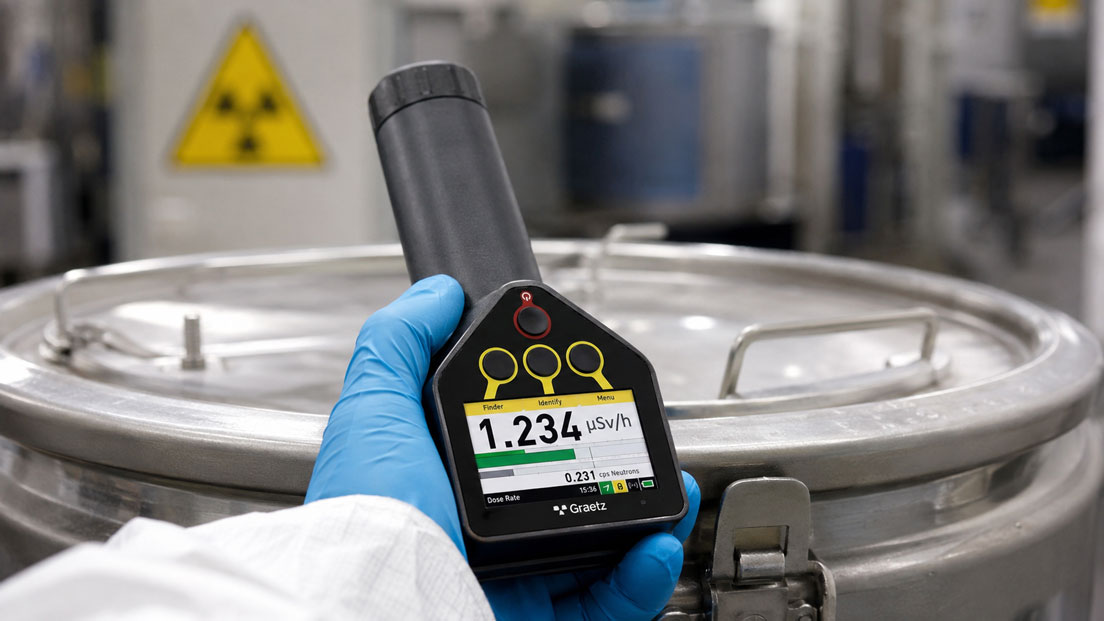
Anyone who wants to select a radiation measuring instrument is often faced with a fundamental question: should the current radiation in the environment be measured, should the personal radiation dose of an individual be monitored, or should a surface be checked for radioactive contamination? This distinction is decisive, because a dose rate meter, a personal dosimeter and a contamination monitor perform different tasks.
In practice, the term “radiation measuring instrument” is often used very generally. It may refer to portable dose rate meters, dosimeters, dose rate warning devices, contamination monitors, area monitoring systems, telescopic probes or radionuclide identifiers. Which device is suitable depends on which measured variable is required, which type of radiation is expected, whether people need to be protected and whether a source only needs to be detected or also identified.
This article explains the most important differences between dose rate, personal dose and contamination. It also shows which device types are useful for radiation protection, fire brigades, industry, medicine, research, nuclear technology, recycling and security applications. The focus is on gamma and X-ray radiation, alpha/beta/gamma contamination, personal protection, surface testing, alarm indication, source identification and the correct selection of suitable radiation measurement technology.
Table of contents
- Basics: which question should the radiation measuring instrument answer?
- Measuring dose rate: how strong is the radiation field right now?
- Monitoring personal dose: which dose has a person received?
- Detecting contamination: is a surface radioactively contaminated?
- Types of radiation: correctly classifying gamma, X-ray, alpha and beta
- Radionuclide identification: when dose rate alone is not enough
- Application areas: fire brigade, industry, medicine, research and recycling
- Selection criteria: measured variable, measuring range, alarm and documentation
- Probes, telescopes and accessories: adapting the measurement task to the site
- Warning and alarm indication: when a warning device is useful
- Documentation, calibration and deployment concept
- Typical mistakes when selecting radiation measuring instruments
- Practical example: unknown find in a recycling facility
- Which measuring instruments / products are suitable?
- Conclusion: clarify the measurement task first, then select the device
- FAQ: frequently asked questions about selecting radiation measuring instruments
Basics: which question should the radiation measuring instrument answer?
The selection of a radiation measuring instrument does not begin with a specific device, but with the measurement task. It makes a major difference whether an incident commander wants to know how high the dose rate is in an area, whether an employee must monitor their personal dose, or whether tools, clothing, vehicles or surfaces need to be checked for contamination.
A dose rate meter primarily answers the question: how high is the radiation at this location at this moment? This information is important for assessing hazardous areas, evaluating distances, checking work areas or locating a radiation source. It is therefore about the current radiation intensity in a room or at a measuring point.
A dose meter or personal dosimeter answers a different question: which radiation dose has a person received over a certain period of time? This information is decisive for personal radiation protection. The dose can accumulate over working time, deployment time or time spent in a radiation field.
A contamination monitor, on the other hand, checks whether radioactive substances are present on a surface, object, item of clothing or person. This is different from a pure dose rate field. A surface can be contaminated even though the dose rate at a greater distance does not appear noticeably high. The measurement task must therefore be clearly separated.
| Measurement task | Typical device type | Which question is answered? |
|---|---|---|
| Measure dose rate | Dose rate meter | How high is the radiation at this location? |
| Monitor personal dose | Dosimeter / personal dosimeter | Which dose has a person received? |
| Check surfaces | Contamination monitor | Is a surface radioactively contaminated? |
| Trigger alarms | Dose rate warning device / alarm dosimeter | Is a defined warning threshold exceeded? |
| Identify source | Radionuclide identifier | Which radionuclide is causing the radiation? |
Measuring dose rate: how strong is the radiation field right now?
Dose rate describes how strong a radiation field currently is at a specific location. It is a central parameter when areas are assessed, barriers are defined, workplaces are checked or radiation sources are searched for. A dose rate meter is therefore often the first instrument used in an unknown radiation situation.
Typical applications include radiation protection checks in industry and research, inspection of work areas, measurements on transport containers, checking storage areas, fire brigade and hazardous goods deployments, monitoring sources in non-destructive testing or measurements in nuclear facilities.
Dose rate meters are primarily relevant for gamma and X-ray radiation, but depending on the device and probe they may also be used for other radiation types or special tasks. Selection depends on the expected measuring range, energy dependence, desired alarm function, robustness and ease of use. For high dose rates or hard-to-reach measuring points, additional probes or telescopes may be required.
It is important that a dose rate meter does not replace a complete contamination check. It can indicate that a radiation field is present or increasing. However, whether a surface is contaminated with radioactive material must be checked using a suitable contamination monitor.
| Dose rate measurement | Typical benefit | Limit of the measurement task |
|---|---|---|
| Area assessment | Assess hazardous areas and workplaces | Does not automatically indicate whether surfaces are contaminated. |
| Source search | Locate increased radiation | Does not reliably identify the radionuclide. |
| Deployment control | Warn fire brigade, industry or radiation protection personnel | Personal dose must be monitored separately. |
| Transport inspection | Measurement on containers, vehicles or packages | Surface contamination requires additional checking. |
| Workplace monitoring | Inspection of areas with potential exposure | Requires a suitable deployment and documentation concept. |
Monitoring personal dose: which dose has a person received?
Personal dose describes the radiation dose that a person has received over a certain period of time. A personal dosimeter is worn on the body and is used to monitor individual exposure. This is particularly important when people work professionally or operationally in areas with possible radiation exposure.
A dosimeter does not replace dose rate measurement in the surrounding area. It does not primarily state how strongly an area is currently radiating, but which dose the wearer has accumulated over time. Dose rate meters and dosimeters therefore often complement each other. One assesses the environment, the other monitors the person.
Electronic dosimeters or alarm dosimeters can also warn when dose or dose rate warning thresholds are exceeded. This is particularly helpful under changing operating conditions, unclear situations or work in areas where radiation may change. For organizational radiation protection, it is also important how measured values are stored, read out and documented.
Typical application areas for personal dosimeters include radiation protection personnel, medicine, research, industry, nuclear technology, non-destructive testing, fire brigades, disaster control and security services. The specific selection depends on which radiation type, measured variable, alarm function, wearing method and documentation are required.
Detecting contamination: is a surface radioactively contaminated?
Contamination means that radioactive substances are present on a surface, object, item of clothing, tool, skin area or vehicle. The measurement task differs significantly from dose rate measurement. While a dose rate meter assesses the radiation field in the environment, a contamination monitor checks the direct contamination of a surface.
Contamination measurements are particularly important when radioactive substances can be released, spread or transferred to materials. Examples include work with open radioactive substances, decontamination areas, laboratories, nuclear technology, medical applications, fire brigade and hazardous goods deployments, recycling facilities or inspection of tools and protective clothing.
The type of radiation plays a decisive role in contamination measurements. Alpha radiation has only a very short range and can already be shielded by thin layers. Beta radiation is more penetrating, but is also sensitive to geometry, distance and shielding. Gamma radiation can also be detected from a greater distance, but does not automatically indicate whether a surface is locally contaminated.
A good contamination monitor must therefore match the expected radiation type, measuring surface, detection limit, operating environment and handling. For surface contamination, a suitable detector area is important so that measurements can be carried out efficiently and reproducibly.
| Contamination measurement | Typical application | Important selection point |
|---|---|---|
| Surface inspection | Tools, tables, floors, containers | Select detector area and sensitivity appropriately. |
| Personnel check | Clothing, gloves, shoes, skin areas | Observe measuring distance and radiation type. |
| Vehicle and material inspection | Recycling, transport, disposal | Consider large areas and documentable results. |
| Decontamination | Before/after check | Clearly define measurement strategy and limit values. |
| Laboratory and research | Workplaces with open radioactive substances | Check alpha/beta/gamma suitability. |
Types of radiation: correctly classifying gamma, X-ray, alpha and beta
The type of radiation has a major influence on device selection. Gamma and X-ray radiation are penetrating and are often monitored with dose rate meters, dose rate warning devices or dosimeters. They are particularly relevant for area checks, personal protection, source monitoring, security applications and many industrial or medical fields of use.
Alpha radiation, on the other hand, can only be detected at very short distances and is strongly attenuated by air, dust, moisture, paper, films or thin layers. Suitable contamination monitors and a very controlled measurement geometry are required for alpha contamination. A pure gamma dose rate meter is not suitable for this.
Beta radiation lies between alpha and gamma in terms of penetration capability. Here too, distance, detector window, protective grid, surface condition and shielding are important. For many contamination measurements, alpha, beta and gamma components must be separated or at least evaluated in a way that fits the measurement task.
The selection of a radiation measuring instrument should therefore never be based only on the general term “radioactive radiation”. The decisive factor is whether gamma/X-ray radiation, alpha/beta contamination or a combination is expected. If the source is unknown, a radionuclide identifier may additionally be required.
| Radiation type | Typical measurement task | Suitable device type |
|---|---|---|
| Gamma radiation | Dose rate, personal dose, source search | Dose rate meter, dosimeter, RID |
| X-ray radiation | Dose rate and personal protection | Dose rate meter, dosimeter, warning device |
| Alpha radiation | Surface contamination | Contamination monitor with alpha suitability |
| Beta radiation | Contamination and surface inspection | Contamination monitor with beta suitability |
| Unknown gamma source | Detection and identification | Radionuclide identifier |
Radionuclide identification: when dose rate alone is not enough
A dose rate meter shows that radiation is present and how high the dose rate is. However, it does not reliably answer the question of which radionuclide is causing the radiation. This exact information can be decisive for unknown sources, security checks, transport incidents, recycling finds, fire brigade deployments or nuclear applications.
A radionuclide identifier, often referred to as an RID, is used to classify gamma sources based on their spectrum. This makes it easier to assess whether the source is, for example, an industrial source, a medical source, naturally occurring radioactive material or another source. This supports further deployment decisions, documentation and communication with specialist authorities.
However, an RID does not automatically replace all other devices. A dose rate meter remains important for quick area assessment. A dosimeter remains relevant for personal protection. A contamination monitor is still required for surface contamination. In many professional deployment concepts, several device types are therefore combined.
The decision to use an RID is particularly useful when it is not only necessary to detect that radiation is present, but also to classify the source more precisely. This applies especially to unknown finds, screening tasks, border and security checks, recycling facilities, emergency organizations and specialized radiation protection teams.
Application areas: fire brigade, industry, medicine, research and recycling
Depending on the application area, the requirements for radiation measuring instruments differ significantly. Fire brigades need robust and quickly operable devices that reliably warn under deployment conditions and enable an initial assessment of the situation. Dose rate meters, dose rate warning devices, personal dosimeters, contamination monitors and, where applicable, radionuclide identifiers are relevant here.
In industry, radiation measuring instruments are used, among other things, in non-destructive testing, level measurement with radioactive sources, material testing, source storage, radiation protection areas and transport checks. Depending on the application, the focus is on dose rate, personnel monitoring or source control.
In medicine and research, radiation measuring instruments are used for work areas with ionizing radiation, radiopharmaceuticals, laboratories, nuclear medicine, research facilities or controlled areas. Contamination detection, personal dose, dose rate and documentation are particularly important here.
Recycling facilities and waste management companies often have a different starting point. There, the aim is frequently to detect unknown or accidentally introduced radioactive sources or contaminated materials at an early stage. In addition to stationary portal monitoring systems, portable dose rate meters, contamination monitors and radionuclide identifiers can be used for clarification.
Selection criteria: measured variable, measuring range, alarm and documentation
When selecting a radiation measuring instrument, measured variable, radiation type, measuring range, alarm function, ease of use, robustness and documentation should be considered together. A device with a very large measuring range is not automatically the best device if the detector type does not match the measurement task. Conversely, a sensitive contamination monitor is of little use if a high dose rate actually needs to be measured from a safe distance.
The measuring range must match the expected situation. In laboratories and controlled areas, low measuring ranges and high sensitivity can be important. For fire brigades, nuclear technology, transport incidents or unknown sources, a wider measuring range and reliable alarm indication may be more important. For contaminated surfaces, however, the ability to detect specific types of radiation and the suitable detector area are often decisive.
Alarm functions are particularly important when people need to be warned quickly. An audible, visual or vibrating alarm can help indicate increased dose rate or dose even under difficult conditions. However, the alarm strategy should match the deployment concept and should not be selected randomly.
Documentation and data transfer are also relevant selection points. In professional applications, measured values, deployment times, doses, test results or alarm events often need to be documented traceably. Memory functions, interfaces, calibration documents and clear device assignment can be important here.
| Selection criterion | Why relevant? | Typical question |
|---|---|---|
| Measured variable | Determines the device type | Dose rate, personal dose, contamination or nuclide identification? |
| Radiation type | Determines detector and measurement geometry | Gamma, X-ray, alpha, beta or combination? |
| Measuring range | Must match the expected radiation | Low activity, work area or high dose rate? |
| Alarm function | Protects people when limits are exceeded | Audible, visual, vibration alarm or several warning thresholds? |
| Documentation | Important for proof and deployment report | Do measured values need to be stored or exported? |
Probes, telescopes and accessories: adapting the measurement task to the site
Not every measurement task can be solved optimally with the basic device alone. Additional probes, probe cables, telescopes or special detectors may be necessary when measuring points are difficult to access, when measurements must be made from a safe distance or when a specific radiation type needs to be detected more sensitively.
Telescopic probes are particularly helpful when high dose rates are suspected or when a measuring point should not be approached directly. Distance from the source is a central protection factor. A measurement from a greater distance can reduce the operator’s exposure and still provide important information about the situation.
Special contamination probes can be used when surfaces, liquids, hard-to-reach areas or larger areas need to be checked. It is important that probe and measuring instrument are compatible and that the measurement strategy is suitable for the respective application.
Accessories should therefore not be considered a minor issue. They can determine whether a measurement can be carried out safely, reproducibly and suitably for deployment. Especially for fire brigades, nuclear technology, research and industrial radiation protection areas, accessories should be included in the deployment concept from the beginning.
Warning and alarm indication: when a warning device is useful
Dose rate warning devices and alarm dosimeters are useful when a person must be warned quickly and clearly of increased radiation. They are not only used to display measured values, but above all to trigger an alarm when defined thresholds are exceeded. This is particularly important in deployments where the radiation situation can change or where the display cannot be observed constantly.
A warning device can provide visual, audible or vibrating alarms. Which alarm type is useful depends on the environment. In noisy industrial environments or fire brigade deployments, a purely audible warning may be insufficient. When protective clothing is worn, visibility is poor or stress levels are high, additional visual or vibrating indications can be important.
Warning thresholds must match the application. A threshold set too low can lead to frequent alarms and reduce acceptance. A threshold set too high can react too late. Warning thresholds should therefore not be selected arbitrarily, but should match the radiation protection concept, deployment type and applicable requirements.
Warning devices do not replace expert assessment. They are an important tool for alerting people to a changed situation in good time. Assessment of the situation, definition of measures and documentation must still be carried out by qualified personnel and a suitable deployment concept.
Documentation, calibration and deployment concept
Radiation measuring instruments are often used in safety-relevant applications. Documentation, calibration, functional testing and device assignment therefore play a major role. A measured value is only reliable if it is clear which device was used, what condition it was in and whether it was suitable for the measurement task.
Regular calibration and functional testing are important to ensure that measuring instruments work reliably. Depending on application area, operator requirements and legal requirements, different test intervals and certificates may be required. For professional applications, calibration status, serial number, measuring range, detector type and accessories should be documented.
The deployment concept should define which device is used for which task. It should also describe how measurements are carried out, documented and evaluated. Especially for contamination measurements, measuring distance, measuring duration, background, detector area and surface condition are decisive for reproducible results.
Training is also important. A radiation measuring instrument only provides meaningful results if the user understands the measured variable, the limits of the device and the operating conditions. Otherwise, misinterpretations can lead to unnecessary uncertainty or incorrect decisions.
Typical mistakes when selecting radiation measuring instruments
A common mistake is assuming that one single radiation measuring instrument can cover all tasks. A simple dose rate meter may be suitable for area measurement, but cannot reliably detect surface contamination with alpha or beta radiation. A dosimeter does not automatically protect a work area, but monitors personal dose.
Another mistake is selecting a device without a clear radiation type. For gamma and X-ray radiation, different detectors and measured variables are relevant than for alpha or beta contamination. Anyone who does not know which radiation type is expected should clarify the deployment scenario more precisely and, where necessary, combine several device types.
The alarm function is also sometimes assessed incorrectly. A device with an alarm is not automatically a complete radiation protection concept. Warning thresholds, deployment rules, training, calibration and documentation must also match. Especially for emergency organizations, it should be clear who reacts to which alarm and how.
Neglecting accessories is also problematic. Without a suitable probe, telescope, carrying solution or protection concept, a good measuring instrument may be difficult to use in practice. The measurement task therefore determines not only the device, but also the necessary accessories.
| Error pattern | Possible cause | Test approach |
|---|---|---|
| Contamination is not detected | Wrong device type or unsuitable detector | Check alpha/beta/gamma suitability and measurement geometry. |
| Dose of a person is unknown | Only dose rate measured, no dosimeter worn | Include personal dosimetry in the deployment concept. |
| Source remains unclear | Dose rate measured, but no nuclide identification | Consider RID or specialist authority for unknown sources. |
| Alarm is missed | Alarm type does not match the environment | Assess audible, visual and vibration warnings. |
| Measured values are not traceable | Calibration, device assignment or documentation missing | Define test concept and documentation process. |
Practical example: unknown find in a recycling facility
In a recycling facility, an unusual radiation reading is detected during incoming inspection. First, it must be clarified whether an increased dose rate is actually present and how the area can be secured. A suitable dose rate meter is used for this purpose. It helps assess the affected area and estimate proximity to the possible source.
Since it is unclear whether radioactive material has spread onto surfaces, pure dose rate measurement is not sufficient. Tools, vehicle parts, containers or material surfaces must also be checked for contamination. This requires a contamination monitor that matches the expected radiation type and measuring surface.
If the source remains unknown, a radionuclide identifier can help classify the type of radiation source more precisely. This information is important for better planning of further measures, communication with specialist authorities, transport, storage or disposal. At the same time, involved personnel should be monitored with dosimeters if relevant exposure is possible.
The example shows: in many real situations, a single device is not sufficient. Dose rate meter, contamination monitor, dosimeter and radionuclide identifier answer different questions and complement each other in a professional radiation protection concept.
Which measuring instruments / products are suitable?
The category radiation measurement technology is the right starting point when different radiation protection measurement tasks need to be considered. It includes device types for dose rate, dosimetry, contamination, radionuclide identification, probes, telescopes and stationary monitoring.
Dose rate meters are suitable for assessing current radiation fields. They are particularly relevant when areas are checked, sources are searched for, transport or work areas are inspected or deployment sites are assessed.
If the individual exposure of people needs to be monitored, dose meters or personal dosimeters are the right device group. They are suitable for people who are present or working in areas with possible radiation exposure.
For checking surfaces, tools, clothing, vehicles or materials for radioactive contamination, contamination monitors are relevant. Depending on the version, they may be suitable for alpha, beta and gamma contamination and support the inspection of workplaces, people and objects.
If an unknown source is not only to be detected, but also classified based on its spectrum, the category radionuclide identifiers is useful. For pure warning tasks, dose rate warning devices can also be used.
| Product / area | Typical use | Particularly relevant for |
|---|---|---|
| Radiation measurement technology | Overview of devices and systems for radiation measurement | Selection between dose rate, dosimetry, contamination and identification |
| Dose rate meters | Measurement of the current dose rate | Area inspection, source search, deployment sites, industry and nuclear technology |
| Dose meters | Monitoring of personal radiation dose | Personal protection, medicine, research, industry, fire brigades and radiation protection personnel |
| Contamination monitors | Checking surfaces for radioactive contamination | Alpha/beta/gamma contamination, decontamination, laboratory, recycling and nuclear technology |
| Radionuclide identifiers | Identification of unknown gamma sources | Unknown finds, security checks, recycling, emergency organizations and specialist authorities |
Conclusion: clarify the measurement task first, then select the device
The selection of a radiation measuring instrument mainly depends on which question is to be answered. If the current radiation in a room is to be assessed, a dose rate meter is required. If the dose of a person is to be monitored, a dosimeter is needed. If radioactive contamination on surfaces is to be checked, a contamination monitor is required. For unknown sources, a radionuclide identifier can also be useful.
It is important not to confuse dose rate, personal dose and contamination. These measurement tasks are related, but they do not replace each other. A single device may be sufficient in simple cases, but in professional radiation protection or deployment concepts, several device types are often combined.
The most important recommendation is: before selecting a product, always clarify measured variable, radiation type, operating environment, alarm requirements, documentation, accessories and training. This turns a general “radiation measuring instrument” into a suitable solution for radiation protection, fire brigades, industry, medicine, research, nuclear technology or recycling.
FAQ: frequently asked questions about selecting radiation measuring instruments
Which radiation measuring instrument do I need first?
That depends on the measurement task. A dose rate meter is usually needed to assess an area. A dosimeter is needed for personal monitoring. A contamination monitor is needed for surface contamination.
What does a dose rate meter measure?
It measures the current dose rate at a location. This makes it possible to assess how strong a radiation field is in an area.
What does a dosimeter measure?
A dosimeter measures the dose that a person has received over a certain period of time. It is worn for individual monitoring.
What does a contamination monitor measure?
A contamination monitor checks whether radioactive substances are present on surfaces, clothing, tools, people or objects.
Can a dose rate meter detect contamination?
It can provide indications of radiation, but it does not replace a suitable contamination monitor. Alpha and beta contamination in particular require suitable detectors and measurement geometry.
Can a dosimeter replace a dose rate meter?
No. A dosimeter monitors the individual dose of a person, while a dose rate meter assesses the current radiation in an area.
When do I need a radionuclide identifier?
A radionuclide identifier is useful when an unknown gamma source must not only be detected, but also classified based on its spectrum.
What is the difference between dose and dose rate?
Dose is the accumulated radiation exposure over time. Dose rate describes how quickly this dose is currently increasing at a location.
Which devices are relevant for fire brigades?
Depending on the deployment concept, dose rate meters, dose rate warning devices, dosimeters, contamination monitors, telescopic probes and radionuclide identifiers may be relevant.
Which devices are used in industry?
In industry, dose rate meters, dosimeters, contamination monitors and, in some cases, radionuclide identifiers are used, for example for sources, NDT, transport or material inspection.
Which devices are useful for recycling facilities?
For recycling facilities, portable dose rate meters, contamination monitors and radionuclide identifiers can be useful, especially for clarifying suspicious finds.
What must be considered especially with alpha radiation?
Alpha radiation has a very short range and is easily shielded. For alpha contamination, suitable detectors and controlled measurement geometry are required.
What is important with beta radiation?
Beta radiation requires suitable detector windows, measuring distance and surface conditions. Shielding and geometry can significantly influence the measurement result.
Why is gamma radiation often easier to measure from a distance?
Gamma radiation is more penetrating than alpha or beta radiation. It can therefore also be detected from a greater distance, depending on source, energy and measuring instrument.
When is a dose rate warning device useful?
It is useful when people need to be warned quickly visually, audibly or by vibration if a dose rate warning threshold is exceeded.
Why are probes and telescopes important?
They enable measurements at hard-to-reach points or from a greater distance. This can improve user safety and make the measurement task easier.
Does a radiation measuring instrument need to be calibrated?
In professional applications, regular calibration or functional testing is important. The requirements depend on application area, operator and regulations.
Which information do I need for product selection?
Important information includes measurement task, radiation type, expected measuring range, operating environment, alarm requirements, documentation requirements, accessory requirements and user group.
Can one device cover all radiation protection tasks?
In simple cases, one device may be sufficient. In professional applications, however, several device types are often combined because dose rate, personal dose, contamination and nuclide identification are different tasks.
Who should assess the final device selection?
The selection should be based on the specific application and, for safety-relevant deployments, coordinated with the radiation protection officer, specialist department or a qualified specialist authority.