


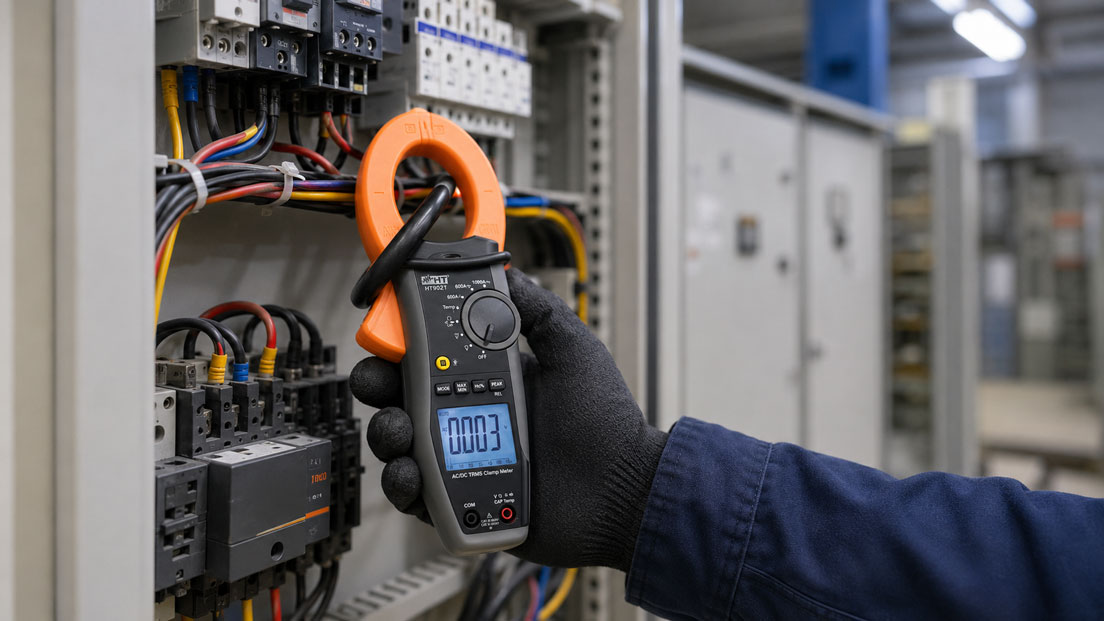
A clamp meter is one of the most important measuring instruments for electricians, maintenance technicians, service technicians, control cabinet builders and plant technicians. It enables current measurement without disconnecting the conductor. Especially in existing systems, distribution boards, machines, PV systems, drives or building technology, this is a major advantage: the measurement can be carried out quickly, contact-free on the conductor and often without shutting down the system.
Nevertheless, not every clamp meter is suitable for every task. Many users ask themselves whether a pure AC clamp meter is sufficient, whether an AC/DC clamp meter is required, whether TRMS is important or whether a leakage current clamp is actually the right choice. In addition, measuring range, resolution, jaw opening, CAT category, inrush current measurement, Min/Max function, frequency range and the question of whether voltage, resistance or power should also be measured all play a role.
This article explains what matters when selecting a clamp meter. The focus is on AC and DC current measurement, TRMS, Hall sensors, leakage current measurement, measuring range, resolution, jaw opening, safety category, inrush current, measurement without disconnecting the conductor and the typical limitations of clamp meters in practice.
Table of contents
- Basics: what does a clamp meter do?
- AC or DC: which type of current needs to be measured?
- TRMS: why true RMS measurement is important in modern systems
- Correctly evaluating measuring range and resolution
- Leakage current clamp or standard clamp meter?
- Jaw opening, conductor size and measuring point
- CAT category and safe use
- Min/Max, inrush current and additional functions
- Limitations of clamp meters: what is often measured incorrectly
- Practical example: current measurement on motor, control cabinet and RCD fault
- Which measuring instruments / products are suitable?
- Conclusion: the right clamp meter depends on the measurement task
- FAQ: frequently asked questions about selecting clamp meters
Basics: what does a clamp meter do?
A clamp meter measures the electrical current flowing through a conductor without having to open the circuit. To do this, the clamp is placed around a single current-carrying conductor. The magnetic field around the conductor is detected and converted into a current value. This advantage is exactly what makes clamp meters so useful in practice: measurement is quick, simple and much less time-consuming than direct current measurement with a disconnected line.
However, it is important to note that a clamp meter must always be placed around a single conductor. If it is placed around a complete cable with outgoing and return conductors, the magnetic fields normally cancel each other out. The clamp then displays no value or only a very small value. This property is deliberately used with leakage current clamps, but it is a common operating error in normal load current measurements.
Clamp meters are used for very different tasks. Typical applications include load current measurement on motors, testing heaters, measuring machines, control cabinet diagnostics, checking consumer currents, monitoring phase loads, measuring on frequency inverters, servicing air conditioning systems, troubleshooting RCD trips or analyzing inrush currents.
The right selection therefore does not start with the price or the maximum ampere value, but with the measurement task. Anyone who only measures AC currents in classic building distribution systems needs a different instrument than someone who wants to measure DC current on batteries, PV systems or DC drives. The selection also differs when very small fault currents need to be measured instead of large load currents.
| Measurement task | Suitable device type | What to pay attention to? |
|---|---|---|
| Load current on AC consumers | AC clamp meter | Check measuring range, TRMS, jaw opening and CAT category. |
| DC current on battery, PV or DC drive | AC/DC clamp meter | Observe Hall sensor, zero adjustment and DC measuring range. |
| Troubleshooting FI/RCD tripping | Leakage current clamp | High resolution in the µA or mA range is required. |
| High currents or large conductor cross-sections | Flexible current transformers | Check loop diameter, measuring range and frequency behavior. |
| Power analysis or performance evaluation | Clamp meter with power analysis | Consider voltage measurement, power values, data logger and interfaces. |
AC or DC: which type of current needs to be measured?
The most important difference between clamp meters is whether alternating current, direct current or both are to be measured. A pure AC clamp meter is designed for alternating current. It is suitable for many classic applications in building technology, distribution boards, motors, heating systems, ventilation systems or machines, provided that AC current is being measured there.
However, an AC clamp meter cannot measure direct current. Anyone who wants to measure currents on batteries, DC power supplies, PV systems, DC drives, vehicle technology, UPS systems or DC intermediate circuits needs an AC/DC clamp meter. These devices usually work with a Hall sensor, which can also detect static magnetic fields and therefore enables DC current measurements.
In practice, this difference is very important. A pure AC clamp can either show no meaningful value at all or display a misleading value on a DC circuit. Conversely, an AC/DC clamp can usually also measure alternating current, but it is often more expensive and must be handled more carefully for DC measurements, for example with zero adjustment before measurement.
The selection should therefore be based on the real systems. In classic low-voltage distribution systems, a good AC TRMS clamp meter is often sufficient. In systems with PV, battery storage, frequency inverters, DC consumers or drive technology, an AC/DC clamp meter is significantly more useful. For troubleshooting small leakage currents, however, neither a normal AC clamp nor a normal AC/DC clamp is sufficient; a leakage current clamp is required here.
| Current type | Typical application | Suitable clamp meter |
|---|---|---|
| AC | Building distribution, motor, heating, ventilation, classic consumer | AC clamp meter, preferably TRMS |
| DC | Battery, PV, DC power supply, DC motor | AC/DC clamp meter with Hall sensor |
| AC with distorted waveform | Frequency inverter, switched-mode power supplies, LED drivers, electronic loads | TRMS clamp meter |
| Very small fault currents | RCD/FI troubleshooting, insulation problems, leakage currents | Leakage current clamp with high resolution |
| Very high currents | Main distribution boards, large consumers, energy analysis | Clamp meter with large measuring range or flexible current transformer |
TRMS: why true RMS measurement is important in modern systems
TRMS stands for True Root Mean Square, meaning true effective value. A TRMS clamp meter measures the actual RMS value of a current signal even if the waveform is not ideally sinusoidal. This is particularly important in modern systems because many consumers no longer draw current in a sinusoidal form.
In the past, many loads were largely linear. With heating resistors or simple motors, the current was often almost sinusoidal. In such cases, simple clamp meters with average-responding measurement could provide usable results. Today, however, switched-mode power supplies, LED lighting, frequency inverters, UPS systems, chargers, electronic controllers and regulated drives are widespread. These consumers can generate distorted current waveforms.
With distorted waveforms, a clamp meter without TRMS capability can display significantly incorrect values. The error is not always immediately obvious because the device still provides stable numbers. Especially during troubleshooting, sizing, load assessment or thermal evaluation, this can lead to wrong conclusions.
For professional applications, TRMS is therefore recommended in many cases. Especially for measurements in control cabinets, industrial systems, building technology with electronic consumers, frequency inverters or power quality topics, a clamp meter with TRMS should be used. It offers more confidence when evaluating real load currents.
| Load type | Waveform | TRMS relevance |
|---|---|---|
| Resistive load | Usually almost sinusoidal | TRMS less critical, but still useful. |
| Simple AC motor | Often relatively close to sinusoidal | TRMS useful, especially during load changes. |
| Frequency inverter | Strongly dependent on measuring point and control | TRMS and suitable frequency range are important. |
| Switched-mode power supply | Non-sinusoidal, often pulsed | TRMS is very important. |
| LED driver / electronic load | Often distorted | TRMS recommended. |
Correctly evaluating measuring range and resolution
A common selection error is to look only at the maximum measuring range. A clamp meter with a 1000 A measuring range appears universal at first glance. However, it may be unsuitable for measuring small consumer currents or mA currents if resolution and accuracy in the lower range are not sufficient. Conversely, a highly sensitive leakage current clamp is not intended for high load currents.
The measuring range must match the typical measurement task. For building technology and many control cabinet measurements, ranges up to a few hundred amps are often sufficient. For main distribution boards, large motors or energy analyses, 600 A, 1000 A or more may be required. For leakage currents, differential currents or troubleshooting on RCDs, however, µA or mA resolution is decisive.
Resolution is also important. If a device only displays in 0.1 A steps, it may be too coarse for assessing small currents. Much finer resolutions are required for leakage currents or standby consumers. However, resolution does not replace accuracy. A device can display many digits and still be inaccurate outside its optimum measuring range.
In practice, a suitable measuring range is therefore often better than the largest possible measuring range. Anyone who has very different tasks may need several clamp meters: a robust TRMS clamp meter for load currents, an AC/DC clamp for DC applications and a leakage current clamp for fault currents.
Leakage current clamp or standard clamp meter?
Leakage current clamps are designed for a different task than standard clamp meters. While a standard clamp meter measures the load current of a single conductor, leakage current clamps detect the smallest differential or leakage currents. They are often used when FI/RCD protective devices trip without the cause being immediately obvious.
During leakage current measurement, several conductors can be enclosed together, for example phase conductor and neutral conductor of a circuit. In a fault-free condition, the currents largely cancel each other out. If a differential current remains, this can indicate leakage current, insulation faults, moisture, device faults or unwanted fault currents. A standard clamp meter is usually not sensitive enough for such small differential currents.
The difference lies mainly in resolution, measuring range and immunity to interference. Leakage current clamps must be able to measure reliably in the µA or mA range. At the same time, they must not be too strongly influenced by external magnetic fields or neighboring conductors under typical ambient conditions. The jaws must also close cleanly because small air gaps can affect the measurement result.
For electricians, a leakage current clamp is therefore a useful addition, but not a replacement for a standard clamp meter. The standard clamp meter measures load currents, while the leakage current clamp helps with fault current troubleshooting and insulation problems. Anyone who regularly performs both tasks should consider both device types separately.
Jaw opening, conductor size and measuring point
The jaw opening determines whether the conductor can be safely enclosed at all. In tight control cabinets, densely populated distribution boards or on large cable cross-sections, a clamp that is too small or awkward can make measurement difficult. However, a large jaw opening is not automatically better because large clamps are harder to use in tight spaces and can be impractical for small conductors.
For classic installation and service work, a compact clamp meter is often more convenient. It is easier to handle in control cabinets and fits more easily around individual conductors. For main lines, busbars or large cable bundles, larger clamps or flexible current transformers may be required. Flexible current transformers can be placed around large conductors or hard-to-reach locations and are particularly useful for high currents.
The position of the conductor in the clamp is also important. Many clamp meters measure most accurately when the conductor is positioned as centrally as possible in the jaw opening. If the conductor lies at the edge or if strong neighboring currents are directly next to it, the measurement result can be influenced. A clean clamp position is particularly important for leakage current measurements.
The measuring point must also be safely accessible. Anyone measuring in a live distribution board needs sufficient space, safe handling, suitable personal protective equipment and a measuring instrument with the appropriate safety category. The mechanical usability of a clamp meter is therefore just as important as the electrical measuring range.
| Practical case | Suitable design | Note |
|---|---|---|
| Tight sub-distribution board | Compact clamp meter | Good handling is more important than maximum jaw opening. |
| Large main line | Large jaw opening or flexible current transformers | Check conductor diameter and measuring range beforehand. |
| Busbar | Suitable clamp or transformer solution | Observe geometry and safety distance. |
| Leakage current on multi-core circuit | Leakage current clamp | Enclose all relevant active conductors together. |
| Temporary energy analysis | Flexible current transformers or power analysis clamp meter | Check installation space, current range and data recording. |
CAT category and safe use
The safety category of a clamp meter is a central selection criterion. It describes the measuring environment for which a measuring instrument is designed. A measurement on a simple electronic circuit must be assessed differently than a measurement in a main distribution board or at the supply point of a building. The closer the measuring point is to the energy source, the higher possible transient overvoltages can be.
In practice, CAT III and CAT IV are particularly relevant. CAT III typically applies to measurements in building installations, distribution boards, permanently installed consumers and industrial systems. CAT IV applies to measurements at the source of the low-voltage installation, for example building connection, meter area or supply feed. The exact selection must match the respective measuring point and voltage.
It is important to consider not only the CAT category, but also the associated voltage. For example, a device may be suitable for CAT III up to a certain voltage, but not automatically for every other measuring environment. In addition, test leads, accessories and the clamp meter itself must all meet the same safety requirement.
A clamp meter increases safety because the circuit does not have to be opened for current measurement. However, it does not replace safe working practices. Before every measurement, the measuring instrument, housing, clamp jaws, leads, display and measuring range should be checked. When working on live systems, the applicable safety rules and personal qualification are decisive.
Min/Max, inrush current and additional functions
In addition to AC/DC, TRMS and measuring range, additional functions can strongly influence the selection. A Min/Max function helps record fluctuating currents without constantly watching the display. This is useful for cyclic loads, pumps, compressors, heaters or machines that draw different currents depending on operating state.
Inrush current measurement is particularly helpful for motors, transformers, power supplies or larger consumers. During switching on, significantly higher currents can occur briefly than during continuous operation. These currents are relevant for fuses, circuit breakers, cable sizing and troubleshooting. A normal instantaneous display often does not reliably capture such short events.
Some clamp meters also offer voltage measurement, resistance, continuity testing, frequency, temperature, power, power factor, harmonics or data logging. This means they can partly supplement a multimeter or a simple analysis device. For professional power analysis, however, it must be checked whether the clamp meter can really capture the required power and quality values.
Interfaces can also be important. Devices with memory, Bluetooth, Wi-Fi or PC evaluation make documentation and long-term observation easier. In maintenance, this can be helpful when load profiles, start-up processes or sporadic faults are to be observed not just selectively, but over a longer period of time.
Limitations of clamp meters: what is often measured incorrectly
Clamp meters are very practical measuring instruments, but they have clear limitations. The most common error is enclosing a complete single-phase cable during a normal load current measurement. Since outgoing and return current generate opposing magnetic fields, the load current is then not displayed correctly. For a normal current measurement, a single conductor must be enclosed.
Another error is using the wrong device type. An AC clamp meter cannot measure DC current. A normal load current clamp cannot reliably assess small leakage currents. A leakage current clamp, in turn, is not intended for high load currents. The measurement task must therefore be clear before measurement.
Frequency inverters can also make measurements more difficult. Depending on whether the measurement is taken at the input or output of the inverter, current waveform, frequency components and interference can be very different. Not every clamp meter is suitable for every measuring point on an inverter. TRMS, frequency range and manufacturer specifications are particularly important here.
Finally, external magnetic fields, neighboring conductors, unfavorable conductor position in the clamp, dirty clamp jaws or missing zero adjustment during DC measurements can influence the result. Anyone who wants plausible measurement results should therefore not only read the numerical value, but also evaluate the measuring conditions.
| Error pattern | Possible cause | Test approach |
|---|---|---|
| Clamp meter displays 0 A although consumer is running | Outgoing and return conductors enclosed together | Measure only one individual conductor. |
| DC current is not displayed | Pure AC clamp meter used | Use AC/DC clamp meter with DC function. |
| Small fault currents cannot be detected | Standard clamp meter instead of leakage current clamp | Use leakage current clamp with suitable resolution. |
| Measured value appears implausible with electronic loads | No TRMS measurement or unsuitable frequency range | Check TRMS device and measuring point. |
| DC measured value drifts | Zero adjustment, temperature drift or residual magnetization | Zero before measurement and check conductor position. |
Practical example: current measurement on motor, control cabinet and RCD fault
A maintenance technician needs to narrow down several electrical problems in a production plant. First, it must be checked whether a three-phase motor is evenly loaded on all phases. A robust AC TRMS clamp meter with a suitable measuring range is sufficient for this. The clamp is placed successively around each phase conductor. This makes it possible to detect whether one phase is noticeably more or less loaded.
In the second step, the output current of a DC power supply needs to be checked. The pure AC clamp meter used previously would be unsuitable for this. This task requires an AC/DC clamp meter that can measure direct current. Before the measurement, the zero point is checked so that the DC measurement is not influenced by offset.
In another part of the system, an RCD also keeps tripping. A normal clamp meter is not sensitive enough here. Instead, a leakage current clamp is used. Depending on the measurement task, phase conductor and neutral conductor are enclosed together to check the differential current. This makes it possible to determine whether leakage current is present and in which circuit the cause is likely to be located.
The example shows: there is no “one” clamp meter for all tasks. Different requirements are decisive for load currents, DC measurements and leakage current troubleshooting. Anyone who clearly defines the measurement task before selecting the device avoids incorrect measurements and saves a lot of time during troubleshooting.
Which measuring instruments / products are suitable?
The category clamp meters / flexible current transformers is the right starting point when currents are to be measured without disconnecting the conductor. There you will find classic clamp meters, flexible current transformers, Hall-effect clamp meters and solutions for different measuring ranges and conductor sizes.
For classic load current measurements in installation, control cabinets and service, multifunction clamp meters / AC/DC are particularly interesting. Depending on the device, AC or AC/DC current, voltage and other multimeter functions can be combined. For many electricians, a TRMS clamp meter in this category is a practical basic tool.
If fault currents, leakage currents or RCD problems are to be specifically investigated, the category leakage current clamps / fault current is the more suitable choice. These devices are designed for small currents with high resolution and help with troubleshooting when RCD protective devices trip unintentionally.
For large conductor cross-sections, high currents or hard-to-reach measuring points, flexible current transformers can be useful. They can be placed more easily around large cables or busbars and are particularly suitable for temporary measurements in main distribution boards or energy analyses.
Depending on the application, specific device examples may include an AC TRMS clamp meter for classic AC measurements, an AC/DC TRMS clamp meter for direct and alternating current or a high-resolution leakage current clamp for fault currents. What matters is not the largest data sheet, but the match between current type, measuring range, resolution, jaw opening, safety category and the practical measuring point.
| Product / area | Typical use | Particularly relevant for |
|---|---|---|
| Clamp meters / flexible current transformers | Overview of current measurement without disconnecting the conductor | Installation, service, maintenance, control cabinet, energy analysis |
| Multifunction clamp meters / AC/DC | Load current measurement and additional multimeter functions | Everyday electrical work, machine service, building technology and control cabinet diagnostics |
| Leakage current clamps / fault current | Measurement of small leakage and differential currents | RCD/FI troubleshooting, insulation problems, stray fault currents |
| Flexible current transformers | Measurement on large conductors or hard-to-reach points | Main distribution boards, large consumers, temporary energy analysis and high currents |
| TRMS AC/DC clamp meter | Universal current measurement on AC and DC circuits | PV, battery, drive technology, frequency inverter environments and modern systems |
Conclusion: the right clamp meter depends on the measurement task
A clamp meter is a very practical measuring instrument because it enables current measurements without disconnecting the conductor. However, selection should always start from the specific measurement task. The decisive factors are current type, waveform, measuring range, resolution, jaw opening, safety category and additional functions.
For classic AC measurements in installation and control cabinets, a good AC TRMS clamp meter is often sufficient. For DC applications on batteries, PV, DC power supplies or drives, an AC/DC clamp meter is required. For fault currents and RCD problems, a leakage current clamp is the better choice. For high currents or large conductor cross-sections, flexible current transformers can be useful.
The most important recommendation is: do not choose the clamp meter with the largest measuring range, but the clamp meter that matches the measurement task. Anyone who correctly evaluates AC/DC, TRMS, resolution, measuring range and safety will obtain more reliable measurement results and avoid typical misinterpretations in practice.
FAQ: frequently asked questions about selecting clamp meters
What is the advantage of a clamp meter?
A clamp meter measures current without disconnecting the conductor. It is simply placed around an individual conductor and is therefore particularly suitable for quick measurements in existing systems.
Can I measure direct current with every clamp meter?
No. An AC/DC clamp meter is required for direct current. Pure AC clamp meters are only suitable for alternating current and do not provide reliable values for DC measurements.
What does AC/DC mean on a clamp meter?
AC/DC means that the clamp meter can measure both alternating current and direct current. This is important for batteries, PV systems, DC power supplies, DC motors or certain drive applications.
What is TRMS?
TRMS means true RMS value. A TRMS clamp meter measures much more reliably even with distorted, non-sinusoidal current waveforms than simple average-responding devices.
When do I need TRMS?
TRMS is particularly important for frequency inverters, switched-mode power supplies, LED drivers, electronic loads, UPS systems and modern building technology systems with nonlinear current consumption.
What is a leakage current clamp?
A leakage current clamp is a particularly sensitive clamp meter for small leakage or differential currents. It is often used for troubleshooting FI/RCD trips.
Can a normal clamp meter measure leakage currents?
Usually not reliably. Normal clamp meters are designed for load currents and often do not have the required resolution in the µA or mA range.
Why does my clamp meter show 0 A although current is flowing?
Often the clamp was placed around a complete cable with outgoing and return conductors. For load current measurement, a single conductor must be enclosed; otherwise the magnetic fields largely cancel each other out.
May I enclose several conductors at the same time?
For normal load current measurement, no. For leakage current or differential current measurement, however, it can be useful to enclose several active conductors together, depending on the measurement task.
What role does the measuring range play?
The measuring range must match the expected current. A very large measuring range is not automatically better if small currents need to be measured with good resolution.
What does resolution mean on a clamp meter?
Resolution indicates the steps in which the device can display values. Fine resolution is particularly important for small currents or leakage currents.
What is important with the jaw opening?
The jaw opening must match the conductor diameter and measuring point. In tight control cabinets, a compact clamp is often more practical; for large conductors, flexible current transformers can be useful.
What are flexible current transformers?
Flexible current transformers are flexible current sensors that can be placed around large conductors or hard-to-reach points. They are particularly suitable for high currents and large conductor cross-sections.
What does CAT III or CAT IV mean?
CAT III and CAT IV describe the safety category of the measuring instrument for certain measuring environments. CAT III is typical for installations and distribution boards, CAT IV for measurements closer to the supply feed.
Is a clamp meter sufficient as a multimeter replacement?
Partly. Many clamp meters can also measure voltage, resistance or continuity. For certain detailed measurements, electronics work or precise voltage measurements, a separate multimeter may still be useful.
What is inrush current measurement?
Inrush current measurement captures brief high currents when motors, transformers, power supplies or other consumers are switched on. This function is helpful for fuse and start-up problems.
Why is zero adjustment important for DC measurement?
AC/DC clamp meters with Hall sensors can have an offset. Before a DC measurement, the zero point should be set so that the displayed value is not falsified.
Which clamp meter is useful for electricians?
For many electricians, a robust TRMS clamp meter with a suitable AC measuring range is a good basic tool. Anyone who also tests DC, PV, batteries or RCD faults should additionally consider AC/DC functionality or a leakage current clamp.