


Thermocouples are among the most important temperature sensors in industrial measurement technology. They are robust, fast, comparatively simple in design and, depending on the version, can also be used at very high temperatures. In practice, however, the question often arises: Which thermocouple type is the right one for my application?
The best-known thermocouple types are Type K, J, T, N, E, R, S and B. They differ in their material pairing, temperature range, sensitivity, long-term stability, resistance to specific atmospheres and typical application. An incorrectly selected thermocouple type can lead to measurement errors, premature sensor failure or incorrect design of the measuring chain.
This article provides a compact overview of the most important thermocouple types, shows their typical characteristics in a colored table and explains what should be considered with regard to temperature range, atmosphere, connection cable, polarity and transmitter.
You can find suitable sensors in our category
Thermocouples.
For flexible applications, for example, the
WIKA Type TC40 cable thermocouple
is suitable. For direct installation in pipelines or vessels, the
WIKA Type TC10-C screw-in thermocouple
can be used. For signal processing of thermocouples, the
WIKA Type T16 temperature transmitter for thermocouples
is relevant.
Table of contents
- What is a thermocouple?
- Why are there different thermocouple types?
- Colored overview: thermocouple types and characteristics
- Thermocouple Type K: the universal standard type
- Thermocouple Type J: iron-constantan for limited temperature ranges
- Thermocouple Type T: good for low temperatures
- Thermocouple Type N: stable alternative to Type K
- Thermocouple Type E: high thermoelectric voltage
- Thermocouples Type R, S and B: noble-metal thermocouples for high temperature
- Color code, polarity and connection errors
- Accuracy classes and limit deviations
- Selecting the correct compensating cable and extension cable
- Operating a thermocouple with a transmitter
- Selection criteria: Which thermocouple type fits?
- Suitable thermocouples and accessories
- Practical examples from industry, mechanical engineering and high-temperature processes
- Checklist for selecting thermocouples
- Conclusion
- FAQ: Frequently asked questions about thermocouple types
What is a thermocouple?
A thermocouple is a temperature sensor consisting of two different metallic conductors. When these two conductors are joined at a measuring point and a temperature difference occurs between the measuring point and the reference junction, a small electrical voltage is generated. This voltage is called thermoelectric voltage.
The thermoelectric voltage depends on the temperature difference and the material pairing used. This exact material pairing determines the thermocouple type, for example Type K, J, T or N.
| Feature | Explanation | Practical meaning |
|---|---|---|
| Measuring principle | Thermoelectric effect between two different conductors. | Thermocouples provide a small mV signal. |
| Type | Material pairing of the thermocouple. | Determines temperature range, stability and operating environment. |
| Reference junction | Reference point of the measurement. | Transmitters or displays require cold junction compensation. |
| Output signal | Very small temperature-dependent voltage. | Cable routing, interference and correct polarity are important. |
| Design | Wire, mineral-insulated thermocouple, cable sensor or process sensor. | Mechanical design must match the application. |
Why are there different thermocouple types?
Not every thermocouple is suitable for every temperature and every atmosphere. A sensor for low temperatures must have different characteristics than a sensor in a furnace, exhaust system, plastics process or chemical plant.
The different thermocouple types were developed to cover different requirements. These include high temperatures, low temperatures, fast response times, good long-term stability, high thermoelectric voltage, resistance to oxidation or use in specific industrial atmospheres.
| Requirement | Why relevant? | Typical selection |
|---|---|---|
| High temperature | Not every material remains stable at high temperatures. | Type K, N, R, S or B. |
| Low temperature | Measuring signal and material behavior must be suitable. | Type T or E. |
| Robust standard application | Sensor should be versatile, cost-effective and available. | Type K. |
| Good stability at high temperature | Drift should be reduced. | Type N or noble-metal types. |
| High-temperature furnace | Very high temperature and oxidizing atmosphere. | Type R, S or B. |
| Old plant / existing measuring chain | Sensor, cable and transmitter must match. | Check type based on the existing measuring chain. |
Colored overview: thermocouple types and characteristics
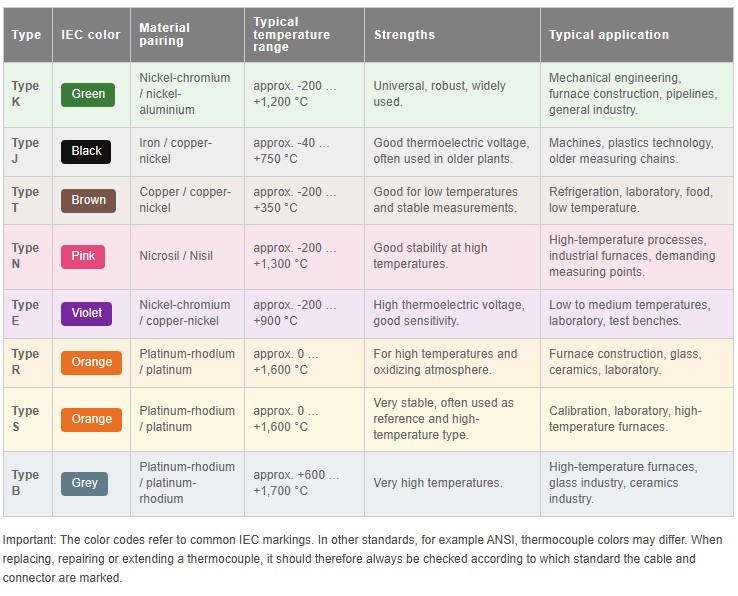
The following table shows typical thermocouple types with material pairing, temperature range, typical applications and IEC color coding. The temperature ranges are general guide values. The actual operating limit always depends on sensor design, wire diameter, sheath material, thermowell, medium, atmosphere and manufacturer specifications.
| Type | IEC color | Material pairing | Typical temperature range | Strengths | Typical application |
|---|---|---|---|---|---|
| Type K | Green | Nickel-chromium / nickel-aluminium | approx. -200 … +1,200 °C | Universal, robust, widely used. | Mechanical engineering, furnace construction, pipelines, general industry. |
| Type J | Black | Iron / copper-nickel | approx. -40 … +750 °C | Good thermoelectric voltage, often used in older plants. | Machines, plastics technology, older measuring chains. |
| Type T | Brown | Copper / copper-nickel | approx. -200 … +350 °C | Good for low temperatures and stable measurements. | Refrigeration, laboratory, food, low temperature. |
| Type N | Pink | Nicrosil / Nisil | approx. -200 … +1,300 °C | Good stability at high temperatures. | High-temperature processes, industrial furnaces, demanding measuring points. |
| Type E | Violet | Nickel-chromium / copper-nickel | approx. -200 … +900 °C | High thermoelectric voltage, good sensitivity. | Low to medium temperatures, laboratory, test benches. |
| Type R | Orange | Platinum-rhodium / platinum | approx. 0 … +1,600 °C | For high temperatures and oxidizing atmosphere. | Furnace construction, glass, ceramics, laboratory. |
| Type S | Orange | Platinum-rhodium / platinum | approx. 0 … +1,600 °C | Very stable, often used as reference and high-temperature type. | Calibration, laboratory, high-temperature furnaces. |
| Type B | Grey | Platinum-rhodium / platinum-rhodium | approx. +600 … +1,700 °C | Very high temperatures. | High-temperature furnaces, glass industry, ceramics industry. |
Important: The color codes refer to common IEC markings. In other standards, for example ANSI, thermocouple colors may differ. When replacing, repairing or extending a thermocouple, it should therefore always be checked according to which standard the cable and connector are marked.
Thermocouple Type K: the universal standard type
Type K is the most commonly used thermocouple type in industrial temperature measurement. It covers a wide temperature range, is robust, widely used and suitable for many standard applications.
Type K is frequently used in machines, pipelines, vessels, furnaces, engines, exhaust applications and general industrial processes. It is a good choice when robust and economical temperature measurement is required and no special chemical or atmospheric requirements speak against it.
| Characteristic | Evaluation | Note |
|---|---|---|
| Temperature range | Wide range up to high temperatures. | Actual limit depends on sensor design and thermowell. |
| Availability | Very high. | Many designs and accessories available. |
| Costs | Usually economical. | More cost-effective than noble-metal thermocouples. |
| Typical weakness | Not ideal for every atmosphere. | Check atmosphere, thermowell and process conditions. |
For flexible standard applications, for example, the
WIKA Type TC40 cable thermocouple
can be a suitable solution.
Thermocouple Type J: iron-constantan for limited temperature ranges
Type J consists of iron and copper-nickel. This type is frequently used in older plants, machines and certain industrial applications. Due to the iron conductor, however, Type J must be considered more carefully with regard to oxidation and corrosion than some other thermocouple types.
Type J is useful when existing plants are already designed for Type J or when temperature ranges are limited and the environmental conditions are suitable. In humid, oxidizing or very high-temperature environments, it should be carefully checked whether Type J is really suitable.
| Advantage | Limitation | Practical recommendation |
|---|---|---|
| Good thermoelectric voltage. | Iron conductor can corrode or oxidize. | Check environment and thermowell. |
| Often present in existing plants. | Not ideal for very high temperatures. | Retain existing type when replacing or adapt measuring chain. |
| Suitable for many machine applications. | Limited operating range compared with Type K or N. | Observe temperature limit and atmosphere. |
Thermocouple Type T: good for low temperatures
Type T consists of copper and copper-nickel. This thermocouple type is frequently used at low temperatures and is well suited for applications where stable measurements in the lower temperature range are required.
Typical applications can be found in refrigeration technology, laboratories, food technology, test benches and low-temperature processes. The upper temperature range is limited compared with Type K or Type N.
| Characteristic | Evaluation | Typical application |
|---|---|---|
| Low temperatures. | Well suited. | Refrigeration, laboratory, low temperature. |
| High temperatures. | Only suitable to a limited extent. | Do not use as a high-temperature sensor. |
| Stable measurement. | Very useful when used in a suitable application. | Quality processes with low temperatures. |
Thermocouple Type N: stable alternative to Type K
Type N was developed as a more stable alternative to Type K for higher temperatures. It offers good long-term stability and can be useful in demanding industrial high-temperature applications.
Type N is often considered where Type K is generally suitable, but drift, long-term stability or high temperature load become more critical. Availability and the existing measuring chain must be taken into account.
| Why Type N? | Advantage | Note |
|---|---|---|
| High temperature load. | Good stability. | Suitable cable and transmitter must be available. |
| Alternative to Type K. | Better long-term stability in many high-temperature applications. | Not automatically interchangeable 1:1 with Type K. |
| Industrial furnaces and processes. | Robust for demanding measuring points. | Check thermowell and atmosphere. |
Thermocouple Type E: high thermoelectric voltage
Compared with many other thermocouple types, Type E provides a high thermoelectric voltage. This can make it interesting for applications where high sensitivity or a good signal at low to medium temperatures is required.
Type E is used less frequently than Type K, but can be useful in laboratory applications, test benches and special measuring tasks. It is essential that the sensor, cable, connector and measuring device are matched to Type E.
| Strength | Practical benefit | To be considered |
|---|---|---|
| High thermoelectric voltage. | Good signal sensitivity. | Measuring device must be set to Type E. |
| Suitable for low to medium temperatures. | Interesting for test benches and laboratories. | Not the typical standard sensor for every industrial plant. |
| Good resolution possible. | Helpful for small temperature changes. | Route cable and polarity correctly. |
Thermocouples Type R, S and B: noble-metal thermocouples for high temperature
Types R, S and B are noble-metal thermocouples based on platinum-rhodium. They are mainly used at very high temperatures, for example in furnaces, glass processes, ceramic processes, laboratory applications or calibration tasks.
These thermocouples are significantly more expensive than standard types such as K or J, but they offer advantages at very high temperatures and in oxidizing atmospheres. They usually require careful selection of thermowell, installation situation and transmitter.
| Type | Typical use | Special feature |
|---|---|---|
| Type R | High temperature, furnace construction, laboratory. | Platinum-rhodium / platinum, high temperature resistance. |
| Type S | High temperature, reference measurements, calibration. | Very stable, often used in demanding measuring tasks. |
| Type B | Very high temperatures. | Less suitable for lower temperatures due to low thermoelectric voltage in the lower range. |
For high-temperature applications, the sensor design should always be considered together with process conditions, atmosphere, thermowell material and desired service life.
Color code, polarity and connection errors
Thermocouples are polarity-dependent. If the positive and negative wires are swapped, the measuring device may display incorrect values. Especially when extending cables, changing connectors or carrying out repairs, it is therefore important to use the correct thermocouple type and the correct color coding.
IEC colors are frequently used in Europe. The negative wire is usually white, while the positive wire is colored according to the type. However, other standards may use different colors. Therefore, one should not rely on color alone, but also check type, standard, connector and documentation.
| Error | Effect | Practical solution |
|---|---|---|
| Polarity swapped | Temperature value runs in the wrong direction or reacts implausibly. | Check plus/minus according to standard and device documentation. |
| Wrong cable type | Additional measurement errors occur. | Use only suitable compensating or extension cable. |
| ANSI and IEC colors confused | Incorrect connection despite seemingly suitable color. | Clearly identify the applicable standard. |
| Copper cable used | Measurement errors due to additional thermoelectric voltages. | Route thermocouple cable to the suitable reference junction. |
| Measuring device set to wrong type | Incorrect linearization and incorrect temperature value. | Set Type K, J, T, N etc. correctly in the device. |
Accuracy classes and limit deviations
Thermocouples are divided into accuracy classes. The permissible limit deviation depends on the thermocouple type, temperature range and respective class. In practice, Class 1 and Class 2 are particularly relevant.
Important: The accuracy class does not describe the complete measurement accuracy of the entire measuring point on its own. Cable, reference junction, transmitter, display, installation situation, heat dissipation and process conditions also affect the measurement result.
| Influencing factor | Why important? | Practical recommendation |
|---|---|---|
| Thermocouple class | Determines the permissible limit deviation of the sensor. | Select class according to the measuring task. |
| Transmitter | Converts mV signal into standard signal. | Parameterize type and measuring range correctly. |
| Cold junction compensation | Required for correct temperature calculation. | Use measuring device or transmitter with suitable compensation. |
| Installation | Heat conduction and immersion depth influence measured value. | Ensure sufficient insertion length and good thermal contact. |
| Ageing | Thermocouples can drift under temperature load. | Define regular checks or replacement intervals. |
Selecting the correct compensating cable and extension cable
Thermocouples must not simply be extended with normal copper cable. If an unsuitable cable is used, additional junctions between different metals are created. This can generate additional thermoelectric voltages that distort the measured value.
Suitable compensating cables or extension cables are used for thermocouples. These must match the thermocouple type. A cable for Type K must therefore not simply be used for Type J, T or N.
| Cable | Meaning | Practical rule |
|---|---|---|
| Thermocouple cable | Consists of the original materials of the thermocouple. | Suitable for direct sensor and measuring sections. |
| Extension cable | Material corresponds to the thermocouple type in the intended temperature range. | Use type-matched cable, for example KX for Type K. |
| Compensating cable | Uses substitute materials with similar thermal behavior. | Use only within the approved temperature range. |
| Copper cable | Normal electrical cable. | Do not use as arbitrary thermocouple extension. |
For long cables, environments with interference or connection to a control system, a temperature transmitter directly near the sensor can be useful.
Operating a thermocouple with a transmitter
Thermocouples provide a small mV signal. This signal is more sensitive to interference than a standardized 4 … 20 mA signal. Thermocouples are therefore often combined with temperature transmitters.
A temperature transmitter converts the thermocouple signal into a standardized output signal. At the same time, it performs linearization and cold junction compensation. The prerequisite is that the transmitter is set to the correct thermocouple type.
| Transmitter function | Benefit | Important |
|---|---|---|
| Linearization | mV signal is converted into temperature. | Set Type K, J, T, N etc. correctly. |
| Cold junction compensation | Reference junction temperature is taken into account. | Incorrect compensation leads to measurement errors. |
| Signal conversion | mV becomes, for example, 4 … 20 mA. | Select scaling to match the process. |
| Interference immunity | Standard signal is better suited for long cables. | Install transmitter as close to the sensor as possible. |
For such applications, for example, the
WIKA Type T16 digital temperature transmitter for thermocouples
is suitable.
Selection criteria: Which thermocouple type fits?
The selection of a thermocouple should not be based only on the maximum temperature. The entire measuring point is decisive: temperature range, atmosphere, mechanical load, response time, chemical load, thermowell, insertion length, connection head, cable and evaluation.
| Selection question | Why important? | Example |
|---|---|---|
| How high is the maximum temperature? | The type must operate stably in the temperature range. | Type K/N for high industrial applications, R/S/B for very high temperatures. |
| How low is the minimum temperature? | Not every type is ideal for low temperatures. | Check Type T or E for low temperature ranges. |
| Which atmosphere is present? | Oxidizing, reducing, humid or aggressive environments affect service life. | Select suitable thermowell and sheath material. |
| How fast must the sensor respond? | Wire diameter and design influence response time. | Small sheath diameters respond faster. |
| Is there mechanical stress? | Vibration, pressure, flow and abrasion stress the sensor. | Use robust design or thermowell. |
| How is the signal evaluated? | Measuring device and thermocouple type must match. | Parameterize transmitter to the correct type. |
Suitable thermocouples and accessories
Depending on the application, different designs may be considered. A cable sensor is suitable for different installation situations than a screw-in thermocouple, an insert or a special thermocouple for the plastics industry.
| Product | Suitable for | Typical application |
|---|---|---|
| Thermocouples category | Overview of thermocouples for industrial temperature measurement. | Preselection of suitable sensor designs. |
| WIKA Type TC40 cable thermocouple | Flexible temperature measurement directly in the process or in bores. | Mechanical engineering, engines, bearings, pipelines, vessels. |
| WIKA Type TC10-C screw-in thermocouple | Direct screw-in installation in processes, pipelines and vessels. | Process industry, plant engineering, industrial temperature measurement. |
| WIKA Type TC10-A insert for thermocouples | Insert for installation in suitable thermowells or connection heads. | Replacement, maintenance and process measuring points. |
| WIKA Type TC47-MB screw-in melt thermocouple | Temperature measurement in plastics machinery. | Extruders, injection molding machines, tool and melt temperature. |
| WIKA Type T16 temperature transmitter for thermocouples | Conversion of thermocouple signals into standard signals. | Control cabinet, connection head, process control technology. |
Practical examples from industry, mechanical engineering and high-temperature processes
Example 1: General temperature measurement on a machine
The temperature of a bearing or housing is to be monitored in a machine. The temperature is elevated, but not extreme. Here, a Type K cable sensor such as the
WIKA Type TC40 cable thermocouple
can be a suitable solution.
Example 2: Temperature measurement in a pipeline
The process temperature is to be measured continuously in a pipeline. The sensor must be mechanically stable and fit the process connection well. A screw-in thermocouple such as the
WIKA Type TC10-C
can be suitable for this.
Example 3: High-temperature measurement in a furnace
Very high temperatures are present in a furnace. It must be checked whether Type K or N is still sufficient or whether a noble-metal thermocouple such as Type R, S or B is required. In addition, thermowell material, atmosphere and service life are decisive.
Example 4: Plastics machine or extruder
In the plastics industry, melt or tool temperatures must be measured reliably. Special designs with suitable thread, short response time and mechanically robust construction are often used for this, for example the
WIKA Type TC47-MB screw-in melt thermocouple.
Example 5: Long cable to the control system
A thermocouple is to be connected to a control system over a long distance. The small mV signal is susceptible to interference. In this case, a temperature transmitter near the sensor can be useful, for example the
WIKA Type T16,
which converts the signal into a standardized output signal.
Checklist for selecting thermocouples
This checklist helps to systematically prepare the selection of a thermocouple.
| Check question | Why important? | Practical recommendation |
|---|---|---|
| Which temperature range must be measured? | The thermocouple type must match the temperature range. | Define minimum and maximum temperature. |
| Which atmosphere is present? | Oxidation, humidity or aggressive media influence service life. | Check medium, environment and thermowell. |
| Which design is required? | A cable sensor is not suitable for every process measuring point. | Select cable sensor, screw-in sensor, insert or special design. |
| How fast must the sensor respond? | Response time depends strongly on design and diameter. | Check measuring tip, sheath diameter and installation type. |
| Which accuracy is required? | Accuracy class and entire measuring chain influence the result. | Consider class, transmitter and calibration. |
| How is the sensor connected? | Wrong cable or polarity creates measurement errors. | Use suitable thermocouple cable, compensating cable and connector. |
| Is a transmitter useful? | Long cables and PLC connection often speak in favor of a transmitter. | Convert thermocouple signal into 4 … 20 mA or another standard signal. |
| Is the existing measuring chain known? | Sensor, cable and device must use the same type. | Use Type K, J, T, N etc. consistently throughout the measuring chain. |
Conclusion: The right thermocouple type depends on temperature, atmosphere and measuring chain
Thermocouples are versatile and robust temperature sensors. However, correct selection depends strongly on the thermocouple type. Type K is a universal standard type for many industrial applications. Type J is frequently used in existing plants and limited temperature ranges. Type T is well suited for low temperatures. Type N is a stable alternative for higher temperatures. Type E offers a high thermoelectric voltage. Types R, S and B are noble-metal thermocouples for high-temperature applications.
For reliable measured values, thermocouple type, temperature range, atmosphere, design, thermowell, connection cable, polarity, transmitter and cold junction compensation must all match. Particularly common errors are caused by incorrect compensating cables, swapped polarity or a measuring device set to the wrong thermocouple type.
You can find an overview of suitable sensors in the category
Thermocouples.
Suitable products include, for example, the
WIKA Type TC40 cable thermocouple,
the
WIKA Type TC10-C screw-in thermocouple,
the
WIKA Type TC10-A insert,
the
WIKA Type TC47-MB screw-in melt thermocouple
and the
WIKA Type T16 temperature transmitter.
FAQ: Frequently asked questions about thermocouple types
Which thermocouple types are there?
Frequently used thermocouple types include Type K, J, T, N, E, R, S and B. They differ in material pairing, temperature range, stability, thermoelectric voltage and typical application.
When do you use thermocouple Type K?
Type K is a universal standard type for many industrial applications. It is robust, widely used and suitable for a wide temperature range.
When is thermocouple Type J useful?
Type J is frequently used in older plants or machines. Due to the iron conductor, suitability in humid, oxidizing or very high-temperature environments must be checked carefully.
What is thermocouple Type T suitable for?
Type T is particularly suitable for low temperatures and applications in refrigeration, laboratories, food technology or low-temperature processes.
What is the advantage of thermocouple Type N?
Type N offers good stability at higher temperatures and can be an alternative to Type K when long-term stability and drift behavior are particularly important.
When do you use Type R, S or B?
Types R, S and B are noble-metal thermocouples for high-temperature applications. They are used, for example, in furnaces, glass processes, ceramic processes, laboratories or calibration tasks.
What color is thermocouple Type K?
According to IEC marking, Type K is usually marked green. However, it is important to note that color codes can differ depending on the standard. ANSI colors differ from IEC colors.
What happens if the polarity is swapped?
If plus and minus are swapped, the measuring device displays implausible or incorrect temperature values. For this reason, thermocouple cable, connector and measuring device must be connected correctly.
Can you extend a thermocouple with normal copper cable?
Arbitrary extension with normal copper cable can cause measurement errors. Suitable thermocouple cables, compensating cables or extension cables should be used for thermocouples.
Why does a thermocouple need a transmitter?
A thermocouple only provides a small mV signal. A transmitter can linearize this signal, perform cold junction compensation and convert it into a standardized output signal such as 4 … 20 mA.
Which thermocouple type is the best?
There is no generally best type. The suitable thermocouple type depends on temperature range, atmosphere, measurement accuracy, installation situation, design and measuring chain.
Which products are suitable for thermocouple applications?
Depending on the application, suitable products include, for example, the
WIKA Type TC40 cable thermocouple,
the
WIKA Type TC10-C screw-in thermocouple,
the
WIKA Type TC10-A insert,
the
WIKA Type TC47-MB screw-in melt thermocouple
or the
WIKA Type T16 temperature transmitter.